
Scientia Silvae Sinicae ›› 2026, Vol. 62 ›› Issue (5): 168-178.doi: 10.11707/j.1001-7488.LYKX20250353
• Research papers • Previous Articles Next Articles
Changhai Wang1,Ao Li2,Wei Zhang3,Yueting Gao4,*( )
)
Received:2025-06-03
Revised:2025-08-12
Online:2026-05-10
Published:2026-05-12
Contact:
Yueting Gao
E-mail:gaoyt@ynau.edu.cn
CLC Number:
Changhai Wang,Ao Li,Wei Zhang,Yueting Gao. Assessment of Water Ecological Security Assessment in Western Border Areas of China: A Case Study of Lancang River Basin in Xishuangbanna[J]. Scientia Silvae Sinicae, 2026, 62(5): 168-178.
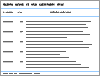
Table 1
Evaluation index system for water ecological safety in the Lancang River Basin of Xishuangbanna"
| 目标层 Target level | 准则层 PSR component | 指标层 Indicator | 单位 Unit | 指标属性 Indicator type | 权重 Weight |
| 西双版纳澜沧江流域 水生态安全状况 Water ecological security situation of Lancang River Basin in Xishuangbanna | 压力 Pressure | 人口密度 Population density (C1) | km?2 | 负 Negative | 0.086 2 |
| 游客接待量 Number of tourists received (C2) | 104 person | 负 Negative | 0.072 8 | ||
| 用水总量 Total volume of water use (C3) | 108 m3 | 负 Negative | 0.031 4 | ||
| 废水排放总量 Total volume of waste water discharged (C4) | 104 t | 负 Negative | 0.044 4 | ||
| 化肥施用量 Consumption of chemical fertilizer (C5) | 104 t | 负 Negative | 0.070 2 | ||
| 农药使用量 Pesticides usage (C6) | 104 t | 负 Negative | 0.053 6 | ||
| 状态 State | 人均可支配收入 Per capita disposable income (C7) | yuan | 正 Positive | 0.071 6 | |
| 人均水资源量偏离指数 Deviation index of per capita water resources (C8) | % | 正 Positive | 0.097 0 | ||
| 地表水环境质量 Surface water environmental quality (C9) | 正 Positive | 0.065 7 | |||
| 全州森林覆盖率 Forest coverage rate of the whole prefecture (C10) | % | 正 Positive | 0.089 3 | ||
| 响应 Response | 城市污水处理率 Urban sewage treatment rate (C11) | % | 正 Positive | 0.052 2 | |
| 万元GDP用水量 Water consumption per 10 000 RMB of GDP (C12) | m3 | 负 Negative | 0.038 2 | ||
| 第三产业增加值比重 Proportion of added value in tertiary industry(C13) | % | 正 Positive | 0.092 4 | ||
| 造林总面积 Total afforestation area (C14) | 104 hm2 | 正 Positive | 0.135 2 |
Table 2
Classification standards for water ecological safety index in the Lancang River Basin of Xishuangbanna"
| 等级 Grade | 指数分值Index score range | 西双版纳澜沧江流域水生态安全特征 Characteristics of water ecological security in the Lancang River Basin of Xishuangbanna | |
| Ⅰ | 非常安全 Very safe | 0.8~1.0 | 水生态系统结构完整、功能健全,水资源供需高度协调,水质指标全面达标,流域生态状态优良,生态服务能力稳定,治理体系高效,是流域水生态的理想状态 The water ecosystem has an intact structure and sound functions. Water resource supply and demand are highly coordinated, all water quality indicators meet the standards, and the ecological status of the basin is excellent. Ecological service capacity is stable and the governance system is efficient, representing the ideal state of water ecological security |
| Ⅱ | 安全 Safe | 0.6~0.8 | 水生态系统结构完整、总体稳定,资源承载与人类活动基本协调,生态服务能力稳定,治理体系完善,是流域水生态的良好状态 The ecosystem structure is intact and generally stable. Resource carrying capacity is basically in balance with human activities. Ecological services are stable, and the governance system is well-developed, representing a good ecological condition of the basin |
| Ⅲ | 一般安全 Moderately safe | 0.4~0.6 | 水生态系统总体稳定,韧性有限,资源承载与人类活动存在结构性矛盾,生态服务产出具有不确定性,治理措施相对到位,是流域水生态的普通状态 The ecosystem is generally stable but has limited resilience. Structural conflicts exist between resource carrying capacity and human activity. Ecological service output is uncertain, and governance measures are relatively in place, representing an ordinary state of water ecological security |
| Ⅳ | 不安全 Unsafe | 0.2~0.4 | 水生态系统处于亚健康状态,资源开发超载、水环境污染较为突出,生态结构受损、服务功能下降。治理体系响应滞后,生态恢复缓慢,面临较高系统性风险 The ecosystem is in a sub-healthy state, with overloaded resource exploitation and significant water pollution. Ecological structure is damaged and service functions are declining. The governance system responds slowly and ecological restoration progresses poorly, posing considerable systemic risks |
| Ⅴ | 非常 不安全 Very unsafe | 0~0.2 | 水生态系统严重退化,资源承载力失衡,水质普遍不达标,生态系统功能崩解,难以维持基本生态安全底线。治理机制失效或缺位,局部区域生态灾害频发,处于高风险状态 The ecosystem is severely degraded, resource carrying capacity is out of balance, and water quality generally fails to meet standards. Ecological functions are collapsing, making it difficult to maintain even basic ecological safety. The governance mechanism is ineffective or absent, with frequent localized ecological disasters and high overall risk |
Table 3
Water ecological safety index in the Lancang River Basin of Xishuangbanna"
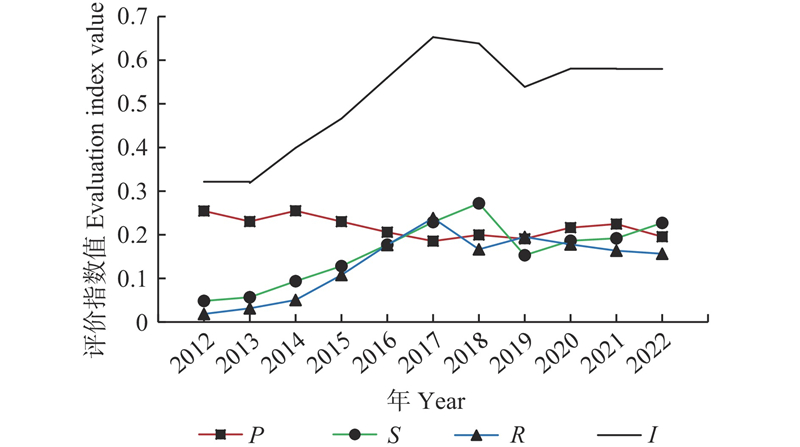
| 指数Index | 2012 | 2013 | 2014 | 2015 | 2016 | 2017 | 2018 | 2019 | 2020 | 2021 | 2022 |
| P | 0.25 | 0.23 | 0.25 | 0.23 | 0.21 | 0.19 | 0.20 | 0.19 | 0.22 | 0.22 | 0.20 |
| S | 0.05 | 0.06 | 0.09 | 0.13 | 0.18 | 0.23 | 0.27 | 0.15 | 0.19 | 0.19 | 0.23 |
| R | 0.02 | 0.03 | 0.05 | 0.11 | 0.18 | 0.24 | 0.17 | 0.19 | 0.18 | 0.16 | 0.16 |
| I | 0.32 | 0.32 | 0.40 | 0.47 | 0.56 | 0.65 | 0.64 | 0.54 | 0.58 | 0.58 | 0.58 |
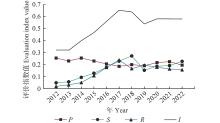
Fig.1
Trend of water ecological safety index in the Lancang River Basin of Xishuangbanna"
| 安玉琴, 杨燕霞. 西藏生态安全研究综述: 基于文献计量和扎根分析的视角. 西藏大学学报(社会科学版), 2020, 35 (3): 184- 191. | |
| An Y Q, Yang Y X. Summary of ecological security research in Tibet from the perspective of bibliometrics and based on deep analysis. Journal of Tibet University, 2020, 35 (3): 184- 191. | |
| 董媛媛. 基于DPEHA模型生态环境健康评价体系的法治化研究. 中国环境管理, 2022, 14 (1): 130- 136. | |
| Dong Y Y. Study on legalization of eco-environmental health assessment system based on DPEHA model. Chinese Journal of Environmental Management, 2022, 14 (1): 130- 136. | |
|
李春华, 叶 春, 刘 燕, 等. 山水林田湖草思想的理论内涵及生态保护修复实践: 以广西左右江流域工程试点为例. 环境工程技术学报, 2019, 9 (5): 499- 506.
doi: 10.12153/j.issn.1674-991X.2019.07.300 |
|
|
Li C H, Ye C, Liu Y, et al. The theoretical connotation of mountain-river-forest-farmland-lake-grassland thoughts and the practice of ecological protection and restoration: taking Guangxi Zuojiang-Youjiang River Basin pilot project as an example. Journal of Environmental Engineering Technology, 2019, 9 (5): 499- 506.
doi: 10.12153/j.issn.1674-991X.2019.07.300 |
|
| 李 凯, 王根绪, 孙向阳, 等. 西南地区森林生态系统水源涵养评价. 地理科学, 2023, 43 (12): 2217- 2227. | |
| Li K, Wang G X, Sun X Y, et al. Evaluation of water conservation function of forest ecosystem in southwest China. Geographical Science, 2023, 43 (12): 2217- 2227. | |
| 裘思谦, 许 尤, 徐雅倩, 等. 澜沧江−怒江中上游河段水温时空特性及差异分析. 长江流域资源与环境, 2022, 31 (10): 2186- 2196. | |
| Qiu S Q, Xu Y, Xu Y Q, et al. Spatio-temporal variations characteristics and differences of water temperature in upper and middle reaches of Lancang-Nujiang River. Resources and Environment in the Yangtze Basin, 2022, 31 (10): 2186- 2196. | |
| 尚文绣, 尚 弈, 严登明, 等. 基于模糊逻辑的黄河流域水安全综合评价方法研究. 水利学报, 2022, 53 (3): 369- 378. | |
| Shang W X, Shang Y, Yan D M, et al. Comprehensive assessment method of water security in Yellow River Basin based on fuzzy logic. Journal of Hydraulic Engineering, 2022, 53 (3): 369- 378. | |
| 司马文卉, 胡小凤, 沈占峰, 等. 大清河流域水生态安全评价指标体系构建. 给水排水, 2021, 57 (1): 90- 95, 102. | |
| Sima W H, Hu X F, Shen Z F, et al. Water ecological safety evaluation index system of Daqing river basin. Water & Wastewater Engineering, 2021, 57 (1): 90- 95, 102. | |
| 王毅勇, 周超凡, 黄 榕, 等. 基于DPSIR−熵权的陕西省水生态安全评价及障碍诊断分析. 环境科学, 2025, 46 (7): 4335- 4348. | |
| Wang Y Y, Zhou C F, Huang R, et al. Evaluation of water ecological security and analysis of barriers in Shaanxi province based on DPSIR-entropy right. Environmental Science, 2025, 46 (7): 4335- 4348. | |
| 魏竞超, 李自涵, 董媛媛. 基于压力−状态−响应(PSR)模型的黄河流域环境安全评价体系法治化研究. 中国环境监测, 2023, 39 (1): 19- 28. | |
| Wei J C, Li Z H, Dong Y Y. Legalization of environmental safety assessment system in the Yellow River Basin based on pressure-state-response(PSR)model. Environmental Monitoring in China, 2023, 39 (1): 19- 28. | |
|
夏海力, 叶爱山. 水生态安全下中国区域创新系统效率时空分异与影响因素研究. 科技进步与对策, 2020, 37 (15): 36- 43.
doi: 10.6049/kjjbydc.Q201908367 |
|
|
Xia H L, Ye A S. Efficiency of China's regional innovation system under water ecological security research on time and space differentiation and influencing factors. Science & Technology Progress and Policy, 2020, 37 (15): 36- 43.
doi: 10.6049/kjjbydc.Q201908367 |
|
|
向媛秀. 西南边疆民族地区生态环境与乡村振兴协调发展研究. 广西社会科学, 2023 (7): 162- 168.
doi: 10.3969/j.issn.1004-6917.2023.07.019 |
|
|
Xiang Y X. Research on the coordinated development of ecological environment and rural revitalization in the ethnic minority areas of the southwest frontier. Social Sciences in Guangxi, 2023 (7): 162- 168.
doi: 10.3969/j.issn.1004-6917.2023.07.019 |
|
| 邢 霞, 修长百, 刘玉春. 基于水足迹理论的黄河流域水安全评价. 中国农业资源与区划, 2022, 43 (2): 250- 258. | |
| Xing X, Xiu C B, Liu Y C. Water security assessment of Yellow River Basin based on water footprint theory. Chinese Journal of Agricultural Resources and Regional Planning, 2022, 43 (2): 250- 258. | |
| 杨璐璐. 仰天岗国家森林公园康复性景观综合评价研究. 森林工程, 2023, 36 (2): 63- 71. | |
| Yang L L. Comprehensive evaluation on the rehabilitation landscape in Yangtiangang National Forest Park. Forest Engineering, 2023, 36 (2): 63- 71. | |
| 杨荣钦, 穆振侠, 黄娩婷, 等. 基于生态系统可持续的塔里木河流域生态安全格局构建. 环境科学, 2025, 46 (11): 7329- 7343. | |
| Yang R Q, Mu Z X, Huang M T, et al. Construction of ecological security pattern of Tarim River basin based on ecosystem sustainability. Environmental Science, 2025, 46 (11): 7329- 7343. | |
| 杨文斌, 段文秀, 崔 扬, 等. 天目湖沙河水库水生态安全状况长期变化及影响因素. 环境科学, 2021, 42 (10): 4739- 4752. | |
| Yang W B, Duan W X, Cui Y, et al. Long-term changes and drivers of ecological security in Shahe Reservoir, China. Environmental Science, 2021, 42 (10): 4739- 4752. | |
| 张亚丽, 陈 亮, 田义超, 等. 2024. 模拟多情景下桂西南峰丛洼地流域土地利用变化及生态系统服务价值的空间响应. 环境科学, 45(12): 6935−6948. | |
| Zhang Y L, Chen L, Tian Y C, et al. 2024. Land use change and ecosystem service value measurement in the peak cluster depression basin in southwest Guangxi under simulated multiple scenarios, 45(12): 6935−6948. [in Chinese] | |
| 郑浩巍, 王焕华, 卢少勇, 等. 基于人工神经网络模型的沧州市水生态承载力评估. 农业资源与环境学报, 2025, 42 (6): 1679- 1686. | |
| Zheng H W, Wang H H, Lu S Y, et al. Assessment of water ecological carrying capacity in Cangzhou City based on artificial neural network model. Journal of Agricultural Resources and Environment, 2025, 42 (6): 1679- 1686. | |
|
Do P, Tian F Q, Zhu T J, et al. Exploring synergies in the water-food-energy nexus by using an integrated hydro-economic optimization model for the Lancang-Mekong River basin. Science of The Total Environment, 2020, 728, 137996.
doi: 10.1016/j.scitotenv.2020.137996 |
|
|
Du Z Y, Ji X B, Zhao W Y, et al. Integrating revised DPSIR and ecological security patterns to assess the health of alpine grassland ecosystems on the Qinghai–Tibet Plateau. Science of The Total Environment, 2024, 957, 177833.
doi: 10.1016/j.scitotenv.2024.177833 |
|
|
Gomez-Jaramillo Y, Berrouet L, Villegas-Palacio C, et al. Navigating water security: a sustainability evaluation in basin socio-ecological systems. The Grande River basin case study, Antioquia-Colombia. Science of The Total Environment, 2025, 959, 178354.
doi: 10.1016/j.scitotenv.2024.178354 |
|
|
Gui Z H, Chen X H, He Y H. Spatiotemporal analysis of water resources system vulnerability in the Lancang River Basin, China. Journal of Hydrology, 2021, 601, 126614.
doi: 10.1016/j.jhydrol.2021.126614 |
|
|
Han Z, Wei Y, Meng J, et al. Integrated water security and coupling of social-ecological system to improve river basin sustainability. Science of The Total Environment, 2023, 905, 167182.
doi: 10.1016/j.scitotenv.2023.167182 |
|
|
Lu X D, Chen J D, Guo J C, et al. Evaluating comprehensive watershed management sustainability based on the emergy ecological footprint model: a case study of Hainan Island, China. Ecological Modelling, 2025, 505, 111120.
doi: 10.1016/j.ecolmodel.2025.111120 |
|
| Qu J H, Peng J F. Significance and enlightenment of implementing water ecological assessment. Water & Ecology, 2025, 1 (1): 100002. | |
| Rapport D, Friend A. 1979. Towards a comprehensive framework for environmental statistics: a stress-response approach. Ottawa: Statistics Canada Catalogue, 11-510. | |
|
Shah M H, Hassan S T, Ullah I, et al. Sustainable water management practice in south Asian countries: the importance of water resources, temperature, and bioenergy on ecological footprint. Gondwana Research, 2025, 144, 109- 122.
doi: 10.1016/j.gr.2025.04.004 |
|
|
Su D N, Yang K, Peng Z Q, et al. Cropland encroachment on ecological land in mainland southeast Asia leads to massive carbon emissions. Ecological Indicators, 2025, 174, 113505.
doi: 10.1016/j.ecolind.2025.113505 |
|
|
Tavosi M, Vafakhah M, Sadeghi S H, et al. Comparative assessment of watershed hydrological health (WHH) using multi-criteria decision-making approach based on PSR framework. Journal of Environmental Management, 2025, 373, 123833.
doi: 10.1016/j.jenvman.2024.123833 |
|
|
Wang G, Xiao C L, Qi Z W, et al. Development tendency analysis for the water resource carrying capacity based on system dynamics model and the improved fuzzy comprehensive evaluation method in the Changchun city, China. Ecological Indicators, 2021, 122, 107232.
doi: 10.1016/j.ecolind.2020.107232 |
|
|
Wang H C, Yang Y F, Wang H R, et al. Analysis of the characteristics and influencing factors of water ecological security in Beijing-Tianjin-Hebei region: a perspective of industrial agglomeration. Ecological Indicators, 2024, 169, 112903.
doi: 10.1016/j.ecolind.2024.112903 |
|
|
Wang Y, Zhou X G, Ding C, et al. Construction and optimization of the watershed-scale ecological network based on network characteristic analysis: a case study of the Lancang River Basin. Ecological Indicators, 2025, 171, 113164.
doi: 10.1016/j.ecolind.2025.113164 |
|
|
Xu Y, Yang L, Sun K Y, et al. Synergistic security relationships and risk measurement of water resources-social economy-ecological environment in Beijing-Tianjin-Hebei region. Ecological Indicators, 2025, 175, 113512.
doi: 10.1016/j.ecolind.2025.113512 |
|
|
Yang Y, Wang H, Zhao Y, et al. Three-way decision approach for water ecological security evaluation and regulation coupled with VIKOR: a case study in Beijing-Tianjin-Hebei region. Journal of Cleaner Production, 2022, 379, 134666.
doi: 10.1016/j.jclepro.2022.134666 |
| No related articles found! |
| Viewed | ||||||
|
Full text |
|
|||||
|
Abstract |
|
|||||
