
Scientia Silvae Sinicae ›› 2025, Vol. 61 ›› Issue (10): 236-246.doi: 10.11707/j.1001-7488.LYKX20240484
• Research papers • Previous Articles
Yukun Xu1,Zexi Xue2,Weiqing Zhuang1,Li Song1,Ansheng Huang3,*( )
)
Received:2024-08-09
Online:2025-10-25
Published:2025-11-05
Contact:
Ansheng Huang
E-mail:haszgfj@163.com
CLC Number:
Yukun Xu,Zexi Xue,Weiqing Zhuang,Li Song,Ansheng Huang. Effectiveness of New Round of Collective Forest Tenure Reform, Functional Efficiency of Township Forestry Stations, and Rural Households’ Income Growth: An Empirical Analysis Based on Panel Vector Autoregression Model[J]. Scientia Silvae Sinicae, 2025, 61(10): 236-246.

Table 1
Evaluation index system for the effectiveness of new round of collective forest tenure reform"
| 一级指标 First-level indicators | 二级指标 Second-level indicators | 选择依据 Criteria for selection | 备注Remarks |
| 森林资源与生态效益Forest resources and ecological benefits | 森林面积Forest area | 直接反映森林资源的规模Directly reflect the scale of forest resources | + |
| 造林面积Afforestation area | 反映区域生态环境的提升质量Reflect the improved quality of the regional ecological environment | + | |
| 活立木总蓄积量 Total standing stock volume | 反映森林资源的储备和潜在经济价值Reflect the reserve and potential economic value of forest resources | + | |
| 林业经济与产业发展Forestry economy and industrial development | 林业总产值 Total output value of forestry | 衡量林业整体经济活动的规模和成果Measure the scale and achievements of the overall economic activities in forestry | + |
| 林业产业结构Forestry industrial structure | 林业第三产业在林业产业中的占比,反映林业产业结构优化情况The proportion of the tertiary industry in forestry industry, reflecting the optimization of the forestry industrial structure | + | |
| 林业系统新增固定资产New fixed assets of the forestry system | 反映对林业系统的投资力度Reflect the investment intensity in the forestry system | + | |
| 林业企业年平均工资Annual average salary of forestry enterprises | 衡量林业企业经济效益和员工福利Measure the economic benefits of forestry enterprises and the welfare of employees | + | |
| 社会经济与民生影响Socio-economic and livelihood impacts | 集体林采伐量与农村人口比值 Ratio of the volume of collective forest harvesting to the rural population | 反映新林改对农村居民的直接经济贡献Reflect the direct economic contribution of new round of collective forest tenure reform to rural residents | + |
| 城乡居民收入水平对比Income level ratio between urban and rural residents | 城乡居民收入水平对比(以农村居民收入水平为1),体现新林改对缩小城乡差距的作用Income level ratio between urban and rural residents (with rural residents’ income level set as 1) , demonstrating the role of new round of collective forest tenure reform in narrowing the urban-rural gap | ? | |
| 农村恩格尔系数 Engel’s coefficient in rural areas | 农民食品支出占消费性支出的比例,间接反映集体林业发展带来的经济效应The proportion of rural residents’ food expenditures in their consumptive expenditures, indirectly reflecting the economic effects brought about by the development of collective forestry | ? | |
| 农村用电量Electricity consumption in rural areas | 反映农村经济发展和居民生活水平变化Reflect the changes in rural economic development and the living standards of residents | + | |
| 林业管理与挑战Forestry management and challenges | 森林病害发生面积与森林面积比Ratio of forest disease occurrence area to forest area | 体现林业管理中森林生态系统中病害的监测防控压力与挑战Reflect the monitoring and control pressure as well as challenges of forest diseases in forest ecosystems in forestry management | ? |
| 森林虫害发生面积与森林面积比Ratio of forest pest occurrence area to forest area | 反映林业管理中森林虫害的防治压力与林业资源保护的现实挑战Reflect the pressure of forest pest control and the real challenges of forestry resource protection in forestry management | ? |
Table 2
Input and output variables for the functional efficiency of township forestry stations"
| 投入、产出变量 Input and output variables | 选择依据 Criteria for selection | |
| 投入变量 Input variables | 长期职工数量 Number of permanent employees | 反映林业站人力资源的稳定性与规模数量Reflect the stability and scale of human resources in forestry stations |
| 职工中大专生比例Proportion of employees with junior college diplomas | 反映林业站的专业管理效率和服务质量Reflect the professional management efficiency and service quality of forestry stations | |
| 国家投资额Amount of national investment | 显示中央政府对林业站的支持力度,包括设施建设、设备更新和技术引进等 Demonstrate the support of the central government for forestry stations, including facility construction, equipment renewal and technology introduction, etc. | |
| 地方投资额Amount of local investment | 反映地方政府对林业的重视程度,有助于响应新林改后的具体需求和挑战Reflect the degree of importance that local governments attach to forestry and help respond to specific needs and challenges after the new round of collective forest tenure reform | |
| 产出变量 Output variables | 造林面积Afforestation area | 作为林业站的核心任务之一,是衡量森林资源增加和林业生态修复的关键指标As one of the core tasks of forestry stations, it is a key indicator for measuring the increase in forest resources and the restoration of forestry ecology |
| 病虫害防治面积Area of pest and disease prevention and control | 反映林业站保护职能,是保障林业资源健康的重要手段Reflect the protection function of forestry stations and is an important means to ensure the health of forestry resources | |
| 示范基地面积 Area of demonstration bases | 展示林业成果和技术效果,体现新林改后对林业经营的引导和推动Showcase the achievements and technological effects of forestry and reflect the guidance and promotion of forestry management after the new round of collective forest tenure reform | |
| 科技推广面积Area of science and technology promotion | 提升林业现代化水平的关键,反映林业站对林业技术的传播和应用程度It is the key to improving the modernization level of forestry, reflecting the dissemination and application degree of forestry technologies by forestry stations | |
| 参与调处林权纠纷数量Number of forest tenure disputes participated in mediation and settlement | 体现林业站在新林改中的协调作用,维护林区社会稳定,确保改革顺利进行Embody the coordinating role of forestry stations in the new round of collective forest tenure reform, maintain social stability in forest areas and ensure the smooth progress of the reform | |
| 受理林业承包合同纠纷数量Number of forestry contract disputes accepted for handling | 反映林业站在合同管理方面的服务能力,确保林权交易的合法性和规范性Reflect the service ability of forestry stations in contract management and ensure the legality and standardization of forest tenure transactions | |
Table 3
Mean values of the evaluation index for the effectiveness of new round of collective forest tenure reform and the efficiency of township forestry stations, as well as mean values of rural households’ income growth"
| 省份 Province | 新林改成效 评价指数 Index of the effectiveness of new round of collective forest tenure reform | 林业站效率 评价指数 Index of the efficiency of forestry stations | 农户增收 Rural households’ income growth/yuan | 省份 Province | 新林改成效 评价指数 Index of the effectiveness of new round of collective forest tenure reform | 林业站效率 评价指数 Index of the efficiency of forestry stations | 农户增收 Rural households’ income growth/yuan | |
| 北京Beijing | 0.116 | 0.191 | 19 744 | 湖北Hubei | 0.147 | 0.544 | 10 465 | |
| 河北Hebei | 0.137 | 0.366 | 10 163 | 湖南Hunan | 0.186 | 0.374 | 9 955 | |
| 山西Shanxi | 0.077 | 0.552 | 8 450 | 广东Guangdong | 0.274 | 0.173 | 12 678 | |
| 内蒙古Inner Mongolia | 0.247 | 0.543 | 9 890 | 广西Guangxi | 0.383 | 0.036 | 8 539 | |
| 辽宁Liaoning | 0.132 | 0.093 | 11 134 | 重庆Chongqing | 0.098 | 0.411 | 9 656 | |
| 吉林Jilin | 0.155 | 0.020 | 10 315 | 四川Sichuan | 0.252 | 0.177 | 9 358 | |
| 黑龙江Heilongjiang | 0.235 | 0.103 | 10 239 | 贵州Guizhou | 0.153 | 0.399 | 6 672 | |
| 江苏Jiangsu | 0.231 | 0.362 | 15 137 | 云南Yunnan | 0.244 | 0.505 | 7 446 | |
| 浙江Zhejiang | 0.193 | 0.317 | 19 363 | 陕西Shaanxi | 0.126 | 0.195 | 7 778 | |
| 安徽Anhui | 0.136 | 0.203 | 9 749 | 甘肃Gansu | 0.087 | 0.190 | 6 167 | |
| 福建Fujian | 0.202 | 0.224 | 12 791 | 青海Qinghai | 0.060 | 0.489 | 7 232 | |
| 江西Jiangxi | 0.168 | 0.136 | 10 226 | 宁夏Ningxia | 0.060 | 0.572 | 8 269 | |
| 山东Shandong | 0.166 | 0.496 | 11 836 | 新疆Xinjiang | 0.109 | 0.519 | 8 438 | |
| 河南Henan | 0.119 | 0.386 | 9 825 | 均值Mean | 0.166 | 0.318 | 10 426 |
Table 4
Descriptive statistical results"
| 变量Variable | 均值Mean | 标准差Std. | 最小值Min. | 最大值Max. |
| Ncfte | 0.166 | 0.083 | 0.037 | 0.539 |
| Tfwe | 0.318 | 0.414 | 0.000 | 2.030 |
| Rhii | 8.787 | 0.437 | 7.731 | 9.903 |
Table 5
Stability test of panel data"
| 变量Variable | P | ||||
| LLC | IPS | HT | ADF-Fisher | Phillips-Perron | |
| Ncfte | 0.068 | 0.078 | 0.977 | 0.935 | 0.974 |
| Tfwe | 0.000 | 0.000 | 0.000 | 0.000 | 0.000 |
| Rhii | 0.000 | 0.000 | 0.973 | 0.529 | 0.893 |
| D.Ncfte | 0.000 | 0.000 | 0.000 | 0.000 | 0.000 |
| D.Tfwe | 0.000 | 0.000 | 0.000 | 0.000 | 0.000 |
| D.Rhii | 0.000 | 0.000 | 0.000 | 0.002 | 0.000 |
Table 6
Results of Granger causality test"
| 原假设Original hypothesis | 自由度df | P | |
| Tfwe不是Ncfte的格兰杰原因Tfwe is not a Granger cause of Ncfte | 0.157 | 1 | 0.692 |
| Rhii不是Ncfte的格兰杰原因Rhii is not a Granger cause of Ncfte | 8.280 | 1 | 0.004 |
| 所有变量都不是Ncfte的格兰杰原因None of the variables are Granger causes of Ncfte | 8.682 | 2 | 0.013 |
| Ncfte不是Tfwe的格兰杰原因Ncfte is not a Granger cause of Tfwe | 1.727 | 1 | 0.189 |
| Rhii不是Tfwe的格兰杰原因Rhii is not a Granger cause of Tfwe | 3.600 | 1 | 0.058 |
| 所有变量都不是Tfwe的格兰杰原因None of the variables are Granger causes of Tfwe | 4.525 | 2 | 0.104 |
| Ncfte不是Rhii的格兰杰原因Ncfte is not a Granger cause of Rhii | 2.790 | 1 | 0.095 |
| Tfwe不是Rhii的格兰杰原因Tfwe is not a Granger cause of Rhii | 3.869 | 1 | 0.049 |
| 所有变量都不是Rhii的格兰杰原因None of the variables are Granger causes of Rhii | 6.793 | 2 | 0.033 |
Table 7
Selection of optimal lag order"
| 滞后阶数Lag order | AIC | BIC | HQIC |
| 1 | ?7.597 | ?6.478* | ?7.149* |
| 2 | ?7.617 | ?6.298 | ?7.087 |
| 3 | ?7.679* | ?6.127 | ?7.054 |
Table 8
GMM coefficient estimation"
| 变量Variable | 滞后1阶Lag 1st order | 系数Coefficient | Z | P |
| D.Ncfte | L1_D.Ncfte | 0.249 | 1.580 | 0.113 |
| L1_D.Tfwe | 0.000 | 0.400 | 0.692 | |
| L1_D.Rhii | 0.070 | 2.880 | 0.004 | |
| D.Tfwe | L1_D.Ncfte | 1.768 | 1.310 | 0.189 |
| L1_D.Tfwe | ?0.226 | ?3.870 | 0.000 | |
| L1_D.Rhii | 1.440 | 1.900 | 0.058 | |
| D.Rhii | L1_D.Ncfte | 0.369 | 1.670 | 0.095 |
| L1_D.Tfwe | 0.010 | 1.970 | 0.049 | |
| L1_D.Rhii | 0.360 | 4.670 | 0.000 |
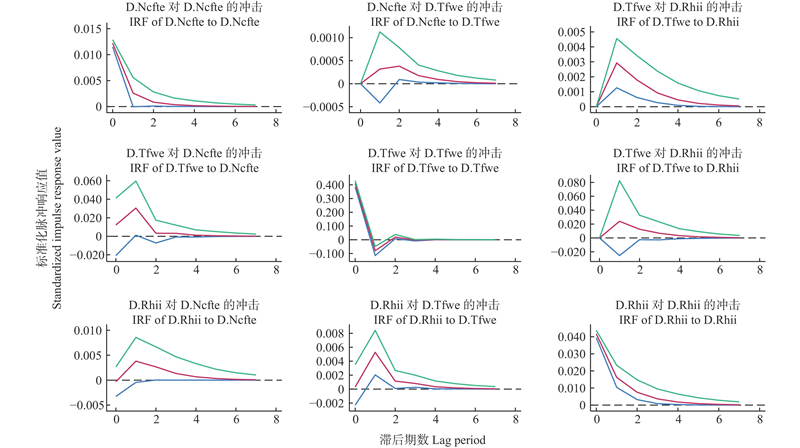
Fig.1
Impulse-responses for PVAR"
|
程小玲. 新时期乡镇林业站面临的形势与发展思考. 林业资源管理, 2013, (6): 28- 32.
doi: 10.3969/j.issn.1002-6622.2013.06.007 |
|
|
Cheng X L. Discussion on the situation and development of township forestry stations in the new period. Forest Resources Management, 2013, (6): 28- 32.
doi: 10.3969/j.issn.1002-6622.2013.06.007 |
|
|
福建省森林资源管理总站. 构筑服务平台 创新服务方式 全面提升职能作用: 福建省基层林业站服务体系建设情况介绍. 林业资源管理, 2010, (4): 5- 7.
doi: 10.3969/j.issn.1002-6622.2010.04.002 |
|
|
General Forest Management Station of Fujian Province. Building service platforms and innovating service methods to comprehensively enhance functional roles: an introduction to the construction of service system for grassroots forestry stations in Fujian Province. Forest Resources Management, 2010, (4): 5- 7.
doi: 10.3969/j.issn.1002-6622.2010.04.002 |
|
| 郭聪聪, 荣艳菊, 张 宇, 等. 我省基层林业站建设成效显著. 河北林业, 2023, (2): 24- 25. | |
| Guo C C, Rong Y J, Zhang Y, et al. Remarkable achievements in the construction of grassroots forestry stations in our province. Hebei Forestry, 2023, (2): 24- 25. | |
| 刘 璨, 康子昊, 朱文清, 等. 中国集体林权制度改革: 2012年以来的新进展与40余年的典型事实分析. 林业经济, 2024, 46 (5): 5- 23. | |
| Liu C, Kang Z H, Zhu W Q, et al. China’s reform of collective forestland tenure: new progresses since 2012 and stylized facts over the past 40 years. Forestry Economics, 2024, 46 (5): 5- 23. | |
| 刘 璨, 李 云, 张敏新, 等. 新时代中国集体林改及其相关环境因素动态分析. 林业经济, 2020, 42 (1): 9- 27. | |
| Liu C, Li Y, Zhang M X, et al. Dynamic analysis on collective forest reform and related environmental factors in China in the new era. Forestry Economics, 2020, 42 (1): 9- 27. | |
| 刘 璨, 刘 浩, 贺胜年. 中国集体林产权制度改革主要政策问题研究. 林业经济, 2011, 33 (8): 8- 19. | |
| Liu C, Liu H, He S N. The key issues on reform of collective forestland tenure in China. Forestry Economics, 2011, 33 (8): 8- 19. | |
| 刘 璨, 刘 浩, 朱文清, 等. 城乡关系背景下中国集体林权制度变迁分析. 中国农村经济, 2023a, (10): 136- 157. | |
| Liu C, Liu H, Zhu W Q, et al. Changes in China’s collective forestland tenure system in the context of urban-rural relations. Chinese Rural Economy, 2023a, (10): 136- 157. | |
| 刘 璨, 张 寒. 集体林权制度改革进程、效应与演化: 2002—2022年. 改革, 2023b, (8): 140- 155. | |
| Liu C, Zhang H. The course, effects, and evolution of the reform of collective forest rights system: 2002—2022. Reform, 2023b, (8): 140- 155. | |
| 刘 璨, 张永亮, 赵 楠, 等. 集体林权制度改革发展现状、问题及对策. 林业经济, 2017, 39 (7): 3- 14,22. | |
| Liu C, Zhang Y L, Zhao N, et al. The status, issues and countermeasures for the reform of collective forestland tenure system in China. Forestry Economics, 2017, 39 (7): 3- 14,22. | |
| 刘朝阳, 柳小慧. 土地财政的货币效应: 理论机制、经验证据与政策含义——基于地级市面板数据的PVAR模型分析. 财政研究, 2021, (11): 45- 58. | |
| Liu C Y, Liu X H. Monetary effect of land finance: theoretical mechanism, empirical evidence and policy implications——PVAR model analysis based on panel data of prefecture-level cities. Public Finance Research, 2021, (11): 45- 58. | |
| 刘煜莹, 洪燕真, 杨小军, 等. “社会-生态系统”视角下森林生态治理研究综述. 林业经济, 2022, 44 (6): 5- 19. | |
| Liu Y Y, Hong Y Z, Yang X J, et al. Review on forest ecological management from the perspective of “social-ecological system”. Forestry Economics, 2022, 44 (6): 5- 19. | |
| 王培帆, 贺 超, 杨桂红, 等. 林业科技服务供需匹配程度及需求影响因素研究: 以辽宁集体林区500户农户为例. 林业经济, 2019, 41 (4): 25- 31,57. | |
| Wang P F, He C, Yang G H, et al. Research on the matching degree of supply and demand for forestry technology service and the influencing factors of demand: a case study of 500 farmers in Liaoning collective forest area. Forestry Economics, 2019, 41 (4): 25- 31,57. | |
| 魏 建, 尹少华, 刘 璨. 新一轮集体林权制度改革对兼业与非兼业农户收入的影响研究. 林业经济, 2018, 40 (12): 64- 71. | |
| Wei J, Yin S H, Liu C. Research on the impact of the new collective forestland tenure reform on the income of part-time and non-part-time households. Forestry Economics, 2018, 40 (12): 64- 71. | |
| 吴守蓉, 邬惠中, 白石则彦. 基于服务型政府建设的基层林业站职能优化途径研究. 农村经济, 2015, (7): 100- 105. | |
| Wu S R, Wu H Z, Bai-Shi Z Y. Research on the optimization path of grassroots forestry station functions based on the construction of a service-oriented government. Rural Economy, 2015, (7): 100- 105. | |
| 杨 萍, 张红霄, 彭晓民, 等. 集体林权制度改革对农户造林意愿的影响: 基于江西省6个案例村农户调查. 西北农林科技大学学报(社会科学版), 2013, 13 (3): 58- 66. | |
| Yang P, Zhang H X, Peng X M, et al. Impact of collective forest tenure reform on farmers’ willingness and action for afforestation: based on case investigation in six villages in Jiangxi Province. Journal of Northwest A& F University (Social Science Edition), 2013, 13 (3): 58- 66. | |
| 张 寒, 赵赛菲, 赵 青. 劳动力成本上升与农户营林投入结构调整: 基于林种视角的分析. 林业经济, 2023, 45 (2): 5- 19. | |
| Zhang H, Zhao S F, Zhao Q. Rising labor costs and farmers' input structure adjustment in forest culture and management: analysis based on the perspective of forest category. Forestry Economics, 2023, 45 (2): 5- 19. | |
| 张 寒, 周正康, 杨红强, 等. 劳动力成本上升对农户营林投入结构的影响: 基于林业社会化服务供给约束的视角. 中国农村经济, 2022, (4): 106- 125. | |
| Zhang H, Zhou Z K, Yang H Q, et al. The impact of increased labor costs on farmers’ input structure of forestland management: an analysis from the perspective of supply constraints of forestry socialized services. Chinese Rural Economy, 2022, (4): 106- 125. | |
| 周小亮, 宋 立. 中国工业低碳转型: 现实分析与政策思考. 数量经济技术经济研究, 2022, 39 (8): 22- 41. | |
| Zhou X L, Song L. Low-carbon transformation of China's industry: realistic analysis and policy thinking. Journal of Quantitative & Technological Economics, 2022, 39 (8): 22- 41. | |
|
Holtz-Eakin D, Newey W, Rosen H S. Estimating vector autoregressions with panel data. Econometrica, 1988, 56 (6): 1371.
doi: 10.2307/1913103 |
|
|
Lu S S, Sun H S, Zhou Y, et al. Examining the impact of forestry policy on poor and non-poor farmers’ income and production input in collective forest areas in China. Journal of Cleaner Production, 2020, 276, 123784.
doi: 10.1016/j.jclepro.2020.123784 |
|
|
Tone K. A slacks-based measure of efficiency in data envelopment analysis. European Journal of Operational Research, 2001, 130 (3): 498- 509.
doi: 10.1016/S0377-2217(99)00407-5 |
|
|
Tone K. A slacks-based measure of super-efficiency in data envelopment analysis. European Journal of Operational Research, 2002, 143 (1): 32- 41.
doi: 10.1016/S0377-2217(01)00324-1 |
|
|
Yang L, Ren Y. Property rights, village democracy, and household forestry income: evidence from China’s collective forest tenure reform. Journal of Forest Research, 2021, 26 (1): 7- 16.
doi: 10.1080/13416979.2020.1854064 |
| [1] | Zhenghuang Shi,fangmiao Hou,Haokun Zhang,Guoxing Huang. Analysis of the Impact of the New Round of Collective Forest Tenure Reform on the Growth of Export Margins of China’s Wood-Based Forest Product [J]. Scientia Silvae Sinicae, 2025, 61(9): 211-222. |
| [2] | Zhao Xiaodi, Li Lingchao, Yang Wentao, Cheng Baodong, Liu Jinlong. Analysis of Socio-Economic Influencing Factors of Forest Transition in Counties of Fujian Province [J]. Scientia Silvae Sinicae, 2019, 55(8): 147-156. |
| [3] | Zhang Minxin;Xiao Ping;Zhang Hongxiao. Equalization in the Usufruct of Forestland:A Reality Choice forthe Collective Forest Tenure Reform [J]. Scientia Silvae Sinicae, 2008, 44(8): 131-136. |
| [4] | Zhang Lei;Wen Caiyun;. Impacts of Collective Forest Tenure Reform on Farmer Households' Livelihood [J]. Scientia Silvae Sinicae, 2008, 44(7): 73-78. |
| Viewed | ||||||
|
Full text |
|
|||||
|
Abstract |
|
|||||
