
Scientia Silvae Sinicae ›› 2026, Vol. 62 ›› Issue (5): 16-26.doi: 10.11707/j.1001-7488.LYKX20250732
• Frontiers and hot topics • Previous Articles Next Articles
Lin Liu1,Honggang Sun2,*( )
)
Received:2025-12-09
Revised:2026-02-02
Online:2026-05-10
Published:2026-05-12
Contact:
Honggang Sun
E-mail:honggangsun@caf.ac.cn
CLC Number:
Lin Liu,Honggang Sun. Effects of Dynamic Coupling Between Biomass and Dead Organic Matter Carbon Pools on Rotation Period and Forest Land Expectation Value of Cunninghamia lanceolata Plantations in Fenyi, Jiangxi Province[J]. Scientia Silvae Sinicae, 2026, 62(5): 16-26.
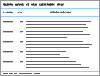
Table 1
Estimation formula for stand carbon sequestration"
| 碳库类型 Carbon pool type | 计算公式 Calculation formula | 变量说明与参数设置 Variable explanations and parameter Settings | 来源 Sources |
| 基准生物量碳库 Base biomass carbon pool (B0) | B0=0.5BEF(aVt+b) | a: 蓄积量转换系数,0.475 4 Volume conversion coefficient, 0.475 4; b: 截距项,30.630 3 Intercept term, 30.630 3; BEF: 生物量扩展因子,1.546 0 Biomass expansion factor, 1.546 0; 0.5:生物量碳含量 Carbon content of biomass | 余智涵等, |
| 动态耦合的生物量碳库 Dynamically coupled biomass carbon pool (B) | 年增量(B′)方程 Annual increment (B′)equation B′= dB0/dt+λD′ 累积碳库方程 Cumulative carbon pool equation B=B0(0)+∫0tB′(s)ds | B0(0):B0的初始值 The initial value of B0; dB0/dt:基准生物量碳库的自然年增量 Natural annual increment of base biomass carbon pool; λ:养分反馈系数 Nutrient feedback coefficient; s:介于0~t之间的某个林龄 A stand age between 0 and t D′:有养分反馈的死亡有机质碳库年变化量 Annual variation of dead organic matter carbon pool with nutrient feedback | 基于Fang等( |
| 死亡有机质碳库 Dead organic matter carbon pool | 无养分反馈的碳库储量(D0) Carbon pool storage without nutrient feedback(D0) D0=D0(0)+∫0t[βB0(s)?αD0(s)]ds 无养分反馈的碳库年变化量(D0') Annual variation of carbon pool without nutrient feedback (D0′) D0′=βB0?αD0 有养分反馈的碳库储量(D) Carbon pool storage with nutrient feedback (D) D=D0(0)+∫0t[βB(s)?αD(s)]ds 有养分反馈的碳库年变化量(D') Annual variation of carbon pool with nutrientfeedback (D′) D′=βB?αD | D0(0):D0的初始值 The initial value of D0; β:生物量年死亡比率 Annual mortality ratio of biomass; α:分解速率常数 Decomposition rate constant | 参考熊鑫等( |
Table 2
Comparison of core indicators of Chinese fir plantations under three scenarios"
| 指标 Index | 单位 Unit | 基准碳库情景 Baseline carbon pool scenario | 静态碳库情景 Static carbon pool scenario | 动态耦合情景 Dynamic coupling scenario |
| 最优轮伐期 Optimal rotation period(T*) | a | 21 | 21 | 21 |
| 21年生LEV峰值 Peak LEV of 21-year-old Chinese fir stands | yuan·hm?2 | 62 386 | 62 534 | 62 555 |
| 21年生生物量碳库 Biomass carbon pool of 21-year-old Chinese fir stands | t·hm?2 | 126.100 | 126.100 | 136.617 |
| 21年生死亡有机质碳库 Dead organic matter carbon pool of 21-year-old Chinese fir stands | t·hm?2 | — | 27.889 | 30.048 |
| 21年生总碳库 Total carbon pool of 21-year-old Chinese fir stands | t·hm?2 | — | 153.988 | 166.665 |
| 40年生LEV LEV of 40-year-old Chinese fir stands | yuan·hm?2 | 23 346 | 23 359 | 23 361 |
| 40年生生物量碳库 Biomass carbon pool of 40-year-old Chinese fir stands | t·hm?2 | 152.452 | 152.452 | 166.532 |
| 40年生死亡有机质碳库 Dead organic matter carbon pool of 40-year-old Chinese fir stands | t·hm?2 | — | 36.856 | 40.227 |
| 40年生总碳库 Total carbon pool of 40-year-old Chinese fir stands | t·hm?2 | — | 189.308 | 206.758 |
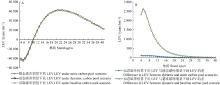
Fig.1
Changes in land expectation value (LEV) with stand age under three scenarios"
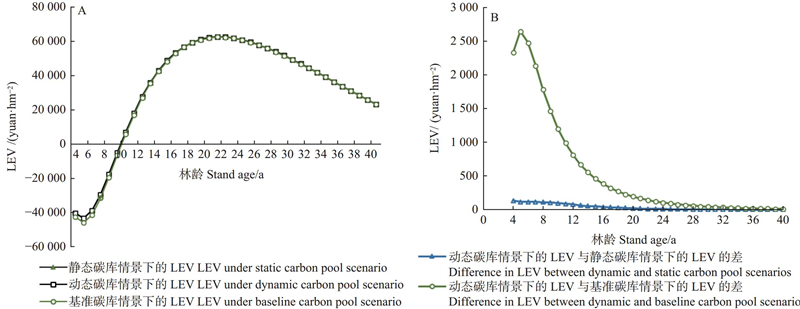
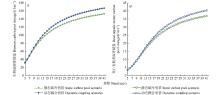
Fig.2
Dynamic comparison of biomass carbon pool (A) and dead organic matter carbon pool (B) in 40-year-old Chinese fir plantations"
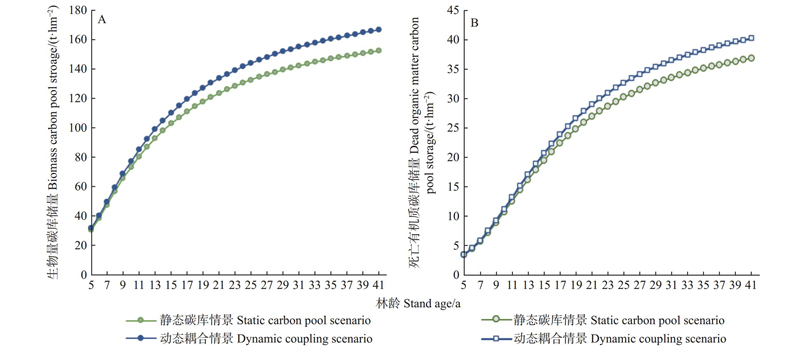
Table 3
Calculation results of total carbon pool under different scenarios t·hm?2"
| 林龄 Stand age | 静态碳库情景 Static carbon pool scenario | 动态耦合情景 Dynamic coupling scenario | |||||
| 基准生物量碳库储量Base biomass carbon pool storage (B0) | 无养分反馈的死亡有机质碳库储量Dead organic matter carbon pool storage without nutrient feedback (D0) | 碳库总储量Total carbon pool storage (TC) | 动态耦合的生物量碳库储量 Dynamically coupled biomass carbon pool storage (B) | 有养分反馈的死亡有机质碳库储量 Dead organic matter carbon pool storage with nutrient feedback (D) | 碳库总储量Total carbon pool storage (TC) | ||
| 5 | 38.508 | 4.509 | 43.018 | 40.135 | 4.647 | 44.782 | |
| 10 | 80.586 | 12.649 | 93.235 | 85.226 | 13.258 | 98.484 | |
| 15 | 107.164 | 21.041 | 128.205 | 114.999 | 22.384 | 137.383 | |
| 20 | 123.574 | 26.970 | 150.543 | 133.727 | 29.009 | 162.736 | |
| 21 | 126.100 | 27.889 | 153.988 | 136.617 | 30.048 | 166.665 | |
| 25 | 134.496 | 30.897 | 165.394 | 146.208 | 33.463 | 179.671 | |
| 40 | 152.452 | 36.856 | 189.308 | 166.532 | 40.227 | 206.758 | |
Table 4
Effects of parameter changes on land expectation value (LEV) and optimal rotation period (T*) of Chinese fir plantation"
| 参数 Parameter | 基准碳库情景 Baseline carbon pool scenario | 静态碳库情景 Static carbon pool scenario | 动态耦合情景 Dynamic coupling scenario | |||||
| T*/a | LEV/(yuan·hm?2) | T*/a | LEV/(yuan·hm?2) | T*/a | LEV/(yuan·hm?2) | |||
| λ=0 | 21 | 62 386 | 21 | 62 386 | 21 | 62 386 | ||
| λ=0.15 | _ | _ | _ | _ | 21 | 62 574 | ||
| λ=0.20 | _ | _ | _ | _ | 21 | 62 588 | ||
| Pc=30 | _ | _ | 21 | 62 438 | 21 | 62 459 | ||
| Pc=77 | _ | _ | 21 | 62 520 | 21 | 62 574 | ||
| Pc=120 | _ | _ | 21 | 62 595 | 21 | 62 678 | ||
| α=0.22 | _ | _ | 21 | 62 542 | 21 | 62 568 | ||
| α=0.25 | _ | _ | 21 | 62 534 | 21 | 62 555 | ||
| α=0.34 | _ | _ | 21 | 62 521 | 21 | 62 533 | ||
| 巢 林, 刘艳艳, 洪 伟, 等. 碳汇木材复合经营对杉木人工林经济成熟龄及现值收益的影响. 福建农林大学学报(自然科学版), 2016, 45 (4): 409- 419. | |
| Chao L, Liu Y Y, Hong W, et al. Effect of combined carbon and timber management on net present value of economic maturity age in Cunninghamia lanceolata plantation. Journal of Fujian Agriculture and Forestry University (Natural Science Edition), 2016, 45 (4): 409- 419. | |
| 董 捷, 曾 咪. 基于碳汇收益和木材收益损失的碳汇造林补偿标准研究. 浙江农业学报, 2022, 34 (4): 790- 800. | |
| Dong J, Zeng M. Research on compensation standard for carbon sequestration afforestation based on carbon sequestration revenue and loss of wood revenue. Acta Agriculturae Zhejiangensis, 2022, 34 (4): 790- 800. | |
| 董灵波, 蔺雪莹, 张一帆, 等. 兼顾碳汇和木材生产的长白落叶松人工林最优轮伐期. 林业科学, 2022, 58 (5): 18- 30. | |
| Dong L B, Lin X Y, Zhang Y F, et al. Optimal rotation of Larix olgensis plantation in considering carbon sequestration and timber production. Scientia Silvae Sinicae, 2022, 58 (5): 18- 30. | |
|
吕梓晴, 段爱国. 不同产区杉木生物量与碳储量模型. 林业科学, 2024, 60 (2): 1- 11.
doi: 10.11707/j.1001-7488.LYKX20220526 |
|
|
Lü Z Q, Duan A G. Biomass and carbon storage model of Cunninghamia lanceolata in different production areas. Scientia Silvae Sinicae, 2024, 60 (2): 1- 11.
doi: 10.11707/j.1001-7488.LYKX20220526 |
|
| 彭 娓, 李凤日, 金星姬, 等. 应用Hooke&Jeeves算法对长白落叶松人工林多目标经营的优化. 东北林业大学学报, 2018, 46 (7): 1- 6. | |
| Peng W, Li F R, Jin X J, et al. Multi-objective management optimization of Larix olgensis plantations by Hooke & Jeeves algorithm. Journal of Northeast Forestry University, 2018, 46 (7): 1- 6. | |
|
沈月琴, 王 枫, 张耀启, 等. 中国南方杉木森林碳汇供给的经济分析. 林业科学, 2013, 49 (9): 140- 147.
doi: 10.11707/j.1001-7488.20130920 |
|
|
Shen Y Q, Wang F, Zhang Y Q, et al. Economic analysis of Chinese fir forest carbon sequestration supply in south China. Scientia Silvae Sinicae, 2013, 49 (9): 140- 147.
doi: 10.11707/j.1001-7488.20130920 |
|
| 童书振, 张建国, 罗红艳, 等. 杉木林密度间伐试验. 林业科学, 2000, 36 (S1): 86- 89. | |
| Tong S Z, Zhang J G, Luo H Y, et al. Studies on the density and thinning experiments of Chinese fir siands. Scientia Silvae Sinicae, 2000, 36 (S1): 86- 89. | |
| 王晓雯, 余智涵, 杨红强. 基于价格随机的苏北杨树人工林多碳库最优轮伐模型构建与评估. 生态学报, 2025, 45 (5): 2326- 2336. | |
| Wang X W, Yu Z H, Yang H Q. Construction and evaluation of the optimal rotation model for multi carbon storage of poplar plantations in northern Jiangsu based on price stochasticity. Acta Ecologica Sinica, 2025, 45 (5): 2326- 2336. | |
|
夏丽丹, 张 虹, 杨靖宇, 等. 杉木凋落物土壤生态功能研究进展. 世界林业研究, 2019, 32 (2): 7- 12.
doi: 10.13348/j.cnki.sjlyyj.2018.0093.y |
|
|
Xia L D, Zhang H, Yang J Y, et al. Research advances in soil ecological functions of Cunninghamia lanceolata litters. World Forestry Research, 2019, 32 (2): 7- 12.
doi: 10.13348/j.cnki.sjlyyj.2018.0093.y |
|
| 辛赞红, 江 洪, 接程月, 等. 模拟轮伐期长短对杉木人工林氮动态的影响. 浙江农林大学学报, 2011, 28 (6): 855- 862. | |
| Xin Z H, Jiang H, Jie C Y, et al. Effects of rotation length on nitrogen dynamics in Chinese fir plantations. Journal of Zhejiang Agriculture and Forestry University, 2011, 28 (6): 855- 862. | |
| 徐 冰, 郭兆迪, 朴世龙, 等. 2000—2050年中国森林生物量碳库: 基于生物量密度与林龄关系的预测. 中国科学: 生命科学, 2020, 40 (7): 587- 594. | |
| Xu B, Guo Z D, Pu S L, et al. Forest biomass carbon pool in China from 2000 to 2050: prediction based on the relationship between biomass density and forest age. Scientia Sinica Vitae, 2020, 40 (7): 587- 594. | |
| 余智涵, 宁 卓, 杨红强. 随机价格下杉木人工林的碳汇收益及最优轮伐期确定. 自然资源学报, 2022, 37 (3): 753- 768. | |
| Yu Z H, Ning Z, Yang H Q. Carbon sequestration benefits and optimal rotation period determination of Chinese fir plantations under stochastic price. Journal of Natural Resources, 2022, 37 (3): 753- 768. | |
| 熊 鑫, 张慧玲, 吴建平, 等. 鼎湖山森林演替序列植物−土壤碳氮同位素特征. 植物生态学报, 2016, 40 (6): 533- 542. | |
| Xiong X, Zhang H L, Wu J P, et al. Characteristics of plant-soil carbon and nitrogen isotopes along a forest succession sequence in Dinghu Mountain. Chinese Journal of Plant Ecology, 2016, 40 (6): 533- 542. | |
| 朱 臻, 沈月琴, 张耀启, 等. 碳汇经营目标下的林地期望价值变化及碳供给: 基于杉木裸地造林假设研究. 林业科学, 2012, 48 (11): 112- 116. | |
| Zhu Z, Shen Y Q, Zhang Y Q, et al. Change of forestland expected value and carbon supply in the objective of carbon sequestration: based on the Chinese fir plantation in bared land. Scientia Silvae Sinicae, 2012, 48 (11): 112- 116. | |
| 臧 颢, 黄锦程, 刘洪生, 等. 杉木人工林碳汇木材多功能经营的最优轮伐期. 北京林业大学学报, 2022, 44 (10): 120- 128. | |
| Zang H, Huang J C, Liu H S, et al. Optimal rotation period of carbon sequestration wood multifunctional management in Chinese fir plantation. Journal of Beijing Forestry University, 2022, 44 (10): 120- 128. | |
|
Asante P, Armstrong G W. Optimal forest harvest age considering carbon sequestration in multiple carbon pools: a comparative statics analysis. Journal of Forest Economics, 2012, 18 (2): 145- 156.
doi: 10.1016/j.jfe.2011.12.002 |
|
|
Asante P, Armstrong G W, Adamowicz W L. Carbon sequestration and the optimal forest harvest decision: a dynamic programming approach considering biomass and dead organic matter. Journal of Forest Economics, 2011, 17 (1): 3- 17.
doi: 10.1016/j.jfe.2010.07.001 |
|
|
Brazee R J. Impacts of declining discount rates on optimal harvest age and land expectation values. Journal of Forest Economics, 2018, 31, 27- 38.
doi: 10.1016/j.jfe.2017.06.002 |
|
|
Chladná Z. Determination of optimal rotation period under stochastic wood and carbon prices. Forest Policy and Economics, 2007, 9 (8): 1031- 1045.
doi: 10.1016/j.forpol.2006.09.005 |
|
|
Dong L B, Bettinger P, Qin H Y, et al. Optimizing rotation lengths for maximizing carbon balance of larch plantations in Northeast China. Journal of Cleaner Production, 2022, 343, 131025.
doi: 10.1016/j.jclepro.2022.131025 |
|
|
Dong L B, Lu W, Liu Z G. Determining the optimal rotations of larch plantations when multiple carbon pools and wood products are valued. Forest Ecology and Management, 2020, 474, 118356.
doi: 10.1016/j.foreco.2020.118356 |
|
|
Ekholm T. Optimal forest rotation under carbon pricing and forest damage risk. Forest Policy and Economics, 2020, 115, 102131.
doi: 10.1016/j.forpol.2020.102131 |
|
|
Fang J, Chen A, Peng C, et al. Changes in forest biomass carbon storage in China between 1949 and 1998. Science, 2001, 292 (5525): 2320- 2322.
doi: 10.1126/science.1058629 |
|
|
Holtsmark B, Hoel M, Holtsmark K. Optimal harvest age considering multiple carbon pools: a comment. Journal of Forest Economics, 2013, 19 (1): 87- 95.
doi: 10.1016/j.jfe.2012.09.002 |
|
|
Hu Y X, Jiang Y H, Chhin S, et al. Alleviating monoculture-induced soil degradation in Chinese fir plantations in Southern China: Optimizing understory mixtures balances stoichiometry and microbial diversity. Industrial Crops and Products, 2025, 232, 121254.
doi: 10.1016/j.indcrop.2025.121254 |
|
|
Price C. Optimal rotation with differently-discounted benefit streams. Journal of Forest Economics, 2017, 26, 1- 8.
doi: 10.1016/j.jfe.2016.10.001 |
|
| Pukkala T. 2014. Does biofuel harvesting and continuous cover management increase carbon sequestration? Forest Policy and Economics, 43: 41−50. | |
| Sun T, Dong L L, Zhang Y Y, et al. 2024. General reversal of N-decomposition relationship during long-term decomposition in boreal and temperate forests. PNAS, 121(20): e2401398121. | |
|
Zhang Y J, Si Y L, Ju S B, et al. Synergistic effects of nitrogen deposition and phosphorus distribution patterns on root morphological and chemical traits, and nutrient efficiency in Chinese fir. Journal of Plant Ecology, 2025, 18 (4): rtaf062.
doi: 10.1093/jpe/rtaf062 |
|
|
Zhou W, Gao L. The impact of carbon trade on the management of short-rotation forest plantations. Forest Policy and Economics, 2016, 62, 30- 35.
doi: 10.1016/j.forpol.2015.10.008 |
| [1] | Zhihan Yu,Hongqiang Yang. Research Frontier and Prospect of Forest Management Decision-Making Methodology Based on Generalized Faustmann Model [J]. Scientia Silvae Sinicae, 2024, 60(9): 170-182. |
| [2] | Lin Zhuo, Wu Chengzhen, Hong Wei, Hong Tao. Economic Benefits Analysis of Carbon Sequestration and Timber and Determination of Optimal Rotation Period for a Cunninghamia lanceolata Plantation——Based on Time Series Model [J]. Scientia Silvae Sinicae, 2016, 52(10): 134-145. |
| Viewed | ||||||
|
Full text |
|
|||||
|
Abstract |
|
|||||
