
Scientia Silvae Sinicae ›› 2026, Vol. 62 ›› Issue (6): 46-55.doi: 10.11707/j.1001-7488.LYKX20250398
• Frontiers and hot topics • Previous Articles Next Articles
Jiajun Wang1,3,Hong Wang2,3,Juan Guo2,3,Naisheng Li1,3,*( ),Youtian Yang1,Yafang Yin2,3
Received:2025-06-19
Revised:2025-07-04
Online:2026-06-10
Published:2026-06-13
Contact:
Naisheng Li
E-mail:lineas@126.com
CLC Number:
Jiajun Wang,Hong Wang,Juan Guo,Naisheng Li,Youtian Yang,Yafang Yin. Variation of Wood Degradation Characteristics in “Nanhai Ⅰ” Shipwreck[J]. Scientia Silvae Sinicae, 2026, 62(6): 46-55.
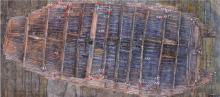
Fig.1
Diagram of sampling points (repeat sampling sites in 2023 and 2024 are marked in blue)"
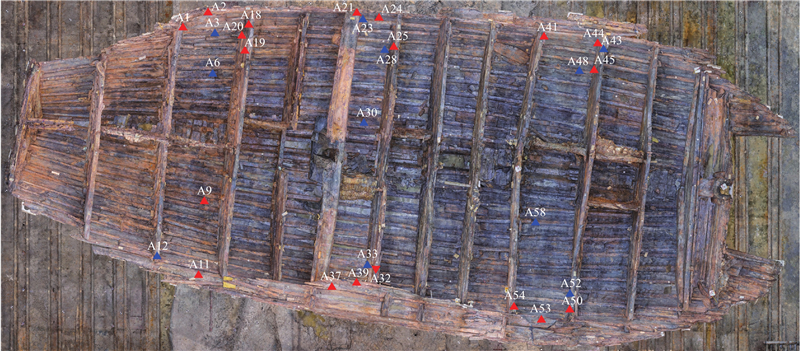
Table 1
Sampling information of wood samples from the “Nanhai No. 1” shipwreck"
| 样品编号 Sample No. | 舱位 Cabin | 采样部位 Sampling site | 是否采样 Sampling or not | 树种Tree species | 保存状况 Preservation condition | ||
| 2023 | 2024 | 2023 | 2024 | ||||
| A1 | 四号舱 Cabin 4 | 隔舱板Partition board | √ | 硬木松Pinus sp. | 重度降解 Severe degradation | ||
| A2 | 船壳板Hull plates | √ | 硬木松Pinus sp. | 重度降解 Severe degradation | |||
| A3 | 船壳板Hull plates | √ | √ | 杉木Cunninghamia lanceolata | 中度至重度降解 Moderate to severe degradation | 重度降解 Severe degradation | |
| A6 | 船壳板Hull plates | √ | √ | 硬木松Pinus sp. | 重度降解 Severe degradation | 重度降解 Severe degradation | |
| A9 | 船壳板Hull plates | √ | 硬木松Pinus sp. | 重度降解 Severe degradation | |||
| A11 | 甲板Deck | √ | 杉木Cunninghamia lanceolata | 重度降解 Severe degradation | |||
| A12 | 隔舱板Partition board | √ | √ | 硬木松Pinus sp. | 重度降解 Severe degradation | 重度降解 Severe degradation | |
| A18 | 隔舱板Partition board | √ | 硬木松Pinus sp. | 重度降解 Severe degradation | |||
| A19 | 隔舱板Partition board | √ | — | — | |||
| A20 | 隔舱板Partition board | √ | 硬木松Pinus sp. | 重度降解 Severe degradation | |||
| A21 | 七号舱 Cabin 7 | 桅面梁Mast surface beam | √ | 樟木Cinnamomum sp. | 重度降解 Severe degradation | ||
| A23 | 加强筋Stiffener | √ | √ | 樟木Cinnamomum sp. | 重度降解 Severe degradation | 重度降解 Severe degradation | |
| A24 | 船壳板Hull plates | √ | 软木松Pinus sp. | 重度降解 Severe degradation | |||
| A25 | 隔舱板Partition board | √ | 软木松Pinus sp. | 重度降解 Severe degradation | |||
| A28 | 船壳板Hull plates | √ | √ | 杉木Cunninghamia lanceolata | 重度降解 Severe degradation | 重度降解 Severe degradation | |
| A30 | 船壳板Hull plates | √ | √ | 硬木松Pinus sp. | 重度降解 Severe degradation | 重度降解 Severe degradation | |
| A32 | 隔舱板Partition board | √ | 硬木松Pinus sp. | 重度降解 Severe degradation | |||
| A33 | 隔舱板Partition board | √ | √ | 硬木松Pinus sp. | 中度至重度降解 Moderate to severe degradation | 中度至重度降解 Moderate to severe degradation | |
| A37 | 加强筋Stiffener | √ | 樟木Cinnamomum sp. | 重度降解 Severe degradation | |||
| A39 | 船壳板Hull plates | √ | 硬木松Pinus sp. | 重度降解 Severe degradation | |||
| A41 | 十一号舱 Cabin 11 | 隔舱板Partition board | √ | 硬木松Pinus sp. | 重度降解 Severe degradation | ||
| A43 | 隔舱板Partition board | √ | 硬木松Pinus sp. | 重度降解 Severe degradation | |||
| A44 | 隔舱板Partition board | √ | 硬木松Pinus sp. | 重度降解 Severe degradation | |||
| A45 | 隔舱板Partition board | √ | 硬木松Pinus sp. | 重度降解 Severe degradation | |||
| A48 | 船壳板Hull plates | √ | √ | 杉木Cunninghamia lanceolata | 重度降解 Severe degradation | 重度降解 Severe degradation | |
| A50 | 隔舱板Partition board | √ | 硬木松Pinus sp. | 重度降解 Severe degradation | |||
| A52 | 隔舱板Partition board | √ | 硬木松Pinus sp. | 重度降解 Severe degradation | 重度降解 Severe degradation | ||
| A53 | 甲板Deck | √ | 杉木Cunninghamia lanceolata | 中度降解 Moderate degradation | |||
| A54 | 隔舱板Partition board | √ | 硬木松Pinus sp. | 重度降解 Severe degradation | |||
| A58 | 船壳板Hull plates | √ | √ | 杉木Cunninghamia lanceolata | 重度降解 Severe degradation | 重度降解 Severe degradation | |
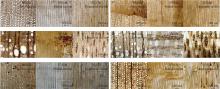
Fig.2
Anatomical structure of representative archaeological wood samples A, C, and E correspond to samples collected from points A3, A23, and A33 in 2024; B, D, and F correspond to samples collected from the same points in 2023."
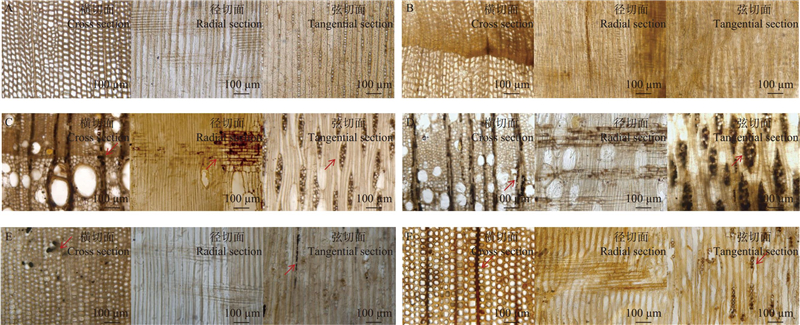
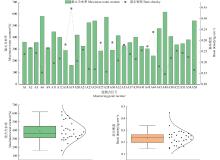
Fig.3
Maximum water content and basic density of archaeological wood samples in 2024"
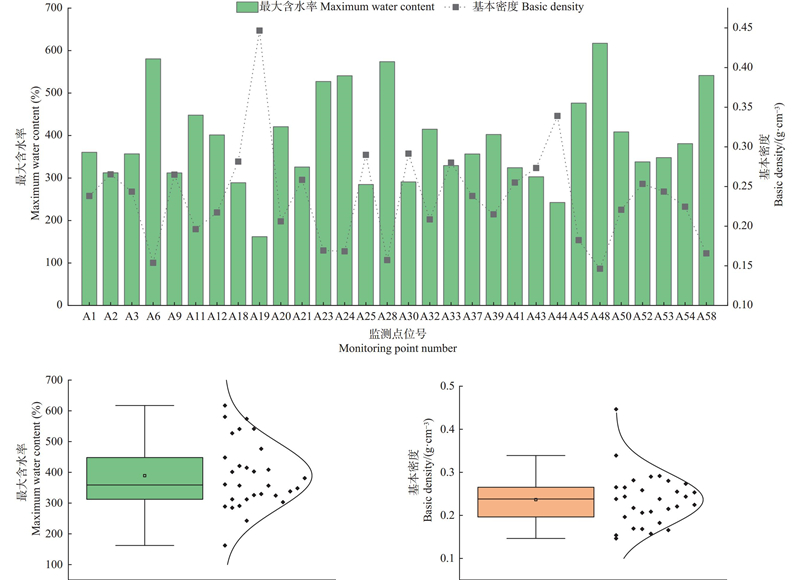
Table 2
Basic density and maximum water content of wood samples from the “Nanhai Ⅰ” shipwreck in 2023"
| 样品编号 Sample No. | 基本密度 Basic density/(g·cm?3) | 最大含水率 Maximum water content (%) |
| A3 | 0.179 | 473 |
| A6 | 0.160 | 559 |
| A12 | 0.165 | 550 |
| A23 | 0.139 | 646 |
| A28 | 0.137 | 652 |
| A30 | 0.250 | 334 |
| A33 | 0.466 | 164 |
| A48 | 0.174 | 527 |
| A52 | 0.233 | 383 |
| A58 | 0.154 | 590 |
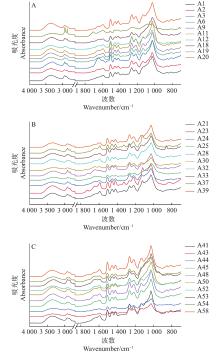
Fig.4
Average ATR-FTIR spectra of archaeological wood samples from cabin 4 (A), cabin 7 (B) and cabin 11 (C) in 2024"
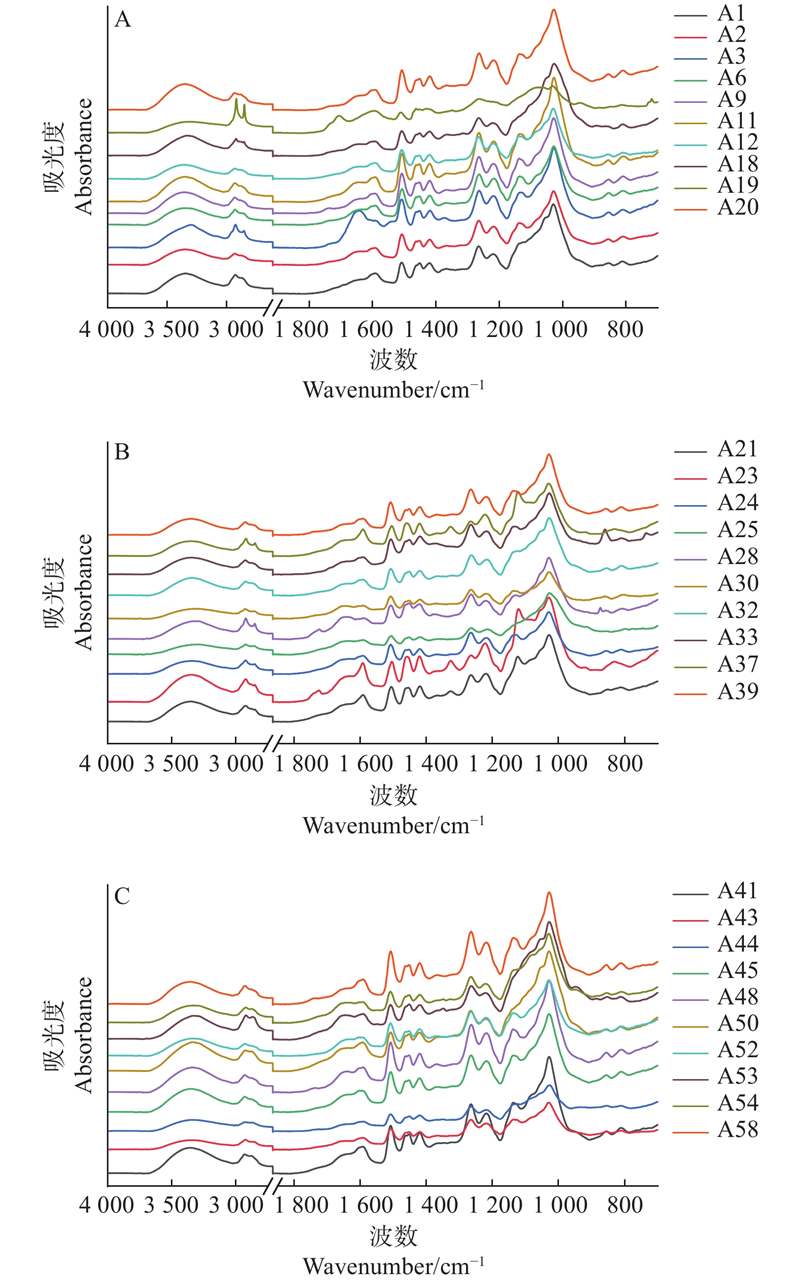
Table 3
H/L values of archaeological wood samples from the “Nanhai Ⅰ” in 2024"
| 四号舱Cabin 4 | 七号舱Cabin 7 | 十一号舱Cabin 11 | |||||
| A1 | 0.81±0.07 | A21 | 0.79±0.08 | A41 | 0.63±0.02 | ||
| A2 | 0.62±0.01 | A23 | 0.76±0.02 | A43 | 0.68±0.02 | ||
| A3 | 0.62±0.04 | A24 | 0.68±0.04 | A44 | 0.68±0.02 | ||
| A6 | 0.62±0.01 | A25 | 0.83±0.01 | A45 | 0.62±0.02 | ||
| A9 | 0.59±0.03 | A28 | 0.74±0.12 | A48 | 0.56±0.01 | ||
| A11 | 0.59±0.02 | A30 | 0.68±0.02 | A50 | 0.87±0.04 | ||
| A12 | 0.65±0.02 | A32 | 0.71±0.03 | A52 | 0.61±0.04 | ||
| A18 | 0.85±0.04 | A33 | 0.90±0.10 | A53 | 0.85±0.07 | ||
| A19 | 1.06±0.08 | A37 | 0.75±0.03 | A54 | 0.72±0.03 | ||
| A20 | 0.62±0.04 | A39 | 0.62±0.02 | A58 | 0.55±0.01 | ||
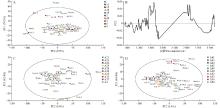
Fig.5
PCA clustering map of archaeological wood samples from cabin 4 (A), cabin 7 (C) and cabin 11 (D), and PC2 loadings plot for cabin 4 (B)"
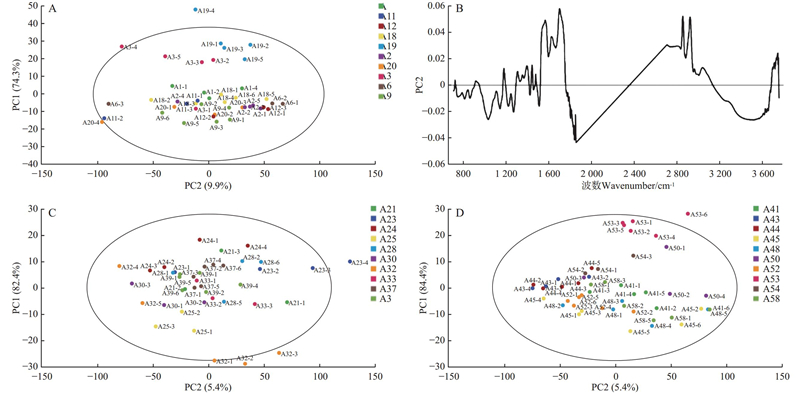
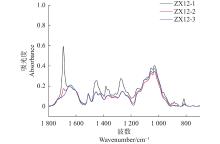
Fig.6
Microcore sample of A12 (A), and ATR-FTIR spectra of each segment (B)"
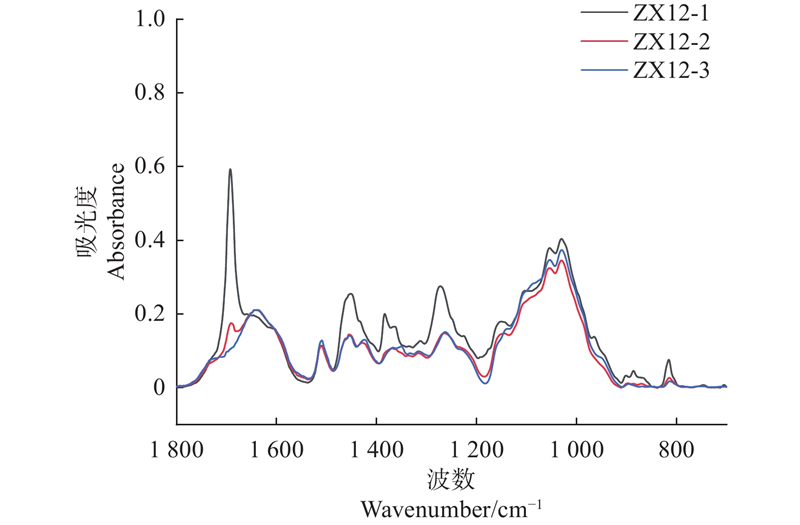
Fig.7
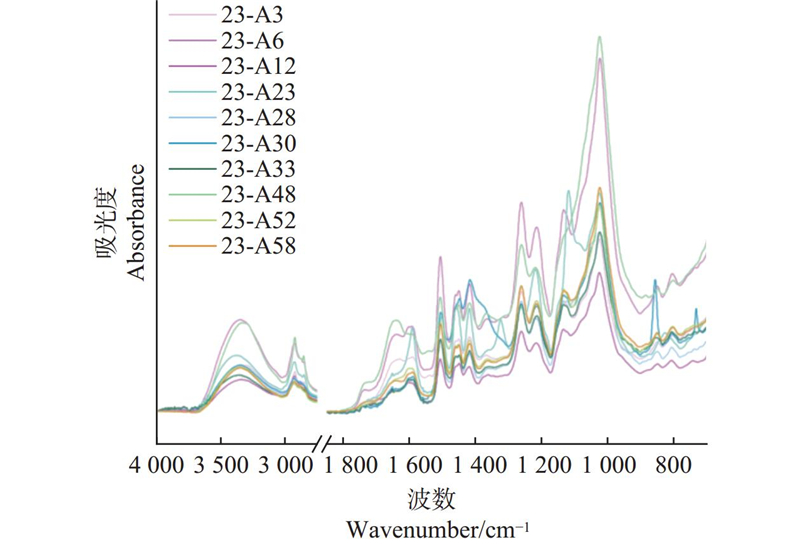
ATR-FTIR spectral changes of monitoring points in cabin 4, 7 and 11 in 2023"
| 陈靖云, 肖达顺. 2025. “南海Ⅰ号”沉船遗址形成过程的考古学观察: “南海Ⅰ号”沉船年代学研究之一. 故宫博物院院刊, (3): 4−15, 146. | |
| Chen J Y, Xiao D S. 2025. The making of the “Nanhai Ⅰ” shipwreck site analyzed from archaeological perspective. Palace Museum Journal, (3): 4−15, 146. [in Chinese] | |
|
陈潇俐, 袁 雨, 潘 彪, 等. 太仓半泾河古船船体用材鉴定与分析. 文物保护与考古科学, 2019, 31 (5): 75- 83.
doi: 10.16334/j.cnki.cn31-1652/k.2019.05.008 |
|
|
Chen X L, Yuan Y, Pan B, et al. Timber species identification and analysis of an ancient ship from Banjing River in Taicang. Sciences of Conservation and Archaeology, 2019, 31 (5): 75- 83.
doi: 10.16334/j.cnki.cn31-1652/k.2019.05.008 |
|
| 成俊卿, 杨家驹, 刘 鹏. 1992. 中国木材志. 北京: 中国林业出版社. | |
| Cheng J Q, Yang J J, Liu P. 1992. Atlas of Chinese wood. Beijing: China Forestry Publishing House. [in Chinese] | |
|
丁见祥. 水下考古学理论的发展与变迁: 兼谈对水下文化遗产保护的启示. 自然与文化遗产研究, 2022, 7 (5): 1- 10.
doi: 10.19490/j.cnki.issn2096-698X.2022.05.001-010 |
|
|
Ding J X. Development and changes in underwater archaeology theory: and implications on underwater cultural heritage protection. Study on Natural and Cultural Heritage, 2022, 7 (5): 1- 10.
doi: 10.19490/j.cnki.issn2096-698X.2022.05.001-010 |
|
| 费利华. 泉州湾宋代海船保存现状的调查研究. 中国文物科学研究, 2014 (3): 74- 79. | |
| Fei L H. An investigation of the state of conservation of the Song Dynasty shipwreck in Quanzhou Bay. China Cultural Heritage Scientific Research, 2014 (3): 74- 79. | |
| 韩刘杨, 郭 娟, 韩向娜, 等. 饱水考古木材保存状况评估研究进展. 林业科学, 2024, 60 (9): 183- 198. | |
| Han L Y, Guo J, Han X N, et al. Research progress and perspective of the preservation state of waterlogged archaeological wood. Scientia Silvae Sinicae, 2024, 60 (9): 183- 198. | |
|
李 仁, 张治国, 金 涛, 等. 沉船饱水考古木材内外部位降解特征研究. 文物保护与考古科学, 2024, 36 (6): 91- 102.
doi: 10.16334/j.cnki.cn31-1652/k.20230402891 |
|
|
Li R, Zhang Z G, Jin T, et al. Research on the degradation characteristics of the inner and outer parts of shipwreck waterlogged archaeological wood. Sciences of Conservation and Archaeology, 2024, 36 (6): 91- 102.
doi: 10.16334/j.cnki.cn31-1652/k.20230402891 |
|
|
李 坚, 甘文涛, 陈志俊, 等. 向新出发, 木材科学前沿发展. 森林工程, 2024, 41 (1): 1- 39.
doi: 10.7525/j.issn.1006-8023.2025.01.001 |
|
|
Li J, Gan W T, Chen Z J, et al. Frontier advances in wood science towards a new departure. Forest Engineering, 2024, 41 (1): 1- 39.
doi: 10.7525/j.issn.1006-8023.2025.01.001 |
|
| 李国清, 曾丽民, 陈承德. 泉州湾宋代海船三种船体木材和泉州地区十四种现代木材的平衡含水量的研究. 福建林学院学报, 1984 (1): 49- 57, 59. | |
| Li G J, Zeng L M, Chen C D. A study on the balanced moisture content of three types of shipbuilding wood used in Song Dynasty ships in Quanzhou Bay and fourteen modern wood species in the Quanzhou area. Journal of Fujian College of Forestry, 1984 (1): 49- 57, 59. | |
| 李乃胜, 陈 岳, 沈大娲. 2017. “南海Ⅰ号”沉船发掘现场保护研究(2014—2016). 北京: 科学出版社. | |
| Li N S, Chen Y, Shen D W. 2017. Research on site protection of “Nanhai Ⅰ” shipwreck excavation (2014—2016). Beijing: Science Press. [in Chinese] | |
|
李秋霞, 曹理想, 谭红铭, 等. 宋代海底沉船“南海Ⅰ号”出水木质文物中细菌类群. 微生物学报, 2018, 58 (8): 1439- 1452.
doi: 10.13343/j.cnki.wsxb.20170488 |
|
|
Li Q X, Cao L X, Tan H M, et al. Bacterial communities in the waterlogged wooden cultural relics from the “Nanhai No. 1” shipwreck. Acta Microbiologica Sinica, 2018, 58 (8): 1439- 1452.
doi: 10.13343/j.cnki.wsxb.20170488 |
|
| 汪嘉君, 张治国. 饱水考古木材保存状况评估、加固和干燥方法研究进展. 木材科学与技术, 2024, 38 (1): 23- 31. | |
| Wang J J, Zhang Z G. Research status of preservation state assessment, consolidation and dehydration methods for waterlogged archaeological wood. Chinese Journal of Wood Science and Technology, 2024, 38 (1): 23- 31. | |
|
王 祺, 冯鑫浩, 刘新有. 古旧木材加固保护研究进展. 材料导报, 2024, 38 (1): 259- 277.
doi: 10.11896/cldb.22070091 |
|
|
Wang Q, Feng X H, Liu X Y. Technological advances in the consolidation of historical woods. Materials Reports, 2024, 38 (1): 259- 277.
doi: 10.11896/cldb.22070091 |
|
|
王雪玉, 李乃胜, 杜 靖. 南海Ⅰ号船体木材中硫铁化合物的分布与含量研究. 光谱学与光谱分析, 2025, 45 (5): 1395- 1402.
doi: 10.3964/j.issn.1000-0593(2025)05-1395-08 |
|
|
Wang X Y, Li N S, Du J. Distribution and content of iron sulfides in the wood of Nanhai Ⅰ shipwreck. Spectroscopy and Spectral Analysis, 2025, 45 (5): 1395- 1402.
doi: 10.3964/j.issn.1000-0593(2025)05-1395-08 |
|
|
翁绚丽, 刘永壮, 于海鹏. 基于硼化学串联糖结晶体系分离高得率高纯度木糖. 森林工程, 2025, 41 (4): 704- 712.
doi: 10.7525/j.issn.1006-8023.2025.04.005 |
|
|
Weng X L, Liu Y Z, Yu H P. The separation of high-yield and high-purity xylose via a boron chemistry-based tandem sugar crystallization. Forest Engineering, 2025, 41 (4): 704- 712.
doi: 10.7525/j.issn.1006-8023.2025.04.005 |
|
| 张治国, 孙 键, 席光兰, 等. 南海Ⅰ号船体木材树种鉴定与用材分析. 水下考古, 2018 (1): 197- 206. | |
| Zhang Z G, Sun J, Xi G L, et al. Identification and analysis of timber species of Nanhai Ⅰ in shipwreck. Underwater Archaeology, 2018 (1): 197- 206. | |
| 周逸航, 王 恺, 孙 键, 等. 2020. 南海Ⅰ号的船体木材树种鉴定. 考古学研究, 1−11, 268−270. | |
| Zhou Y H, Wang K, Sun J, et al. 2020. Identification of timber species on the hull of Nanhai Ⅰ. Archaeological Study, 1−11, 268−270. [in Chinese] | |
|
Barham L, Duller G A T, Candy I, et al. Evidence for the earliest structural use of wood at least 476, 000 years ago. Nature, 2023, 622 (7981): 107- 111.
doi: 10.1038/s41586-023-06557-9 |
|
|
Chupin L, Motillon C, Charrier-El Bouhtoury F, et al. Characterisation of maritime pine (Pinus pinaster) bark tannins extracted under different conditions by spectroscopic methods, FTIR and HPLC. Industrial Crops and Products, 2013, 49, 897- 903.
doi: 10.1016/j.indcrop.2013.06.045 |
|
|
Cutajar M, Braovac S, Stockman R A, et al. Evaluation of two terpene-derived polymers as consolidants for archaeological wood. Scientific Reports, 2023, 13 (1): 3664.
doi: 10.1038/s41598-023-29785-5 |
|
|
Despotopoulou M, Langejans G H J, Hendrikx R W A, et al. Testing non-destructive spectrometric methods for the identification and distinction of archaeological pine wood tar and birch bark tar. Journal of Archaeological Science: Reports, 2024, 56, 104571.
doi: 10.1016/j.jasrep.2024.104571 |
|
|
Han Y Q, Du J, Huang X D, et al. Chemical properties and microbial analysis of waterlogged archaeological wood from the Nanhai No. 1 shipwreck. Forests, 2021, 12 (5): 587.
doi: 10.3390/f12050587 |
|
|
High K E, Penkman K E H. A review of analytical methods for assessing preservation in waterlogged archaeological wood and their application in practice. Heritage Science, 2020, 8 (1): 83.
doi: 10.1186/s40494-020-00422-y |
|
|
IAWA Committee. IAWA list of microscopic features for hardwood identification. IAWA Bull, 1989, 10 (3): 219- 332.
doi: 10.1163/22941932-90001201 |
|
|
IAWA Committee. IAWA List of microscopic features for softwood identification. IAWA Journal, 2004, 25 (1): 1- 70.
doi: 10.1163/22941932-90000349 |
|
|
Klaassen R K W M. Bacterial decay in wooden foundation piles: patterns and causes: a study of historical pile foundations in the Netherlands. International Biodeterioration & Biodegradation, 2008, 61 (1): 45- 60.
doi: 10.1016/j.ibiod.2007.07.006 |
|
|
Li R, Guo J, Macchioni N, et al. Characterisation of waterlogged archaeological wood from Nanhai No. 1 shipwreck by multidisciplinary diagnostic methods. Journal of Cultural Heritage, 2022, 56, 25- 35.
doi: 10.1016/j.culher.2022.05.004 |
|
|
Łucejko J J, de Lamotte A, Andriulo F, et al. Evaluation of soda lignin from wheat straw/sarkanda grass as a potential future consolidant for archaeological wood. Forests, 2021, 12 (7): 911.
doi: 10.3390/f12070911 |
|
|
Macchioni N, Capretti C, Sozzi L, et al. Grading the decay of waterlogged archaeological wood according to anatomical characterisation. The case of the Fiavé site (NE Italy). International Biodeterioration & Biodegradation, 2013, 84, 54- 64.
doi: 10.1016/j.ibiod.2013.05.028 |
|
| McConnachie G D G, Eaton R A, Jones M. A re-evaluation of the use of maximum moisture content data for assessing the condition of waterlogged archaeological wood. E-Preservation Science, 2008, 5, 29- 35. | |
|
Pizzo B, Pecoraro E, Alves A, et al. Quantitative evaluation by attenuated total reflectance infrared (ATR-FTIR) spectroscopy of the chemical composition of decayed wood preserved in waterlogged conditions. Talanta, 2015, 131, 14- 20.
doi: 10.1016/j.talanta.2014.07.062 |
|
| Traoré M, Kaal J, Martínez Cortizas A. 2016. Application of FTIR spectroscopy to the characterization of archeological wood. Spectrochimica Acta Part A, Molecular and Biomolecular Spectroscopy, 153: 63−70. | |
|
Xia Y, Chen T Y, Wen J L, et al. Multi-analysis of chemical transformations of lignin macromolecules from waterlogged archaeological wood. International Journal of Biological Macromolecules, 2018, 109, 407- 416.
doi: 10.1016/j.ijbiomac.2017.12.114 |
|
|
Zhang H Y, Shen D W, Zhang Z G, et al. Characterization of degradation and iron deposits of the wood of Nanhai I shipwreck. Heritage Science, 2022, 10 (1): 202.
doi: 10.1186/s40494-022-00845-9 |
|
|
Zhu J, Li N S, Du J, et al. The application of three-dimensional tomography and chemical mapping by soft X-ray microscopy to fungi spore on wood from the Nanhai No. 1 shipwreck. Journal of Cultural Heritage, 2023, 60, 22- 28.
doi: 10.1016/j.culher.2023.01.006 |
| [1] | Tuo He,Shoujia Liu,Yang Lu,Yonggang Zhang,Lichao Jiao,Yafang Yin. iWood: An Automated Wood Identification System for Endangered and Precious Tree Species Using Convolutional Neural Networks [J]. Scientia Silvae Sinicae, 2021, 57(9): 152-159. |
| [2] | Zhou Houde;Liu Yuhuan;;Ruan Rongsheng;Peng Hong;Zhang Jinsheng;. Extraction of Lignin from Bamboo(Phyllostachys edulis)by Atmospheric Acetic Acid Process [J]. Scientia Silvae Sinicae, 2011, 47(10): 153-159. |
| [3] | Xia Yufang;Chen Honghui. STUDY ON PLANTING DENSITY AFFECTING OF THE WOOD PROPERTIES OF MASSON PINE [J]. Scientia Silvae Sinicae, 2002, 38(2): 113-118. |
| [4] | Tefu Qin. THE CHEMICAL STRUCTURES AND CHARACTERISTICS OF THE MWLs OF CHINESE FIR (CUNNINGHAMIA LANCEOLATA)AND POPLAR "SANBEI" NO.1 (POPULUS NIGRA×P.SIMONII)WOOD [J]. Scientia Silvae Sinicae, 1999, 35(3): 69-75. |
| [5] | Liu Peng;Cheng Fang;Yang Jiaju. A COMPUTERIZED DATABASE INQUIRY SYSTEM OF HARDWOOD FROM SOUTHEAST ASIA [J]. , 1992, 28(5): 480-484. |
| Viewed | ||||||
|
Full text |
|
|||||
|
Abstract |
|
|||||
