
Scientia Silvae Sinicae ›› 2026, Vol. 62 ›› Issue (9): 53-61.doi: 10.11707/j.1001-7488.LYKX20250698
• Frontiers and hot topics • Previous Articles Next Articles
Baosen Hu1,2,3,Chengjun Zhou2,3,*( ),Lifeng Zheng2,3,*(),Zhilong Wu2,3,Xinnian Zhou2,3
Received:2025-11-19
Revised:2026-05-13
Online:2026-09-10
Published:2026-09-16
Contact:
Chengjun Zhou,Lifeng Zheng
E-mail:zhouchengjun07@qq.com;lizlf@163.com
CLC Number:
Baosen Hu,Chengjun Zhou,Lifeng Zheng,Zhilong Wu,Xinnian Zhou. Model and Verification of Tension at Both Ends of the Saddle of a Multi-Span Cableway with Double Carrying Cables[J]. Scientia Silvae Sinicae, 2026, 62(9): 53-61.

Fig.1
Cableway profile diagram"

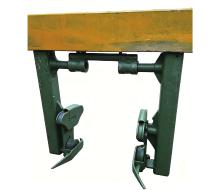
Fig.2
The physical picture of cableway saddle"


Fig.3
The flat curved plate of saddle set of double-skyline ropeway"


Fig.4
The physical picture of the double-skyline over the saddle set"
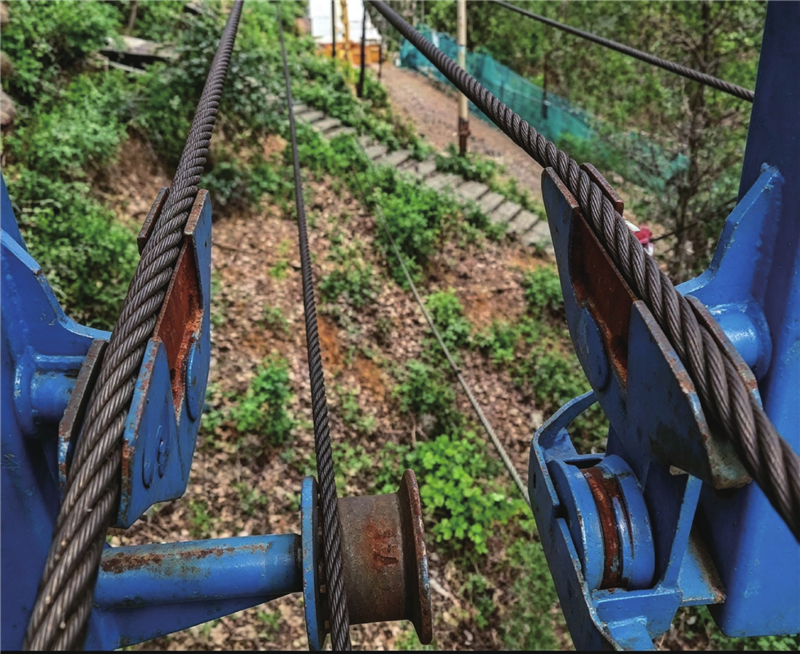

Fig.5
The schematic diagram of force of the flat curved plate of saddle set"
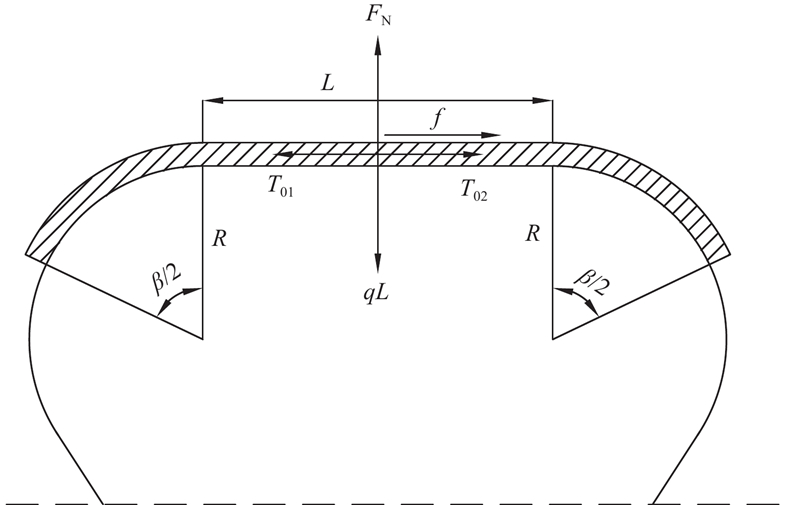

Fig.6
The schematic diagram of micro-element force analysis"


Fig.7
Force analysis in rectangular coordinates"
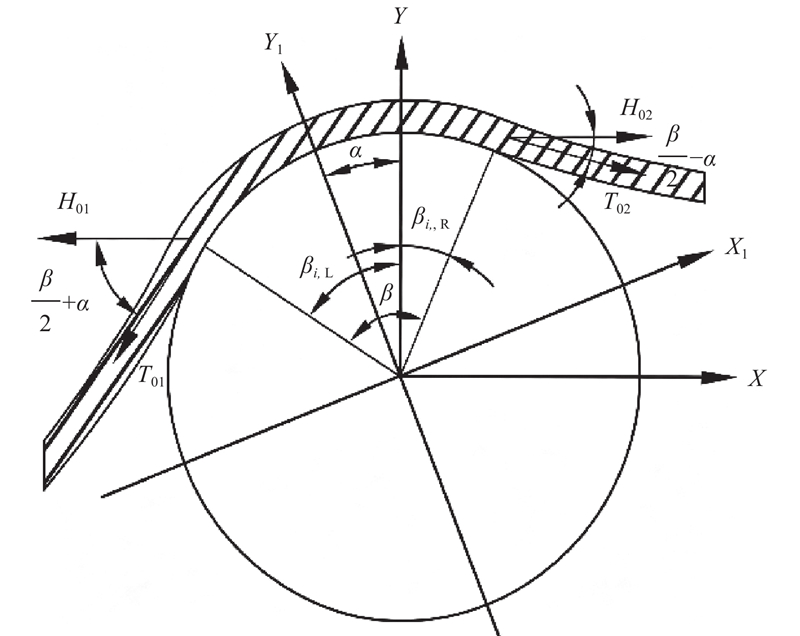
Table 1
Parameters of each span of the ropeway"
| 测量内容 Measuring points | 跨号Span-sign | 合计 Aggregate | |||||
| 1 | 2 | 3 | 4 | 5 | 6 | ||
| 跨距Span/m | 54.2 | 20.2 | 84.4 | 44.9 | 13.4 | 92.5 | 309.5 |
| 倾角Inclination angle/(°) | 12.292 | 13.864 | 12.438 | 3.066 | 2.071 | ?0.96 | 42.772 |
| 斜距Slope distance/m | 55.5 | 20.8 | 86.4 | 45.0 | 13.4 | 92.5 | 421.6 |
Table 2
Parameters of saddle set without load"
| 鞍座序号 Saddle serial number | 左倾角 Left angle (βi,L)/(°) | 右倾角 Right angle (βi,R)/(°) | 包角 Wrap angle (β)/(°) | 偏移角 Deviation angle (α)/(°) |
| 1 | 8.300 | 15.312 | 23.612 | ?3.506 |
| 2 | 12.398 | 18.400 | 30.797 | ?3.001 |
| 3 | 6.191 | 6.387 | 12.578 | ?0.098 |
| 4 | 0.276 | 3.065 | 3.341 | ?1.395 |
| 5 | 1.076 | 5.895 | 6.970 | ?2.409 |
Table 3
Measured unloaded horizontal tension at both ends of saddle set kN"
| 鞍座及承载索序号 Saddle and carrying rope number | 鞍座左侧 Left side of saddle | 鞍座右侧 Right side of saddle | 水平拉力差值 Horizontal tension difference | |||
| 拉力T01 Tensile force (T01) | 水平拉力H01 Horizontal tensile force (H01) | 拉力T02 Tensile force (T02) | 水平拉力H02 Horizontal tensile force (H02) | |||
| 1-1 | 41.40 | 40.97 | 43.00 | 41.47 | 0.51 | |
| 1-2 | 43.00 | 42.00 | 45.80 | 43.46 | 1.46 | |
| 1-3 | 45.90 | 45.63 | 46.10 | 45.81 | 0.18 | |
| 1-4 | 46.50 | 46.50 | 46.50 | 46.43 | 0.07 | |
| 1-5 | 47.60 | 47.59 | 49.60 | 49.34 | 1.75 | |
| 2-1 | 41.60 | 41.16 | 43.20 | 41.67 | 0.50 | |
| 2-2 | 43.60 | 42.58 | 45.10 | 42.79 | 0.21 | |
| 2-3 | 45.40 | 45.14 | 46.60 | 46.31 | 1.18 | |
| 2-4 | 47.10 | 47.10 | 48.50 | 48.43 | 1.33 | |
| 2-5 | 49.00 | 48.99 | 50.80 | 50.53 | 1.54 | |
Table 4
Comparison between theoretical and measured values of saddle unloaded tension"
| 鞍座及承载索序号 Saddle and carrying rope number | 鞍板偏向 Saddle plate bias | 理论值T01 Theoretical value (T01)/kN | 实测值T01 Measured value (T01)/kN | 相对误差 Relative error (δ)(%) |
| 1-1 | 右偏Right | 43.00 | 44.01 | 2.35 |
| 1-2 | 45.80 | 46.41 | 1.34 | |
| 1-3 | 46.10 | 47.55 | 3.15 | |
| 1-4 | 46.50 | 47.20 | 1.50 | |
| 1-5 | 49.60 | 48.69 | 1.83 | |
| 2-1 | 右偏Right | 43.20 | 44.22 | 2.36 |
| 2-2 | 45.10 | 46.31 | 2.69 | |
| 2-3 | 46.60 | 48.19 | 3.42 | |
| 2-4 | 48.50 | 49.97 | 3.04 | |
| 2-5 | 50.80 | 51.96 | 2.29 |
Table 5
Parameters of saddle set of load span with load correction"
| 左倾角 Left angle (β'i,L)/(°) | 右倾角 Right angle (β'i,R)/(°) | 包角 Wrap angle (β')/(°) | 偏移角 Deviation angle (α')/(°) |
| 0.191 | 14.354 | 14.545 | ?7.081 |
Table 6
Loaded horizontal tensions on both ends of the saddle set for load correction"
| 承载索序号 Carrying rope number | 鞍座左端 Left end of saddle | 鞍座右端 Right end of saddle | 水平拉力差值 Horizontal tension difference/kN | 差值占比 Difference ratio (%) | |||
| 拉力T'01 Tensile force (T'01)/kN | 水平拉力H'01 Horizontal tensile force (H'01)/kN | 拉力T'02 Tensile force (T'02)/kN | 水平拉力H'02 Horizontal tensile force (H'02)/kN | ||||
| 1 | 75.90 | 75.90 | 81.70 | 79.15 | 3.25 | 4.11 | |
| 2 | 76.80 | 76.80 | 82.80 | 80.22 | 3.42 | 4.26 | |
Table 7
Comparing the theoretical and measured values of the loaded tension with correction"
| 承载索序号 Carrying rope number | 鞍板偏向 Saddle plate bias | 理论值T01' Theoretical value (T01')/kN | 实测值T01' Measured value (T01')/kN | 相对误差 Relative error (δ)(%) |
| 1 | 右偏Right | 81.70 | 78.61 | 3.79 |
| 2 | 右偏Right | 82.80 | 79.53 | 3.95 |
Table 8
Sensitivity of key parameters on the left-end tension of the saddle"
| 参数 Parameter | 变化幅度 Range of variation | 拉力相对变化率 Relative rate of change of tensile force (%) |
| 摩擦系数 Coefficient of friction (μ0) | +10% | +3.41 |
| ?10% | ?3.44 | |
| 温度变化 Temperature change (Δt) | +10 ℃ | +1.05 |
| ?10 ℃ | ?1.01 |
| 官印生, 周新年, 郑丽凤, 等. 抛物线理论多跨索道设计模型. 起重运输机械, 2007 (7): 12- 17. | |
| Guan Y S, Zhou X N, Zheng L F, et al. Multi-span engineering ropeway design based on parabola theory. Hoisting and Conveying Machinery, 2007 (7): 12- 17. | |
|
江 明. 考虑索间耦合效应的双索货运索道系统设计. 机械设计与制造, 2020 (9): 80- 84.
doi: 10.3969/j.issn.1001-3997.2020.09.020 |
|
|
Jiang M. Design of double cable freight ropeway system considering coupling effect between cables. Machinery Design & Manufacture, 2020 (9): 80- 84.
doi: 10.3969/j.issn.1001-3997.2020.09.020 |
|
| 贾 畅, 王丽娜, 唐亚坤, 等. 利用Biome-BGC模型模拟黄土区沙棘人工林碳通量时的生理生态参数敏感性. 林业科学, 2022, 58 (11): 49- 60. | |
| Jia C, Wang L N, Tang Y K, et al. Sensitivity of ecophysiological parameters in simulating carbon fluxes of Hippophae rhamnoides plantation in the loess area using the Biome-BGC model. Scientia Silvae Sinicae, 2022, 58 (11): 49- 60. | |
| 蓝丽姗. 2017. 架空吊运索道作业过程的振动建模研究. 福州: 福建农林大学. | |
| Lan L S. 2017. Study on vibration modeling of aerial ropeway operation. Fuzhou: Fujian Agriculture and Forestry University. [in Chinese] | |
| 李正红, 窦 博, 蓝丽姗, 等. 架空索道在窜移条件下的振动研究. 黄河科技学院学报, 2020, 22 (11): 20- 25. | |
| Li Z H, Dou B, Lan L S, et al. Research on vibration of aerial cableway under transition condition. Journal of Huanghe S&T College, 2020, 22 (11): 20- 25. | |
| 李玉彤. 2024. 竹林集材索道的力学性能研究及设计. 长沙: 中南林业科技大学. | |
| Li Y T. 2024. Mechanical property analysis and modular design of forestry skidding ropeway. Changsha: Central South University of Forestry and Technology. [in Chinese] | |
|
梁玉娟, 左 倩, 赖华碧, 等. 静摩擦力在曲面上的累积效应. 河池学院学报, 2016, 36 (5): 109- 112.
doi: 10.3969/j.issn.1672-9021.2016.05.020 |
|
|
Liang Y J, Zuo Q, Lai H B, et al. The cumulative effect of static friction on the surface. Journal of Hechi University, 2016, 36 (5): 109- 112.
doi: 10.3969/j.issn.1672-9021.2016.05.020 |
|
|
罗仙仙, 周新年, 胡永生, 等. 双承载缆索在特大桥吊装工程上的设计与应用. 福建林学院学报, 2003, 23 (4): 305- 308.
doi: 10.13324/j.cnki.jfcf.2003.04.005 |
|
|
Luo X X, Zhou X N, Hu Y S, et al. The design and application of double skyline suspension cable hoisting of unusually large brigde. Journal of Fujian College of Forestry, 2003, 23 (4): 305- 308.
doi: 10.13324/j.cnki.jfcf.2003.04.005 |
|
|
秦 剑, 张飞凯, 刘 晨, 等. 山区公路与货运索道联合路径规划方法. 山东科学, 2023, 36 (3): 90- 99.
doi: 10.3976/j.issn.1002-4026.2023.03.011 |
|
|
Qin J, Zhang F K, Liu C, et al. Path planning for material transportation by combining mountain road and freight ropeway. Shandong Science, 2023, 36 (3): 90- 99.
doi: 10.3976/j.issn.1002-4026.2023.03.011 |
|
|
文曙东, 杨 荣, 景文川, 等. 基于抛物线理论考虑多跨窜移时货运索道运行轨迹的研究. 东北电力技术, 2018, 39 (1): 8- 10.
doi: 10.3969/j.issn.1004-7913.2018.01.002 |
|
|
Wen S D, Yang R, Jing W C, et al. Research on the trajectory of freight ropeway considering multi-span channeling based on parabolic theory. Northeast Electric Power Technology, 2018, 39 (1): 8- 10.
doi: 10.3969/j.issn.1004-7913.2018.01.002 |
|
|
杨明远, 朱纪洪, 杨赟杰, 等. 垂直/短距起降飞机起飞策略优化. 中国科学: 技术科学, 2026, 56 (3): 548- 565.
doi: 10.1360/SST-2025-0361 |
|
|
Yang M Y, Zhu J H, Yang Y J, et al. Take off strategy optimization for vertical/short takeoff and landing aircraft. Scientia Sinica Technologica, 2026, 56 (3): 548- 565.
doi: 10.1360/SST-2025-0361 |
|
| 于 昊, 苗峰显, 张 君, 等. 电力施工货运索道新型握索器研制. 电力设备管理, 2025 (14): 291- 293. | |
| Yu H, Miao F X, Zhang J, et al. Development of a new cable grip for power construction freight ropeways. Electric Power Equipment Management, 2025 (14): 291- 293. | |
| 曾 浩, 周成军, 周新年, 等. 双承载货运索道跑车结构分析与优化. 森林工程, 2022, 38 (4): 125- 130. | |
| Zeng H, Zhou C J, Zhou X N, et al. Structure analysis and optimization of the carriage for freight ropeway of double-skyline. Forest Engineering, 2022, 38 (4): 125- 130. | |
| 张金淼, 秦 剑, 孙国磊, 等. 多档货运索道承载钢丝绳与鞍座接触摩擦力分析研究. 应用物理, 2021, 11 (5): 270- 275. | |
| Zhang J M, Qin J, Sun G L, et al. Analysis and research on contact friction between steel wire rope and saddle of multi-grade freight ropeway. Applied Physics, 2021, 11 (5): 270- 275. | |
|
张清华, 李 乔, 周凌远. 悬索桥主缆与鞍座摩擦特性理论分析方法. 中国公路学报, 2014, 27 (1): 44- 50.
doi: 10.19721/j.cnki.1001-7372.2014.01.007 |
|
|
Zhang Q H, Li Q, Zhou L Y. Theoretical analysis of cable-saddle friction characteristics for suspension bridges. China Journal of Highway and Transport, 2014, 27 (1): 44- 50.
doi: 10.19721/j.cnki.1001-7372.2014.01.007 |
|
|
郑丽凤, 周新年, 巫志龙. 悬索的理论计算与实测误差分析. 北华大学学报(自然科学版), 2010, 11 (2): 162- 168.
doi: 10.3969/j.issn.1009-4822.2010.02.015 |
|
|
Zheng L F, Zhou X N, Wu Z L. Error analysis among theoretical calculation and measure data of flexible cable. Journal of Beihua University (Natural Science Edition), 2010, 11 (2): 162- 168.
doi: 10.3969/j.issn.1009-4822.2010.02.015 |
|
|
周成军, 巫志龙, 周新年, 等. 多跨索道的可移动中间支架设计. 森林与环境学报, 2016, 36 (1): 104- 110.
doi: 10.13324/j.cnki.jfcf.2016.01.017 |
|
|
Zhou C J, Wu Z L, Zhou X N, et al. Design of movable intermediate support for multi-span cableway. Journal of Forest and Environment, 2016, 36 (1): 104- 110.
doi: 10.13324/j.cnki.jfcf.2016.01.017 |
|
|
周凌远, 李 乔. 缆索与鞍座间的摩擦特性. 兰州理工大学学报, 2011, 37 (2): 117- 121.
doi: 10.13295/j.cnki.jlut.2011.02.034 |
|
|
Zhou L Y, Li Q. Characteristics of friction between cable and saddle. Journal of Lanzhou University of Technology, 2011, 37 (2): 117- 121.
doi: 10.13295/j.cnki.jlut.2011.02.034 |
|
| 周新年, 罗仙仙, 罗桂生, 等. 牛顿迭代法悬索线形与拉力的研究. 林业科学, 2004, 40 (5): 164- 167. | |
| Zhou X N, Luo X X, Luo G S, et al. Study on newton lteration method of sketch and tension of suspensionrope. Scientia Silvae Sinicae, 2004, 40 (5): 164- 167. | |
|
周新年, 官印生, 张正雄, 等. 武当山特殊吊装索道设计研究. 林业科学, 2007, 43 (3): 108- 112.
doi: 10.3321/j.issn:1001-7488.2007.03.018 |
|
|
Zhou X N, Guan Y S, Zhang Z X, et al. Design study of special hoisting cableway in Wudang Mountain. Scientia Silvae Sinicae, 2007, 43 (3): 108- 112.
doi: 10.3321/j.issn:1001-7488.2007.03.018 |
|
| 周新年, 巫志龙, 周成军. 我国工程索道技术装备及其发展趋势. 林业机械与木工设备, 2010a, 38 (12): 4- 12. | |
| Zhou X N, Wou C J, Zhou C J. Engineering ropeway technology and equipment and its development trend in china. Forestry Machinery & Woodworking Equipment, 2010a, 38 (12): 4- 12. | |
| 周新年, 巫志龙, 官印生, 等. 移动式承载索应用于特大桥吊装工程的设计. 林业科学, 2010b, 46 (6): 107- 112. | |
| Zhou X N, Wu Z L, Guan Y S, et al. Design of movable skyline hoisting cableway used in unusually large bridge. Scientia Silvae Sinicae, 2010b, 46 (6): 107- 112. | |
|
周新年, 巫志龙, 周成军, 等. 基于VB 6.0的抛物线理论多跨索道侧型图设计. 福建林学院学报, 2012, 32 (3): 208- 212.
doi: 10.3969/j.issn.1001-389X.2012.03.003 |
|
|
Zhou X N, Wu Z L, Zhou C J, et al. Programming of vertical section profile of multi-span cableway of parabolic theory based on VB 6.0. Journal of Fujian College of Forestry, 2012, 32 (3): 208- 212.
doi: 10.3969/j.issn.1001-389X.2012.03.003 |
|
| 周新年, 周成军, 郑丽凤. 2020. 工程索道. 北京: 机械工业出版社. | |
| Zhou X N, Zhou C J, Zheng L F. 2020. Engineering ropeway. Beijing: China Machine Press. [in Chinese] | |
| Bhushan B, Ko P L. Introduction to tribology. Applied Mechanics Reviews, 2003, 56 (1): B6- B7. | |
|
Chang X D, Peng Y X, Zhu Z C, et al. Sliding friction and wear characteristics of wire rope contact with sheave under long-distance transmission conditions. Materials, 2022, 15 (20): 7092.
doi: 10.3390/ma15207092 |
|
|
do Vale J L, da Silva C H. Kinetic friction coefficient modeling and uncertainty measurement evaluation for a journal bearing test apparatus. Measurement, 2020, 154 (8): 107470.
doi: 10.1016/j.measurement.2020.107470 |
|
|
Hu T, Wang Y H, Huang Z Y, et al. Global sensitivity analysis of textured surface friction coefficient for rotary vane actuator rotating seal. Surface Topography: Metrology and Properties, 2026, 14 (1): 015017.
doi: 10.1088/2051-672X/ae41d3 |
|
|
Liang D, Shuai W, Song A, et al. Experimental investigation of equivalent friction coefficient between rope–drum mechanism and pulley transmission loss for high-altitude wind power generation systems. Energies, 2025, 18 (23): 6079.
doi: 10.3390/en18236079 |
|
|
Qin J, Chen J, Wan J C, et al. Study on friction of bearing cable and saddle with different material in freight ropeways. Materials Science Forum, 2016, 878, 148- 152.
doi: 10.4028/www.scientific.net/MSF.878.148 |
| [1] | Chang Jia,Lina Wang,Yakun Tang. Sensitivity Analysis of Ecophysiological Parameters for the Simulated Carbon Flux Using the Biome-BGC Model in a Hippophae rhamnoides Plantation in the Loess Region [J]. Scientia Silvae Sinicae, 2022, 58(11): 49-60. |
| [2] | Xiaoyun Xia,Yong Pang,Qingfeng Huang,Rong Wu,Dongsheng Chen,Yu Bai. Prediction of Biomass Growth of Larix olgensis Based on 3-PG Model [J]. Scientia Silvae Sinicae, 2021, 57(3): 67-78. |
| [3] | Bin Wang,Xianglin Tian,Tianjian Cao. Uncertainty Analysis of Height Predictions for Young Pinus tabulaeformis Using a Bayesian Approach [J]. Scientia Silvae Sinicae, 2020, 56(11): 73-86. |
| [4] | Tang Shupei, Li Chunhua, Liu Wei, Wuliji, Bao Weidong. Viability Analysis of Chinese Goral Population in Saihanwula National Nature Reserve,Inner Mongolia [J]. Scientia Silvae Sinicae, 2019, 55(3): 118-124. |
| [5] | Li Haikui;Fa Lei. Height-Diameter Model for Major Tree Species in China Using the Classified Height Method [J]. Scientia Silvae Sinicae, 2011, 47(10): 83-90. |
| [6] | Qiu Rongzu;Huang Dehua;Weng Fajin;Wang Zhoujun;Wang Chaoqun. GIS-Based Decision System of Wood Landing Location [J]. Scientia Silvae Sinicae, 2005, 41(1): 211-214. |
| Viewed | ||||||
|
Full text |
|
|||||
|
Abstract |
|
|||||
