
Scientia Silvae Sinicae ›› 2026, Vol. 62 ›› Issue (9): 42-52.doi: 10.11707/j.1001-7488.LYKX20260119
• Frontiers and hot topics • Previous Articles Next Articles
Zheng Wang1,Jingling Zhao2,Rong Ma3,Yingmei Liang4,Chengming Tian1,*( )
Received:2026-02-28
Revised:2026-06-29
Online:2026-09-10
Published:2026-09-16
Contact:
Chengming Tian
E-mail:chengmt@bjfu.edu.cn
CLC Number:
Zheng Wang,Jingling Zhao,Rong Ma,Yingmei Liang,Chengming Tian. Impact of Jujube Tree Cultivation Methods on the Occurrence of Jujube Fruit Black Spot Disease and Jujube Gall Midge[J]. Scientia Silvae Sinicae, 2026, 62(9): 42-52.
Table 1
Plot characteristics"
| 调查项目Survey item | 调查类型Survey type | 备注Remarks |
| 品种 Variety | 骏枣 Ziziphus jujuba ‘Juizao’、灰枣 Ziziphus jujuba ‘Huizao’、冬枣 Ziziphus jujuba ‘Dongzao’、赛蜜酥 Ziziphus jujuba ‘Saimisu’ | — |
| 树龄 Tree age/a | 7、10、12、13、14、15、17、18、20 | — |
| 株行距 Row spacing and plant spacing | 2 m×4.5 m、2 m×8 m、2 m×10 m、 3 m×4 m(稀植Sparse planting); 1.5 m×3 m、1.5 m×4 m(标准Standard);1 m×3 m、1 m×4 m(密植Close planting) | — |
| 土壤类型 Soil type | 壤土 Loam、沙土 Sandy soil | — |
| 间作类型 Intercropping type | 无间作 Continuous cultivation、油菜 Brassica napus、南瓜 Cucurbita moschata、玉米 Zea mays、小麦 Triticum aestivum、棉花 Gossypium hirsutum、红花 Carthamus tinctorius、板蓝根 Isatis tinctoria、蒲公英 Taraxacum mongolicum、辣椒 Capsicum annuum | — |
| 灌溉类型 Irrigation type | 漫灌IA Flood irrigation | IA:定期(4—10月)、周期规律(每25天1次)、共5~8 次 Regularly (April?October), Regular cycle (once every 25 days), 5?8 times in total IB:不定期、无周期规律、次数 < 5或 > 8 Irregular, irregular cycle, Frequency < 5 or > 8 |
| 漫灌IB Flood irrigation | ||
| 滴灌IA Drip irrigation | ||
| 滴灌IB Drip irrigation | ||
| 修剪方式 Pruning method | 精细修剪PA Precise pruning 精细修剪PB Precise pruning 精细修剪PC Precise pruning 粗放修剪PA Extensive pruning 粗放修剪PB Extensive pruning 粗放修剪PC Extensive pruning | 精细修剪:规律修剪程度(每株保留枣头枝35~40个) Precise pruning: Regular pruning degree (retaining 35?40 jujube branches) 粗放修剪:无规律修剪程度(枣头枝 > 40个,或 < 35个) Extensive pruning: irregular pruning degree ( > 40 or < 35 jujube branches) PA:冬剪+夏季抹芽 Winter cutting+summer cutting PB:夏季抹芽:4—8月 Summer pruning: April to August PC:冬剪:12—次年4月 Winter pruning: December to April of the following year |
| 施肥方式 Fertilization method | 精细管理FA Precise management 精细管理FB Precise management 精细管理FC Precise management 粗放管理FA Extensive management 粗放管理FB Extensive management 粗放管理FC Extensive management | 精细管理(次数3~5,时期规律,生长关键期:萌芽期、花期、坐果期、采后恢复期) Precise management (frequency3?5, regular period, key growth periods: germination, flowering, fruiting, post harvest-recovery) 粗放管理(次数 < 3或 > 5,时期无规律) Extensive management (frequency < 3 or > 5, irregular period) FA:地面根系施肥、叶面喷施 Fertilization of ground roots and foliar spraying FB:地面根系施肥 Fertilization of ground roots FC:叶面施肥 Foliar fertilization |

Fig.1
Structural equation model of the impact of different cultivation management factors on the incidence of black spot disease in jujube fruits and the effects of various factors"

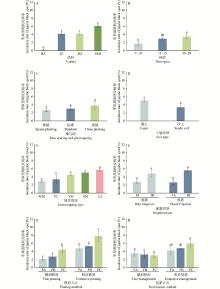
Fig.2
Impact of different cultivation management modes on jujube black spot disease (mean ± SE)"


Fig.3
Structural equation model of the impact of different cultivation management factors on the leaf rolling rate of the jujube gall midge and the effects of various factors"


Fig.4
Impact of different cultivation management modes on the jujube gall midge (mean ± SE)"
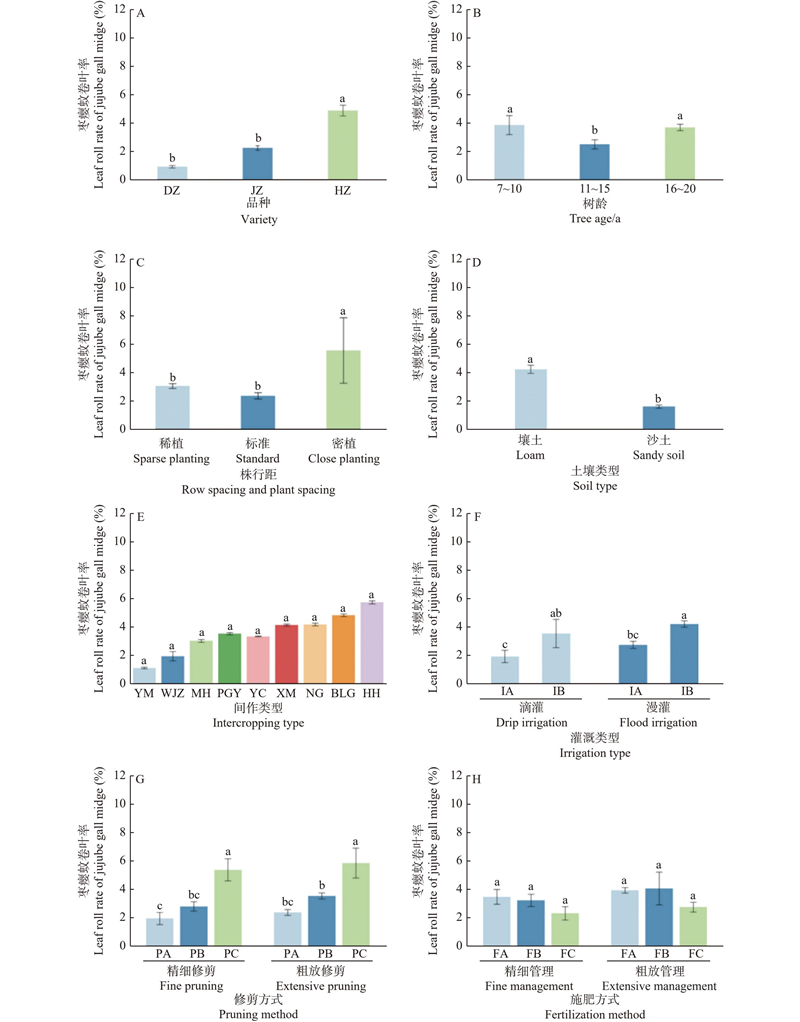

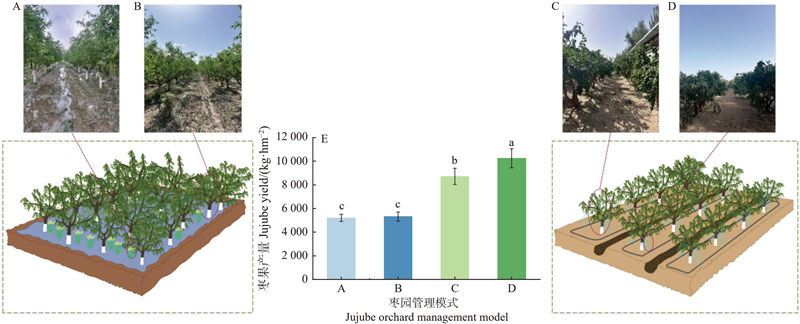
Fig.5
Irregular management mode jujube orchard (A、B) and “Five-Standardized” disease and insect resistant mode jujube orchard (C、D)"
| 陈波浪, 盛建东, 李建贵, 等. 氮、磷、钾肥对红枣产量和品质的影响. 北方园艺, 2011 (3): 1- 3. | |
| Chen B L, Sheng J D, Li J G, et al. Effect of nitrogen, phosphorus, potassium fertilizer on the yield and the quality of zizvphus jujube. Northern Horticulture, 2011 (3): 1- 3. | |
|
郭开发, 杜 琴, 赵思峰, 等. 库尔勒香梨腐烂病发生的影响因素及药剂防效. 中国植保导刊, 2016 (1): 71- 72, 62.
doi: 10.3969/j.issn.1672-6820.2016.01.016 |
|
|
Guo K F, Du Q, Zhao S F, et al. Influencing factors of Korla fragrant pear rot and its control effect. China Plant Protection, 2016 (1): 71- 72, 62.
doi: 10.3969/j.issn.1672-6820.2016.01.016 |
|
| 曲泽洲. 1993. 中国果树志: 枣卷. 北京: 中国林业出版社. | |
| Qu Z Z. 1993. China fruit tree catalogu: Jujube. Beijing: China Forestry Publishing House. [in Chinese] | |
|
罗 达, 吴正保, 谢亚丽. 栽植密度对枣园冠层结构与果实性状的影响. 西北林学院学报, 2023, 38 (2): 160- 165.
doi: 10.3969/j.issn.1001-7461.2023.02.22 |
|
|
Luo D, Wu Z B, Xie Y L. Effects of planting density on canopy structure and fruit characters in jujube orchards. Journal of Northwest Forestry University, 2023, 38 (2): 160- 165.
doi: 10.3969/j.issn.1001-7461.2023.02.22 |
|
| 刘孟军, 王玖瑞, 刘 平, 等. 2015. 中国枣生产与科研成就及前沿进展. 园艺学报, 42(9): 1683−1698. | |
| Liu M J, Wang J R, Liu P, et al. 2015. Historical achievements and frontier advances in the production and research of Chinese jujube (Ziziphus jujuba)in China. Acta Horticulturae Sinica, 42(9): 1683−1698. [in Chinese] | |
| 刘晓琳, 梁英梅, 游崇娟, 等. 枣果黑斑病病菌对新疆不同枣树品种的致病性. 植物保护, 2015, 41 (5): 183- 187, 216. | |
| Liu X L, Liang Y M, You C J, et al. Pathogenicity of Alternaria alternata on different jujube varieties in Xinjiang. Plant Protection, 2015, 41 (5): 183- 187, 216. | |
| 李 毅, 肖莉娟, 王 凡, 等. 新疆南疆枣瘿蚊发生动态调查与防治植物源农药筛选. 西北农林科技大学学报(自然科学版), 2025, 53 (2): 102- 108. | |
| Li Y, Xiao L J, Wang F, et al. Investigation on the occurrence dynamics of Dasineura jujubifolia in Southern Xinjiang and screening of plant-derived pesticides. Journal of Northwest A&F University(Natual Science Ed. ), 2025, 53 (2): 102- 108. | |
| 马 荣, 刘晓琳, 梁英梅, 等. 枣果黑斑病发生相关因素分析及田间药效试验. 中国农学通报, 2015, 31 (16): 182- 189. | |
| Ma R, Liu X L, Liang Y M, et al. Analysis of the influencing factors on disease occurrence of jujube black spot and field efficacy test. Chinese Agricultural Science Bulletin, 2015, 31 (16): 182- 189. | |
| 马 荣, 刘晓琳, 梁英梅, 等. 2016. 新疆枣果黑斑病发生规律及温湿度对其的影响. 植物保护学报, 43(5): 805−811. | |
| Ma R, Liu X L, Liang Y M, et al. 2016. The growth and decline regularity of jujube black spot pathogen and the influence of temperature and humidity in Xinjiang. Journal of Plant Protection, 43(5): 805−811. [in Chinese] | |
| 马玉珊, 范盈盈, 刘 敏, 等. 2022. 生物诱导剂和杀菌剂对新疆红枣黑斑病抗性的影响. 河南农业科学, 51(7): 112−122. | |
| Ma Y S, Fan Y Y, Liu M, et al. 2022. Effects of biological inducers and fungicides on black spot disease resistance of Xinjiang jujube. Journal of Henan Agricultural Sciences, 51(7): 112−122. [in Chinese] | |
| 尚国丽, 田春娇, 刘志国, 等. 2024. 不同水肥条件对枣树生长和结实的影响. 果树学报, 41(6): 1160−1169. | |
| Shang G L, Tian C J, Liu Z G, et al. 2024. Effects of different treatments of water and fertilization on growth and fruiting of Chinese jujube. Journal of Fruit Science, 41(6): 1160−1169. [in Chinese] | |
| 田呈明, 梁英梅, 高爱琴, 等. 2000. 基于栽培管理措施的猕猴桃细菌性溃疡病防治技术. 西北林学院学报, 15(4): 72−76. | |
| Tian C M, Liang Y M, Gao A Q, et al. 2000. Control technique of kiwifruit limb bacterial canker on the basis of cultivated measures. Journal of Northwest Forestry University, 15(4): 72−76. [in Chinese] | |
|
吴逸群, 贾碧云, 马 聪. 冬枣主要虫害及防治技术. 北方园艺, 2018 (15): 203- 207.
doi: 10.3969/j.issn.1673-1514.2025.06.019 |
|
|
Wu Y Q, Jia B Y, Ma C. Main pests and control techniques of winter jujube. Northern Horticulture, 2018 (15): 203- 207.
doi: 10.3969/j.issn.1673-1514.2025.06.019 |
|
| 新疆维吾尔自治区统计局. 2021. 新疆统计年鉴. 北京: 中国统计出版社. | |
| Burea of Statistics of Xinjiang Uyghur Autonomous Region. 2021. Xinjiang statistical yearbook. Beijing: China Statistics Press. [in Chinese] | |
| 许 瑛, 姚兆群, 郭俊玲, 等. 2016. 不同管理模式下阿拉尔枣园2种害虫发生规律调查. 新疆农垦科技, 39(12): 26−29. | |
| Xu Y, Yao Z Q, Guo J L, et al. 2016. Investigation on the occurrence patterns of two pests in Alar jujube orchard under different management modes. Xinjiang Farm Research of Science and Technology, 39(12): 26−29. [in Chinese] | |
| 王得伟, 王德成, 王旭峰, 等. 2025. 切根施肥对新疆骏枣树根系发育影响. 林业科学, 61(9): 236−244. | |
| Wang D W, Wang D C, Wang X F, et al. 2025. Preliminary report on the effect of root cutting and fertilization on the root development of Xinjiang jujube tree. Scientia Silvae Sinicae, 61(9): 236−244. [in Chinese] | |
| 王 兰, 冯宏祖, 熊仁次, 等. 新疆红枣病虫害发生现状及对策. 中国植保导刊, 2014, 34 (6): 73- 75. | |
| Wang L, Feng H Z, Xiong R C, et al. Occurrence status and countermeasures of jujube pests and diseases in Xinjiang. China Plant Protection, 2014, 34 (6): 73- 75. | |
| 阎雄飞, 程鑫辉, 郝 哲, 等. 枣瘿蚊幼虫在设施枣树上的空间分布型及抽样技术. 南京林业大学学报(自然科学版), 2022, 46 (4): 201- 208. | |
| Yan X F, Cheng X H, Hao Z, et al. Spatial distribution patterns and sampling techniques of Dasineura jujubifolia larvae on facility jujube trees. Journal of Nanjing Forestry University (Natural Sciences Edition), 2022, 46 (4): 201- 208. | |
| 张微微, 古丽斯坦·阿不都拉, 贾秦岚, 等. 新疆不同品种红枣农药残留风险评估与排序. 食品工业科技, 2023, 44 (9): 262- 270. | |
| Zhang W W, Gulistan Abdullah, Jia Q L, et al. Risk assessment and ranking of pesticide residues in different varieties of Xinjiang red jujube. Science and Technology of Food Industry, 2023, 44 (9): 262- 270. | |
|
张 宣, 宋韬亮, 刘 平, 等. 枣缩果病发生与矿质元素含量的关系. 林业科学, 2019, 55 (2): 109- 117.
doi: 10.11707/j.1001-7488.20190211 |
|
|
Zhang X, Song T L, Liu P, et al. Relationships between fruit shrinking disease and mineral element contents in Ziziphus jujuba. Scientia Silvae Sinicae, 2019, 55 (2): 109- 117.
doi: 10.11707/j.1001-7488.20190211 |
|
| 朱晓锋, 徐兵强, 阿布都克尤木·卡德尔, 等. 2024. 新疆枣树病虫害发生与防治现状分析. 新疆农业科学, 61(增1): 116−121. | |
| Zhu X F, Xu B Q, Abudukeyoumu Kadeer, et al. 2024. The occurrence and control status of fruit tree diseases and insect pests in Xinjiang: a case study of jujube. Xinjiang Agricultural Sciences, 61(S1): 116−121. [in Chinese] | |
|
Jiao K L, Han P J, Yang M L, et al. A new species of gall midge (Diptera: Cecidomyiidae) attacking jujube, Ziziphus jujuba in China. Zootaxa, 2017, 4247 (4): 487- 493.
doi: 10.11646/zootaxa.4247.4.10 |
|
|
Keum E, Jiao K L, Cho K Y, et al. Morphological, genetic and symptomatic identification of an invasive jujube pest in korea, Dasineura jujubifolia Jiao & Bu (Diptera: Cecidomyiidae). Journal of Asia-Pacific Entomology, 2022, 25 (3): 101935.
doi: 10.1016/j.aspen.2022.101935 |
|
|
Choi S I, Ajuna H B, Won S J, et al. The insecticidal potential of Bacillus velezensis CE 100 against Dasineura jujubifolia Jiao & Bu (Diptera: Cecidomyiidae) larvae infestation and its role in the enhancement of yield and fruit quality of jujube (Zizyphus jujuba Miller var. inermis Rehder). Crop Protection, 2023, 163, 106098.
doi: 10.1016/j.cropro.2022.106098 |
|
|
Yang R, Song S, Chen S, et al. Adaptive evaluation of green manure rotation for a low fertility farmland system:impacts on crop yield, soil nutrients, and soil microbial community. Catena, 2023, 222, 106873.
doi: 10.1016/j.catena.2022.106873 |
|
|
Yang Y Q, Mali P, Arthur L, et al. Advanced technologies for precision tree fruit disease management: a review. Computers and Electronics in Agriculture, 2025, 229, 109704.
doi: 10.1016/j.compag.2024.109704 |
| Viewed | ||||||
|
Full text |
|
|||||
|
Abstract |
|
|||||
