
Scientia Silvae Sinicae ›› 2026, Vol. 62 ›› Issue (10): 172-180.doi: 10.11707/j.1001-7488.LYKX20250716
• Research papers • Previous Articles
Xiaona Cai1,Yingyi Li1,Pengliang Pan2,*( ),Zhou Zhou2,Zuorui Shen3
Received:2025-11-27
Online:2026-10-10
Published:2026-10-16
Contact:
Pengliang Pan
E-mail:panzai-7@163.com
CLC Number:
Xiaona Cai,Yingyi Li,Pengliang Pan,Zhou Zhou,Zuorui Shen. Analysis on the Forewings Morphology Characteristics of 16 Species of Noctuids ( Lepidoptera: Noctuoidea) Based on Geometric Morphometry[J]. Scientia Silvae Sinicae, 2026, 62(10): 172-180.
Table 1
Directory of 16 noctuid species for experiment"
| 亚科 Subfamily | 属 Genus | 种 Species | |
| 目夜蛾科 Erebidae | 影夜蛾亚科 Toxocampinae | 客来夜蛾属Chrysorithrum | 客来夜蛾 Chrysorithrum amata |
| 壶夜蛾亚科 Calpinae | 嘴壶夜蛾属 Oraesia | 鸟嘴壶夜蛾 Oraesia excavata | |
| 目夜蛾亚科 Erebinae | 裳夜蛾属Catocala | 鸽光裳夜蛾 Catocala columbina | |
| 栎裳夜蛾 Catocala dissimilis | |||
| 显裳夜蛾 Catocala deuteronympha | |||
| 宁裳夜蛾 Catocala nymphaeoides | |||
| 鸱裳夜蛾 Catocala patala | |||
| 夜蛾科 Noctuidae | 实夜蛾亚科 Heliothinae | 焰夜蛾属 Pyrrhia | 焰夜蛾 Pyrrhia umbra |
| 铃夜蛾属 Helicoverpa | 棉铃虫 Helicoverpa armigera | ||
| 夜蛾亚科Noctuinae | 红棕灰夜蛾属 Sarcopolia | 红棕灰夜蛾 Sarcopolia illoba | |
| 陌夜蛾属 Trachea | 黑环陌夜蛾 Trachea melanospila | ||
| 陌夜蛾 Trachea atriplicis | |||
| 地夜蛾属 Agrotis | 小地老虎 Agrotis ipsilon | ||
| 黄地老虎 Agrotis segetum | |||
| 八字地老虎 Agrotis c-nigrum | |||
| 毛夜蛾亚科Pantheinae | 后夜蛾属Trisuloides | 白斑后夜蛾 Trisuloides c-album |

Fig.1
Landmarks locations on the right wing of C. dissimilis"


Fig.2
Line plot of 15 landmarks on the right forewings of 16 noctuid species after GPA"
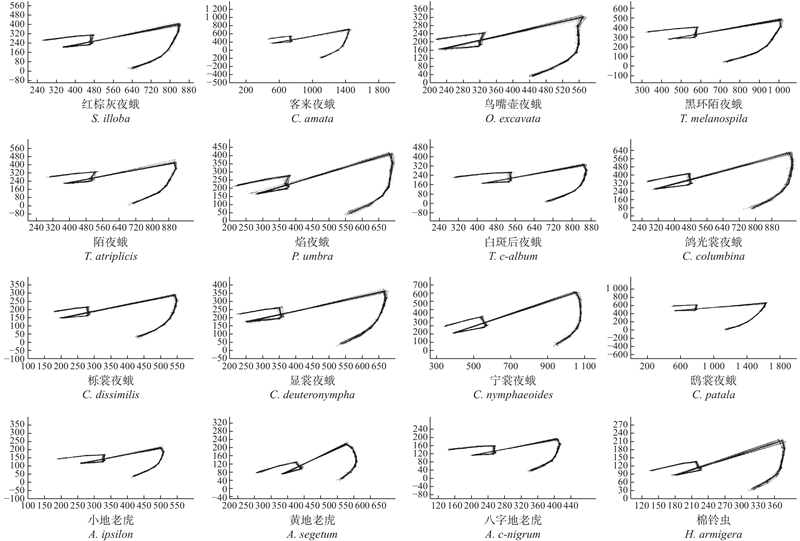

Fig.3
Distribution map of landmarks on the right forewings of 16 noctuid species"
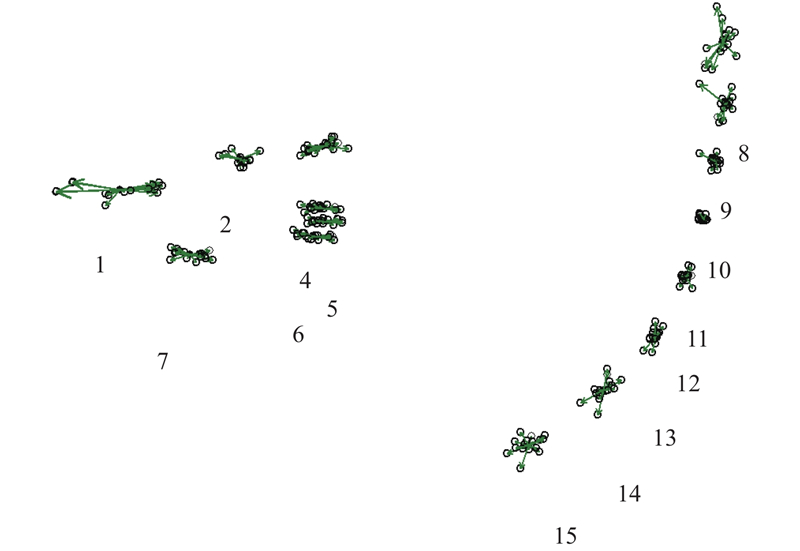

Fig.4
Scatter plots and box plots of landmarks for 16 noctuid species"


Fig.5
Thin plate spline of 15 landmarks on the right forewings of 16 noctuid specie"

Table 2
Results of one-way variance analysis"
| 地标点 Landmarks | 效应平方和SA Efficacy sum of square | 误差平方和SE Error sum of square | F值 F value |
| 1 | 0.001 80 | 0.000 04 | 1 339.694 68 |
| 2 | 0.000 15 | 0.000 03 | 132.098 33 |
| 3 | 0.000 24 | 0.000 04 | 199.098 95 |
| 4 | 0.000 15 | 0.000 01 | 649.687 01 |
| 5 | 0.000 16 | 0.000 01 | 872.617 64 |
| 6 | 0.000 20 | 0.000 01 | 694.578 18 |
| 7 | 0.000 25 | 0.000 02 | 353.145 15 |
| 8 | 0.000 11 | 0.000 35 | 9.993 04 |
| 9 | 0.000 07 | 0.000 13 | 17.497 50 |
| 10 | 0.000 03 | 0.000 03 | 25.874 10 |
| 11 | 0.000 01 | 0.000 01 | 56.829 63 |
| 12 | 0.000 02 | 0.000 04 | 15.661 84 |
| 13 | 0.000 03 | 0.000 08 | 9.983 53 |
| 14 | 0.000 11 | 0.000 14 | 24.092 56 |
| 15 | 0.000 14 | 0.000 09 | 49.584 67 |
Table 3
The eigenvalues and contribution rates of the first and second discriminant functions"
| 判别函数 Discriminant function | 特征值 Eigenvalue | 占总体贡献率 Variance (%) | 累计贡献率 Cumulative (%) |
| 1 | 3 320 807.60 | 92.10 | 92.10 |
| 2 | 190 520.04 | 5.28 | 97.38 |

Fig.6
Discriminant scatter plot of 16 noctuid species"

Table 4
Classification results of 16 species of noctuids"
| 种类 Species | 正确数 Correct number | 总和 Total | 正确率 Correct rate (%) |
| 白斑后夜蛾T. c-album | 7 | 10 | 70 |
| 鸱裳夜蛾C. patala | 10 | 10 | 100 |
| 鸽光裳夜蛾C. columbina | 10 | 10 | 100 |
| 黑环陌夜蛾T. melanospila | 10 | 10 | 100 |
| 红棕灰夜蛾S. illoba | 10 | 10 | 100 |
| 客来夜蛾C. amata | 10 | 10 | 100 |
| 陌夜蛾T. atriplicis | 10 | 10 | 100 |
| 宁裳夜蛾C. nymphaeoides | 10 | 10 | 100 |
| 焰夜蛾P. umbra | 10 | 10 | 100 |
| 八字地老虎A. c-nigrum | 10 | 10 | 100 |
| 黄地老虎A. segetum | 10 | 10 | 100 |
| 栎裳夜蛾C. dissimilis | 10 | 10 | 100 |
| 棉铃虫H. armigera | 10 | 10 | 100 |
| 鸟嘴壶夜蛾O. excavata | 10 | 10 | 100 |
| 显裳夜蛾C. deuteronympha | 10 | 10 | 100 |
| 小地老虎A. ipsilon | 10 | 10 | 100 |
| 程 扬. 2024. 26种夜蛾科幼虫比较形态学研究. 沈阳: 沈阳农业大学. | |
| Chen Y. 2024. Comparative morphology in the larvae of 26 species of Noctuidae. Shenyang: Shenyang Agricultural University. [in Chinese] | |
| 蔡小娜, 苏筱雨, 黄大庄, 等. 基于几何形态测量学的天蛾科成虫数字化分类. 林业科学, 2019a, 55 (1): 38- 46. | |
| Cai X N, Su X Y, Huang D Z, et al. Digital classification of sphingid moths adults (Lepidoptera: Sphingidae) based on geometric morphometry. Scientia Silvae Sinicae, 2019a, 55 (1): 38- 46. | |
|
蔡小娜, 张若楠, 李 阳, 等. 地标点法在夜蛾昆虫数字化分类中的应用研究. 环境昆虫学报, 2019b, 41 (1): 106- 112.
doi: 10.3969/j.issn.1674-0858.2019.01.14 |
|
|
Cai X N, Zhang R N, Li Y, et al. Application of landmarks on digital classification of noctuid moths ( Lepidoptera: Noctuidae). Journal of Environmental Entomology, 2019b, 41 (1): 106- 112.
doi: 10.3969/j.issn.1674-0858.2019.01.14 |
|
| 蔡小娜, 黄大庄, 沈佐锐, 等. 2016. 用于昆虫分类鉴定的几何形态计量学方法研究: 相对扭曲分析. 生物数学学报, 31(2): 254−262. | |
| Cai X N, Huang D Z, Shen Z R, et al. 2016a. Research on geometric morphometric method used for insects classification and identification: relative warp analysis. Journal of Biomathematics, 31(2): 254−262. [in Chinese] | |
| 蔡小娜, 黄大庄, 沈佐锐, 等. 蛾翅翅脉特征在夜蛾昆虫数学分类学中的应用. 中国农业大学学报, 2015, 20 (5): 188- 193. | |
| Cai X N, Huang D Z, Shen Z R, et al. Application of wings vein characteristics on mathematics identification of noctuid moths (Lepidoptera: Noctuidae). Journal of China Agricultural University, 2015, 20 (5): 188- 193. | |
| 顾佳怡. 2024. 基于几何形态测量学的天牛后翅形态研究. 武汉: 长江大学. | |
| Gu J Y. 2024. A research of hindwing of longhorn beetles based on geometric morphpmetric. Wuhan: Yangtze University. [in Chinese] | |
| 韩辉林, 科诺申科, 李成德. 2020. 中国东北三省夜蛾总科名录Ⅰ: 目夜蛾科(部分)、尾夜蛾科、瘤蛾科和夜蛾科. 哈尔滨: 黑龙江科学技术出版社. | |
| Han H L, Vladimir S. Kononenko, Li C D. 2020. The Catalogue of the Noctuoidea in the three provinces of northeast China Ⅰ: families Erebidae (part), Euteliidae, Nolidae and Noctuidae. Harbin: Heilongjiang Science and Technology Press. [in Chinese] | |
| 侯雪梅, 赵琳超, 潘鹏亮. 几何形态测量学在昆虫学研究中的应用. 现代农业科技, 2025, (20): 140- 145. | |
| Hou X M, Zhao L C, Pan P L. Applications of geometric morphometrics in entomological research. Modern Agricultural Science and Technology, 2025, (20): 140- 145. | |
|
蒋 昕, Stroiski A, 秦道正. 宽广蜡蝉属及广翅蜡蝉属前翅几何形态学分析. 昆虫学报, 2013, 66 (3): 391- 398.
doi: 10.16380/j.kcxb.2023.03.012 |
|
|
Jiang X, Stroiski A, Qin D Z. Geometric morphometric analysis of forewing in Pochazia and Ricania (Hemiptera: Ricaniidae). Acta Entomologica Sinica, 2013, 66 (3): 391- 398.
doi: 10.16380/j.kcxb.2023.03.012 |
|
|
李彤彤, 郭素娟, 李艳华. 基于叶片形态数字化分析的板栗品种鉴别. 林业科学, 2023, 59 (3): 115- 126.
doi: 10.11707/j.1001-7488.LYKX20220339 |
|
|
Li T T, Guo S J, Li Y H. Identification of chestnut varieties based on digital analysis of leaf morphology. Scientia Silvae Sinicae, 2023, 59 (3): 115- 126.
doi: 10.11707/j.1001-7488.LYKX20220339 |
|
| 李晓慧, 汤永涛, 田 菲, 等. 几何形态测量法结合Micro CT扫描对两水系花斑裸鲤的形态分析. 水生生物学报, 2020, 44 (4): 853- 861. | |
| Li X H, Tang Y T, Tian F, et al. Morphological analysis used by geometric morphometrics combined with microct among Gymnocypris eckloni in two drainage (Teleostei: Cyprinidae). Acta Hydrobiologica Sinica, 2020, 44 (4): 853- 861. | |
| 林达坤, 黄世国, 张飞萍, 等. 基于改进差分进化算法的鳞翅目昆虫图像识别方法. 林业科学, 2020, 56 (3): 73- 81. | |
| Lin D K, Huang S G, Zhang F P, et al. Method of image recognition for Lepidopteran insects based on improved differential evolution algorithm. Scientia Silvae Sinicae, 2020, 56 (3): 73- 81. | |
| 潘鹏亮, 洪 枫, 陈俊华, 等. 三种广翅蜡蝉前翅形态数值特征提取与分析. 应用昆虫学报, 2020, 57 (4): 980- 987. | |
| Pan P L, Hong F, Chen J H, et al. Extraction and analysis of numerical characteristics from forewings of three plant hopper species (Homoptera: Ricaniidae). Chinese Journal of Applied Entomology, 2020, 57 (4): 980- 987. | |
| 秦仕明, 张建设, 冯科力, 等. 八种中国新同脉缟蝇亚属翅的几何形态学分析. 应用昆虫学报, 2023, 60 (3): 922- 933. | |
| Qin S M, Zhang J S, Feng K L, et al. Geometric morphometric analysis of the wing of eight Chinese species in the subgenus Neohomoneura (Diptera: Lauxaniidae: Homoneura). Chinese Journal of Applied Entomology, 2023, 60 (3): 922- 933. | |
|
王 超, 方 舟, 陈新军. 基于几何形态测量法的剑尖枪乌贼角质颚形态变化研究. 渔业科学进展, 2023, 44 (1): 58- 69.
doi: 10.19663/j.issn2095-9869.20210722001 |
|
|
Wang C, Fang Z, Chen X J. Beak morphology variation of Uroteuthis edulis based on geometric morphometrics. Progress in Fishery Sciences, 2023, 44 (1): 58- 69.
doi: 10.19663/j.issn2095-9869.20210722001 |
|
| 温 慧. 2024. 小叶蝉族前翅端区脉序几何形态测量学研究(半翅目: 叶蝉科: 小叶蝉亚科). 杨凌: 西北农林科技大学. | |
| Wen H. 2024. Geometric morphometric analysis of forewing apical area venation of typhlocybini (Hemiptera: Cicadellidae: Typhlocybinae). Yangling: Northwest A&F University. [in Chinese] | |
| 徐自强. 2022. 鸣螽科(昆虫纲, 直翅目)翅形态学及其系统分类学价值. 成都: 四川农业大学. | |
| Xu Z Q. 2022. Wing morphology and its systematic taxonomicvalue of Prophalangopsidae (Insecta, Orthoptera). Chengdu: Sichuan Agricultural University. [in Chinese] | |
|
邢 松, 周 蜜, 刘 武. 中国人牙齿形态测量分析: 近代人群上, 下颌前臼齿齿冠轮廓形状及其变异. 人类学学报, 2010, 29 (2): 132- 149.
doi: 10.16359/j.cnki.cn11-1963/q.2010.02.003 |
|
|
Xing S, Zhou M, Liu W. Morphometric analysis of chinese teeth: crown shapes and their variations in maxillary and mandibular premolars of a recent Chinese population. Acta Anthropologica Sinica, 2010, 29 (2): 132- 149.
doi: 10.16359/j.cnki.cn11-1963/q.2010.02.003 |
|
| 张睿珂, 陈梅香, 李 明, 等. 基于机器视觉的蛾类三维姿态中前翅间夹角计算方法. 林业科学, 2017, 53 (11): 120- 130. | |
| Zhang R K, Chen X M, Li M, et al. Method of extracting forewings angle of 3D pose for the moth based on machine vision. Scientia Silvae Sinicae, 2017, 53 (11): 120- 130. | |
|
Cardini A, Seetah K, Barker G. How many specimens do I need? Sampling error in geometric morphometrics: Testing the sensitivity of means and variances in simple randomized selection experiments. Zoomorphology, 2015, 134 (2): 149- 163.
doi: 10.1007/s00435-015-0253-z |
|
|
Medialdea L, Bogin B, Thiam M, et al. Severe acute malnutrition morphological patterns in children under five. Scientific reports, 2021, 11 (1): 4237.
doi: 10.1038/s41598-021-82727-x |
|
| Motch Perrine S M, Stecko T, Neuberger T, et al. 2017. Integration of brain and skull in prenatal mouse models of Apert and Crouzon syndromes. Frontiers in Human Neuroscience, 11: 00369. | |
|
Rohlf F J, SLICE D. Extensions of the procrustes method for the optimal superimposition of landmarks. Systematic Zoology, 1990, 39 (1): 40- 59.
doi: 10.2307/2992207 |
|
| Rohlf F J. 1998a. tpsUtil. Ecology and evolution, SUNY. New York: Stony Brook. | |
| Rohlf F J. 1998b. tpsDig2. Ecology and evolution, SUNY. New York: Stony Brook. | |
| Rohlf F J. 1998c. Past. Ecology and evolution, SUNY. New York: Stony Brook. | |
| Rohlf F J. Shape statistics: procrustes superimpositions and tangent spaces. Journal of Classification, 1999, 16 (2): 197- 223. | |
|
Selden R Z. Ceramic morphological organisation in the southern Caddo area: the Clarence H. Webb collections. Journal of Cultural Heritage, 2019, 35, 41- 55.
doi: 10.1016/j.culher.2018.07.002 |
| [1] | Xiansheng Geng,Yuxia Zhao,Xiaoqi Jia,Pinpin Peng,Wei Zhang,Jinping Shu. Development and Application of Multiplex PCR Assay for Identification of Three Noctuid Species in Shoot-used Bamboo Forests [J]. Scientia Silvae Sinicae, 2024, 60(10): 86-93. |
| [2] | Tongtong Li,Sujuan Guo,Yanhua Li. Identification of Chestnut Varieties Based on Digital Analysis of Leaf Morphology [J]. Scientia Silvae Sinicae, 2023, 59(3): 115-126. |
| [3] | Zhang Qin, Mo Youdi, Zhang Yabo, Shu Jinping, Wang Haojie, Wu Hong. Genetic Relationship of Shoot-Boring Noctuids Based on Mitochondrial Cytochrome Oxidase Ⅰ Gene [J]. Scientia Silvae Sinicae, 2017, 53(4): 96-104. |
| Viewed | ||||||
|
Full text |
|
|||||
|
Abstract |
|
|||||
