
Scientia Silvae Sinicae ›› 2026, Vol. 62 ›› Issue (10): 13-29.doi: 10.11707/j.1001-7488.LYKX20260065
• Frontiers and hot topics • Previous Articles Next Articles
Weixi Zhang1,2,Tengqian Zhang1,2,3,Zihao Wang1,2,Lulan Miao1,2,Zhengsai Yuan1,2,Xiaohua Su1,2,Changjun Ding1,2,4,*( )
Received:2026-01-29
Online:2026-10-10
Published:2026-10-16
Contact:
Changjun Ding
E-mail:changjund@126.com
CLC Number:
Weixi Zhang,Tengqian Zhang,Zihao Wang,Lulan Miao,Zhengsai Yuan,Xiaohua Su,Changjun Ding. Identification of PdHyPRPs Gene Family in Populus × euramericana ‘Bofeng 3’ and Acquisition of Salt Tolerant Gene PdHyPRP1/2 Edited Poplar[J]. Scientia Silvae Sinicae, 2026, 62(10): 13-29.
Table 1
Species information for phylogenetic analysis"
| 科 Family | 种 Species | 蛋白名称 Protein name | 基因ID Gene ID | 功能 Function | 参考文献 Reference |
| 十字花科Brassicaceae | 拟南芥 Arabidopsis thaliana | AtPRP1 | AT1G54970 | 定位于根部,参与细胞伸长过程 Localized to the root and involved in the process of cell elongation | |
| AtPRP2 | AT2G21140 | 叶、茎、花等地上器官大量表达,参与发育途径 Highly expressed in aboveground organs such as leaves, stems and flowers, and involved in developmental pathways | |||
| AtPRP3 | AT3G62680 | 定位于根部,参与根毛发育 Localized to the root, and involved in root hair development. | |||
| AtPRP4 | AT2G41500 | 种子发育 Involved in seed development | |||
| AZI1 | AT4G12470 | 抗大豆锈病 Involved in plant defense to Asian soybean rust | |||
| 杨柳科 Salicaceae | 84K杨 P. alba × P. glandulosa | PagHyPRP1A | Pop_A06G061665 | 抗旱、耐盐负调控因子 Negative regulator of drought resistance and salt tolerance | |
| PagHyPRP1B | Pop_G06G075919 | ||||
| 芸香科Rutaceae | 枳 Poncirus trifoliata | PtrPRP | Ptrif.0006s1191 | 通过影响活性氧(ROS)稳态发挥耐寒作用 Functions in cold tolerance by influencing ROS homeostasis | |
| 茄科Solanaceae | 番茄 Solanum lycopersicum | SlHyPRP1 | Solyc12T000374 | 负调控盐、低温、高温和氧化胁迫 Negatively regulate salt, low-temperature, high-temperature and oxidative stresses | |
| 本氏烟草 Nicotiana benthamiana | NbHyPRP1 | Nbe16g02620 | 基础防御的负调控因子 A negative regulator in basic defense against pathogens | ||
| 辣椒 Capsicum annuum | CaHyPRP1 | NC_061111 | 负调控病原菌敏感性、抑制防御相关基因表达 Negatively regulate pathogen susceptibility and inhibit the expression of defense-related genes | ||
| 锦葵科Malvaceae | 海岛棉 Gossypium barbadense | GbHyPRP1 | Gobar.D06G154100 | 负调控棉花对黄萎病菌的抗性(通过细胞壁增厚和 ROS积累) Negatively regulate resistance to Verticillium dahliae in cotton (via cell wall thickening and ROS accumulation) | |
| 陆地棉 Gossypium hirsutum | GhPRP5 | Gohir.A05G175900 | 参与纤维发育 Involved in fiber development | ||
| GhHyPRP4 | Gohir.A07G029100 | 叶中优先表达;冷胁迫诱导上调表达,干旱/盐/ABA胁迫下调表达 Expressed in leaves; up-regulated in response to cold and down-regulation to draught, salt or ABA treatment | |||
| 禾本科Poaceae | 水稻 Oryza sativa | OsPRP3 | LOC_Os10g05750 | 调控胞质脯氨酸水平、稳定细胞外基质、增强耐寒性 Regulate cytoplasmic proline levels, stabilize the extracellular matrix, and enhance cold tolerance | |
| 高粱 Sorghum bicolor | SbGPRP1 | Sobic.009G023200 | 响应SA信号及生物/非生物胁迫,增强对病原菌的抗性 Respond to SA signaling, biotic, or abiotic stresses, and enhance resistance to pathogens. | ||
| 豆科Fabaceae | 木豆 Cajanus cajan | CcHyPRP | CRH08913 | 正调控干旱、盐度和高温及真菌病原体稻瘟病菌抗性 Positively regulate resistance to drought, salinity, high temperature, and the fungal pathogen Magnaporthe oryzae | |
| 黄花苜蓿 Medicago falcata | MfHyPRP | ABQ01426 | 正调控耐寒、抗旱及氧化胁迫 Positively regulate cold tolerance, drought resistance and oxidative stress tolerance |
Table 2
Primers used in the experiment"
| 用途Purpose | 引物名称 Primer name | 序列 Sequence(5'–3') | 用途 Purpose | 引物名称 Primer name | 序列 Sequence(5'–3') |
| 实时定量PCR Real-time fluorescent quantitative PCR | PdHyPRP1-RT-F | GCTTGCTCTTCAGCTCCTTGTTAC | PdHyPRP1、PdHyPRP2特异性克隆引物 Specific cloning primers of PdHyPRP1, PdHyPRP2 | PdHyPRP1-F | GAGAGTGAACATGGATTCTACC |
| PdHyPRP1-RT-R | GCAAACACTACTCGCTAACTC | PdHyPRP1-R | CTAGAGAGAGCAAGTGTAACCAG | ||
| PdHyPRP2-RT-F | TCCAATTGTGAAGCCACCAGTGAC | PdHyPRP2-F | ATGGATTCTACCAAAATTTCAGC | ||
| PdHyPRP2-RT-R | TAGCCCACCAAGAAGATCCAC | PdHyPRP2-R | CTAGAGAGAGCAAGTGTAACCAG | ||
| PdHyPRP3-RT-F | ATATCCACCTGGTTCTGGTG | 载体构建及测序引物 Primers for vector construction and sequencing | PdHyPRP1/2-g1-F | ATATATGGTCTCGattg$\underline{{\rm{CCTCAGCCACCTCAATTCT}}}$GTTTTAGAGCTAGAAATAGC | |
| PdHyPRP3--RT-R | CTGTCCACAAGTTATCAGCAC | ||||
| PdHyPRP4-RT-F | ACCAATCGTGAAGCCACCAAAG | PdHyPRP1/2-g2-R | ATTATTGGTCTCGaaac$\underline{{\rm{CAACTCTTGACTGTGGTTC}}}$CAATCTCTTAGTCGACTCTAC | ||
| PdHyPRP4-RT-R | CAGCATTCATCCTTGGCACTAC | ||||
| PdHyPRP5-RT-F | GGAGACAAGATGGCTAAGTTTGC | PdHyPRP1/2-CIS(NcoI)-F | CATGCCATGGCACCAAAGGGAAAGCCATG | ||
| PdHyPRP5-RT-R | TGGTTTAGGGTGAGGTGTGTAAG | PdHyPRP1/2-CIS(AscI)-R | TTGGCGCGCCTTGAGAGTGGTGCACAAGCAG | ||
| PdHyPRP6-RT-F | CAAGTTAGGTGCATGTGTGGATG | PdHyPRP1/2-ANTI(XbaI)-F | GCTCTAGACACCAAAGGGAAAGCCATG | ||
| PdHyPRP6-RT-R | CAGCATCCAAGTCTACAAGACCT | PdHyPRP1/2-ANTI(BamHI)-R | CGGGATCCTTGAGAGTGGTGCACAAGCAG | ||
| PdHyPRP7-RT-F | GACTTGGATGCTGCCATATGTC | 基因编辑株系 鉴定 Primers for identification of gene-edited lines | U6-1F | TTAATCCAAACTACTGCAGCCTGAC | |
| PdHyPRP7-RT-R | AACACAACCTGCGACCATCAAG | U6-1R | CATCGGAACTGCAAAACTCA | ||
| PdHyPRP8-RT-F | CTTGTCCCAGAGACACATTGAAG | U6-2F | AGCCCTCTTCTTTCGATCCATCAAC | ||
| PdHyPRP8-RT-R | GCCACATGCACTAACAAGTAC | U6-2R | TGTCCCAGGATTAGAATGATTAGGC | ||
| PdHyPRP9-RT-F | GGAAAGTGCCCTAAAGATGCAC | zCas -F | TGAGAACATCGTCATTGAGATGG | ||
| PdHyPRP9-RT-R | TCCACAGACATTGAGAAGCAAGC | zCas - R | TCAGCTTGTCATTCTCATCGTAC | ||
| PdHyPRP11-RT-F | CGGTTCATTACTTAACGTCACCG | 抑制表达株系鉴定 Primers for identification of gene-silencing lines | Cis-F | ATAAGGAAGTTCATTTCATTTG | |
| PdHyPRP11-RT-R | GGATGTTAAGGTTGATGCCCAAG | Cis-R | CAATCAAATGAAGAGCCAAT | ||
| PdHyPRP12-RT-F | GTATGTGCTGATTTGCTCGGTTC | Anti-F | CTTACTTACACTTGCCTTGGAG | ||
| PdHyPRP12-RT-R | ACAGCAGCCTCGAGATCAAGAAG | Anti-R | ATCTGAGCTACACATGCTCAG | ||
| PdHyPRP14-RT-F | TGGTGTTTGTGGCAACTGGTTAG | 过表达株系鉴定 Primers for identification of over-expression lines | pROKII-1-F | AGACGTTCCAACCACGTCTT | |
| PdHyPRP14-RT-R | CTTTCCACAAGCACTTAGGAGC | pROKII-1-R | CCAGTGAATTCCCGATCTAG | ||
| PdHyPRP15-RT-F | CAGCCTCATTGATGGTCTTGTTG | pROKII-2-F | TTTCATTTGGAGAGAACACG | ||
| PdHyPRP15-RT-R | CCTATCGCATTCGTTGAGCAAC | pROKII-2-R | TGCCAAATGTTTGAACGATC | ||
| PdHyPRP16-RT-F | CTCTACCTCGTGCTTTTTGTGG | 编辑株系靶点分析 Primers for target site analysis of gene-edited lines | PdHyPRP1-F | CATCCATCACTATTCGATCC | |
| PdHyPRP16-RT-R | ATTAGAGGGGGAAAGGCAAAGAG | PdHyPRP1-R | GTGTCACTGGTGGCTTAACAA | ||
| Actin-F | CATCCAGGCTGTCCTTTCCC | PdHyPRP2-F | ATATAACAACACTACTCTCCAC | ||
| Actin-R | AACGAAGGATGGCGTGTGG | PdHyPRP2-R | CTAGAGAGAGCAAGTGTAACCAG |
Table 3
Characteristics of 16 PdHyPRPs genes in Populus deltoides"
| 基因名 Gene name | 基因号 Gene ID | 编码区长度 CDS length/bp | 蛋白长度 Protein length/aa | 相对分子质量 MW/kDa | 等电点 pI | 亚细胞定位预测 Subcellular localization prediction |
| PdHyPRP1 | Podel.18G127900 | 960 | 319 | 32.95 | 9.54 | 细胞壁;细胞核Cell wall; nucleus |
| PdHyPRP2 | Podel.06G070400 | 597 | 198 | 20.57 | 8.94 | 细胞膜;细胞核Cell wall; nucleus |
| PdHyPRP3 | Podel.03G117900 | 711 | 236 | 23.55 | 8.87 | 细胞核 Nucleus |
| PdHyPRP4 | Podel.06G008500 | 555 | 184 | 19.18 | 8.87 | 细胞核Nucleus |
| PdHyPRP5 | Podel.06G008400 | 672 | 223 | 23.31 | 9.26 | 细胞核Nucleus |
| PdHyPRP6 | Podel.06G008600 | 588 | 195 | 20.44 | 7.99 | 细胞膜Cell membrane |
| PdHyPRP7 | Podel.16G016000 | 438 | 46.31 | 9.92 | 细胞壁Cell wall | |
| PdHyPRP8 | Podel.18G025600 | 366 | 121 | 12.48 | 6.12 | 细胞膜Cell membrane |
| PdHyPRP9 | Podel.03G118000 | 420 | 139 | 14.24 | 9.18 | 细胞膜Cell membrane |
| PdHyPRP10 | Podel.T024000 | 420 | 139 | 14.24 | 9.18 | 细胞膜Cell membrane |
| PdHyPRP11 | Podel.01G129400 | 426 | 141 | 14.57 | 9.12 | 细胞膜Cell membrane |
| PdHyPRP12 | Podel.01G170000 | 399 | 132 | 13.56 | 9.06 | 细胞膜Cell membrane |
| PdHyPRP13 | Podel.01G129300 | 396 | 131 | 13.49 | 8.37 | 细胞膜Cell membrane |
| PdHyPRP14 | Podel.14G063600 | 396 | 131 | 13.64 | 8.83 | 细胞膜Cell membrane |
| PdHyPRP15 | Podel.01G129600 | 360 | 119 | 12.81 | 7.47 | 细胞膜Cell membrane |
| PdHyPRP16 | Podel.13G138300 | 426 | 141 | 15.14 | 8.88 | 细胞膜Cell membrane |

Fig.1
Gene structure and amino acid sequences similarity analysis of PdHyPRPs from Populus deltoides"
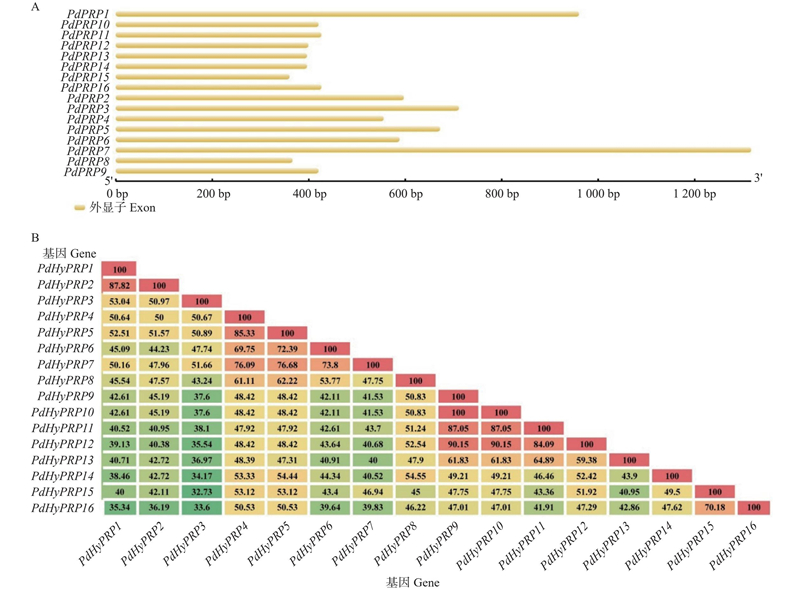

Fig.2
Multiple alignment of HyPRPs encoded amino acid sequences in Populus deltoides"

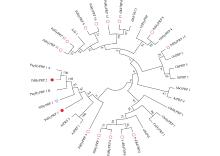
Fig.3
Phylogenetic tree analysis of HyPRPs between Populus deltoides and other species Solanum lycopersicum SlHyPRP1, PdHyPRP that clusters in the same clade with Solanum lycopersicum SlHyPRP1, Other PdHyPRPs, Unlabeled protein sources: see Table 1."

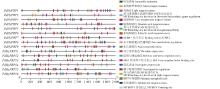
Fig.4
Analysis of cis-acting elements in the promoter of PdHyPRPs in Populus deltoides"

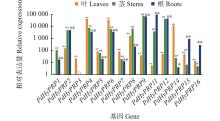
Fig.5
Relative expression levels of PdHyPRPs gene in leaves, stems and roots of Populus euramaricana ‘Bofeng 3’"

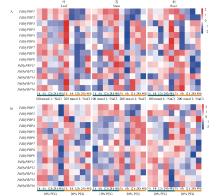
Fig.6
Response of PdHyPRPs genes to NaCl and PEG stress in Populus euramaricana ‘Bofeng 3’ seedings"

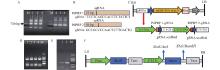
Fig.7
PCR amplification of PdHyPRP1, and PdHyPRP1 and vectors construction"

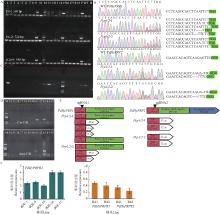
Fig.8
PCR detection and target site analysis of partial gene-edited, overexpressed and gene-silenced lines"

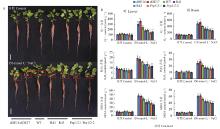
Fig.9
Salt tolerance determination of gene-edited lines of Populus euramaricana ‘Bofeng 3’"

| 范艳玲. 2025. 珙桐PRP基因家族分析及DiPRP14的功能验证. 长沙: 中南林业科技大学. | |
| Fan Y L. 2025. Analysis of the PRP gene family in the dove tree genome and functional validation of a DiPRP14 gene. Changsha: Central South University of Forestry and Technology. [in Chinese] | |
| 韩 青, 陈 瑞, 杨 野, 等. 植物富含脯氨酸蛋白的研究进展. 植物生理学报, 2015, 51 (8): 1179- 1184. | |
| Han Q, Chen R, Yang Y, et al. Progress on plant proline-rich protein. Plant Physiology Communications, 2015, 51 (8): 1179- 1184. | |
|
翟 莹, 雷婷婷, 闫 帆, 等. 大豆逆境诱导基因GmPRP的克隆与表达. 作物学报, 2011, 37 (12): 2152- 2157.
doi: 10.3724/SP.J.1006.2011.02152 |
|
|
Zhai Y, Lei T T, Yan F, et al. Cloning and expression of a stress-induced GmPRP gene in soybean (Glycine max). Acta Agronomica Sinica, 2011, 37 (12): 2152- 2157.
doi: 10.3724/SP.J.1006.2011.02152 |
|
|
钟姗辰, 张伟溪, 张冰玉, 等. ‘渤丰3号’杨叶片高效原生质体提取体系的建立与优化. 林业科学研究, 2025, 38 (2): 116- 126.
doi: 10.12403/j.1001-1498.20240366 |
|
|
Zhong S C, Zhang W X, Zhang B Y, et al. Establishment and optimization of an efficient protoplast extraction system for Populus ‘Bofeng 3 hao’ leaves. Forest Research, 2025, 38 (2): 116- 126.
doi: 10.12403/j.1001-1498.20240366 |
|
|
Banday Z Z, Cecchini N M, Speed D J, et al. Friend or foe: hybrid proline-rich proteins determine how plants respond to beneficial and pathogenic microbes. Plant Physiology, 2022, 190 (1): 860- 881.
doi: 10.1093/plphys/kiac263 |
|
| Bernhardt C, Tierney M L. Expression of AtPRP3, a proline-rich structural cell wall protein from Arabidopsis, is regulated by cell-type-specific developmental pathways involved in root hair formation. Plant Physiology, 2000, 122 (3): 705- 714. | |
| Boron A K, Van Orden J, Markakis M N, et al. Proline-rich protein-like PRPL1 controls elongation of root hairs in Arabidopsis thaliana. Journal of Experimental Botany, 2014, 65 (18): 5485- 5495. | |
|
Debbarma J, Sarki Y N, Saikia B, et al. Ethylene response factor (ERF) family proteins in abiotic stresses and CRISPR-Cas9 genome editing of ERFs for multiple abiotic stress tolerance in crop plants: a review. Molecular Biotechnology, 2019, 61 (2): 153- 172.
doi: 10.1007/s12033-018-0144-x |
|
|
Dvořáková L, Cvrčková F, Fischer L. Analysis of the hybrid proline-rich protein families from seven plant species suggests rapid diversification of their sequences and expression patterns. BMC Genomics, 2007, 8, 412.
doi: 10.1186/1471-2164-8-412 |
|
| Fowler T J, Bernhardt C, Tierney M L. Characterization and expression of four proline-rich cell wall protein genes in Arabidopsis encoding two distinct subsets of multiple domain proteins. Plant Physiology, 1999, 121 (4): 1081- 1092. | |
|
Gothandam K M, Nalini E, Karthikeyan S, et al. OsPRP3, a flower specific proline-rich protein of rice, determines extracellular matrix structure of floral organs and its overexpression confers cold-tolerance. Plant Molecular Biology, 2010, 72 (1/2): 125- 135.
doi: 10.1007/s11103-009-9557-z |
|
| Halder T, Upadhyaya G, Roy S, et al. Glycine rich proline rich protein from Sorghum bicolor serves as an antimicrobial protein implicated in plant defense response. Plant Molecular Biology, 2019, 101 (1/2): 95- 112. | |
|
Huang G Q, Gong S Y, Xu W L, et al. GhHyPRP4, a cotton gene encoding putative hybrid proline-rich protein, is preferentially expressed in leaves and involved in plant response to cold stress. Acta Biochimica et Biophysica Sinica, 2011, 43 (7): 519- 527.
doi: 10.1093/abbs/gmr040 |
|
| Jung H W, Tschaplinski T J, Wang L, et al. Priming in systemic plant immunity. Science, 2009, 324 (5923): 89- 91. | |
|
Kapoor R, Kumar G, Arya P, et al. Genome-wide analysis and expression profiling of rice hybrid proline-rich proteins in response to biotic and abiotic stresses, and hormone treatment. Plants, 2019, 8 (9): 343.
doi: 10.3390/plants8090343 |
|
|
Li D D, Yang J L, Pak S, et al. PuC3H35 confers drought tolerance by enhancing lignin and proanthocyanidin biosynthesis in the roots of Populus ussuriensis. New Phytologist, 2022, 233 (1): 390- 408.
doi: 10.1111/nph.17799 |
|
|
Li J H, Ouyang B, Wang T T, et al. HyPRP1 gene suppressed by multiple stresses plays a negative role in abiotic stress tolerance in tomato. Frontiers in Plant Science, 2016, 7, 967.
doi: 10.3389/fpls.2016.00967 |
|
|
Liu D Q, Han Q, Shah T, et al. A hybrid proline-rich cell-wall protein gene JsPRP1 from Juglans sigillata Dode confers both biotic and abiotic stresses in transgenic tobacco plants. Trees, 2018, 32 (5): 1199- 1209.
doi: 10.1007/s00468-018-1702-3 |
|
|
Liu Z Y, Xie Q J, Tang F F, et al. The ThSOS3 gene improves the salt tolerance of transgenic Tamarix hispida and Arabidopsis thaliana. Frontiers in Plant Science, 2021, 11, 597480.
doi: 10.3389/fpls.2020.597480 |
|
|
Ma Y Y, Wu T L, Zhong G Y, et al. Overexpression of a new proline-rich protein encoding gene CsPRP4 increases starch accumulation in Citrus. Scientia Horticulturae, 2020, 260, 108744.
doi: 10.1016/j.scienta.2019.108744 |
|
|
Mellacheruvu S, Tamirisa S, Vudem D R, et al. Pigeonpea hybrid-proline-rich protein (CcHyPRP) confers biotic and abiotic stress tolerance in transgenic rice. Frontiers in Plant Science, 2016, 6, 1167.
doi: 10.3389/fpls.2015.01167 |
|
|
Nawaz G, Han Y, Usman B, et al. Knockout of OsPRP1, a gene encoding proline-rich protein, confers enhanced cold sensitivity in rice (Oryza sativa L.) at the seedling stage. 3 Biotech, 2019, 9 (7): 254.
doi: 10.1007/s13205-019-1787-4 |
|
|
Peng T, Jia M M, Liu J H. RNAi-based functional elucidation of PtrPRP, a gene encoding a hybrid proline rich protein, in cold tolerance of Poncirus trifoliata. Frontiers in Plant Science, 2015, 6, 808.
doi: 10.3389/fpls.2015.00808 |
|
|
Priyanka B, Sekhar K, Reddy V D, et al. Expression of pigeonpea hybrid-proline-rich protein encoding gene (CcHyPRP) in yeast and Arabidopsis affords multiple abiotic stress tolerance. Plant Biotechnology Journal, 2010, 8 (1): 76- 87.
doi: 10.1111/j.1467-7652.2009.00467.x |
|
|
Rajasheker G, Nagaraju M, Varghese R P, et al. Identification and analysis of proline-rich proteins and hybrid proline-rich proteins super family genes from Sorghum bicolor and their expression patterns to abiotic stress and zinc stimuli. Frontiers in Plant Science, 2022, 13, 952732.
doi: 10.3389/fpls.2022.952732 |
|
|
Saikia B, Debbarma J, Maharana J, et al. SlHyPRP1 and DEA1, the multiple stress responsive eight-cysteine motif family genes of tomato (Solanum lycopersicum L.) are expressed tissue specifically, localize and interact at cytoplasm and plasma membrane in vivo. Physiology and Molecular Biology of Plants, 2020a, 26 (12): 2553- 2568.
doi: 10.1007/s12298-020-00913-z |
|
|
Saikia B, Singh S, Debbarma J, et al. Multigene CRISPR/Cas9 genome editing of hybrid proline rich proteins (HyPRPs) for sustainable multi-stress tolerance in crops: the review of a promising approach. Physiology and Molecular Biology of Plants, 2020b, 26 (5): 857- 869.
doi: 10.1007/s12298-020-00782-6 |
|
|
Tan J L, Zhuo C L, Guo Z F. Nitric oxide mediates cold- and dehydration-induced expression of a novel MfHyPRP that confers tolerance to abiotic stress. Physiologia Plantarum, 2013, 149 (3): 310- 320.
doi: 10.1111/ppl.12032 |
|
|
Tran M T, Doan D T H, Kim J, et al. CRISPR/Cas9-based precise excision of SlHyPRP1 domain(s) to obtain salt stress-tolerant tomato. Plant Cell Reports, 2021, 40 (6): 999- 1011.
doi: 10.1007/s00299-020-02622-z |
|
|
Wang L Q, Wen S S, Wang R, et al. PagWOX11/12a activates PagCYP736A12 gene that facilitates salt tolerance in poplar. Plant Biotechnology Journal, 2021, 19 (11): 2249- 2260.
doi: 10.1111/pbi.13653 |
|
|
Xing H L, Dong L, Wang Z P, et al. A CRISPR/Cas9 toolkit for multiplex genome editing in plants. BMC Plant Biology, 2014, 14 (1): 327.
doi: 10.1186/s12870-014-0327-y |
|
| Xu W L, Zhang D J, Wu Y F, et al. Cotton PRP5 gene encoding a proline-rich protein is involved in fiber development. Plant Molecular Biology, 2013, 82, 353- 365. | |
|
Yang J, Zhang Y, Wang X, et al. HyPRP1 performs a role in negatively regulating cotton resistance to V. dahliae via the thickening of cell walls and ROS accumulation. BMC Plant Biology, 2018, 18 (1): 339.
doi: 10.1186/s12870-018-1565-1 |
|
|
Yeom S I, Seo E, Oh S K, et al. A common plant cell-wall protein HyPRP1 has dual roles as a positive regulator of cell death and a negative regulator of basal defense against pathogens. The Plant Journal, 2012, 69 (5): 755- 768.
doi: 10.1111/j.1365-313X.2011.04828.x |
|
|
Zhang T Q, Zhang W X, Ding C J, et al. A breeding strategy for improving drought and salt tolerance of poplar based on CRISPR/Cas9. Plant Biotechnology Journal, 2023, 21 (11): 2160- 2162.
doi: 10.1111/pbi.14147 |
|
|
Zhou Y Y, Zhang Y, Wang X W, et al. Root-specific NF-Y family transcription factor, PdNF-YB21, positively regulates root growth and drought resistance by abscisic acid-mediated indoylacetic acid transport in Populus. New Phytologist, 2020, 227 (2): 407- 426.
doi: 10.1111/nph.16524 |
| [1] | Junhui Wang,Changjun Ding,Jun Wang,Wei Li,Liangjiao Xue,Keming Luo,Shihui Niu,Jinhui Chen,Weixi Zhang,Aimin Wu,Miaomiao Zhang,Xiyang Zhao,Hengfu Yin. Advances in Genetic Breeding Research of Chinese Forest Trees in 2025 [J]. Scientia Silvae Sinicae, 2026, 62(6): 1-14. |
| [2] | Xinyi Lin,Xinglu Zhou,Lei Zhang,Lijuan Wang,Xinmin An,Jianjun Hu. Biosafety Assessment of Transgenic Poplar Expressing the BtCry1Ac Gene [J]. Scientia Silvae Sinicae, 2026, 62(2): 134-146. |
| [3] | Chenchen Guo,Qi Li,Siyuan Li,Zemin Wang,Yingnan Chen,Suyun Wei,Jianjun Hu. Genomic Selection for Dynamic Growth Traits during the Seedling Stage of Poplar Hybrid Population [J]. Scientia Silvae Sinicae, 2026, 62(1): 32-41. |
| [4] | Yafei Wang,Yu Zou,Xucun Zhu,Shusen Zhang,Shaoran Li,Ye Wang,Liming Jia. Plastic Response of Leaf-Fine Root Phenotype and Growth Rhythm of Populus tomentosa Plantation to Thinning Intensity [J]. Scientia Silvae Sinicae, 2026, 62(1): 95-108. |
| [5] | Yang Jiao,Jing Qiao,Zhixin Zeng,Shen Wang,Xuexin Yang,Yingrui Zhang,Yubing Yang,Yusen Zhao,Wenbo Shu. Construction of an Efficient Hairy Root Genetic Transformation System in 84K Poplar Tissue Culture Seedlings [J]. Scientia Silvae Sinicae, 2026, 62(1): 122-132. |
| [6] | Junhui Wang,Changjun Ding,Wei Li,Keming Luo,Jun Wang,Weixi Zhang,Shihui Niu,Miaomiao Zhang,Xiyang Zhao,Liangjiao Xue,Hengfu Yin. Advances in Genetic Breeding Research of Chinese Forest Trees in 2024 [J]. Scientia Silvae Sinicae, 2025, 61(7): 35-51. |
| [7] | Lei Zhang,Xinglu Zhou,Lijuan Wang,Jianjun Hu. Advance of Poplar Molecular Breeding with Insect Resistance and Transgenic Biosafety Assessment Research [J]. Scientia Silvae Sinicae, 2025, 61(2): 190-203. |
| [8] | Qian Li,Fan Zhang,Xiangxue Meng,Xiaoyun Wu,Jianzhuang Pang,Hang Xu,Zhiqiang Zhang. Simulation of Net Carbon Exchange of Poplar Plantation in North China Plain Based on Decomposition-Reconstruction and Machine Learning [J]. Scientia Silvae Sinicae, 2025, 61(12): 72-82. |
| [9] | Hui Li,Qingnan Wang,Chenglei Zhu,Huayu Sun,Xiaolin Di,Zhimin Gao. Identification and Function of Rubisco Activase Gene Family in Three Bamboo Species [J]. Scientia Silvae Sinicae, 2025, 61(11): 35-44. |
| [10] | Jiangtao Guo,Jingjing Peng,Xin Ma,Fan Liu,Yongxiu Xia. Responses of Poplar Plantations in Northern China Sandy Land to Conventional Fertilization and Drip Fertigation [J]. Scientia Silvae Sinicae, 2025, 61(10): 135-145. |
| [11] | Lingyu Yang,Wenguang Shi,Zhibin Luo. Characteristics of Ectomycorrhizal Fungi Paxillus involutus Promoting Nitrogen Uptake and Utilization of Its Host Populus tremula × Populus alba [J]. Scientia Silvae Sinicae, 2024, 60(9): 69-79. |
| [12] | Xiaolin Qiu,Shumin Wang,Lu Yu,Yuchen Yang,Dianguang Xiong,Chengming Tian. Functional of SNARE Protein CcNyv1 in Cytospora chrysosperma [J]. Scientia Silvae Sinicae, 2024, 60(9): 90-98. |
| [13] | Yingqi He,Lufei Wang,Yamei Zhang,Yanglun Yu,Wenji Yu. Effect of Compression Ratios on the Surface Hardness of Poplar Wood Scrimber [J]. Scientia Silvae Sinicae, 2024, 60(9): 141-149. |
| [14] | Aoyu Wang,Youzheng Guo,Tan Deng,Yang Liu,Nan Di,Jie Duan,Ximeng Li,Benye Xi. Comparison of Several Methods for Evaluating Plant Water Regulation Strategies [J]. Scientia Silvae Sinicae, 2024, 60(8): 109-119. |
| [15] | Kong Yue,Xiang Li,Xinlei Shi,Xuekai Jiao,Peng Wu,Zhongfeng Zhang,Guoliang Dong,Yuanjin Fang. Effects of Thermal Pretreatment on Lateral Performance of Poplar Cross-Laminated Timber Shear Walls [J]. Scientia Silvae Sinicae, 2024, 60(7): 117-128. |
| Viewed | ||||||
|
Full text |
|
|||||
|
Abstract |
|
|||||
