
Scientia Silvae Sinicae ›› 2026, Vol. 62 ›› Issue (10): 125-140.doi: 10.11707/j.1001-7488.LYKX20260225
• Research papers • Previous Articles
Jiayi Leng1,2,Xiaowei Yang2,3,Guijuan Yang2,Junhui Wang2,Wenjun Ma2,Sanping An4,Benwang Gao5,Lifang Wang4,Miaomiao Zhang2,*( )
Received:2026-04-17
Online:2026-10-10
Published:2026-10-16
Contact:
Miaomiao Zhang
E-mail:mmzhang@caf.ac.cn
CLC Number:
Jiayi Leng,Xiaowei Yang,Guijuan Yang,Junhui Wang,Wenjun Ma,Sanping An,Benwang Gao,Lifang Wang,Miaomiao Zhang. Comprehensive Selection of Picea abies Clones based on the Analysis of Growth, Wood Properties, Resistance, and Genetic Structure[J]. Scientia Silvae Sinicae, 2026, 62(10): 125-140.
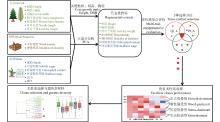
Fig.1
Main content structure framework U: Membership function; PCA: Principal component analysis; Qi: Multi-trait comprehensive index."


Fig.2
Genetic structure and clustering analysis of the Picea abies clones"


Table 1
Analysis of population genetic parameters of Picea abies"
| 指标Indicator | 均值Mean | 标准差SD |
| 有效等位基因数 Effective allele number | 1.40 | 0.29 |
| 观测杂合度 Observed heterozygosity | 0.21 | 0.15 |
| 期望杂合度 Expected heterozygosity | 0.26 | 0.14 |
| Shannon-Wiener 多样性指数 Shannon-Wiener diversity index | 0.41 | 0.18 |
| 多态性信息含量 Polymorphic information content | 0.21 | 0.10 |
Table 2
Descriptive statistics for different traits of Picea abies clones"
| 性状 Traits | 最大值 Max | 最小值 Min | 均值 Mean | 标准差 SD | 变异系数 CV (%) | 偏度系数 Skewness | 峰度系数 Kurtosis | 遗传力 h2 | 遗传方差 Vu | 残差方差 Ve |
| 树高 Tree height/m | 8.950 | 3.170 | 6.605 | 1.099 | 16.643 | –0.400 | –0.196 | 0.141 | 0.172 | 1.047 |
| 胸径 DBH/cm | 12.800 | 3.100 | 8.390 | 1.781 | 21.222 | 0.051 | –0.416 | 0.485 | 1.886 | 2.001 |
| 冠幅 Crown width/cm | 432.940 | 144.830 | 288.169 | 56.482 | 19.600 | –0.108 | –0.357 | 0.001 | 0.000 | 0.001 |
| 树干通直度 Trunk straightness | 4.700 | 2.850 | 3.951 | 0.358 | 9.068 | –0.414 | 0.196 | 0.000 | 0.000 | 0.001 |
| 枝条基径 Branch base diameter/mm | 20.000 | 10.230 | 15.545 | 2.141 | 13.776 | –0.339 | –0.644 | 0.368 | 2.160 | 3.712 |
| 木材密度 Pilodyn/mm | 45.300 | 29.150 | 37.400 | 3.106 | 8.306 | –0.087 | –0.145 | 0.658 | 9.359 | 4.869 |
| 弹性模量 MOE/GPa | 4.950 | 2.850 | 3.908 | 0.343 | 8.783 | –0.277 | 0.996 | 0.608 | 0.103 | 0.066 |
| 针叶长 Needle length/cm | 2.220 | 0.940 | 1.436 | 0.244 | 17.006 | 0.446 | 0.394 | 0.001 | 0.000 | 0.000 |
| 叶片干质量 Leaf dry weight/g | 3.400 | 1.100 | 1.817 | 0.387 | 21.313 | 1.083 | 1.691 | 0.508 | 0.097 | 0.094 |
| 淀粉含量 Starch/(g·kg–1) | 11.920 | 1.640 | 8.947 | 1.428 | 15.957 | –2.464 | 11.692 | 0.873 | 3.394 | 0.496 |
| 可溶性糖含量 Soluble sugar content/(g·kg–1) | 13.300 | 1.240 | 8.164 | 2.012 | 24.650 | –0.225 | 2.225 | 0.000 | 0.001 | 0.000 |
| 叶绿素含量 Chlorophyll content/(mg·g–1) | 7.850 | 1.170 | 3.261 | 1.195 | 36.648 | 0.819 | 1.217 | 0.100 | 0.160 | 1.444 |
| 叶芽萌发等级 Budburst stage | 9.000 | 2.000 | 6.886 | 1.962 | 28.497 | –0.551 | –0.767 | 0.686 | 3.371 | 1.545 |
| 氮含量Nitrogen content/(g·kg–1) | 13.600 | 5.660 | 9.612 | 1.671 | 17.384 | –0.012 | –0.899 | 0.036 | 0.105 | 2.808 |
| 磷含量Phosphorus content/(g·kg–1) | 2.250 | 0.900 | 1.389 | 0.313 | 22.548 | 0.358 | –0.737 | 0.785 | 0.127 | 0.035 |

Fig.3
Correlations between different traits of Picea abies clones"


Fig.4
Comparation of rankings results from three evaluation methods for growth, wood properties and stress resistance"


Fig.5
Comprehensive selection of optimal candidates based on representative indicators"

Table 3
Key traits performance of 13 selected clones of Picea abies"
| 系号 No. | 生长Growth (H, DBH, LDW) | 材性Wood (Pilodyn, MOE) | 抗逆Resist (CC, BS) | 综合贡献值 Comprehensive classification |
| 2025 | 1.95 | 0.20 | 0.29 | G-D |
| 2012 | 1.78 | 0.71 | 0.05 | G-D |
| 1946 | 2.41 | 0.32 | 1.95 | G-D |
| 1760 | 1.01 | 0.51 | 0.65 | G-D |
| 2382 | 0.89 | –0.10 | 1.14 | G-D |
| 1719 | 0.77 | 1.71 | 0.99 | W-P |
| 1455 | 1.05 | 1.59 | 0.83 | W-P |
| 2215 | 0.85 | –0.07 | 0.89 | G-D |
| 2114 | 1.39 | 0.82 | 0.45 | G-D |
| 1941 | 0.71 | 1.30 | 0.64 | W-P |
| 1943 | 0.78 | 0.63 | 0.98 | G-D |
| 2065 | 0.52 | 0.54 | 0.92 | S-D |
| 1878 | 1.60 | –0.29 | 0.49 | G-D |
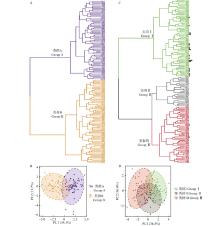
Fig.6
Cluster analysis and PCA of the Picea abies clones"


Fig.7
Performance of the three groups in the seven key traits"

|
安三平, 欧阳芳群, 马建伟, 等. 欧洲云杉无性系遗传变异及早期选择. 西北林学院学报, 2018, 33 (6): 61- 65.
doi: 10.3969/j.issn.1001-7461.2018.06.10 |
|
|
An S P, Ouyang F Q, Ma J W, et al. Genetic variation and early evaluation of Picea abies clones. Journal of Northwest Forestry University, 2018, 33 (6): 61- 65.
doi: 10.3969/j.issn.1001-7461.2018.06.10 |
|
|
安三平, 王丽芳, 王美琴, 等. 欧洲云杉无性系苗期选育. 东北林业大学学报, 2011, 39 (12): 16- 19, 23.
doi: 10.3969/j.issn.1000-5382.2011.12.005 |
|
|
An S P, Wang L F, Wang M Q, et al. Selection and breeding of cutting clones of Picea abies during seedling stage. Journal of Northeast Forestry University, 2011, 39 (12): 16- 19, 23.
doi: 10.3969/j.issn.1000-5382.2011.12.005 |
|
|
高本旺, 欧阳芳群, 高 晗, 等. 鄂西地区欧洲云杉幼龄无性系生长差异及早期评价与选择. 林业科学研究, 2021, 34 (5): 88- 94.
doi: 10.13275/j.cnki.lykxyj.2021.005.010 |
|
|
Gao B W, Ouyang F Q, Gao H, et al. Growth difference and early evaluation and selection of young Picea abies clones in western Hubei. Forest Research, 2021, 34 (5): 88- 94.
doi: 10.13275/j.cnki.lykxyj.2021.005.010 |
|
| 潘春林. 2012. 欧洲云杉嫁接无性系遗传变异与选择. 北京: 中国林业科学研究院. | |
| Pan C L. 2012. Genetic variation and selection of grafted clones of Picea abies. Beijing: Chinese Academy of Forestry. [in Chinese] | |
|
夏 燕, 张建伟, 田开春, 等. 云杉5个种18个种源的早期评价. 东北林业大学学报, 2014, 42 (12): 1- 6.
doi: 10.3969/j.issn.1000-5382.2014.12.001 |
|
|
Xia Y, Zhang J W, Tian K C, et al. Early valuation of eighteen provenances from five species of spruce. Journal of Northeast Forestry University, 2014, 42 (12): 1- 6.
doi: 10.3969/j.issn.1000-5382.2014.12.001 |
|
|
Alexander D H, Novembre J, Lange K. Fast model-based estimation of ancestry in unrelated individuals. Genome Research, 2009, 19 (9): 1655- 1664.
doi: 10.1101/gr.094052.109 |
|
|
Alexandru A M, Mihai G, Stoica E, et al. Multi-trait selection and stability in Norway spruce (Picea abies) provenance trials in Romania. Forests, 2023, 14 (3): 456.
doi: 10.3390/f14030456 |
|
|
Aro T, Tan B Y, Chen Z Q, et al. Multivariate models improve accuracy of genomic prediction for spring frost tolerance in Norway spruce. The Plant Genome, 2025, 18 (4): e70151.
doi: 10.1002/tpg2.70151 |
|
|
Baison J, Vidalis A, Zhou L H, et al. Genome-wide association study identified novel candidate loci affecting wood formation in Norway spruce. The Plant Journal, 2019, 100 (1): 83- 100.
doi: 10.1111/tpj.14429 |
|
|
Berlin M, Jansson G, Högberg K A. Genotype by environment interaction in the southern Swedish breeding population of Picea abiesusing new climatic indices. Scandinavian Journal of Forest Research, 2015, 30 (2): 112- 121.
doi: 10.1080/02827581.2014.978889 |
|
|
Bínová Z, Korecký J, Dvořák J, et al. Genetic structure of Norway spruce ecotypes studied by SSR markers. Forests, 2020, 11 (1): 110.
doi: 10.3390/f11010110 |
|
| Browning B L, Browning S R. 2016. Genotype imputation with millions of reference samples. American Journal of Human Genetics 98(1): 116–126. | |
|
Chen Z Q, Baison J, Pan J, et al. Accuracy of genomic selection for growth and wood quality traits in two control-pollinated progeny trials using exome capture as the genotyping platform in Norway spruce. BMC Genomics, 2018, 19 (1): 946.
doi: 10.1186/s12864-018-5256-y |
|
|
Chen Z Q, Helmersson A, Westin J, et al. Efficiency of using spatial analysis for Norway spruce progeny tests in Sweden. Annals of Forest Science, 2017, 75 (1): 2.
doi: 10.1007/s13595-017-0680-8 |
|
|
Chen Z Q, Hai H N T, Helmersson A, et al. Advantage of clonal deployment in Norway spruce (Picea abies (L.) H. Karst). Annals of Forest Science, 2020, 77 (1): 14.
doi: 10.1007/s13595-020-0920-1 |
|
|
Chen Z Q, Zan Y J, Milesi P, et al. Leveraging breeding programs and genomic data in Norway spruce (Picea abies L. Karst) for GWAS analysis. Genome Biology, 2021, 22 (1): 210.
doi: 10.1186/s13059-021-02421-z |
|
|
Chen Z Q, Zan Y J, Zhou L H, et al. Genetic architecture behind developmental and seasonal control of tree growth and wood properties in Norway spruce. Frontiers in Plant Science, 2022, 13, 927673.
doi: 10.3389/fpls.2022.927673 |
|
|
Dai J H, Fan Y R, Diao S, et al. Construction of core collection and phenotypic evaluation of Toona sinensis. Forests, 2023, 14 (6): 1269.
doi: 10.3390/f14061269 |
|
|
Ding X Y, Zhang Y N, Sun J M, et al. Genetic selection for growth, wood quality and resin traits of potential Slash pine for multiple industrial uses. Forestry Research, 2024, 4, e023.
doi: 10.48130/forres-0024-0020 |
|
|
Fang S Z, Liu Y, Yue J, et al. Assessments of growth performance, crown structure, stem form and wood property of introduced poplar clones: results from a long-term field experiment at a lowland site. Forest Ecology and Management, 2021, 479, 118586.
doi: 10.1016/j.foreco.2020.118586 |
|
|
Gross N, Le Bagousse-Pinguet Y, Liancourt P, et al. Functional trait diversity maximizes ecosystem multifunctionality. Nature Ecology & Evolution, 2017, 1 (5): 132.
doi: 10.1038/s41559-017-0132 |
|
|
Han C, Chen J N, Liu Z M, et al. Morphological and physiological responses of Melia azedarach seedlings of different provenances to drought stress. Agronomy, 2022, 12 (6): 1461.
doi: 10.3390/agronomy12061461 |
|
|
Hannrup B, Cahalan C, Chantre G, et al. Genetic parameters of growth and wood quality traits in Picea abies. Scandinavian Journal of Forest Research, 2004, 19 (1): 14- 29.
doi: 10.1080/02827580310019536 |
|
|
Hayatgheibi H, Hallingbäck H R, Gezan S A, et al. Cross-generational genomic prediction of Norway spruce (Picea abies) wood properties: an evaluation using independent validation. BMC Genomics, 2025, 26 (1): 680.
doi: 10.1186/s12864-025-11861-x |
|
| Jansson G, Danusevičius D, Grotehusman H, et al. 2013. Norway spruce (Picea abies (L.) H. Karst.)//Pâques L E. ed. Forest Tree Breeding in Europe. Dordrecht: Springer Netherlands, 123–176. | |
|
Karacic A, Adler A, Weih M, et al. An analysis of poplar growth and quality traits to facilitate identification of climate-adapted plant material for Sweden. BioEnergy Research, 2021, 14 (2): 409- 425.
doi: 10.1007/s12155-020-10210-y |
|
|
Korecký J, Čepl J, Korolyova N, et al. Resistance to bark beetle outbreak in Norway spruce: population structure analysis and comparative genomic assessment of surviving (LTS) and randomly selected reference trees. Forests, 2023, 14 (10): 2074.
doi: 10.3390/f14102074 |
|
|
Korecký J, Čepl J, Stejskal J, et al. Genetic diversity of Norway spruce ecotypes assessed by GBS-derived SNPs. Scientific Reports, 2021, 11, 23119.
doi: 10.1038/s41598-021-02545-z |
|
|
Krenn T, Berthold D, Ritter N, et al. Effects of growth and treatment conditions on the quality of Norway spruce (Picea abies L.) sawn timber. Forests, 2024, 15 (9): 1588.
doi: 10.3390/f15091588 |
|
|
Kumar S, Stecher G, Tamura K. MEGA7: molecular evolutionary genetics analysis version 7.0 for bigger datasets. Molecular Biology and Evolution, 2016, 33 (7): 1870- 1874.
doi: 10.1093/molbev/msw054 |
|
|
Lenz P, Cloutier A, MacKay J, et al. Genetic control of wood properties in Picea glauca: an analysis of trends with cambial age. Canadian Journal of Forest Research, 2010, 40 (4): 703- 715.
doi: 10.1139/X10-014 |
|
|
Lenz P R N, Nadeau S, Mottet M J, et al. Multi-trait genomic selection for weevil resistance, growth, and wood quality in Norway spruce. Evolutionary Applications, 2020, 13 (1): 76- 94.
doi: 10.1111/eva.12823 |
|
|
Mickelbart M V, Hasegawa P M, Bailey-Serres J. Genetic mechanisms of abiotic stress tolerance that translate to crop yield stability. Nature Reviews Genetics, 2015, 16 (4): 237- 251.
doi: 10.1038/nrg3901 |
|
| Mura C. 2025. Surviving the winter: tree phenology and frost hardiness at the boundary between temperate and boreal forest in eastern Canada. Québec: Université du Québec. | |
|
Pan Y Y, Jiang L P, Xu G Y, et al. Evaluation and selection analyses of 60 Larix kaempferi clones in four provenances based on growth traits andwood properties. Tree Genetics & Genomes, 2020, 16 (2): 27.
doi: 10.1007/s11295-020-1420-z |
|
| Park Y S, Weng Y H, Mansfield S D. Genetic effects on wood quality traits of plantation-grown white spruce (Picea glauca) and their relationships with growth. Tree Genetics and Genomes, 2012, 8 (2): 303- 311. | |
| Pérez-Harguindeguy N, Díaz S, Garnier E, et al. New handbook for standardised measurement of plant functional traits worldwide. Australian Journal of Botany, 2013, 61 (3): 167- 234. | |
|
Pliura A, Zhang S Y, MacKay J, et al. Genotypic variation in wood density and growth traits of poplar hybrids at four clonal trials. Forest Ecology and Management, 2007, 238 (1/2/3): 92- 106.
doi: 10.1016/j.foreco.2006.09.082 |
|
|
Poorter H, Niklas K J, Reich P B, et al. Biomass allocation to leaves, stems and roots: meta-analyses of interspecific variation and environmental control. New Phytologist, 2012, 193 (1): 30- 50.
doi: 10.1111/j.1469-8137.2011.03952.x |
|
|
Pretzsch H. Canopy space filling and tree crown morphology in mixed-species stands compared with monocultures. Forest Ecology and Management, 2014, 327, 251- 264.
doi: 10.1016/j.foreco.2014.04.027 |
|
|
Purcell S, Neale B, Todd-Brown K, et al. PLINK: a tool set for whole-genome association and population-based linkage analyses. American Journal of Human Genetics, 2007, 81 (3): 559- 575.
doi: 10.1086/519795 |
|
| Ray D, Berlin M, Alia R, et al. 2022. Transformative changes in tree breeding for resilient forest restoration. Frontiers in Forests and Global Change 5: 1005761. | |
|
Reich P B. The world-wide ‘fast–slow’ plant economics spectrum: a traits manifesto. Journal of Ecology, 2014, 102 (2): 275- 301.
doi: 10.1111/1365-2745.12211 |
|
|
Rennenberg H, Loreto F, Polle A, et al. Physiological responses of forest trees to heat and drought. Plant Biology, 2006, 8 (5): 556- 571.
doi: 10.1055/s-2006-924084 |
|
|
Rieksts-Riekstiņš R, Zeltiņš P, Baliuckas V, et al. Pinus sylvestris breeding for resistance against natural infection of the fungus Heterobasidion annosum. Forests, 2020, 11 (1): 23.
doi: 10.3390/f11010023 |
|
|
Ritchie R J. Consistent sets of spectrophotometric chlorophyll equations for acetone, methanol and ethanol solvents. Photosynthesis Research, 2006, 89 (1): 27- 41.
doi: 10.1007/s11120-006-9065-9 |
|
|
Salmela M J. Patterns of genetic diversity vary among shoot and root functional traits in Norway spruce (Picea abies) along a latitudinal gradient. Oikos, 2021, 130 (7): 1143- 1157.
doi: 10.1111/oik.08203 |
|
|
Schuldt B, Buras A, Arend M, et al. A first assessment of the impact of the extreme 2018 summer drought on Central European forests. Basic and Applied Ecology, 2020, 45, 86- 103.
doi: 10.1016/j.baae.2020.04.003 |
|
|
Senf C, Seidl R. Mapping the forest disturbance regimes of Europe. Nature Sustainability, 2021, 4 (1): 63- 70.
doi: 10.1101/2020.03.30.015875 |
|
|
Song Y J, Sterck F, Zhou X Q, et al. Drought resilience of conifer species is driven by leaf lifespan but not by hydraulic traits. New Phytologist, 2022, 235 (3): 978- 992.
doi: 10.1111/nph.18177 |
|
|
Torres-Sánchez E, Acosta J J, Hodge G R, et al. Multi-trait selection in a Pinus pinaster Aiton breeding program: developing a selection index dealing with genotype by environment interaction in volume. Forestry, 2026, 99 (2): cpaf054.
doi: 10.1093/forestry/cpaf054 |
|
|
VanRaden P M. Efficient methods to compute genomic predictions. Journal of Dairy Science, 2008, 91 (11): 4414- 4423.
doi: 10.3168/jds.2007-0980 |
|
| Waraich E A, Ahmad R, Saifullah, et al. Role of mineral nutrition in alleviation of drought stress in plants. Australian Journal of Crop Science, 2011, 5 (6): 764- 777. | |
|
Weih M, Asplund L, Bergkvist G. Assessment of nutrient use in annual and perennial crops: a functional concept for analyzing nitrogen use efficiency. Plant and Soil, 2011, 339 (1): 513- 520.
doi: 10.1007/s11104-010-0599-4 |
|
|
Yemm E W, Willis A J. The estimation of carbohydrates in plant extracts by anthrone. The Biochemical Journal, 1954, 57 (3): 508- 514.
doi: 10.1042/bj0570508 |
|
|
Zhang P P, Ding J X, Wang Q T, et al. Contrasting coordination of non-structural carbohydrates with leaf and root economic strategies of Alpine coniferous forests. New Phytologist, 2024, 243 (2): 580- 590.
doi: 10.1111/nph.19678 |
|
|
Zhou X L, Zhang L, Zhang M, et al. Genomic selection for growth and wood properties in multi-generation hybrid populations of Populus deltoides. Horticulture Research, 2025, 12 (9): uhaf165.
doi: 10.1093/hr/uhaf165 |
| [1] | Yanping Zhou,Hanyu Li,Zhengqiang Huang,Nan Wang,Qingfen Li. Changes in Endogenous Hormone Content and Gene Expression during Long-Term Subculture of Picea abies Embryogenic Callus [J]. Scientia Silvae Sinicae, 2026, 62(7): 113-125. |
| [2] | Hui Yang,Haiyan Zhao,Lan Lou,Lingfeng Zhang,Zimiao Zhang,Xiaoming Jia,Quanxin Bi,Libing Wang. Paternal Identification and Genetic Diversity Analysis of Open-Pollinated Progeny of Xanthoceras sorbifolium [J]. Scientia Silvae Sinicae, 2026, 62(4): 142-153. |
| [3] | Jianguo Zhang,Yunxiao Li,Aiguo Duan,Zhaoshan Wang,Xiongqing Zhang,Juanjuan Liu,Caiyun He. Genetic Uniformity of Chinese Fir Populations Demonstrates that 2 000 Years of Cultivation Have Led to Their Complete Transformation into Plantations [J]. Scientia Silvae Sinicae, 2025, 61(12): 1-23. |
| [4] | Yan Liang,Yinhua Wang,Liping Yan,Yuguang Kong,Qinghua Li,Weiguo Zhong,Zexin Tian,Yuanfu Dong,Yuanshuai Zhang. Analysis of Genetic Diversity in Robinia pseudoacacia Populations and Preliminary Screening of the Core Germplasm [J]. Scientia Silvae Sinicae, 2025, 61(11): 242-254. |
| [5] | Junhong Zhang,Yang Wang,Shengcai Zhou,Xiaolin Wu,Renchao Wu,Qi Yang,Yuting Zhang,Zaikang Tong. Genetic Structure Analysis and Core Germplasm Collection Construction of Phoebe bournei Populations [J]. Scientia Silvae Sinicae, 2024, 60(1): 68-79. |
| [6] | Xiaolei Ding,Qingtong Wang,Sixi Lin,Ruiwen Zhao,Yue Zhang,Jianren Ye. Analysis of Genetic Variations of Bursaphelenchus xylophilus Populations between Guangdong and Jiangsu Provinces with SNP Marker [J]. Scientia Silvae Sinicae, 2022, 58(8): 1-9. |
| [7] | Wenting Pan,Jianjun Sun,Qinqin Yuan,Lili Zhang,Kangqiao Deng,Yueqiao Li. Analysis of Genetic Diversity and Structure in Different Provenances of Liriodendron by RAD-seq Technique [J]. Scientia Silvae Sinicae, 2022, 58(4): 74-81. |
| [8] | Chaoqun Du,Xiaomei Sun,Yunhui Xie,Yimei Hou. Genetic Diversity of Larix kaempferi Populations with Different Levels of Improvement in Northern Subtropical Region [J]. Scientia Silvae Sinicae, 2021, 57(5): 68-76. |
| [9] | Zirui Jia,Ya Wang,Jianwei Ma,Sanping An,Jiwen Hu,Junhui Wang. Response to Thermal Stability of PSⅡ for Temperature Rising in Picea abies [J]. Scientia Silvae Sinicae, 2020, 56(7): 22-32. |
| [10] | Xia Li,Libao Wang,Yafeng Wen,Jun Lin,Xingtong Wu,Meiling Yuan,Yuan Zhang,Minqiu Wang,Xinyu Li. Genetic Diversity of Chinese Fir (Cunninghamia lanceolata) Breeding Populations among Different Generations [J]. Scientia Silvae Sinicae, 2020, 56(11): 53-61. |
| [11] | Ma Songmei, Wang Chuncheng, Sun Fangfang, Wei Bo, Nie Yingbin. Genetic Diversity of an Endangered Plant Amygdalus ledebouriana in Xinjiang [J]. Scientia Silvae Sinicae, 2019, 55(9): 71-80. |
| [12] | Jin Ling, Liu Mingguo, Dong Shengjun, Wu Yueliang, Zhang Xin. Genetic Diversity and Fingerprints of 97 Armeniaca sibirica Clones Based on SSR Markers [J]. Scientia Silvae Sinicae, 2018, 54(7): 51-61. |
| [13] | Bao Wenquan, Wuyun Tana, Du Hongyan, Li Tiezhu, Liu Huimin, Wang Lin, Bai Yu. Genetic Diversity and Population Structure of Amygdalus mira in the Tibet Plateau in China Based on SSR Markers [J]. Scientia Silvae Sinicae, 2018, 54(2): 30-41. |
| [14] | Yang Hanbo, Zhang Rui, Wang Bangshun, Xu Zhaoyou, Chen Huanwei, Zhou Zhichun. Analysis of Genetic Diversity in Schima superba Plus Tree Germplasms by SSR Markers [J]. Scientia Silvae Sinicae, 2017, 53(5): 43-53. |
| [15] | Mao Xiuhong, Zheng Yongqi, Sun Baiyou, Zhang Yuanshuai, Han Congcong, Wei Xiao, Xun Shouhua. Genetic Diversity and Fingerprints of Robinia pseudoacacia Clones Based on SSR Markers [J]. Scientia Silvae Sinicae, 2017, 53(10): 80-89. |
| Viewed | ||||||
|
Full text |
|
|||||
|
Abstract |
|
|||||
