
Scientia Silvae Sinicae ›› 2026, Vol. 62 ›› Issue (9): 73-81.doi: 10.11707/j.1001-7488.LYKX20260144
• Research papers • Previous Articles Next Articles
Jianghuan Qin,Haikui Li,Lu Yang,Jingyuan He,Xianzhao Liu*( )
Received:2026-03-12
Revised:2026-06-02
Online:2026-09-10
Published:2026-09-16
Contact:
Xianzhao Liu
E-mail:liuxianzhao@ifrit.ac.cn
CLC Number:
Jianghuan Qin,Haikui Li,Lu Yang,Jingyuan He,Xianzhao Liu. Regulatory Effect of Ectomycorrhizal Tree Species Dominance on Tree Species Richness and Stand Aboveground Biomass in Temperate Forests[J]. Scientia Silvae Sinicae, 2026, 62(9): 73-81.

Fig.1
Principal component analysis results of environmental factors in all plots"
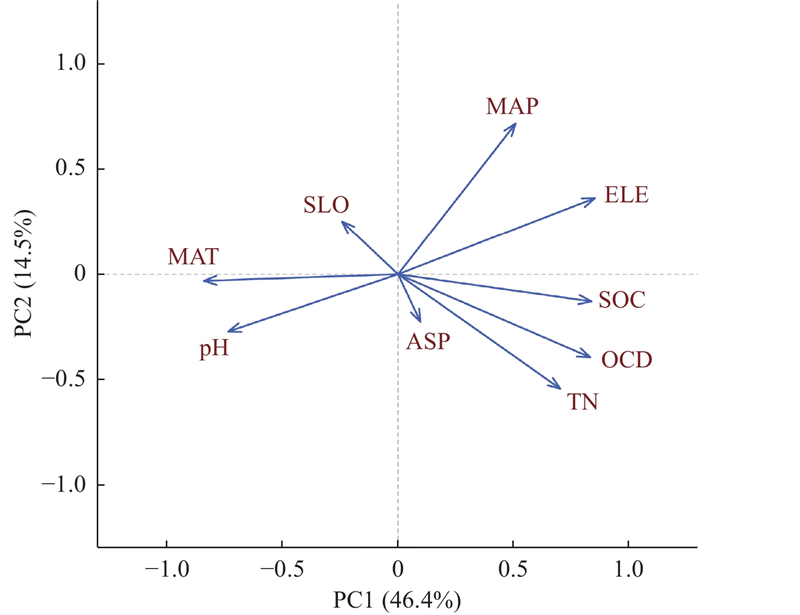

Fig.2
Relationships among EcM species dominance, tree species richness, and aboveground biomass in stands"


Fig.3
Relative effects of various factors on forest biomass In the figure, the “×” indicates an interaction effect. The circles and short lines represent the standardized regression coefficients and 95% confidence intervals, respectively, and solid circles indicate significant effects (P<0.05), and open circles indicate non-significant effects (P>0.05). ***: P<0.001; **: P<0.01: *: P<0.05."


Fig.4
Direct and indirect influencing factors of forest biomass"

| 车 盈. 2024. 生物多样性对阔叶红松林生态系统功能的影响机制. 哈尔滨: 东北林业大学. | |
| Che Y. 2024. Effects of biodiversity on ecosystem functioning in the mixed broadleaved-Korean pine (Pinus koraiensis) forest. Harbin: Northeast Forestry University. [in Chinese] | |
|
方 迪, 马 宁, 李胜功, 等. 菌根共生类型对森林养分内循环的调控作用. 植物生态学报, 2026, 50 (3): 552- 565.
doi: 10.17521/cjpe.2025.0254 |
|
|
Fang D, Ma N, Li S G, et al. Regulatory role of mycorrhizal types in internal nutrient cycling of forest ecosystems. Chinese Journal of Plant Ecology, 2026, 50 (3): 552- 565.
doi: 10.17521/cjpe.2025.0254 |
|
|
韩 飞, 张家铱, 夏 蕾, 等. 菌根类型对亚热带森林主要树种根叶功能性状关联的影响. 生态学杂志, 2023, 42 (4): 838- 845.
doi: 10.13292/j.1000-4890.202304.004 |
|
|
Han F, Zhang J Y, Xia L, et al. Effects of mycorrhizal type on the correlation of root and leaf functional traits of main tree species in subtropical forests. Chinese Journal of Ecology, 2023, 42 (4): 838- 845.
doi: 10.13292/j.1000-4890.202304.004 |
|
|
李 鑫, 刘红霞, 陈生娟, 等. 混交林驯化的AMF通过抑制侧柏生长增强刺槐的竞争优势. 林业科学, 2025, 61 (10): 87- 95.
doi: 10.11707/j.1001-7488.LYKX20250158 |
|
|
Li X, Liu H X, Chen S J, et al. Mixed forest-domesticated AMF conferred a competitive advantage on Robinia pseudoacacia by suppressing the growth of Platycladus orientalis. Scientia Silvae Sinicae, 2025, 61 (10): 87- 95.
doi: 10.11707/j.1001-7488.LYKX20250158 |
|
| 秦江环, 张春雨, 赵秀海. 基于温带针阔混交林植物–土壤反馈的Janzen–Connell假说检验. 植物生态学报, 2022, 46 (6): 624- 631. | |
| Qin J H, Zhang C Y, Zhao X H. Testing Janzen–Connell hypothesis based on plant-soil feedbacks in a temperate coniferous and broadleaved mixed forest. Chinese Journal of Plant Ecology, 2022, 46 (6): 624- 631. | |
|
张会儒, 雷相东, 张春雨, 等. 森林质量评价及精准提升理论与技术研究. 北京林业大学学报, 2019, 41 (5): 1- 18.
doi: 10.16675/j.cnki.cn14-1065/f.2019.14.046 |
|
|
Zhang H R, Lei X D, Zhang C Y, et al. Research on theory and technology of forest quality evaluation and precision improvement. Journal of Beijing Forestry University, 2019, 41 (5): 1- 18.
doi: 10.16675/j.cnki.cn14-1065/f.2019.14.046 |
|
|
Barceló M, van Bodegom P M, Tedersoo L, et al. Mycorrhizal tree impacts on topsoil biogeochemical properties in tropical forests. Journal of Ecology, 2022, 110 (6): 1271- 1282.
doi: 10.1111/1365-2745.13868 |
|
|
Barry K E, Mommer L, van Ruijven J, et al. The future of complementarity: disentangling causes from consequences. Trends in Ecology & Evolution, 2019, 34 (2): 167- 180.
doi: 10.1016/j.tree.2018.10.013 |
|
|
Bennett J A, Maherali H, Reinhart K O, et al. Plant-soil feedbacks and mycorrhizal type influence temperate forest population dynamics. Science, 2017, 355 (6321): 181- 184.
doi: 10.1126/science.aai8212 |
|
|
Brundrett M C, Tedersoo L. Evolutionary history of mycorrhizal symbioses and global host plant diversity. New Phytologist, 2018, 220 (4): 1108- 1115.
doi: 10.1111/nph.14976 |
|
|
Carteron A, Vellend M, Laliberté E. Mycorrhizal dominance reduces local tree species diversity across US forests. Nature Ecology & Evolution, 2022, 6 (4): 370- 374.
doi: 10.1038/s41559-021-01634-6 |
|
|
Chari N R, Muratore T J, Frey S D, et al. Long-term soil warming drives different belowground responses in arbuscular mycorrhizal and ectomycorrhizal trees. Global Change Biology, 2024, 30 (11): e17550.
doi: 10.1111/gcb.17550 |
|
|
Cotrufo M F, Ranalli M G, Haddix M L, et al. Soil carbon storage informed by particulate and mineral-associated organic matter. Nature Geoscience, 2019, 12 (12): 989- 994.
doi: 10.1038/s41561-019-0484-6 |
|
|
Deng M F, Hu S J, Guo L L, et al. Tree mycorrhizal association types control biodiversity-productivity relationship in a subtropical forest. Science Advances, 2023, 9 (3): eadd4468.
doi: 10.1126/sciadv.add4468 |
|
|
Dietrich P, Ferlian O, Huang Y Y, et al. Tree diversity effects on productivity depend on mycorrhizae and life strategies in a temperate forest experiment. Ecology, 2023, 104 (2): e3896.
doi: 10.1002/ecy.3896 |
|
|
Eagar A C, Abu P H, Brown M A, et al. Setting the stage for plant–soil feedback: Mycorrhizal influences over conspecific recruitment, plant and fungal communities, and coevolution. Journal of Ecology, 2025, 113 (6): 1327- 1344.
doi: 10.1111/1365-2745.14393 |
|
|
Hengl T, Mendes de Jesus J, Heuvelink G B M, et al. Soil grids 250 m: Global gridded soil information based on machine learning. PLoS ONE, 2017, 12 (2): e0169748.
doi: 10.1371/journal.pone.0169748 |
|
|
Jiang F, Pu X, Schmid B, et al. Mycorrhizal symbioses and tree diversity in global forest communities. Science Advances, 2025, 11 (24): eadt5743.
doi: 10.1126/sciadv.adt5743 |
|
|
Jiang F, Zhu K, Cadotte M W, et al. Tree mycorrhizal type mediates the strength of negative density dependence in temperate forests. Journal of Ecology, 2020, 108 (6): 2601- 2610.
doi: 10.1111/1365-2745.13413 |
|
|
Yang K, Zhang Q, Zhu J J, et al. Mycorrhizal type regulates trade-offs between plant and soil carbon in forests. Nature Climate Change, 2024, 14 (1): 91- 97.
doi: 10.1038/s41558-023-01864-5 |
|
|
Chen L, Swenson N G, Ji N N, et al. Differential soil fungus accumulation and density dependence of trees in a subtropical forest. Science, 2019, 366 (6461): 124- 128.
doi: 10.1126/science.aau1361 |
|
|
Liu X R, Yu K L, Liu H, et al. Contrasting drought tolerance traits of woody plants is associated with mycorrhizal types at the global scale. New Phytologist, 2024, 244 (5): 2024- 2035.
doi: 10.1111/nph.20097 |
|
|
Luo S, Phillips R P, Jo I, et al. Higher productivity in forests with mixed mycorrhizal strategies. Nature Communications, 2023a, 14, 1377.
doi: 10.1038/s41467-023-36888-0 |
|
|
Luo Y H, Ma L L, Cadotte M W, et al. Testing the ectomycorrhizal–dominance hypothesis for ecosystem multifunctionality in a subtropical mountain forest. New Phytologist, 2024, 243 (6): 2401- 2415.
doi: 10.1111/nph.20003 |
|
|
Luo Y H, Ma L L, Seibold S, et al. The diversity of mycorrhiza-associated fungi and trees shapes subtropical mountain forest ecosystem functioning. Journal of Biogeography, 2023b, 50 (4): 715- 729.
doi: 10.1111/jbi.14563 |
|
|
Ma J, Chen L, Mi X, et al. The interactive effects of soil fertility and tree mycorrhizal association explain spatial variation of diversity–biomass relationships in a subtropical forest. Journal of Ecology, 2023, 111, 1037- 1049.
doi: 10.1111/1365-2745.14076 |
|
|
Ma S H, Chen G P, Cai Q, et al. Mycorrhizal dominance influences tree species richness and richness–biomass relationship in China’s forests. Ecology, 2025, 106 (1): e4501.
doi: 10.1002/ecy.4501 |
|
|
Mao Z K, Corrales A, Zhu K, et al. Tree mycorrhizal associations mediate soil fertility effects on forest community structure in a temperate forest. New Phytologist, 2019, 223 (1): 475- 486.
doi: 10.1111/nph.15742 |
|
|
Mao Z K, Wiegand T, Corrales A, et al. Mycorrhizal types regulate tree spatial associations in temperate forests: ectomycorrhizal trees might favour species coexistence. Ecology Letters, 2024, 27 (10): e70005.
doi: 10.1111/ele.70005 |
|
|
Phillips R P, Brzostek E, Midgley M G. The mycorrhizal-associated nutrient economy: a new framework for predicting carbon–nutrient couplings in temperate forests. New Phytologist, 2013, 199 (1): 41- 51.
doi: 10.1111/nph.12221 |
|
|
Poggio L, de Sousa L M, Batjes N H, et al. SoilGrids 2.0: producing soil information for the globe with quantified spatial uncertainty. Soil, 2021, 7 (1): 217- 240.
doi: 10.5194/soil-7-217-2021 |
|
|
Qin J H, Geng Y, Li X Y, et al. Mycorrhizal type and soil pathogenic fungi mediate tree survival and density dependence in a temperate forest. Forest Ecology and Management, 2021, 496, 119459.
doi: 10.1016/j.foreco.2021.119459 |
|
|
Ray T, Delory B M, Beugnon R, et al. Tree diversity increases productivity through enhancing structural complexity across mycorrhizal types. Science Advances, 2023, 9 (40): eadi2362.
doi: 10.1126/sciadv.adi2362 |
|
|
Soudzilovskaia N A, Vaessen S, Barcelo M, et al. FungalRoot: global online database of plant mycorrhizal associations. New Phytologist, 2020, 227 (3): 955- 966.
doi: 10.1111/nph.16569 |
|
|
Steidinger B S, Crowther T W, Liang J, et al. Climatic controls of decomposition drive the global biogeography of forest-tree symbioses. Nature, 2019, 569 (7756): 404- 408.
doi: 10.1038/s41586-019-1128-0 |
|
|
Wang B, Qiu Y L. Phylogenetic distribution and evolution of mycorrhizas in land plants. Mycorrhiza, 2006, 16 (5): 299- 363.
doi: 10.1007/s00572-005-0033-6 |
|
|
Wu X M, Mao Z K, Sun W J, et al. Above-and belowground effects of ectomycorrhizal dominance on soil carbon and nitrogen in a temperate forest. Journal of Plant Ecology, 2026, 19 (1): rtaf143.
doi: 10.1093/jpe/rtaf143 |
|
|
Yan G Y, Fan C N, Zheng J Q, et al. Forest carbon stocks increase with higher dominance of ectomycorrhizal trees in high latitude forests. Nature Communications, 2024, 15, 5959.
doi: 10.1038/s41467-024-50423-9 |
|
|
Zheng J J, Freschet G T, Tedersoo L, et al. A trait-based root acquisition-defence-decomposition framework in angiosperm tree species. Nature Communications, 2024, 15, 5311.
doi: 10.1038/s41467-024-49666-3 |
| [1] | Shimei Xiong,Bingxiang Tan,Wenqiang Xu,Xiaoyao Li,Lifeng Pang,Bing Hu. Estimation of Aboveground Biomass in Desert Haloxylon ammodendron Shrubland Based on UAV Multispectral and LiDAR Data [J]. Scientia Silvae Sinicae, 2026, 62(6): 96-108. |
| [2] | Wenqiang Gao,Xiangdong Lei,Xiao He,Yutang Li. Variability in Tree Species Diversity-Aboveground Biomass Relationship in Temperate Forest Types and Developmental Stages in Northeast China [J]. Scientia Silvae Sinicae, 2026, 62(4): 55-67. |
| [3] | Min Deng,Huaijiang He,Xiangju Wu,Xinna Zhang,Chunyu Zhang,Xiuhai Zhao. Effects of Biomass Allocation Trade-Offs and Traits of Temperate Forests in Northeast China on Seedling Growth [J]. Scientia Silvae Sinicae, 2026, 62(3): 48-60. |
| [4] | Sheng Zhou,Fugen Jiang,Shuai Chen,Yi Long,Binbin Wang,Zige Song,Hua Sun. Estimation of Forest Aboveground Biomass Using Joint Spaceborne-UAV LiDAR and Sentinel-2 Data [J]. Scientia Silvae Sinicae, 2026, 62(3): 74-87. |
| [5] | Yuwei Zhang,Mengting Mo,Bo Shu,Jiajia Yao,Zhilin Yuan. Fungal Elicitors Promote Flavonoid Biosynthesis in Sanghuangporus vaninii and the Underlying Mechanisms [J]. Scientia Silvae Sinicae, 2026, 62(3): 146-160. |
| [6] | Xiahui Hua,Xianyin Ding,Shaoze Wu,Qinyun Huang,Shu Diao,Yadi Wu,Qifu Luan. Aboveground Biomass Models for Young Pinus elliottii Plantations Based on Various Growth Factors [J]. Scientia Silvae Sinicae, 2026, 62(3): 211-222. |
| [7] | Liuyuan Huang,Yan Zheng,Xinjie Cheng,Weisheng Zeng,Qing Xu,Zhengyang Hou. Estimation of Forest Aboveground Biomass Based on Non-Wall-to-Wall Remote Sensing Auxiliary Data [J]. Scientia Silvae Sinicae, 2025, 61(9): 22-38. |
| [8] | Zhiyong Wang,Mengyan Zhou,Wenyi Chen,Wenjun Ma,Junhui Wang,Yi Zhang,Chuangye Wu,Zhibin Luo,Jing Zhou. Selection of Catalpa bungei Clones with High Productivity and High Nitrogen Utilization Efficiency and Analysis of G × E Interaction [J]. Scientia Silvae Sinicae, 2025, 61(8): 96-105. |
| [9] | Yujiao Zhang,Hengqian Zhao,Hancong Fu,Ge Liu,Xiadan Huangfu,Xuanqi Liu. Inversion Model of Aboveground Biomass at Individual Tree Scale Based on the Multiple Features of UAV Remote Sensing [J]. Scientia Silvae Sinicae, 2025, 61(8): 129-141. |
| [10] | Xiaoyan Xiong,Caixia Li,Guoqi Chai,Long Chen,Xiang Jia,Lingting Lei,Xiaoli Zhang. Estimation of Aboveground Biomass in Regional Forests by Using Integrating UAV-LiDAR and GEDI Data [J]. Scientia Silvae Sinicae, 2025, 61(8): 142-153. |
| [11] | Jiamin Wu,Yaxin Wang,Bin Sun,Zhijie Ma,Weina Sun,Liang Hong. Remote Sensing Estimation of Biomass of Caragana korshinskii with UAV [J]. Scientia Silvae Sinicae, 2025, 61(6): 13-24. |
| [12] | Feifei Yang,Wangfei Zhang,Lei Zhao,Han Zhao,Yongjie Ji,Mengjin Wang. Two-Stage Remote Sensing Feature Optimization and GF-1 Data-Supported Forest Above-Ground Biomass Inversion [J]. Scientia Silvae Sinicae, 2025, 61(4): 9-19. |
| [13] | Xia Liu,Chengxing Ling,Yongfu Chen,Hua Liu,Zhenping He,Zejiang Li,Weina Sun,Zhijie Ma,Haixia You,Wen Lü,Feng Zhao,Haowei Zeng,Xinmiao Wang. Additive Biomass Models and Carbon Content of Thirteen Typical Shrubs in Erdos Region [J]. Scientia Silvae Sinicae, 2025, 61(4): 117-128. |
| [14] | Shixin Zhang,Yangyang Geng,Ting Zhou,Jihui Wang,Bokai Hu,Yana Liu. Regulation of Lactarius akahatsu on the Growth and Root Metabolites of Pinus massoniana and Pinus armandii Seedlings [J]. Scientia Silvae Sinicae, 2024, 60(9): 50-58. |
| [15] | Lingyu Yang,Wenguang Shi,Zhibin Luo. Characteristics of Ectomycorrhizal Fungi Paxillus involutus Promoting Nitrogen Uptake and Utilization of Its Host Populus tremula × Populus alba [J]. Scientia Silvae Sinicae, 2024, 60(9): 69-79. |
| Viewed | ||||||
|
Full text |
|
|||||
|
Abstract |
|
|||||
