
Scientia Silvae Sinicae ›› 2026, Vol. 62 ›› Issue (10): 1-12.doi: 10.11707/j.1001-7488.LYKX20260141
• Frontiers and hot topics •
Haodong Liu1,Pengsen Sun1,*( ),Zhen Yu2,Meirong Sun1,Lei Zhang3,Shirong Liu1
Received:2026-03-11
Online:2026-10-10
Published:2026-10-16
Contact:
Pengsen Sun
E-mail:sunpsen@caf.ac.cn
CLC Number:
Haodong Liu,Pengsen Sun,Zhen Yu,Meirong Sun,Lei Zhang,Shirong Liu. Correction and Evaluation of Precipitation Product in Sub-Alpine Forested Regions of Southwestern China Based on a Convolutional Neural Network[J]. Scientia Silvae Sinicae, 2026, 62(10): 1-12.
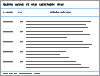
Table 1
Precipitation product data characteristics"
| 降水产品 Precipitation product | 空间分辨率 Spatial resolution | 时间分辨率 Temporal resolution | 时间范围 Temporal coverage | 数据类型 Data type |
| IMERG | 0.1° | 逐日 Daily | 2000年至今 2000 to present | 卫星降水产品 Satellite precipitation products |
| CMORPH-BLD | 0.25° | 逐日 Daily | 1998年至今 1998 to present | 卫星降水产品 Satellite precipitation products |
| CMA-RA/Land | 0.25° | 逐日 Daily | 1979年至今 1979 to present | 再分析降水产品 Reanalysis precipitation products |
| ERA5-Land | 0.1° | 逐小时 Hourly | 1950年至今 1950 to present | 再分析降水产品 Reanalysis precipitation products |
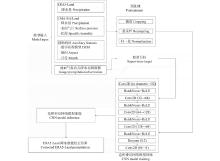
Fig.1
Workflow of CNN-based bias correction for ERA5-Land precipitation"
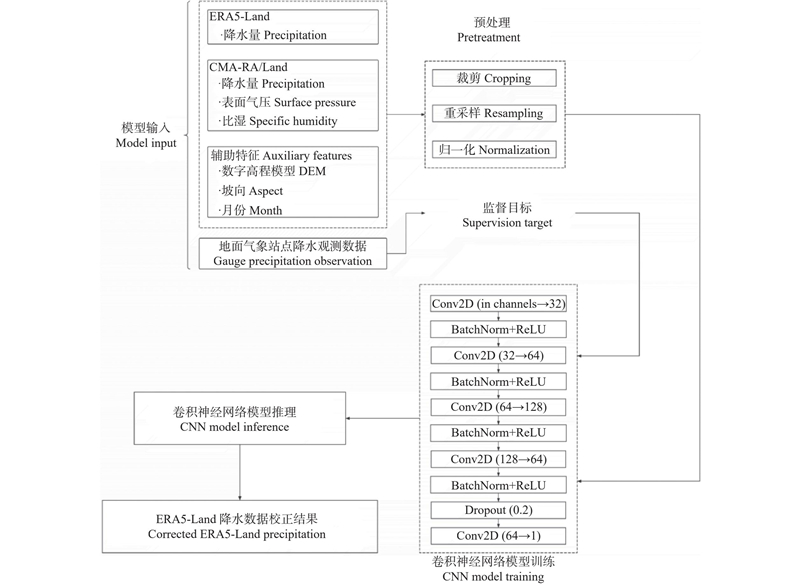
Table 2
Sensitive parameters and their value ranges for DHSVM model"
| 参数名称 Parameters | 单位 Unit | 建议取值范围 Recommended range |
| 降雨截留系数 Rain leaf area index multiplier | m | 无统一推荐范围 No universally recommended range |
| 降雪截留系数 Snow leaf area index multiplier | m | 无统一推荐范围 No universally recommended range |
| 土壤层数Number of soil layers | — | 1~3 |
| 土壤横向导水率 Soil lateral conductivity | m·s?1 | 1.00E–5~1.00E–2 |
| 土壤纵向导水率 Soil vertical conductivity | m·s?1 | 1.00E–5~1.00E–2 |
| 土壤孔隙度Soil porosity | m3·m?3 | 0.40~0.60 |
| 田间持水量Field capacity | m3·m?3 | 0.18~0.41 |
| 土壤萎蔫点Soil wilting point | m3·m?3 | 0.05~0.28 |
| 土壤密度Soil density | kg·m?3 | 1 000~3 000 |
| 最小/最大冠层阻力 Min/max canopy resistance | s·m?1 | 0~500 / 0~5 000 |
| 根系深度Root depths | m | 无统一推荐范围 No universally recommended range |
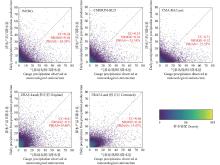
Fig.2
Density scatterplots of daily precipitation from different precipitation products against daily precipitation observed at meteorological stations"
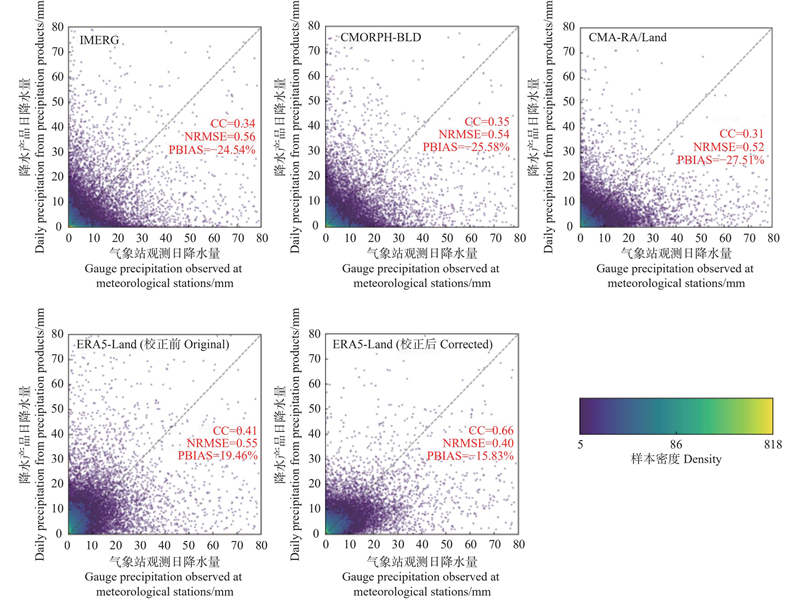
Table 3
Evaluation indices of various precipitation products under different precipitation intensities"
| 降水产品 Precipitation product | 相关系数 Correlation coefficient | 百分比偏差 Percent bias (%) | 归一化均方根误差 Normalized root mean square error | ||||||||
| 小雨 Light rain | 中雨 Moderate rain | 大雨 Heavy rain | 小雨 Light rain | 中雨 Moderate rain | 大雨 Heavy rain | 小雨 Light rain | 中雨 Moderate rain | 大雨 Heavy rain | |||
| IMERG | 0.14 | 0.13 | 0.40 | 31.85 | –52.11 | –69.11 | 0.89 | 1.10 | 0.55 | ||
| CMORPH-BLD | 0.15 | 0.13 | 0.37 | 30.53 | –52.69 | –70.26 | 0.82 | 1.01 | 0.55 | ||
| CMA-RA/Land | 0.17 | 0.14 | 0.29 | 35.98 | –58.40 | –77.83 | 0.63 | 0.91 | 0.59 | ||
| ERA5-Land (校正前 Original) | 0.28 | 0.11 | 0.22 | 104.94 | –15.73 | –54.98 | 0.92 | 1.00 | 0.53 | ||
| ERA5-Land (校正后 Corrected) | 0.35 | 0.22 | 0.60 | 33.92 | –40.22 | –55.08 | 0.50 | 0.76 | 0.45 | ||
Fig.3
Taylor diagrams of different precipitation products"
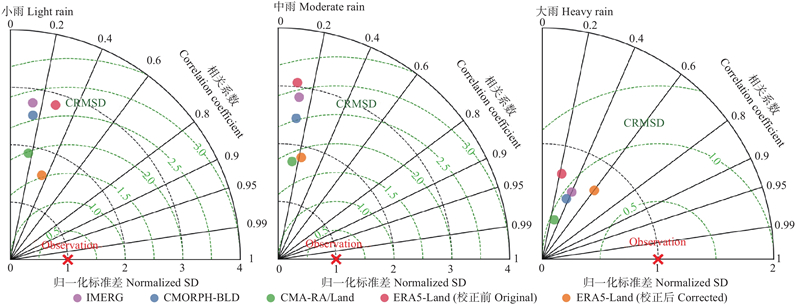
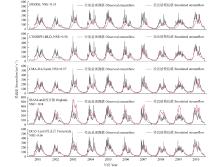
Fig.4
Runoff hydrographs at Sangping hydrological station simulated by DHSVM driven with different precipitation products"
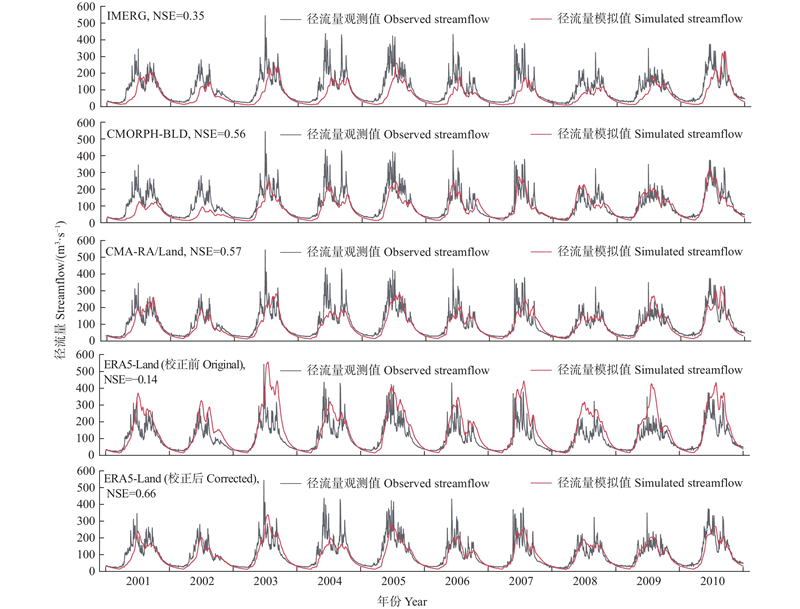
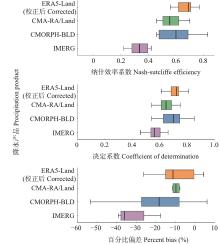
Fig.5
Boxplots of runoff simulation performance driven by different precipitation products"
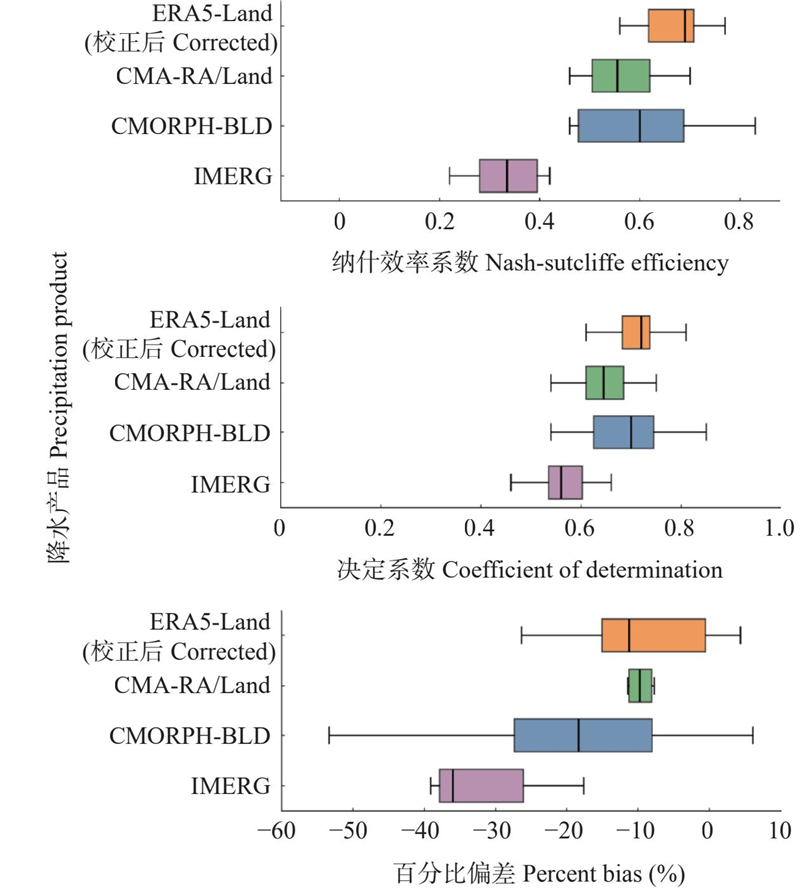
Table 4
Performance metrics of different precipitation products in different seasons"
| 降水产品 Precipitation product | 相关系数 Correlation coefficient | 百分比偏差 Percent bias (%) | 归一化均方根误差 Normalized root mean square error | |||||||||||
| 春季 Spring | 夏季 Summer | 秋季 Autumn | 冬季 Winter | 春季 Spring | 夏季 Summer | 秋季 Autumn | 冬季 Winter | 春季 Spring | 夏季 Summer | 秋季 Autumn | 冬季 Winter | |||
| IMERG | 0.19 | 0.32 | 0.31 | 0.06 | –30.84 | –19.59 | –24.80 | –67.10 | 0.47 | 0.52 | 0.55 | 0.47 | ||
| CMORPH-BLD | 0.21 | 0.33 | 0.31 | 0.15 | –27.39 | –24.20 | –23.00 | –61.31 | 0.45 | 0.51 | 0.53 | 0.43 | ||
| CMA-RA/Land | 0.24 | 0.25 | 0.34 | 0.22 | –28.22 | –26.61 | –27.99 | –34.89 | 0.42 | 0.50 | 0.49 | 0.39 | ||
| ERA5-Land (校正前 Original) | 0.49 | 0.32 | 0.56 | 0.27 | 14.77 | 13.67 | 28.77 | 89.26 | 0.38 | 0.54 | 0.45 | 0.59 | ||
| ERA5-Land (校正后 Corrected) | 0.62 | 0.62 | 0.69 | 0.36 | –16.03 | –15.86 | –14.68 | –24.07 | 0.32 | 0.39 | 0.36 | 0.35 | ||
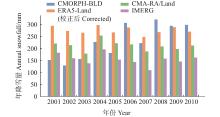
Fig.6
Comparison of annual snowfall from 2001 to 2010 driven by different precipitation products"
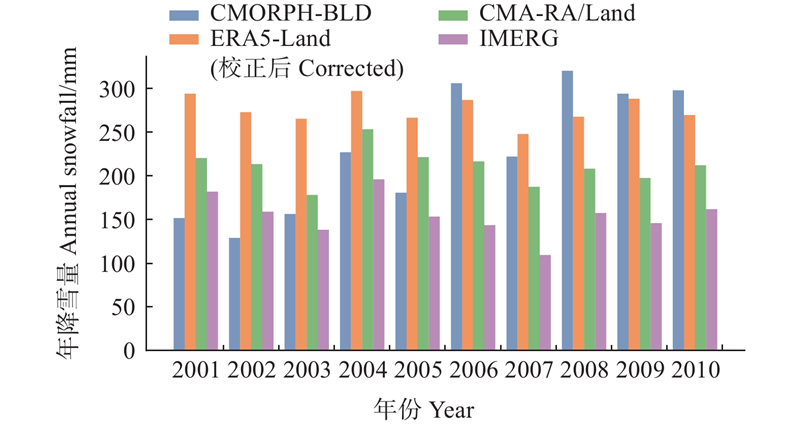
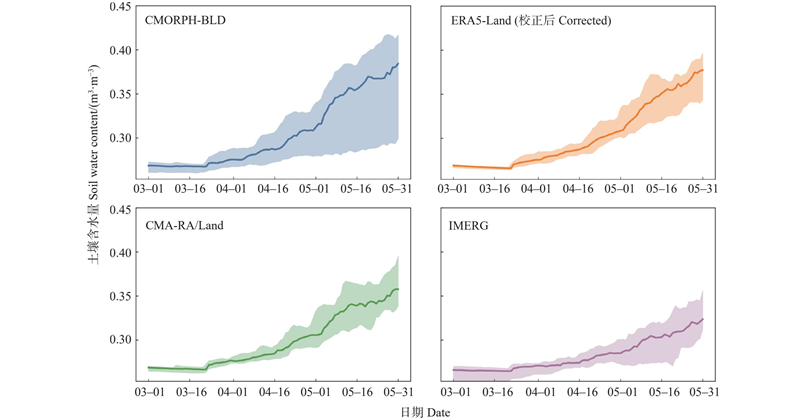
Fig.7
Multi-year daily variation of spring (March–May) soil moisture in 2001—2010"
| 陈仁升, 韩春坛, 王 磊, 等. 祁连山2019—2020年面降水量及高山区降水监测意义. 冰川冻土, 2023, 45 (2): 676- 687. | |
| Chen R S, Han C T, Wang L, et al. Impact of the alpine precipitation measurements on the precipitation in 2019 and 2020 in the Qilian Mountains. Journal of Glaciology and Geocryology, 2023, 45 (2): 676- 687. | |
| 王彩霞, 黄安宁, 郑 鹏, 等. 中国第一代全球陆面再分析(CRA40/Land)气温和降水产品在中国大陆的适用性评估. 高原气象, 2022, 41 (5): 1325- 1334. | |
| Wang C X, Huang A N, Zheng P, et al. Applicability evaluation of China’s first generation of global land surface reanalysis (CRA40/Land) air temperature and precipitation products in China mainland.. Plateau Meteorology, 2022, 41 (5): 1325- 1334. | |
| 雍 斌, 周振杨, 陶 新, 等. 2025. 黄河源区多源融合降水产品综合评价及其水文效应评估. 水资源保护, 41(2): 47–57, 76. | |
| Yong B, Zhou Z Y, Tao X, et al. 2025. Comprehensive evaluation and hydrological effect evaluation of multi-source fusion precipitation product in the Yellow River source area. Water Resources Protection, 41(2): 47−57, 76.[in Chinese] | |
| 赵 奕, 南卓铜, 李祥飞, 等. 分布式水文模型DHSVM在西北高寒山区流域的适用性研究. 冰川冻土, 2019, 41 (1): 147- 157. | |
| Zhao Y, Nan Z T, Li X F, et al. On applicability of a fully distributed hydrological model in the cold and alpine watershed of Northwest China. Journal of Glaciology and Geocryology, 2019, 41 (1): 147- 157. | |
| Chen H N, Sun L Y, Cifelli R, et al. Deep learning for bias correction of satellite retrievals of orographic precipitation. IEEE Transactions on Geoscience and Remote Sensing, 2022, 60, 1- 11. | |
| Cui X Q, Liu S R, Wei X H. Impacts of forest changes on hydrology: a case study of large watersheds in the upper reaches of Minjiang River watershed in China. Hydrology and Earth System Sciences, 2012, 16 (11): 4279- 4290. | |
| DeBeer C M, Pomeroy J W. Influence of snowpack and melt energy heterogeneity on snow cover depletion and snowmelt runoff simulation in a cold mountain environment. Journal of Hydrology, 2017, 553, 199- 213. | |
| Draper D W, Newell D A, Wentz F J, et al. The global precipitation measurement (GPM) microwave imager (GMI): instrument overview and early on-orbit performance. IEEE Journal of Selected Topics in Applied Earth Observations and Remote Sensing, 2015, 8 (7): 3452- 3462. | |
| Gou J J, Miao C Y, Sorooshian S, et al. Satellite-based precipitation error propagation in the hydrological modeling chain across China. Journal of Hydrology, 2024, 632, 130906. | |
| Jiang Y Z, Yang K, Shao C K, et al. A downscaling approach for constructing high-resolution precipitation dataset over the Tibetan Plateau from ERA5 reanalysis. Atmospheric Research, 2021, 256, 105574. | |
| Joyce R J, Janowiak J E, Arkin P A, et al. CMORPH: a method that produces global precipitation estimates from passive microwave and infrared data at high spatial and temporal resolution. Journal of Hydrometeorology, 2004, 5 (3): 487- 503. | |
| Kolluru V, Kolluru S, Konkathi P. Evaluation and integration of reanalysis rainfall products under contrasting climatic conditions in India. Atmospheric Research, 2020, 246, 105121. | |
| Liang S L, Zhao X, Liu S H, et al. A long-term Global LAnd Surface Satellite (GLASS) data-set for environmental studies. International Journal of Digital Earth, 2013, 6 (sup1): 5- 33. | |
| Lü Y, Yong B, Huang F, et al. Investigating twelve mainstream global precipitation datasets: which one performs better on the Tibetan Plateau?. Journal of Hydrology, 2024, 633, 130947. | |
| Maggioni V, Meyers P C, Robinson M D. A review of merged high-resolution satellite precipitation product accuracy during the tropical rainfall measuring mission (TRMM) era. Journal of Hydrometeorology, 2016, 17 (4): 1101- 1117. | |
| Moriasi D N, Arnold J G, Van Liew M W, et al. Model evaluation guidelines for systematic quantification of accuracy in watershed simulations. Transactions of the ASABE, 2007, 50 (3): 885- 900. | |
| Muñoz-Sabater J, Dutra E, Agustí-Panareda A, et al. ERA5-Land: A state-of-the-art global reanalysis dataset for land applications. Earth System Science Data, 2021, 13 (9): 4349- 4383. | |
| Roe G H. Orographic precipitation. Annual Review of Earth and Planetary Sciences, 2005, 33 (1): 645- 671. | |
| Sambyal S, Shastri S, Taloor A K, et al. Statistical and machine learning-based bias-correction of ERA5 forcing data: implications for Himalayan glacier melt modelling. Physics and Chemistry of the Earth, Parts A/B/C, 2026, 143, 104387. | |
| Schober P, Boer C, Schwarte L A. Correlation coefficients: appropriate use and interpretation. Anesthesia & Analgesia, 2018, 126 (5): 1763- 1768. | |
| Sun G, Wei X H, Hao L, et al. Forest hydrology modeling tools for watershed management: a review. Forest Ecology and Management, 2023, 530, 120755. | |
| Sun Q H, Miao C Y, Duan Q Y, et al. A review of global precipitation data sets: Data sources, estimation, and intercomparisons. Reviews of Geophysics, 2018, 56 (1): 79- 107. | |
| Surfleet C G, Marks S J. Hydrologic and suspended sediment effects of forest roads using field and DHSVM modelling studies. Forest Ecology and Management, 2021, 499, 119632. | |
| Wang F, Tian D, Carroll M. Customized deep learning for precipitation bias correction and downscaling. Geoscientific Model Development, 2023, 16 (2): 535- 556. | |
| Wang W, Lin H, Chen N C, et al. Evaluation of multi-source precipitation products over the Yangtze River Basin. Atmospheric Research, 2021, 249, 105287. | |
| Wigmosta M S, Vail L W, Lettenmaier D P. A distributed hydrology-vegetation model for complex terrain. Water Resources Research, 1994, 30 (6): 1665- 1679. | |
| Zhan H, Yu D X, Wang L, et al. Stronger influences of grassland growth than grassland area on hydrological processes in the source region of the Yellow River. Journal of Hydrology, 2024, 642, 131886. | |
| Zhang L, Ren D, Nan Z T, et al. Interpolated or satellite-based precipitation? Implications for hydrological modeling in a meso-scale mountainous watershed on the Qinghai-Tibet Plateau. Journal of Hydrology, 2020, 583, 124629. | |
| Zhang T T, Liang Z M, Li W T, et al. Statistical post-processing of precipitation forecasts using circulation classifications and spatiotemporal deep neural networks. Hydrology and Earth System Sciences, 2023, 27 (10): 1945- 1960. | |
| Zhong Q, Fang Z L, Chen H M, et al. Fusing multi-scale numerical model forecasts to improve short-term intense rainfall forecast with a deep learning rain network. Journal of Meteorological Research, 2025, 39 (6): 1441- 1462. |
| [1] | Ronghan Qin,Guoqiu Fan,Qiaoling Han,Yili Zheng,Jichen Xu,Hao Liang. Inversion of Relative Dielectric Constant of Tree Root Zone Based on MWFCNet [J]. Scientia Silvae Sinicae, 2026, 62(1): 109-121. |
| [2] | Jiandong Qi,Shangzi Zheng,Ziyi Chen,Zhongtian Ma. Wildlife Image Recognition of Infrared Cameras in Beijing Area Based on an Improvement ConvNeXt Model [J]. Scientia Silvae Sinicae, 2024, 60(8): 33-45. |
| [3] | Jingyi Xu,Zhi Zhang,Fei Yan,Wenyue Zhang. Leaf Identification Based on GAN-DCNN [J]. Scientia Silvae Sinicae, 2024, 60(4): 40-51. |
| [4] | Su Tong, Xu Jie. Tree Species Identification Method Based on Generative Adversarial Network [J]. Scientia Silvae Sinicae, 2024, 60(2): 97-105. |
| [5] | Xi Pan,Kang Li,Zhong Yang. Wood Species Identification through Fusion of NIR Spectroscopy and Digital Image Features Information Using Convolutional Neural Networks [J]. Scientia Silvae Sinicae, 2024, 60(12): 136-145. |
| [6] | Jiandong Qi,Zhongtian Ma,Dehuai Zhang,Yun Tian. Wildlife Image Recognition in Miyun District Based on BS-ResNeXt-50 [J]. Scientia Silvae Sinicae, 2023, 59(8): 112-122. |
| [7] | Yujie Miao,Shiping Zhu,Jing Pu,Junxian Li,Lingkai Ma,Hua Huang. Recognition of Furniture Wood Image Species Based on Convolutional Neural Networks [J]. Scientia Silvae Sinicae, 2023, 59(8): 133-140. |
| [8] | Yingwu Mao,Ying Guo,Wangfei Zhang,Yong Su,Yuan Guan. Tree Species Classification by Combining LiDAR, Hyperspectral Data and 3D-CNN Method [J]. Scientia Silvae Sinicae, 2023, 59(3): 73-83. |
| [9] | Huimin Feng,Kun Jin. Voiceprint Recognition of Male Nomascus hainanus Based on Convolutional Neural Network [J]. Scientia Silvae Sinicae, 2023, 59(1): 119-127. |
| [10] | Tuo He,Shoujia Liu,Yang Lu,Yonggang Zhang,Lichao Jiao,Yafang Yin. iWood: An Automated Wood Identification System for Endangered and Precious Tree Species Using Convolutional Neural Networks [J]. Scientia Silvae Sinicae, 2021, 57(9): 152-159. |
| [11] | Ziyu Zhao,Xiaoxia Yang,Hui Guo,Zhedong Ge,Yucheng Zhou. Recognition Method of Wood Macro- and Micro-Structure Based on Convolution Neural Network [J]. Scientia Silvae Sinicae, 2021, 57(6): 134-143. |
| [12] | Hengshuo Su,Jun Lü,Zhiping Ding,Yanjie Tang,Xudong Chen,Qiang Zhou,Zheyu Zhang,Qing Yao. Wood Identification Algorithm Based on Improved Residual Neural Network [J]. Scientia Silvae Sinicae, 2021, 57(12): 147-154. |
| [13] | Xuanxin Liu,Yu Sun,Jian Cui,Qi Jiang,Zhibo Chen,Youqing Luo. Early Recognition of Feeding Sound of Trunk Borers Based on Artificial Intelligence [J]. Scientia Silvae Sinicae, 2021, 57(10): 93-101. |
| [14] | Lin Zhao,Xiaoli Zhang,Yanshuang Wu,Bin Zhang. Subtropical Forest Tree Species Classification Based on 3D-CNN for Airborne Hyperspectral Data [J]. Scientia Silvae Sinicae, 2020, 56(11): 97-107. |
| [15] | Guangqun Zhang,Yingjie Li,Hangjun Wang,Houkui Zhou. Forest Image Classification Based on Fine-Tuning CaffeNet [J]. Scientia Silvae Sinicae, 2020, 56(10): 121-128. |
| Viewed | ||||||
|
Full text |
|
|||||
|
Abstract |
|
|||||
