
Scientia Silvae Sinicae ›› 2026, Vol. 62 ›› Issue (9): 13-27.doi: 10.11707/j.1001-7488.LYKX20260105
• Frontiers and hot topics • Previous Articles
Mengyao Zhou,Ge Wei,Yuxuan Fan,Enxi Li,Xuefei Tang*( ),Guoqiang Fan*()
Received:2026-01-05
Revised:2026-04-16
Online:2026-09-10
Published:2026-09-16
Contact:
Xuefei Tang,Guoqiang Fan
E-mail:Tangxf5@henau.edu.cn;zlxx64@henau.edu.cn
CLC Number:
Mengyao Zhou,Ge Wei,Yuxuan Fan,Enxi Li,Xuefei Tang,Guoqiang Fan. Genome-Wide Identification of the CPP Transcription Factor Family in Paulownia fortunei and Analysis of Their Expression Patterns in Response to Multiple Stresses[J]. Scientia Silvae Sinicae, 2026, 62(9): 13-27.

Table S1
The protein ID of CPP genes in A.thaliana, O.sativa, and P.fortunei"
| 拟南芥A. thaliana | |
| AtCPP1 | AT2G20110 |
| AtCPP2 | AT3G04850 |
| AtCPP3 | AT3G16160 |
| AtCPP4 | AT3G22760 |
| AtCPP5 | AT3G22780 |
| AtCPP6 | AT4G14770 |
| AtCPP7 | AT4G29000 |
| AtCPP8 | AT5G25790 |
| 水稻O. sativa | |
| OsCPP1 | LOC_Os01g55580 |
| OsCPP2 | LOC_Os02g17460 |
| OsCPP3 | LOC_Os03g43730 |
| OsCPP4 | LOC_Os04g09560 |
| OsCPP5 | LOC_Os05g43380 |
| OsCPP6 | LOC_Os05g51040 |
| OsCPP7 | LOC_Os06g22670 |
| OsCPP8 | LOC_Os07g07974 |
| OsCPP9 | LOC_Os08g28214 |
| OsCPP10 | LOC_Os12g41210 |
| OsCPP11 | LOC_Os12g41230 |
| 泡桐P. fortunei | |
| PfCPP1 | Pfo01g004380.1 |
| PfCPP2 | Pfo03g006650.1 |
| PfCPP3 | Pfo07g014910.1 |
| PfCPP4 | Pfo11g002630.1 |
| PfCPP5 | Pfo18g002590.1 |
| PfCPP6 | Pfo18g003730.1 |
| PfCPP7 | Pfo19g004140.1 |
Table S2
Information of transcriptome sequencing data sources"
| 登录号Accession number |
| SRR11787883 |
| SRR11787894 |
| SRR11787905 |
| SRR11787916 |
| SRR11787922-SRR11787928 |
| SRR11787938 |
| SRR11787942-SRR11787944 |
| SRR11787949 |
| SRR11787960 |
| SRR11787971 |
| PRJNA221355 |
| PRJNA289582 |
Table S3
qRT-PCR primers for PfCPP genes in Paulownia"
| 引物Primer | 序列Sequence (5'?3') |
| PfCPP3-F | GTGGGGTTCGTAGACGTTGT |
| PfCPP3-R | CGGTAGTGATTTTGGCCCCT |
| PfCPP4-F | AATCTGGAGGGGGTAAGCCA |
| PfCPP4-R | GCTCCCGCCATCTCAAAAAC |
| PfCPP5-F | AACTGCCGCGTCGTAAAATG |
| PfCPP5-R | GGCGTTATTGCAGGCGATTT |
| PfCPP6-F | CACCTAATCGGCCTGCTCAA |
| PfCPP6-R | CAGGTGGCTCGATGATGTGT |
| PfCPP7-F | CTTGCAACACGCAAGCAGAT |
| PfCPP7-R | GTCTTGCTGGAGTCATCCCC |
| PfActin-F | AATGGAATCTGCTGGAAT |
| PfActin-R | ACTGAGGACAATGTTACC |
Table S5
qRT-PCR reaction program"
| 步骤Steps | 温度Temperature/℃ | 时间Time/s |
| 预变性Pre-denaturation | 95 | 30 |
| 变性Transsexual | 95 | 5 |
| 退火Annealing | 58 | 10 |
| 延伸Extension | 72 | 30 |
| 溶解曲线Dissolution curve | 机器自定义Machine customisation | 机器自定义Machine customisation |
Table S6
Primer sequence information"
| 序号 No. | 基因载体 Gene vector | 正向引物序列 Forward primer sequence | 反向引物序列 Reverse primer sequence |
| 1 | pSAK277-PfCPP4 | GTGGATCCAAAGAATTCATGGGGGAGGGGGGTGAG | CTCCTTTACCCATGAATTCCTGATTAGGGGTGAGGGAAGG |
Table 1
Analysis of physicochemical properties of the PfCPP gene family in P. fortunei"
| 基因 ID Gene ID | 基因名称 Gene name | 染色体 Chromosome | 氨基酸数目 Number of amino acid | 分子量 Molecular weight/kDa | 等电点 pI | 总平均亲水系数 GRAVY | 亚细胞定位 Subcellular location |
| Pfo01g004380.1 | PfCPP1 | Chr01 | 461 | 49.92 | 8.38 | –0.68 | 细胞核Nucleus |
| Pfo03g006650.1 | PfCPP2 | Chr03 | 609 | 65.89 | 8.53 | –0.67 | 细胞核Nucleus |
| Pfo07g014910.1 | PfCPP3 | Chr07 | 949 | 102.80 | 5.97 | –0.58 | 细胞核Nucleus |
| Pfo11g002630.1 | PfCPP4 | Chr11 | 793 | 86.49 | 5.58 | –0.65 | 细胞核Nucleus |
| Pfo18g002590.1 | PfCPP5 | Chr18 | 536 | 58.87 | 8.60 | –0.60 | 细胞核Nucleus |
| Pfo18g003730.1 | PfCPP6 | Chr18 | 942 | 102.33 | 5.65 | –0.62 | 细胞核Nucleus |
| Pfo19g004140.1 | PfCPP7 | Chr19 | 794 | 86.71 | 5.37 | –0.70 | 细胞核Nucleus |

Fig.1
Phylogenetic tree of CPP family proteins from P. fortunei, A. thaliana, and O. sativa"

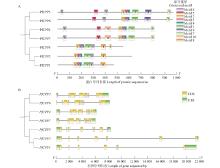
Fig.2
Analyses of conserved motifs and gene structures of the PfCPP gene family in P. fortunei"


Fig.S1
Analysis of protein domains and cis-acting elements in the PfCPP gene family of P. fortunei"


Fig.3
Heatmap analysis of cis-acting elements in the promoters of PfCPP genes"


Fig.4
Collinearity analysis of the PfCPP gene family"
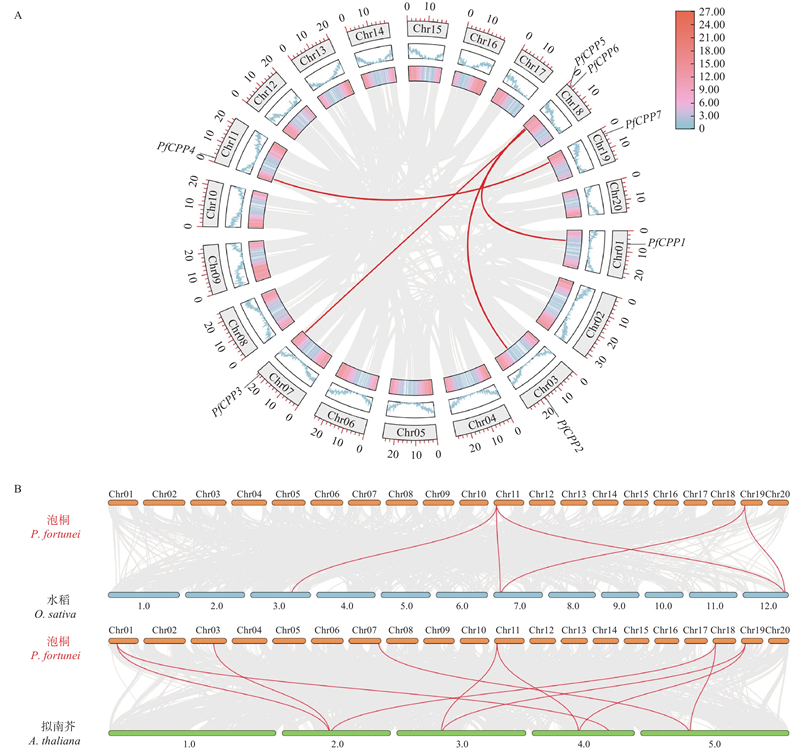
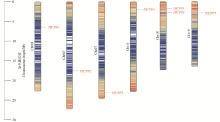
Fig.S2
Chromosomal localization of the PfCPP gene family"


Fig.5
Expression heatmap and RT-qPCR analysis of diseased and healthy seedlings under Rif treatment"
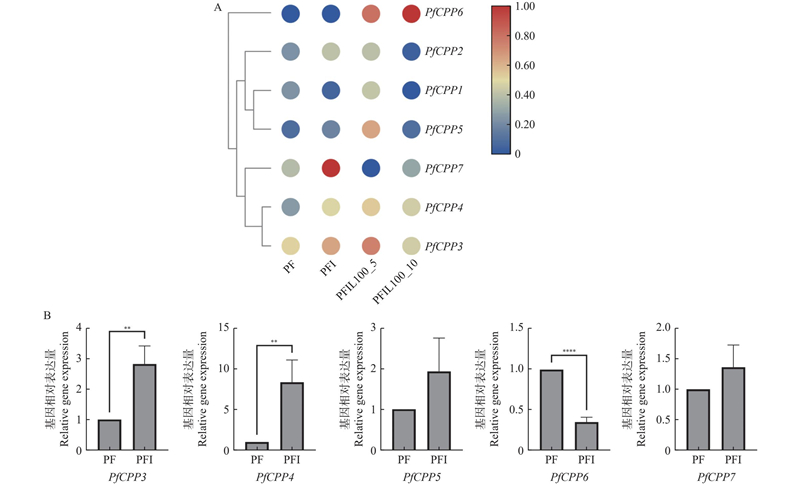

Fig.6
Expression profile of PfCPP genes in P. fortunei under abiotic stress"


Fig.7
Subcellular localisation diagram"
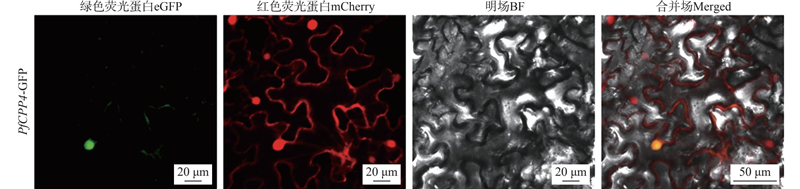

Fig.8
Protein prediction of the PfCPP genes in P. fortunei"


Fig.S3
PfCPP protein interaction network"

Table S4
qRT-PCR amplification system"
| 组分Component | 体积Volume/μL |
| cDNA | 1 |
| 2× qPCR Master Mix | 10 |
| 正向引物Forward primer | 0.4 |
| 反向引物Reverse primer | 0.4 |
| ddH2O | 加到20 Add to 20 |
| 巩 克, 王希胤. 3个伞形科植物CPP基因家族的比较基因组学分析. 种子科技, 2021, 39 (16): 11- 13, 16. | |
| Gong K, Wang X Y. Comparative genomic analysis of CPP gene families in three umbelliferae plants. Seed Science and Technology, 2021, 39 (16): 11- 13, 16. | |
|
黄 静, 郑 晶, 胡乐佳, 等. 陆地棉CPP转录因子家族全基因组鉴定及分析. 分子植物育种, 2022, 20 (14): 4556- 4566.
doi: 10.13271/j.mpb.020.004556 |
|
|
Huang J, Zheng J, Hu L J, et al. Genome-wide identification and analysis of CPP transcription factor family in Gossypium hirsutum L. Molecular Plant Breeding, 2022, 20 (14): 4556- 4566.
doi: 10.13271/j.mpb.020.004556 |
|
| 蒋建平. 1990. 泡桐栽培学. 北京: 中国林业出版社. | |
| Jiang J P. 1990. Cultivation of Paulownia. Beijing: China Forestry Publishing House. [in Chinese] | |
| 李可鑫, 赵 微, 徐林琳, 等. 温度胁迫对白桦丛生苗次生产物合成及抗逆酶积累的影响. 北京林业大学学报, 2021, 43 (7): 31- 39. | |
| Li K X, Zhao W, Xu L L, et al. Effects of temperature stress on the accumulation of secondary metabolites and defensive enzymes in multiple shoots of Betula platyphylla. Journal of Beijing Forestry University, 2021, 43 (7): 31- 39. | |
| 潘冉冉, 位明明, 王亚杰, 等. 巴西橡胶树HbCPP1基因的克隆与表达分析. 植物生理学报, 2018, 54 (5): 763- 772. | |
| Pan R R, Wei M M, Wang Y J, et al. Cloning and expression analysis of HbCCP1 in rubber tree (Hevea brasiliensis). Plant Physiology Journal, 2018, 54 (5): 763- 772. | |
| 唐雪飞, 蒲婷婷, 李豫杰, 等. 泡桐研究进展与展望. 林业科学, 2025, 61 (7): 114- 128. | |
| Tang X F, Pu T T, Li Y J, et al. Research progress and prospect of Paulownia. Scientia Silvae Sinicae, 2025, 61 (7): 114- 128. | |
| 王园龙. 2016. 干旱胁迫对不同种(品种)泡桐基因表达的影响. 郑州: 河南农业大学. | |
| Wang Y L. 2016. The influence of gene expression in different species (varieties) of Paulownia under drought stress. Zhengzhou: Henan Agricultural University. [in Chinese] | |
|
杨如兴, 王鹏杰, 陈芝芝, 等. 茶树CPP转录因子家族的全基因组鉴定及分析. 西北植物学报, 2019, 39 (6): 1024- 1032.
doi: 10.7606/j.issn.1000-4025.2019.06.1024 |
|
|
Yang R X, Wang P J, Chen Z Z, et al. Genome-wide identification and analysis of CPP transcription factor family in tea plants. Acta Botanica Boreali-Occidentalia Sinica, 2019, 39 (6): 1024- 1032.
doi: 10.7606/j.issn.1000-4025.2019.06.1024 |
|
| 张培源. 2023. 干旱胁迫下不同倍性鄂川泡桐的生理特性及代谢组学研究. 郑州: 河南农业大学. | |
| Zhang P Y. 2023. Physiological characteristics and metabolomics of different ploidy Paulownia albiphloea under drought stress. Zhengzhou: Henan Agricultural University. [in Chinese] | |
| 张旭丽, 王瑞军, 郗小倩, 等. 干旱胁迫及复水对黄芪幼苗生长、生理特性及次生代谢产物积累的影响. 作物杂志, 2024 (5): 204- 211. | |
| Zhang X L, Wang R J, Xi X Q, et al. Effects of drought stress and rehydration on growth, physiological characteristics and accumulation of secondary metabolites in Astragalus mongholicus seedlings. Crops, 2024 (5): 204- 211. | |
| 张兆涵, 范梓晗, 焦 蕊, 等. 低温胁迫下林木的生理响应特征. 温带林业研究, 2024, 7 (1): 38- 41,46. | |
| Zhang Z H, Fan Z H, Jiao R, et al. Physiological response characteristics of trees under low temperature stress. Journal of Temperate Forestry Research, 2024, 7 (1): 38- 41,46. | |
| 赵才美, 黄兴奇, 殷富有, 等. 水稻NAC转录因子家族的研究进展. 植物科学学报, 2020, 38 (2): 278- 287. | |
| Zhao C M, Huang X Q, Yin F Y, et al. Research progress on NAC transcription factor family in Oryza sativa L. Plant Science Journal, 2020, 38 (2): 278- 287. | |
|
Cai H S, Tian S, Liu C L, et al. Identification of a MYB3R gene involved in drought, salt and cold stress in wheat (Triticum aestivum L. ). Gene, 2011, 485 (2): 146- 152.
doi: 10.1016/j.gene.2011.06.026 |
|
|
Cao Y B, Sun G L, Zhai X Q, et al. Genomic insights into the fast growth of Paulownias and the formation of Paulownia witches' broom. Molecular Plant, 2021, 14 (10): 1668- 1682.
doi: 10.1016/j.molp.2021.06.021 |
|
|
Chen C J, Wu Y, Li J W, et al. TBtools-Ⅱ: a “one for all, all for one” bioinformatics platform for biological big-data mining. Molecular Plant, 2023, 16 (11): 1733- 1742.
doi: 10.1016/j.molp.2023.09.010 |
|
|
Fan G Q, Dong Y P, Deng M J, et al. Plant-pathogen interaction, circadian rhythm, and hormone-related gene expression provide indicators of phytoplasma infection in Paulownia fortunei. International Journal of Molecular Sciences, 2014, 15 (12): 23141- 23162.
doi: 10.3390/ijms151223141 |
|
|
Fan G Q, Wang L M, Dong Y P, et al. Genome of Paulownia (Paulownia fortunei) illuminates the related transcripts, miRNA and proteins for salt resistance. Scientific Reports, 2017, 7 (1): 1285.
doi: 10.1038/s41598-017-01360-9 |
|
|
Fan G Q, Xu E K, Deng M J, et al. Phenylpropanoid metabolism, hormone biosynthesis and signal transduction-related genes play crucial roles in the resistance of Paulownia fortunei to Paulownia witches’ broom phytoplasma infection. Genes & Genomics, 2015, 37 (11): 913- 929.
doi: 10.1007/s13258-015-0321-2 |
|
| Finn R D, Mistry J, Schuster-Böckler B, et al. 2006. Pfam: clans, web tools and services. Nucleic Acids Research, 34(Database issue): D247-D251. | |
|
Gu L, Kang T Y, Zeng T, et al. Comprehensive identification and expression analysis of the CPP gene family in maize (Zea mays L.). BMC Plant Biology, 2025, 25, 731.
doi: 10.1186/s12870-025-06783-5 |
|
|
Guo N, Zhai X Q, Fan G Q. Chemical composition, health benefits and future prospects of Paulownia flowers: a review. Food Chemistry, 2023, 412, 135496.
doi: 10.1016/j.foodchem.2023.135496 |
|
|
Hauser B A, He J Q, Park S O, et al. TSO1 is a novel protein that modulates cytokinesis and cell expansion in Arabidopsis. Development, 2000, 127 (10): 2219- 2226.
doi: 10.1242/dev.127.10.2219 |
|
|
Jakubowski M. Cultivation potential and uses of Paulownia wood: a review. Forests, 2022, 13 (5): 668.
doi: 10.3390/f13050668 |
|
|
Jangpangi D, Patni B, Chandola V, et al. Medicinal plants in a changing climate: understanding the links between environmental stress and secondary metabolite synthesis. Frontiers in Plant Science, 2025, 16, 1587337.
doi: 10.3389/fpls.2025.1587337 |
|
|
Jiang W Q, Li N, Zhang D P, et al. Elevated temperature and drought stress significantly affect fruit quality and activity of anthocyanin-related enzymes in jujube (Ziziphus jujuba Mill. cv. ‘Lingwuchangzao’). PLoS One, 2020, 15 (11): e0241491.
doi: 10.1371/journal.pone.0241491 |
|
|
Liu D, Meng S, Xiang Z H, et al. An R1R2R3 MYB transcription factor, MnMYB3R1, regulates the polyphenol oxidase gene in mulberry (Morus notabilis). International Journal of Molecular Sciences, 2019, 20 (10): 2602.
doi: 10.3390/ijms20102602 |
|
|
Liu R L, Feng Y Z, Li Q Y, et al. Genome-wide analysis of CPP transcription factor family in endangered plant Phoebe bournei and its response to adversity. Plants, 2025, 14 (5): 803.
doi: 10.3390/plants14050803 |
|
|
Liu Z C, Rumming M P, Meyerowitz E M. TSO1 functions in cell division during Arabidopsis flower development. Development, 1997, 124 (3): 665- 672.
doi: 10.1242/dev.124.3.665 |
|
| Lu T, Dou Y C, Zhang C. 2013. Fuzzy clustering of CPP family in plants with evolution and interaction analyses. BMC Bioinformatics, 14(S13): S10. | |
|
Lugli L, Mezzalira G, Lambardi M, et al. Paulownia spp. a bibliometric trend analysis of a global multi-use tree. Horticulturae, 2023, 9 (12): 1352.
doi: 10.3390/horticulturae9121352 |
|
|
Nakabayashi R, Yonekura-Sakakibara K, Urano K, et al. Enhancement of oxidative and drought tolerance in Arabidopsis by overaccumulation of antioxidant flavonoids. The Plant Journal, 2014, 77 (3): 367- 379.
doi: 10.1111/tpj.12388 |
|
|
Netshimbupfe M H, Berner J, Van Der Kooy F, et al. Influence of drought and heat stress on mineral content, antioxidant activity and bioactive compound accumulation in four African Amaranthus species. Plants (Basel), 2023, 12 (4): 953.
doi: 10.3390/plants12040953 |
|
|
Permatasari N A, Pöhnl T, Neugart S. Impact of drought, salinity, and their combination on growth, mineral content, and plant secondary metabolites of tomatoes (Solanum lycopersicum L.). Physiologia Plantarum, 2026, 178 (1): e70725.
doi: 10.1111/ppl.70725 |
|
|
Rakhimzhanova A, Kasapoğlu A G, Sapakova A, et al. Expression analysis and characterization of the CPP gene family of Melatonin-treated common bean cultivars under different abiotic stresses. South African Journal of Botany, 2023, 160, 282- 294.
doi: 10.1016/j.sajb.2023.07.013 |
|
| Schrödinger L L C. 2020. The PyMOL molecular graphics system, Version 2.0. New York: Schrödinger, LLC. | |
| Song X Y, Zhang Y Y, Wu F C, et al. 2016. Genome-wide analysis of the maize (Zea may L.) CPP-like gene family and expression profiling under abiotic stress. Genetics and Molecular Research, 15(3). | |
|
Sun Y Q, Jia X Y, Chen D X, et al. Genome-wide identification and expression analysis of cysteine-rich polycomb-like protein (CPP) gene family in tomato. International Journal of Molecular Sciences, 2023, 24 (6): 5762.
doi: 10.3390/ijms24065762 |
|
|
Tamura K, Stecher G, Kumar S. MEGA11: molecular evolutionary genetics analysis version 11. Molecular Biology and Evolution, 2021, 38 (7): 3022- 3027.
doi: 10.1093/molbev/msab120 |
|
| Wang Y L, Cao L, Deng M J, et al. Analysis of salt stress-responsive microRNAs in Paulownia fortunei by high-throughput sequencing. Journal of Henan Agricultural University, 2015, 49 (4): 461- 467. | |
|
Wang Y P, Tang H B, Debarry J D, et al. MCScanX: a toolkit for detection and evolutionary analysis of gene synteny and collinearity. Nucleic Acids Research, 2012, 40 (7): e49.
doi: 10.1093/nar/gkr1293 |
|
|
Yang J H, Hansen A S. Enhancer selectivity in space and time: from enhancer-promoter interactions to promoter activation. Nature Reviews Molecular Cell Biology, 2024, 25 (7): 574- 591.
doi: 10.1038/s41580-024-00710-6 |
|
|
Yang L, Fang S Y, Liu L, et al. WRKY transcription factors: Hubs for regulating plant growth and stress responses. Journal of Integrative Plant Biology, 2025, 67 (3): 488- 509.
doi: 10.1111/jipb.13828 |
|
|
Yang Z F, Gu S L, Wang X F, et al. Molecular evolution of the CPP-like gene family in plants: insights from comparative genomics of Arabidopsis and rice. Journal of Molecular Evolution, 2008, 67 (3): 266- 277.
doi: 10.1007/s00239-008-9143-z |
|
|
Zhang L, Liu B B, Zhang J, et al. Insights of molecular mechanism of xylem development in five black poplar cultivars. Frontiers in Plant Science, 2020, 11, 620.
doi: 10.3389/fpls.2020.00620 |
|
|
Zhang L, Zhao H K, Wang Y M, et al. Genome-wide identification and expression analysis of the CPP-like gene family in soybean. Genetics and Molecular Research, 2015, 14 (1): 1260- 1268.
doi: 10.4238/2015.february.13.4 |
|
|
Zhou Y, Hu L F, Ye S F, et al. Genome-wide identification and characterization of cysteine-rich polycomb-like protein (CPP) family genes in cucumber (Cucumis sativus) and their roles in stress responses. Biologia, 2018, 73 (4): 425- 435.
doi: 10.2478/s11756-018-0049-y |
| Viewed | ||||||
|
Full text |
|
|||||
|
Abstract |
|
|||||
