
Scientia Silvae Sinicae ›› 2026, Vol. 62 ›› Issue (10): 71-81.doi: 10.11707/j.1001-7488.LYKX20260024
• Research papers • Previous Articles Next Articles
Yuan Gao1,2,Haijun Yang3,Jinghui Meng1,2,*( )
Received:2026-01-12
Revised:2026-07-09
Online:2026-10-10
Published:2026-10-17
Contact:
Jinghui Meng
E-mail:jmeng@bjfu.edu.cn
CLC Number:
Yuan Gao,Haijun Yang,Jinghui Meng. Management Techniques of Natural Forests for Optimal Carbon Sink Capacity in Zhejiang Province[J]. Scientia Silvae Sinicae, 2026, 62(10): 71-81.

Table 1
Descriptive statistics of stand variables for fixed natural forest plots in 2019"
| 取值范围Range | DBH/cm | B/(m2·hm–2) | N/(trees·hm–2) | S1 | D2 |
| 最大值Max. | 84.60 | 69.96 | 7 590 | 1.60 | 2.29 |
| 最小值Min. | 5.00 | 1.92 | 465 | 0.00 | 0.00 |
| 平均值Mean | 9.84 | 26.74 | 3 073 | 0.91 | 1.28 |
| 标准差SD | 4.85 | 12.57 | 1 267.22 | 0.32 | 0.37 |
Table 2
Parameter estimates and fit statistics of DBH-growth models for dominant tree species groups in natural forests"
| 模型项 Model term | 栎类 Quercus spp. | 马尾松 Pinus massoniana | 木荷 Schima superba | 杉木 Cunninghamia lanceolata | 其他树种 Others |
| 截距项Intercept | 5.34×10⁻¹*** | 6.45×10⁻¹*** | 5.50×10⁻¹*** | 1.05×100*** | 6.26×10⁻¹*** |
| 胸径Diameter at breast height/cm | 2.76×10⁻²*** | 2.72×10⁻²*** | 3.37×10⁻²*** | 3.30×10⁻²*** | 3.36×10⁻²*** |
| 立地地形因子Slope-cosAspect interaction | 2.25×10⁻⁴*** | –2.01×10⁻⁴ | –4.57×10⁻⁴*** | –3.66×10⁻⁴*** | 6.99×10⁻⁵ |
| 树种多样性Tree species diversity | 7.63×10⁻²*** | 8.83×10⁻³ | 8.64×10⁻²*** | –1.73×10⁻¹*** | 4.72×10⁻²*** |
| 径阶多样性Diameter class diversity | –3.90×10⁻²*** | –6.59×10⁻²*** | 3.30×10⁻²*** | –1.75×10⁻¹*** | –1.07×10⁻¹*** |
| 胸高断面积Basal area at breast height/m2 | –4.90×10⁻³*** | –6.83×10⁻³*** | –8.55×10⁻³*** | –1.15×10⁻²*** | –3.61×10⁻³*** |
| 每公顷株数Stand density/(trees·hm–2) | –1.46×10⁻⁵*** | 1.91×10⁻⁶ | 1.28×10⁻⁶ | –2.97×10⁻⁶ | –4.42×10⁻⁵*** |
| R2 | 0.23 | 0.15 | 0.20 | 0.27 | 0.21 |
| AIC | 23 943.43 | 6 232.73 | 11 515.32 | 17 818.72 | 27 118.68 |
| BIC | 24 011.55 | 6 287.80 | 11 577.58 | 17 882.93 | 27 187.12 |
| logLik | –11 963.71 | –3 108.37 | –5 749.66 | –8 901.36 | –13 551.34 |
Table 3
Parameter estimates and fit statistics of mortality models for dominant tree species groups in natural forests"
| 模型项 Model term | 栎类 Quercus spp. | 马尾松 Pinus massoniana | 木荷 Schima superba | 杉木 Cunninghamia lanceolata | 其他树种 Others |
| 截距项Intercept | –1.91×100*** | –1.91×100*** | –1.52×10–0*** | –1.74×100*** | –1.44×100*** |
| 胸径Diameter at breast height/cm | –2.12×10⁻²*** | –8.89×10⁻³** | –5.25×10⁻²*** | –7.64×10⁻²*** | –3.90×10⁻²*** |
| 立地地形因子Slope-cosAspect interaction | –1.59×10⁻³*** | –2.20×10⁻³** | –9.46×10⁻⁵ | 2.18×10⁻³** | –3.89×10⁻⁴ |
| 树种多样性Tree species diversity | –7.00×10⁻² | 2.18×10⁻¹*** | –3.62×10⁻¹*** | 2.09×10⁻¹*** | –4.29×10⁻² |
| 径阶多样性Diameter–class diversity | 9.78×10⁻² | 1.50×10⁻¹ | –5.06×10⁻² | 8.50×10⁻² | 3.94×10⁻² |
| 胸高断面积Basal area at breast height/m2 | 5.23×10⁻⁴*** | 1.96×10⁻²*** | 9.96×10⁻³** | 1.05×10⁻²*** | 1.60×10⁻³ |
| 每公顷株数Stand density/(trees·hm–2) | 3.75×10⁻⁵*** | –1.64×10⁻⁴*** | 1.04×10⁻⁵ | –9.47×10⁻⁵*** | –3.15×10⁻⁵* |
| R2 | 0.25 | 0.13 | 0.14 | 0.16 | 0.12 |
| AIC | 10 341.94 | 3 567.11 | 3 201.64 | 3 563.39 | 12 190.86 |
| BIC | 10 402.04 | 3 615.92 | 3 256.38 | 3 620.14 | 12 251.23 |
| logLik | –5 163.97 | –1 776.55 | –1 593.82 | –1 774.70 | –6 088.43 |
Table 4
Parameter estimates and fit statistics of recruitment models for dominant tree species groups in natural forests"
| 模型项 Model term | 栎类 Quercus spp. | 马尾松 Pinus massoniana | 木荷 Schima superba | 杉木 Cunninghamia lanceolata | 其他树种 Others |
| 截距项Intercept | –4.61×100 | 7.30×100 | –3.77×101** | 4.99×101 | 2.64×101** |
| 每公顷株数Stand density/(trees·hm–2) | –1.06×10⁻²** | –1.63×10⁻³ | 3.02×10⁻³*** | –2.69×10⁻²*** | –2.79×10⁻³ |
| 立地地形因子Slope-cosAspect interaction | 1.04×10⁻¹ | 7.13×10⁻² | 2.01×10⁻¹* | –1.31×10⁻¹ | 1.16×10⁻¹ |
| 树种多样性Tree species diversity | 5.15×101*** | –3.36×100 | 3.52×101*** | 4.26×101* | 2.59×101*** |
| 径阶多样性Diameter–class diversity | –6.06×101*** | –3.04×101** | –1.13×101 | –8.13×101*** | –1.27×101 |
| 胸高断面积Basal area at breast height/m2 | –2.49×10⁻¹ | –1.86×100** | –8.31×10⁻¹* | –3.08×100*** | –1.36×100*** |
| 树种每公顷株数Species group stand density/(trees·hm–2) | 5.43×10⁻²*** | 6.01×10⁻²*** | 3.27×10⁻²*** | 7.70×10⁻²*** | 3.51×10⁻²*** |
| logSigma | 4.42×100*** | 3.83×100*** | 4.06×100*** | 4.73×100*** | 4.26×100*** |
| R2 | 0.22 | 0.26 | 0.14 | 0.22 | 0.11 |
| AIC | 6 428.83 | 1 158.32 | 3 184.99 | 2 794.65 | 10 841.67 |
| BIC | 6 469.64 | 1 193.77 | 3 221.73 | 2 831.88 | 10 882.85 |
| logLik | –3 206.41 | –571.16 | –1 584.49 | –1 389.32 | –5 412.84 |
Table 5
Simulated structural equilibrium and carbon storage under different equilibrium–curve scenarios"
| 编号 No. | 采伐后胸高断面积 Post-harvest basal area at breast height/ (m2·hm–2) | 保留木最大胸径 Maximum DBH of retained trees/ cm | 相邻直径比 Adjacent diameter ratio | var | ic/ (t·hm–2a–1) | QU (%) | FI (%) | MP (%) | SS (%) | OT (%) | C/ (t·hm–2) |
| 1 | 30 | 35 | 1.3 | 0.42 | 8.24 | 98.07 | 0.00 | 0.00 | 0.20 | 1.73 | 171.98 |
| 2 | 30 | 35 | 1.5 | 0.99 | 6.97 | 95.79 | 0.08 | 0.07 | 1.85 | 2.21 | 161.27 |
| 3 | 30 | 35 | 1.7 | 1.89 | 8.10 | 94.15 | 0.08 | 0.07 | 4.35 | 1.35 | 163.56 |
| 4 | 30 | 40 | 1.3 | 0.22 | 7.02 | 98.09 | 0.00 | 0.00 | 0.00 | 1.91 | 155.76 |
| 5 | 30 | 40 | 1.5 | 0.49 | 8.29 | 97.46 | 0.08 | 0.07 | 0.99 | 1.40 | 170.26 |
| 6 | 30 | 40 | 1.7 | 0.67 | 6.99 | 93.66 | 0.38 | 0.07 | 4.50 | 1.39 | 158.32 |
| 7 | 30 | 45 | 1.3 | 0.06 | 8.50 | 98.34 | 0.00 | 0.00 | 0.00 | 1.66 | 179.69 |
| 8 | 30 | 45 | 1.5 | 0.12 | 6.27 | 98.05 | 0.09 | 0.00 | 0.73 | 1.13 | 150.07 |
| 9 | 30 | 45 | 1.7 | 0.20 | 8.29 | 94.82 | 0.34 | 0.06 | 3.14 | 1.64 | 176.77 |
| 10 | 35 | 35 | 1.3 | 0.42 | 7.92 | 96.30 | 0.00 | 0.00 | 0.92 | 2.78 | 182.70 |
| 11 | 35 | 35 | 1.5 | 1.54 | 9.04 | 95.32 | 0.56 | 0.06 | 2.24 | 1.83 | 190.68 |
| 12 | 35 | 35 | 1.7 | 1.79 | 6.91 | 95.33 | 0.35 | 0.07 | 2.53 | 1.72 | 168.44 |
| 13 | 35 | 40 | 1.3 | 0.03 | 10.05 | 97.48 | 0.00 | 0.00 | 0.08 | 2.44 | 208.06 |
| 14 | 35 | 40 | 1.5 | 0.08 | 8.62 | 94.85 | 0.07 | 0.06 | 2.21 | 2.81 | 192.60 |
| 15 | 35 | 40 | 1.7 | 0.19 | 8.45 | 95.68 | 0.33 | 0.06 | 2.34 | 1.59 | 182.24 |
| 16 | 35 | 45 | 1.3 | 0.05 | 8.47 | 98.42 | 0.00 | 0.00 | 0.00 | 1.58 | 188.88 |
| 17 | 35 | 45 | 1.5 | 0.15 | 9.10 | 97.57 | 0.07 | 0.06 | 0.87 | 1.44 | 195.01 |
| 18 | 35 | 45 | 1.7 | 0.23 | 9.40 | 95.55 | 0.57 | 0.06 | 2.28 | 1.55 | 187.21 |
| 19 | 40 | 35 | 1.3 | 0.40 | 10.29 | 96.10 | 0.06 | 0.00 | 1.42 | 2.42 | 209.67 |
| 20 | 40 | 35 | 1.5 | 1.10 | 9.30 | 90.35 | 0.52 | 0.05 | 6.28 | 2.80 | 205.86 |
| 21 | 40 | 35 | 1.7 | 2.02 | 6.31 | 95.66 | 0.31 | 0.06 | 2.23 | 1.74 | 190.89 |
| 22 | 40 | 40 | 1.3 | 0.06 | 9.64 | 97.38 | 0.00 | 0.00 | 0.52 | 2.11 | 213.20 |
| 23 | 40 | 40 | 1.5 | 0.09 | 9.54 | 95.77 | 0.51 | 0.05 | 2.06 | 1.60 | 206.93 |
| 24 | 40 | 40 | 1.7 | 0.20 | 8.71 | 95.47 | 0.55 | 0.06 | 2.21 | 1.72 | 193.24 |
| 25 | 40 | 45 | 1.3 | 0.08 | 10.54 | 99.00 | 0.00 | 0.00 | 0.07 | 0.93 | 237.85 |
| 26 | 40 | 45 | 1.5 | 0.12 | 9.12 | 95.04 | 0.28 | 0.05 | 2.03 | 2.59 | 209.46 |
| 27 | 40 | 45 | 1.7 | 0.21 | 8.95 | 96.27 | 0.29 | 0.05 | 2.06 | 1.32 | 206.51 |
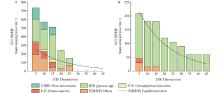
Fig.1
Diameter distribution at the initial (A) and final stages (B) of simulation"
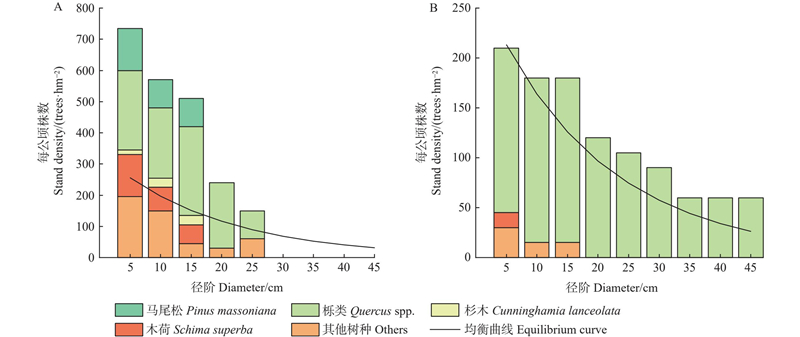
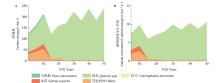
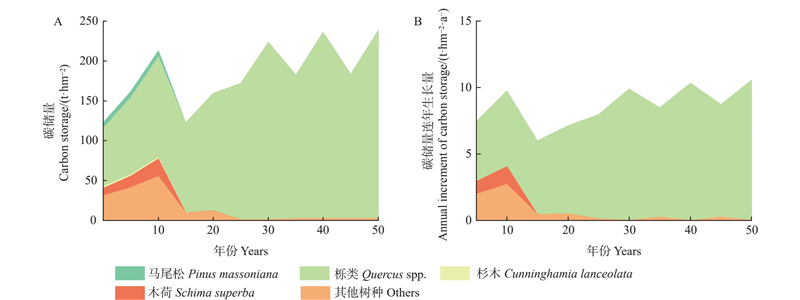
Fig.2
Changes in stand carbon storage and current annual increment during the simulation period"
| 陈 欣, 韩有志. 华北落叶松林林分密度对林下更新影响研究. 山西农业大学学报(自然科学版), 2024, 44 (2): 110- 118. | |
| Chen X, Han Y Z. Study on the effect of stand density on understory regeneration in Larix principis-rupprechtii forest in north China. Journal of Shanxi Agricultural University (Natural Science Edition), 2024, 44 (2): 110- 118. | |
|
彭祚登, 乔 丹. 沈国舫先生关于天然林保育思想的研究. 北京林业大学学报(社会科学版), 2017, 16 (4): 1- 7.
doi: 10.13931/j.cnki.bjfuss.2017071 |
|
|
Peng Z D, Qiao D. Studies on Shen Guo-Fang’s thoughts of natural forest conservation. Journal of Beijing Forestry University (Social Sciences), 2017, 16 (4): 1- 7.
doi: 10.13931/j.cnki.bjfuss.2017071 |
|
| 施 义, 施 贤. 双碳背景下森林资源保护与碳汇利用规划研究. 林业科技情报, 2025, 57 (2): 63- 65. | |
| Shi Y, Shi X. Research on forest resource protection and carbon sink utilization planning under the background of carbon peaking and carbon neutrality. Forestry Science and Technology Information, 2025, 57 (2): 63- 65. | |
|
王田雨, 岳文泽, 黄 波, 等. 未来气候变化情景下浙江省陆地生态系统碳汇估算与保护区识别. 地理学报, 2025, 80 (1): 183- 199.
doi: 10.11821/dlxb202501012 |
|
|
Wang T Y, Yue W Z, Huang B, et al. Estimation of terrestrial ecosystem carbon sinks and identification of carbon sink conservation areas under future climate change scenarios: a case study of Zhejiang Province. Acta Geographica Sinica, 2025, 80 (1): 183- 199.
doi: 10.11821/dlxb202501012 |
|
|
王湘龙. 实施全面停止天然林商业性采伐政策的建议. 热带林业, 2019, 47 (3): 76- 79.
doi: 10.3969/j.issn.1672-0938.2019.03.018 |
|
|
Wang X L. Suggestions on implementing the policy of stopping commercial cutting of natural forests. Tropical Forestry, 2019, 47 (3): 76- 79.
doi: 10.3969/j.issn.1672-0938.2019.03.018 |
|
|
赵卫高, 高 原, 杨 鑫, 等. 重庆市天然栎类转移矩阵和均衡曲线的构建及应用. 中南林业科技大学学报, 2026, 46 (1): 50- 59.
doi: 10.14067/j.cnki.1673-923x.2026.01.005 |
|
|
Zhao W G, Gao Y, Yang X, et al. Construction and application of transition matrix and equilibrium curve for oak natural secondary forests in Chongqing. Journal of Central South University of Forestry and Technology, 2026, 46 (1): 50- 59.
doi: 10.14067/j.cnki.1673-923x.2026.01.005 |
|
| 郑云峰. 关于强化浙江省天然林保护修复的调研报告. 国家林业和草原局管理干部学院学报, 2023, 22 (suppl.1): 1- 6. | |
| Zheng Y F. Research report on strengthening protection and restoration of natural forests in Zhejiang Province. National Academy of Forestry and Grassland Administration Journal, 2023, 22 (suppl.1): 1- 6. | |
|
Abrams M D, Scott M L. Disturbance-mediated accelerated succession in two Michigan forest types. Forest Science, 1989, 35 (1): 42- 49.
doi: 10.1093/forestscience/35.1.42 |
|
|
Amyntas A, Berti E, Gauzens B, et al. Niche complementarity among plants and animals can alter the biodiversity–ecosystem functioning relationship. Functional Ecology, 2023, 37 (10): 2652- 2665.
doi: 10.1111/1365-2435.14419 |
|
|
Bonan G B. Forests and climate change: forcings, feedbacks, and the climate benefits of forests. Science, 2008, 320 (5882): 1444- 1449.
doi: 10.1126/science.1155121 |
|
|
Bryan B A, Gao L, Ye Y Q, et al. China’s response to a national land-system sustainability emergency. Nature, 2018, 559 (7713): 193- 204.
doi: 10.1038/s41586-018-0280-2 |
|
| Burkhart H E, Tomé M. 2012. Whole-stand models for even-aged stands//Modeling forest trees and stands. Dordrecht: Springer Netherlands, 245–260. | |
|
Carrijo J V N, de Freitas Ferreira A B, Ferreira M C, et al. The growth and production modeling of individual trees of Eucalyptus urophylla plantations. Journal of Forestry Research, 2020, 31 (5): 1663- 1672.
doi: 10.1007/s11676-019-00920-1 |
|
|
Clark J S, Fastie C, Hurtt G, et al. Reid’s paradox of rapid plant migration. BioScience, 1998, 48 (1): 13- 24.
doi: 10.2307/1313224 |
|
|
Connell J H, Slatyer R O. Mechanisms of succession in natural communities and their role in community stability and organization. The American Naturalist, 1977, 111 (982): 1119- 1144.
doi: 10.1086/283241 |
|
|
Coomes D A, Allen R B. Mortality and tree-size distributions in natural mixed-age forests. Journal of Ecology, 2007, 95 (1): 27- 40.
doi: 10.1111/j.1365-2745.2006.01179.x |
|
|
D’Amato A W, Catanzaro P F, Fletcher L S. Early regeneration and structural responses to patch selection and structural retention in second-growth northern hardwoods. Forest Science, 2015, 61 (1): 183- 189.
doi: 10.5849/forsci.13-180 |
|
|
Dean T J, Baldwin V C. The relationship between Reineke’s stand-density index and physical stem mechanics. Forest Ecology and Management, 1996, 81 (1/2/3): 25- 34.
doi: 10.1016/0378-1127(95)03666-0 |
|
|
Dillaway D N, Stringer J W, Rieske L K. Light availability influences root carbohydrates, and potentially vigor, in white oak advance regeneration. Forest Ecology and Management, 2007, 250 (3): 227- 233.
doi: 10.1016/j.foreco.2007.05.019 |
|
|
Du X, Chen X Y, Zeng W S, et al. A climate-sensitive transition matrix growth model for uneven-aged mixed-species oak forests in north China. Forestry, 2021, 94 (2): 258- 277.
doi: 10.1093/forestry/cpaa035 |
|
|
Feng X M, Fu B J, Piao S L, et al. Revegetation in China’s Loess Plateau is approaching sustainable water resource limits. Nature Climate Change, 2016, 6 (11): 1019- 1022.
doi: 10.1038/nclimate3092 |
|
|
Frelich L E, Reich P B. Spatial patterns and succession in a Minnesota southern-boreal forest. Ecological Monographs, 1995, 65 (3): 325- 346.
doi: 10.2307/2937063 |
|
|
Hantsch L, Bien S, Radatz S, et al. Tree diversity and the role of non-host neighbour tree species in reducing fungal pathogen infestation. Journal of Ecology, 2014, 102 (6): 1673- 1687.
doi: 10.1111/1365-2745.12317 |
|
|
Harmer R, Morgan G. Development of Quercus robur advance regeneration following canopy reduction in an oak woodland. Forestry, 2007, 80 (2): 137- 149.
doi: 10.1093/forestry/cpm006 |
|
|
Hu Z H, Yu M J. Study on successions sequence of evergreen broad-leaved forest in Gutian Mountain of Zhejiang, eastern China: species diversity. Frontiers of Biology in China, 2008, 3 (1): 45- 49.
doi: 10.1007/s11515-008-0011-4 |
|
|
Hui G Y, Zhang G G, Zhao Z H, et al. Methods of forest structure research: a review. Current Forestry Reports, 2019, 5 (3): 142- 154.
doi: 10.1007/s40725-019-00090-7 |
|
|
Liang J J, Buongiorno J, Monserud R A, et al. Effects of diversity of tree species and size on forest basal area growth, recruitment, and mortality. Forest Ecology and Management, 2007, 243 (1): 116- 127.
doi: 10.1016/j.foreco.2007.02.028 |
|
|
Liang J, Crowther T W, Picard N, et al. Positive biodiversity-productivity relationship predominant in global forests. Science, 2016, 354 (6309): aaf8957.
doi: 10.1126/science.aaf8957 |
|
|
Liang J J, Picard N. Matrix model of forest dynamics: an overview and outlook. Forest Science, 2013, 59 (3): 359- 378.
doi: 10.5849/forsci.11-123 |
|
|
Liu B, Liu Q Q, Daryanto S, et al. Responses of Chinese fir and Schima superba seedlings to light gradients: implications for the restoration of mixed broadleaf-conifer forests from Chinese fir monocultures. Forest Ecology and Management, 2018, 419, 51- 57.
doi: 10.1016/j.foreco.2018.03.033 |
|
|
López I, Ortuño S F, Martín Á J, et al. Estimating the sustainable harvesting and the stable diameter distribution of European beech with projection matrix models. Annals of Forest Science, 2007, 64 (6): 593- 599.
doi: 10.1051/forest:2007037 |
|
|
Luo Y, Chen H Y H. Competition, species interaction and ageing control tree mortality in boreal forests. Journal of Ecology, 2011, 99 (6): 1470- 1480.
doi: 10.1111/j.1365-2745.2011.01882.x |
|
|
Meyer H A. Structure, growth, and drain in balanced uneven-aged forests. Journal of Forestry, 1952, 50 (2): 85- 92.
doi: 10.1093/jof/50.2.85 |
|
|
Pan Y D, Birdsey R A, Fang J Y, et al. A large and persistent carbon sink in the world’s forests. Science, 2011, 333 (6045): 988- 993.
doi: 10.1126/science.1201609 |
|
|
Porté A, Bartelink H H. Modelling mixed forest growth: a review of models for forest management. Ecological Modelling, 2002, 150 (1/2): 141- 188.
doi: 10.1016/s0304-3800(01)00476-8 |
|
|
Pretzsch H, Biber P. A re-evaluation of reineke’s rule and stand density index. Forest Science, 2005, 51 (4): 304- 320.
doi: 10.1093/forestscience/51.4.304 |
|
|
Pretzsch H, Biber P. Tree species mixing can increase maximum stand density. Canadian Journal of Forest Research, 2016, 46 (10): 1179- 1193.
doi: 10.1139/cjfr-2015-0413 |
|
|
Seidl R, Thom D, Kautz M, et al. Forest disturbances under climate change. Nature Climate Change, 2017, 7 (6): 395- 402.
doi: 10.1038/nclimate3303 |
|
|
Sohn J A, Gebhardt T, Ammer C, et al. Mitigation of drought by thinning: Short-term and long-term effects on growth and physiological performance of Norway spruce (Picea abies). Forest Ecology and Management, 2013, 308, 188- 197.
doi: 10.1016/j.foreco.2013.07.048 |
|
|
Song Y F, Yan G, Zhang G F. Light competition contributes to the death of Masson pines of coniferous-broadleaf mixed forests in subtropical China. Forests, 2022, 13 (1): 85.
doi: 10.3390/f13010085 |
|
|
Stage A R. An expression for the effect of aspect, slope, and habitat type on tree growth. Forest Science, 1976, 22 (4): 457- 460.
doi: 10.1093/forestscience/22.4.457 |
|
|
Stephenson N L, Das A J, Condit R, et al. Rate of tree carbon accumulation increases continuously with tree size. Nature, 2014, 507 (7490): 90- 93.
doi: 10.1038/nature12914 |
|
|
Sterba H. Equilibrium curves and growth models to deal with forests in transition to uneven-aged structure-application in two sample stands. Silva Fennica, 2004, 38 (4): 413- 423.
doi: 10.14214/sf.409 |
|
|
Tobin J. Estimation of relationships for limited dependent variables. Econometrica, 1958, 26 (1): 24.
doi: 10.2307/1907382 |
|
|
Turnbull L A, Crawley M J, Rees M. Are plant populations seed-limited? A review of seed sowing experiments. Oikos, 2000, 88 (2): 225- 238.
doi: 10.1034/j.1600-0706.2000.880201.x |
|
| Weiskittel A R, Hann D W, Kershaw J A, et al. , 2011. Forest Growth and Yield Modeling. Chichester: John Wiley & Sons. | |
|
Young B, Liang J J, Stuart Chapin F. Effects of species and tree size diversity on recruitment in the Alaskan boreal forest: a geospatial approach. Forest Ecology and Management, 2011, 262 (8): 1608- 1617.
doi: 10.1016/j.foreco.2011.07.011 |
|
| Zenner E K. 2004. Does old-growth condition imply high live-tree structural complexity? Forest Ecology and Management, 195(1/2): 243–258. | |
|
Zhai L, Will R E, Zhang B. Structural diversity is better associated with forest productivity than species or functional diversity. Ecology, 2024, 105 (4): e4269.
doi: 10.1002/ecy.4269 |
| Viewed | ||||||
|
Full text |
|
|||||
|
Abstract |
|
|||||
