
Scientia Silvae Sinicae ›› 2026, Vol. 62 ›› Issue (9): 82-95.doi: 10.11707/j.1001-7488.LYKX20250741
• Research papers • Previous Articles Next Articles
Hailiang Lu,Weitao Zou,Chao Li,Guangsheng Chen,Weipeng Jing*( )
Received:2025-12-11
Online:2026-09-10
Published:2026-09-23
Contact:
Weipeng Jing
E-mail:jwp@nefu.edu.cn
CLC Number:
Hailiang Lu,Weitao Zou,Chao Li,Guangsheng Chen,Weipeng Jing. Forest Disturbance Detection Method Based on Multi-source Data Fusion and Deep Temporal Modeling[J]. Scientia Silvae Sinicae, 2026, 62(9): 82-95.
Fig.1
Forest disturbance detection in the Huzhong area using multi-source data fusion and the LTFD method"
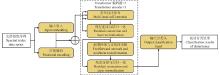
Fig.2
The structure of the Transformer model"

Table 1
LandTrendr-Y and LandTrendr-M algorithm parameters setting"
| 参数名称Parameter name | LandTrendr-Y | LandTrendr-M |
| maxSegments | 6 | 18 |
| spikeThreshold | 0.9 | 0.95 |
| vertexCountOvershoot | 3 | 5 |
| preventOneYearRecovery | 真True | 真True |
| recoveryThreshold | 0.25 | 0.25 |
| pvalThreshold | 0.05 | 0.05 |
| bestModelProportion | 0.75 | 075 |
| minObservationsNeeded | 6 | 6 |
Table 2
Spatial-spectral fusion verification results"
| 方法Methods | |||||
| BT-H | 0.134 | 0.036 | 0.835 | 0.112 | 0.856 |
| SR-D | 0.027 | 0.006 | 0.967 | 0.065 | 0.929 |
| PSDip | 0.016 | 0.016 | 0.968 | 0.158 | 0.829 |
| ZSPNet | 0.007 | 0.003 | 0.990 | 0.047 | 0.950 |
Table 3
Spatiotemporal fusion verification results"
| 方法Methods | RMSE | SAM | ERGAS | CC | SSIM |
| STARFM | 0.021 | 0.072 | 0.913 | 0.793 | 0.941 |
| FSDAF | 0.046 | 0.079 | 5.418 | 0.667 | 0.931 |
| StfNet | 0.020 | 0.053 | 0.774 | 0.862 | 0.958 |
| StfMLP | 0.020 | 0.053 | 0.771 | 0.875 | 0.959 |
Table 4
Results of LTFD disturbance detection using various spectral index combinations"
| 光谱指数组合 Spectral index combination | 扰动分类 Disturbance classification | 参考数据Reference | UA | PA | OA | Kappa | |
| 非扰动Undisturbed | 扰动Disturbed | ||||||
| NBR | 非扰动Undisturbed | 726 | 53 | 0.931 | 0.932 | 0.890 | 0.656 |
| 扰动Disturbed | 54 | 141 | 0.727 | 0.723 | |||
| NBR+EVI | 非扰动Undisturbed | 704 | 26 | 0.903 | 0.964 | 0.895 | 0.701 |
| 扰动Disturbed | 76 | 168 | 0.866 | 0.689 | |||
| NBR+NDMI | 非扰动Undisturbed | 704 | 37 | 0.903 | 0.950 | 0.884 | 0.662 |
| 扰动Disturbed | 76 | 157 | 0.809 | 0.674 | |||
| NBR+NDMI+EVI | 非扰动Undisturbed | 693 | 22 | 0.888 | 0.969 | 0.888 | 0.688 |
| 扰动Disturbed | 87 | 172 | 0.887 | 0.664 | |||
Table 5
Verification results of different disturbance detection methods"
| 方法 Methods | 扰动分类 Disturbance classification | 参考数据Reference | UA | PA | OA | Kappa | TOA | |
| 非扰动Undisturbed | 扰动Disturbed | |||||||
| LandTrendr-Y | 非扰动Undisturbed | 763 | 89 | 0.978 | 0.896 | 0.891 | 0.604 | 0.686 |
| 扰动Disturbed | 17 | 105 | 0.541 | 0.861 | ||||
| LandTrendr-M | 非扰动Undisturbed | 728 | 92 | 0.933 | 0.888 | 0.852 | 0.498 | 0.088 |
| 扰动Disturbed | 52 | 102 | 0.526 | 0.662 | ||||
| RF | 非扰动Undisturbed | 665 | 24 | 0.853 | 0.965 | 0.857 | 0.620 | 0.742 |
| 扰动Disturbed | 115 | 170 | 0.876 | 0.596 | ||||
| LTFD | 非扰动Undisturbed | 704 | 26 | 0.903 | 0.964 | 0.895 | 0.701 | 0.767 |
| 扰动Disturbed | 76 | 168 | 0.866 | 0.689 | ||||
Table 6
Disturbance classification results of LTFD and RF"
| 方法 Methods | 火灾Fire | 采伐Logging | OA | Kappa | |||
| UA | PA | UA | PA | ||||
| RF | 0.810 | 0.708 | 0.787 | 0.424 | 0.565 | 0.443 | |
| LTFD | 0.886 | 0.809 | 0.787 | 0.543 | 0.662 | 0.564 | |
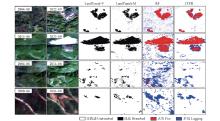
Fig.3
Visual comparison of different disturbance detection methods"
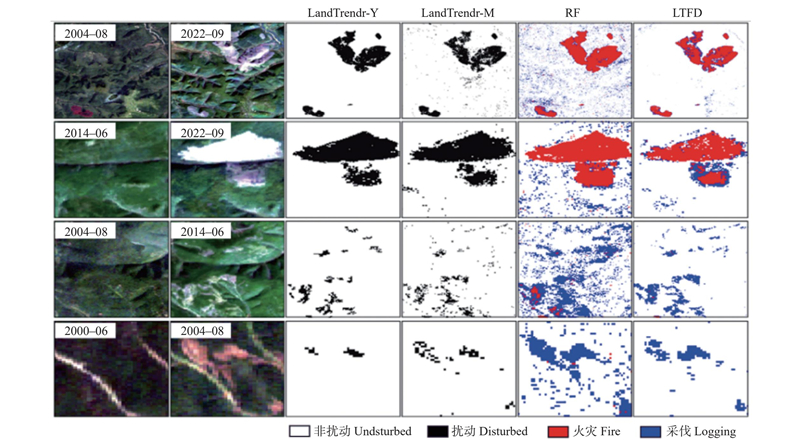
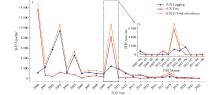
Fig.4
Statistics of forest disturbance area in the study area"
Table 7
Staged statistics of forest disturbance area hm2"
| 年份 Year | 火灾面积 Fire area | 采伐面积 Logging area | 总面积 Total area |
| 2000—2005 | 17 726.22 | 24 430.32 | 42 156.54 |
| 2006—2010 | 9 752.76 | 6 712.29 | 16 465.05 |
| 2011—2015 | 883.35 | 4 477.41 | 5 360.76 |
| 2016—2022 | 1 533.33 | 1 453.05 | 2 986.38 |
| 陈宏伟, 胡远满, 常 禹, 等. 森林采伐方式对森林景观的影响模拟: 以大兴安岭呼中林区为例. 生态学杂志, 2013, 32 (7): 1888- 1895. | |
| Chen H W, Hu Y M, Chang Y, et al. Simulation of the effect of forest harvest mode on forest landscape: a case study in Huzhong forest region of Daxing’anling Mountains, China. Chinese Journal of Ecology, 2013, 32 (7): 1888- 1895. | |
| 毛学刚, 姚 瑶, 范文义. 基于Landsat长时间序列的森林扰动参数提取与树高估算. 林业科学, 2019, 55 (3): 79- 87. | |
| Mao X G, Yao Y, Fan W Y. Extraction of forest disturbance parameters and estimation of forest height based on long time-series Landsat. Scientia Silvae Sinicae, 2019, 55 (3): 79- 87. | |
| 沈文娟, 李明诗, 黄成全. 长时间序列多源遥感数据的森林干扰监测算法研究进展. 遥感学报, 2018, 22 (6): 1005- 1022. | |
| Shen W J, Li M S, Huang C Q. Review of remote sensing algorithms for monitoring forest disturbance from time series and multi-source data fusion. National Remote Sensing Bulletin, 2018, 22 (6): 1005- 1022. | |
|
王 晨, 庞 勇, 袁智文, 等. 基于LandTrendr算法和森林资源清查数据的海南岛森林扰动监测与分析. 生态学报, 2025, 45 (16): 8054- 8070.
doi: 10.20103/j.stxb.202409092167 |
|
|
Wang C, Pang Y, Yuan Z W, et al. Forest disturbance monitoring and analysis based on LandTrendr algorithm and forest resource inventory data in Hainan Island. Acta Ecologica Sinica, 2025, 45 (16): 8054- 8070.
doi: 10.20103/j.stxb.202409092167 |
|
|
王明玉, 李伟克, 舒立福, 等. 雷击火高发的呼中地区瞭望塔配置的可视性评价. 林业科学, 2023, 59 (10): 9- 21.
doi: 10.11707/j.1001-7488.LYKX20220917 |
|
|
Wang M Y, Li W K, Shu L F, et al. Visibility evaluation of the lookout tower configuration in Huzhong area where lightning fires frequently occur. Scientia Silvae Sinicae, 2023, 59 (10): 9- 21.
doi: 10.11707/j.1001-7488.LYKX20220917 |
|
|
王 宁, 岳彩荣, 罗洪斌, 等. 森林扰动遥感影像检测方法研究进展. 世界林业研究, 2022, 35 (4): 40- 46.
doi: 10.13348/j.cnki.sjlyyj.2022.0022.y |
|
|
Wang N, Yue C R, Luo H B, et al. Review on forest disturbance detection methods by remote sensing. World Forestry Research, 2022, 35 (4): 40- 46.
doi: 10.13348/j.cnki.sjlyyj.2022.0022.y |
|
|
吴 伶, 刘湘南, 刘美玲, 等. 融合遥感时间序列时空谱信息的森林扰动检测与归因研究进展. 遥感学报, 2024, 28 (3): 558- 575.
doi: 10.11834/jrs.20232211 |
|
|
Wu L, Liu X N, Liu M L, et al. Review of the detection and attribution of multi-type forest disturbances using an ensemble of spatio-temporal-spectral information from remote sensing images. National Remote Sensing Bulletin, 2024, 28 (3): 558- 575.
doi: 10.11834/jrs.20232211 |
|
| 肖 亮, 刘鹏飞, 李 恒. 多源空−谱遥感图像融合方法进展与挑战. 中国图象图形学报, 2020, 25 (5): 851- 863. | |
| Xiao L, Liu P F, Li H. Progress and challenges in the fusion of multisource spatial−spectral remote sensing images. Journal of Image and Graphics, 2020, 25 (5): 851- 863. | |
|
杨广奇, 刘 慧, 钟锡武, 等. 遥感图像时空融合综述. 计算机工程与应用, 2022, 58 (10): 27- 40.
doi: 10.3778/j.issn.1002-8331.2111-0131 |
|
|
Yang G Q, Liu H, Zhong X W, et al. Temporal and spatial fusion of remote sensing images: a review. Computer Engineering and Applications, 2022, 58 (10): 27- 40.
doi: 10.3778/j.issn.1002-8331.2111-0131 |
|
|
杨宇迪, 郭 颖, 田 昕, 等. 多时间分辨率遥感森林变化监测方法综述. 遥感技术与应用, 2025, 40 (4): 1026- 1035.
doi: 10.11873/j.issn.1004-0323.2025.4.1026 |
|
|
Yang Y D, Guo Y, Tian X, et al. Review of multi-time resolution remote sensing forest change detection methods. Remote Sensing Technology and Application, 2025, 40 (4): 1026- 1035.
doi: 10.11873/j.issn.1004-0323.2025.4.1026 |
|
|
郑明心, 李玥莹, 王肇钧, 等. 干扰对森林土壤动物群落特征的影响. 生态学杂志, 2026, 45 (2): 606- 616.
doi: 10.13292/j.1000-4890.202602.050 |
|
|
Zheng M X, Li Y Y, Wang Z J, et al. The impacts of disturbance on soil faunal communities in forests. Chinese Journal of Ecology, 2026, 45 (2): 606- 616.
doi: 10.13292/j.1000-4890.202602.050 |
|
|
钟 莉, 陈芸芝, 汪小钦. 基于Landsat时序数据的森林干扰监测. 林业科学, 2020, 56 (5): 80- 88.
doi: 10.11707/j.1001-7488.20200509 |
|
|
Zhong L, Chen Y Z, Wang X Q. Forest disturbance monitoring based on time series of Landsat data. Scientia Silvae Sinicae, 2020, 56 (5): 80- 88.
doi: 10.11707/j.1001-7488.20200509 |
|
|
Bhat Y, Nandy S, Das K, et al. Vegetation disturbance and regrowth dynamics in shifting cultivation landscapes. Scientific Reports, 2024, 14 (1): 28324.
doi: 10.1038/s41598-024-78089-9 |
|
|
Breiman L. Random forests. Machine Learning, 2001, 45 (1): 5- 32.
doi: 10.1023/A:1010933404324 |
|
|
Cai J J, Huang B, Fung T. Progressive spatiotemporal image fusion with deep neural networks. International Journal of Applied Earth Observation and Geoinformation, 2022, 108, 102745.
doi: 10.1016/j.jag.2022.102745 |
|
|
Cai Y T, Li X, Zhu P, et al. China earth observation data cube: the 30-m seamless annual leaf-on Landsat composites from 1985 to 2023. Journal of Remote Sensing, 2025, 5, 698.
doi: 10.34133/remotesensing.0698 |
|
|
Chen G S, Lu H L, Di D L, et al. StfMLP: spatiotemporal fusion multilayer perceptron for remote-sensing images. IEEE Geoscience and Remote Sensing Letters, 2023, 20, 5000105.
doi: 10.1109/lgrs.2022.3230720 |
|
|
Du B, Yuan Z L, Bo Y C, et al. A combined deep learning and prior knowledge constraint approach for large-scale forest disturbance detection using time series remote sensing data. Remote Sensing, 2023, 15 (12): 2963.
doi: 10.3390/rs15122963 |
|
|
Foga S, Scaramuzza P L, Guo S, et al. Cloud detection algorithm comparison and validation for operational Landsat data products. Remote Sensing of Environment, 2017, 194, 379- 390.
doi: 10.1016/j.rse.2017.03.026 |
|
|
Gao F, Masek J, Schwaller M, et al. On the blending of the Landsat and MODIS surface reflectance: predicting daily Landsat surface reflectance. IEEE Transactions on Geoscience and Remote Sensing, 2006, 44 (8): 2207- 2218.
doi: 10.1109/TGRS.2006.872081 |
|
|
Hansen M C, Potapov P V, Moore R, et al. High-resolution global maps of 21st-century forest cover change. Science, 2013, 342 (6160): 850- 853.
doi: 10.1126/science.1244693 |
|
|
Kennedy R E, Yang Z Q, Gorelick N, et al. Implementation of the LandTrendr algorithm on google earth engine. Remote Sensing, 2018, 10 (5): 691.
doi: 10.3390/rs10050691 |
|
|
Liu X, Deng C W, Chanussot J, et al. StfNet: a two-stream convolutional neural network for spatiotemporal image fusion. IEEE Transactions on Geoscience and Remote Sensing, 2019, 57 (9): 6552- 6564.
doi: 10.1109/TGRS.2019.2907310 |
|
|
Liu Z, Zhang Y R, Zheng X. Improving urban forest expansion detection with LandTrendr and machine learning. Forests, 2024, 15 (8): 1452.
doi: 10.3390/f15081452 |
|
|
Lu H L, Paoletti M E, Haut J M, et al. A novel spectral-spatial attention network for zero-shot pansharpening. IEEE Journal of Selected Topics in Applied Earth Observations and Remote Sensing, 2025, 18, 19805- 19820.
doi: 10.1109/JSTARS.2025.3587244 |
|
|
Lolli S, Alparone L, Garzelli A, et al. Haze correction for contrast-based multispectral pansharpening. IEEE Geoscience and Remote Sensing Letters, 2017, 14 (12): 2255- 2259.
doi: 10.1109/LGRS.2017.2761021 |
|
|
Marinelli D, Dalponte M, Frizzera L, et al. A method for continuous sub-annual mapping of forest disturbances using optical time series. Remote Sensing of Environment, 2023, 299, 113852.
doi: 10.1016/j.rse.2023.113852 |
|
|
Perbet P, Guindon L, Côté J F, et al. Evaluating deep learning methods applied to Landsat time series subsequences to detect and classify boreal forest disturbances events: The challenge of partial and progressive disturbances. Remote Sensing of Environment, 2024, 306, 114107.
doi: 10.1016/j.rse.2024.114107 |
|
|
Peng Y D, Li W S, Luo X B, et al. Integrated fusion framework based on semicoupled sparse tensor factorization for spatio-temporal-spectral fusion of remote sensing images. Information Fusion, 2021, 65, 21- 36.
doi: 10.1016/j.inffus.2020.08.013 |
|
|
Potapov P, Hansen M C, Pickens A, et al. The global 2000–2020 land cover and land use change dataset derived from the Landsat archive: first results. Frontiers in Remote Sensing, 2022, 3, 856903.
doi: 10.3389/frsen.2022.856903 |
|
|
Qiu D A, Liang Y J, Shang R, et al. Improving LandTrendr forest disturbance mapping in China using multi-season observations and multispectral indices. Remote Sensing, 2023, 15 (9): 2381.
doi: 10.3390/rs15092381 |
|
|
Rui X Y, Cao X Y, Li Y N, et al. Variational zero-shot multispectral pansharpening. IEEE Transactions on Geoscience and Remote Sensing, 2024, 62, 5409716.
doi: 10.1109/tgrs.2024.3492059 |
|
|
Schiller C, Költzow J, Schwarz S, et al. Forest disturbance detection in Central Europe using transformers and Sentinel-2 time series. Remote Sensing of Environment, 2024, 315, 114475.
doi: 10.1016/j.rse.2024.114475 |
|
| Vaswani A, Shazeer N, Parmar N, et al. 2017. Attention is all you need. In 31st Conference on Neural Information Processing Systems (NIPS 2017), Long Beach, CA, USA. | |
|
Vicinanza M R, Restaino R, Vivone G, et al. A pansharpening method based on the sparse representation of injected details. IEEE Geoscience and Remote Sensing Letters, 2015, 12 (1): 180- 184.
doi: 10.1109/LGRS.2014.2331291 |
|
|
Wang J, Wang J D, Zhou H M, et al. Detecting forest disturbance in northeast China from GLASS LAI time series data using a dynamic model. Remote Sensing, 2017a, 9 (12): 1293.
doi: 10.3390/rs9121293 |
|
|
Wang L H, Wei F L, Tagesson T, et al. Transforming forest management through rewilding: enhancing biodiversity, resilience, and biosphere sustainability under global change. One Earth, 2025, 8 (3): 101195.
doi: 10.1016/j.oneear.2025.101195 |
|
|
Wang L, Liu S D, Song W J, et al. Global high-resolution forest disturbance type dataset. Earth System Science Data, 2026, 18 (2): 1601- 1617.
doi: 10.5194/essd-18-1601-2026 |
|
|
Wang Q M, Zhang Y H, Onojeghuo A O, et al. Enhancing spatio-temporal fusion of MODIS and Landsat data by incorporating 250 m MODIS data. IEEE Journal of Selected Topics in Applied Earth Observations and Remote Sensing, 2017b, 10 (9): 4116- 4123.
doi: 10.1109/JSTARS.2017.2701643 |
|
|
Xu K, Lin W S, Zhang N. Comparative analysis of forest disturbance detection in the key state-owned forest region of the Greater Khingan Range of China based on different algorithms. Geocarto International, 2025, 40, 2489526.
doi: 10.1080/10106049.2025.2489526 |
|
|
Zhang X, Zhao T T, Xu H, et al. GLC_FCS30D: the first global 30 m land-cover dynamics monitoring product with a fine classification system for the period from 1985 to 2022 generated using dense-time-series Landsat imagery and the continuous change-detection method. Earth System Science Data, 2024, 16 (3): 1353- 1381.
doi: 10.5194/essd-16-1353-2024 |
|
|
Zhou G X, Liu M, Liu X N. An autoencoder-based model for forest disturbance detection using Landsat time series data. International Journal of Digital Earth, 2021, 14 (9): 1087- 1102.
doi: 10.1080/17538947.2021.1949399 |
|
|
Zhu X L, Helmer E H, Gao F, et al. A flexible spatiotemporal method for fusing satellite images with different resolutions. Remote Sensing of Environment, 2016, 172, 165- 177.
doi: 10.1016/j.rse.2015.11.016 |
| [1] | Xing¹ Zhang,Yufan¹ Yan,Bolin¹ Fu,Jingwen Li,Lingxue Yu,Ying Li,Rongxin Deng,Jing Sun. An Automatic Extraction Method for Farmland Shelterbelts Based on ENVINet5-SME [J]. Scientia Silvae Sinicae, 2026, 62(9): 124-138. |
| [2] | Zeyu Xu,Rongrong Li. A Surface Defect Detection Algorithm for Bamboo Strips Based on Lightweight Feature Fusion and Spatial Reconstruction [J]. Scientia Silvae Sinicae, 2026, 62(7): 186-196. |
| [3] | Zongqi Yao,Lingting Lei,Guoqi Chai,Langning Huo,Xin Tian,Xiaoli Zhang. Collaborative Detection Method with Spaceborne Multispectral and SAR Data for Land Cover and Forest Type Changes [J]. Scientia Silvae Sinicae, 2026, 62(2): 160-172. |
| [4] | Yaodi Li,Ye Tian,Changchun Zhang,Jiangjian Xie,Haitao Zhao,Junguo Zhang. Wildlife Image Recognition Methods and Challenges Based on Deep Learning [J]. Scientia Silvae Sinicae, 2026, 62(1): 207-222. |
| [5] | Zeyu Cui,Huaiqing Zhang,Yang Liu,Jing Zhang,Tingdong Yang,Rurao Fu. Progress and Applications of 3D Modeling and Visualization Simulation Technology for Trees [J]. Scientia Silvae Sinicae, 2025, 61(6): 1-12. |
| [6] | Xiaoning Ge,Xinqiao Xu,Huaiqing Zhang,Jing Zhang,Jie Yang,Zeyu Cui,Rurao Fu,Jinjie Liang,Tianhua Zou,Linlong Wang,Yang Liu. Progress and Reflection on Genotype-Environment Interaction Algorithms in Forest Tree Breeding [J]. Scientia Silvae Sinicae, 2025, 61(3): 1-15. |
| [7] | Min Ji,Rui Gao,Xiaohuan Wang,Xingliang Diao,Jiakai Han,Yang Zhao,Guofu Wang,Wei Zhang. Online Detecting Method of Structural Lumber Knot Based on Deep Learning [J]. Scientia Silvae Sinicae, 2025, 61(11): 150-159. |
| [8] | Wanying Xie,Wenping Liu,Han Wang. UAV Images of Pine Forests for Early Detection of Pine Wood Nematode Infestation [J]. Scientia Silvae Sinicae, 2024, 60(9): 124-133. |
| [9] | Jiandong Qi,Shangzi Zheng,Ziyi Chen,Zhongtian Ma. Wildlife Image Recognition of Infrared Cameras in Beijing Area Based on an Improvement ConvNeXt Model [J]. Scientia Silvae Sinicae, 2024, 60(8): 33-45. |
| [10] | Zhikang Tian,Zhedong Ge,Huanqi Zheng,Zhishuai Zheng,Yucheng Zhou. Microscopic Identification Methods for 75 Types of Hardwood Based on Deep Neural Network [J]. Scientia Silvae Sinicae, 2024, 60(10): 94-103. |
| [11] | Jiandong Qi,Zhongtian Ma,Dehuai Zhang,Yun Tian. Wildlife Image Recognition in Miyun District Based on BS-ResNeXt-50 [J]. Scientia Silvae Sinicae, 2023, 59(8): 112-122. |
| [12] | Jia Li,Lan Lan,Zuozhong Zhang,Wentao Yuan,Demin Gao,Shuqin Zong,Qiaolin Ye. Inversion Technology of Forest Fuel Moisture Content Based on Deep Learning [J]. Scientia Silvae Sinicae, 2022, 58(10): 47-58. |
| [13] | Xianglin Tian,Ziyan Liao,Shuaichao Sun,Hailian Xue,Bin Wang,Tianjian Cao. Impacts of Multiple Source Data on Forest Forecasting and Uncertainty Propagation [J]. Scientia Silvae Sinicae, 2021, 57(3): 51-66. |
| [14] | Yan Zhou,Wenping Liu,Youqing Luo,Shixiang Zong. Small Object Detection for Infected Trees Based on the Deep Learning Method [J]. Scientia Silvae Sinicae, 2021, 57(3): 98-107. |
| [15] | Li Zhong,Yunzhi Chen,Xiaoqin Wang. Forest Disturbance Monitoring Based on Time Series of Landsat Data [J]. Scientia Silvae Sinicae, 2020, 56(5): 80-88. |
| Viewed | ||||||
|
Full text |
|
|||||
|
Abstract |
|
|||||
