
Scientia Silvae Sinicae ›› 2026, Vol. 62 ›› Issue (9): 177-186.doi: 10.11707/j.1001-7488.LYKX20250737
• Research papers • Previous Articles
Yiran Lü1,2,Tao Zhang3,Juan Guo1,Yongping Chen1,*( )
Received:2025-12-09
Revised:2026-04-22
Online:2026-09-10
Published:2026-09-16
Contact:
Yongping Chen
E-mail:chenyp@caf.ac.cn
CLC Number:
Yiran Lü,Tao Zhang,Juan Guo,Yongping Chen. Changes Regularity of Chemical Composition on the Shallow Surface of Larch Wood Used in Ancient Buildings[J]. Scientia Silvae Sinicae, 2026, 62(9): 177-186.

Fig.1
Optical micrographs of three sections of ancient architectural and fresh wood"


Fig.2
Photos of ancient architectural wood 17#(a), 3#(b), 15#(c) and fresh wood 22#(d) and diagram of sample preparation (e)"
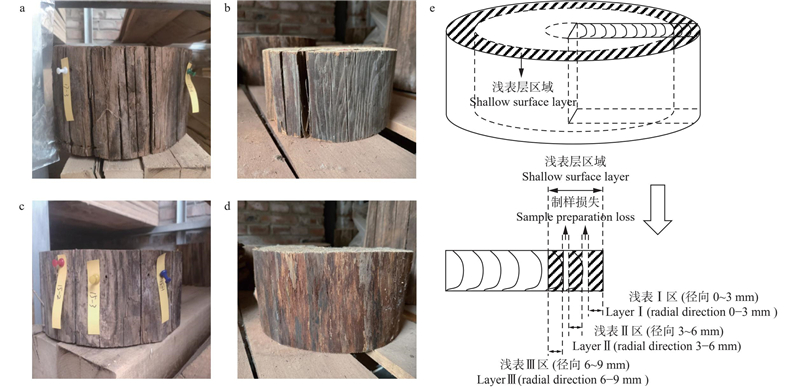

Fig.3
Chemical composition content of ancient architectural and fresh wood"

Table 1
The infrared spectral characteristic peaks of the main chemical composition of wood and their identifications"
| 波数 Wavenumbers/ cm?1 | 归属 Identifications | 化学组分 Composition |
| 1 737 | 乙酰基和羧基中的C=O 伸缩振动 C=O stretching in acetyl groups and carboxyl groups vibration | 半纤维素 Hemicellulose |
| 1 512 | C=C芳香族骨架振动 C=C aromatic skeletal vibration | 木质素 Lignin |
| 1 460 | C—H弯曲振动 C—H bending vibration | 半纤维素、木质素 Hemicellulose, lignin |
| 1 373 | C—H弯曲振动 C—H bending vibration | 纤维素、半纤维素 Cellulose, hemicellulose |
| 1 330 | O—H面内弯曲振动 O—H in-plane bending vibration | 纤维素无定形区 Amorphous cellulose |
| 1 318 | C—H剪切振动 C—H shearing vibration | 纤维素结晶区 Crystalline cellulose |
| 1 230 | C—O伸缩振动 C—O stretching vibration | 半纤维素 Hemicellulose |
| 897 | C—H弯曲振动 C—H bending vibration | 纤维素 Cellulose |

Fig.4
Infrared spectrogram of ancient architectural and fresh wood"

Table 2
The comparison results of the ratio of the peak intensities of ancient architectural and fresh wood"
| 组别 Group types | 古建材/新材Ancient architectural wood/fresh wood (A/F) | ||||||
| I1 512/897 | I1 737/897 | I1 230/897 | I1 460/897 | I1 373/897 | I1 330/897 | I1 318/897 | |
| 17-1# | 0.79 | — | 0.85 | 0.91 | 0.94 | 0.99 | 1.01 |
| 17-2# | 0.88 | — | 0.93 | 0.96 | 0.97 | 1.00 | 1.02 |
| 17-3# | 0.87 | 0.60 | 0.91 | 0.94 | 0.94 | 0.96 | 0.96 |
| 3-1# | 0.79 | 0.70 | 0.87 | 0.88 | 0.92 | 0.92 | 0.91 |
| 3-2# | 0.85 | 0.68 | 0.98 | 0.94 | 0.98 | 0.97 | 0.97 |
| 3-3# | 0.87 | 0.75 | 0.92 | 0.94 | 0.94 | 0.94 | 0.93 |
| 15-1# | 0.96 | 0.65 | 0.95 | 0.99 | 1.02 | 1.03 | 1.04 |
| 15-2# | 0.98 | 0.79 | 1.04 | 1.01 | 1.04 | 1.04 | 1.06 |
| 15-3# | 0.97 | 0.86 | 0.99 | 0.97 | 0.94 | 0.98 | 0.99 |

Fig.5
X-ray diffraction spectra (a) and the relative crystallinity (b) of ancient architectural and fresh wood"


Fig.6
Infrared spectrum (a) and the relative ratio results of characteristic peak intensities (b) of ancient architectural and fresh wood"


Fig.7
X-ray diffraction spectra (a) and relative crystallinity (b) of ancient architectural and fresh wood"

| 陈凯强, 龙克莹, 初石民, 等. 自然老化对古建筑木材细胞壁结构与成分的影响. 木材科学与技术, 2023, 37 (5): 30- 37. | |
| Chen K Q, Long K Y, Chu S M, et al. Effects of natural aging on the cell wall structure and chemical composition of ancient architectural wood. Chinese Journal of Wood Science and Technology, 2023, 37 (5): 30- 37. | |
| 李 坚. 2020. 木材波谱学. 北京: 科学出版社. | |
| Li J. 2020. Wood spectroscopy. Beijing: Science Press. [in Chinese] | |
|
李 坚, 甘文涛, 陈志俊, 等. 向新出发, 木材科学前沿发展. 森林工程, 2025, 41 (1): 1- 39.
doi: 10.7525/j.issn.1006-8023.2025.01.001 |
|
|
Li J, Gan W T, Chen Z J, et al. Frontier advances in wood science towards a new departure. Forest Engineering, 2025, 41 (1): 1- 39.
doi: 10.7525/j.issn.1006-8023.2025.01.001 |
|
| 李 雄, 符小慧, 张文博, 等. 故宫长春宫木构件材质劣化研究. 文物保护与考古科学, 2019, 31 (1): 58- 64. | |
| Li X, Fu X H, Zhang W B, et al. Study of the degradation of wood structural components of the Changchun Palace. Sciences of Conservation and Archaeology, 2019, 31 (1): 58- 64. | |
| 刘 波, 付跃进, 马星霞, 等. 2021. 木材生物病害严重区域古建筑木构件树种选择及与生物病害的关系. 林业科学, 57(12): 108−121. | |
| Liu B, Fu Y J, Ma X X, et al. 2021, Relationship between wood species selection and biological diseases of ancient building wooden components in severe wood biological diseases area. Scientia Silvae Sinicae, 57(12): 108−121. [in Chinese] | |
| 刘人源, 曾珠亮, 李 权. 涂饰对贵州民族木结构建筑用材表面色差及防腐性能的影响. 森林工程, 2023, 39 (3): 100- 106. | |
| Liu R Y, Zeng Z L, Li Q. The effect of finishing treatment on the surface color difference and decay resistance performance of national wooden structure building materials in Guizhou Province. Forest Engineering, 2023, 39 (3): 100- 106. | |
| 马艳如. 2019. 山西古建筑木构件残损类型与化学组分变化分析. 哈尔滨: 东北林业大学. | |
| Ma Y R. 2019. Analysis on the damage types and chemical composition changes of wood components in ancient buildings in Shanxi. Harbin: Northeast Forestry University. [in Chinese] | |
| 谭 平, 吴国源, 喻梦哲, 等. 笔谈: 中国木构建筑遗产的整体价值认知与阐释体系构建. 中国文化遗产, 2025 (5): 4- 24. | |
| Tan P, Wu G Y, Yu M Z, et al. Pen talk: the construction of an overall value recognition and interpretation system for China’s wooden architectural heritage. China Cultural Heritage, 2025 (5): 4- 24. | |
| 王 辉, 张 典, 张文博, 等. 故宫养心殿区古建筑望板老化状况分析. 林业机械与木工设备, 2021, 49 (6): 59- 64. | |
| Wang H, Zhang D, Zhang W B, et al. Analysis of the deterioration condition of roof boarding of ancient buildings in the hall of mental cultivation of the Forbidden City. Forestry Machinery & Woodworking Equipment, 2021, 49 (6): 59- 64. | |
| 王雪玉, 李乃胜, 杜 靖. 南海Ⅰ号船体木材中硫铁化合物的分布与含量研究. 光谱学与光谱分析, 2025, 45 (5): 1395- 1402. | |
| Wang X Y, Li N S, Du J. Distribution and content of iron sulfides in the wood of Nanhai Ⅰ shipwreck. Spectroscopy and Spectral Analysis, 2025, 45 (5): 1395- 1402. | |
| 袁 诚, 翟胜丞, 章一蒙, 等. 红外光谱结合热重法对考古木材降解状况的分析. 光谱学与光谱分析, 2020, 40 (9): 2943- 2950. | |
| Yuan C, Zhai S C, Zhang Y M, et al. Simple evaluation of the degradation state of archaeological wood based on the infrared spectroscopy combined with thermogravimetry. Spectroscopy and Spectral Analysis, 2020, 40 (9): 2943- 2950. | |
| 袁 霄. 2023. 古建筑常用树种木构件材质性能预测及其影响因素研究. 北京: 中国林业科学研究院. | |
| Yuan X. 2023. Prediction of wood properties and influencing factors of wood components of common wood species in ancient architecture. Beijing: Chinese Academy of Forestry. [in Chinese] | |
| 张 琼, 陈勇平, 赵 鹏. 故宫木结构建筑用材树种概述: 兼论故宫古建筑由明至清的用材变化. 故宫博物院院刊, 2024 (8): 53- 74, 156. | |
| Zhang Q, Chen Y P, Zhao P. An overview of the tree species and the changes used in the timber architectures of the Forbidden City through the Ming and the Qing dynasties. Palace Museum Journal, 2024 (8): 53- 74, 156. | |
| Bouramdane Y, Fellak S, El Mansouri F, et al. Impact of natural degradation on the aged lignocellulose fibers of moroccan cedar softwood: structural elucidation by infrared spectroscopy (ATR-FTIR) and X-ray diffraction (XRD). Fermentation, 2022, 8 (12): 698. | |
| Guo J, Xiao L, Han L Y, et al. Deterioration of the cell wall in waterlogged wooden archeological artifacts, 2 400 years old. IAWA Journal, 2019, 40 (4): 820- 844. | |
| Han L Y, Wang K, Wang W B, et al. Nanomechanical and topochemical changes in elm wood from ancient timber constructions in relation to natural aging. Materials, 2019, 12 (5): 786. | |
| Kashcheyeva E I, Gismatulina Y A, Mironova G F, et al. Properties and hydrolysis behavior of celluloses of different origin. Polymers, 2022, 14 (18): 3899. | |
| Mi X C, Li Y Q, Qin X C, et al. Effects of natural weathering on aged wood from historic wooden building: diagnosis of the oxidative degradation. Heritage Science, 2023, 11, 109. | |
| Spear M J, Broda M. Comparison of contemporary elm (Ulmus spp. ) and degraded archaeological elm: the use of dynamic mechanical analysis under ambient moisture conditions. Materials, 2020, 13 (21): 5026. | |
| Sunardi S, Istikowati W T, Ishiguri F, et al. FTIR spectroscopy and color change of wood for assessment and monitoring of softwood degradation by white-rot fungus Porodaedalea pini. AIP Conference Proceedings, 2018, 2026 (1): 020024. | |
| Wang Q, Feng X H, Liu X Y. Advances in historical wood consolidation and conservation materials. BioResources, 2023, 18 (3): 6680- 6723. | |
| Xin Z B, Li Y F, Qiu X Q, et al. Effects of environmental factors on natural aging of timber members of ancient buildings: ultraviolet radiation, temperature and moisture. Construction and Building Materials, 2024, 456, 139303. | |
| Yang Y, Sun H, Yang S, et al. Fourier-transform infrared spectroscopy analysis of the changes in chemical composition of wooden components: part Ⅱ. The ancient building of Danxia Temple. Forest Products Journal, 2021, 71 (3): 283- 289. | |
| Zhang J, Li T, Lu W D, et al. Influence of wood species and natural aging on the mechanics properties and microstructure of wood. Journal of Building Engineering, 2024, 91, 109469. | |
| Zhao C C, Zhang X C, Liu L N, et al. Probing chemical changes in holocellulose and lignin of timbers in ancient buildings. Polymers, 2019, 11 (5): 809. |
| [1] | Lingyue Cai,Zebin Liu,Yunni Wang,Guorui Wang,Yanhui Wang,Pengtao Yu,Lihong Xu,Meixue Qu. Multi-Time Scale Response Characteristics of Tree Transpiration to Its Main Impact Factors in Larix gmelinii var. principis-rupprechtii Plantations in the Liupan Mountain Area [J]. Scientia Silvae Sinicae, 2026, 62(6): 15-26. |
| [2] | Xiangyu Guo,Xianjie Meng,Qingling Li. Alterations in Microstructure and Chemical Composition of the Surface Timber of the Main Load-Bearing Wooden Components during Aging in the Holy Mother Hall of Jinci [J]. Scientia Silvae Sinicae, 2026, 62(3): 223-230. |
| [3] | Xunya Zhang,Huaqiang Yu,Yafang Yin,Xiaomei Jiang. Effect of Moisture Content and Temperature on Acousto-Ultrasonic Parameters of Larix gmelinii Wood [J]. Scientia Silvae Sinicae, 2026, 62(1): 156-163. |
| [4] | Chunmeng Hui,Pinbo Wang,Haibin Zhou,Zefang Xiao,Yanjun Xie. Effect of the North-South Orientation of Larix gmelinii var. principis-rupprechtii Border Trees on Its Physical and Mechanical Properties [J]. Scientia Silvae Sinicae, 2026, 62(1): 164-176. |
| [5] | Hui Peng,Hongchen Yu,Tianyi Zhan,Jianxiong Lü. Effects of Artificial Weathering Conditions on the Color of Korean Pine Wood [J]. Scientia Silvae Sinicae, 2025, 61(7): 274-282. |
| [6] | Shan Gao,Qing Wang,Lili Lu,Jie Shen,Jian Li. Pattern of Brittleness Transition in Impact Fracture of Wood at Subzero Temperature and the Relationship Models [J]. Scientia Silvae Sinicae, 2025, 61(7): 146-156. |
| [7] | Shiji Yang,Yanfang Wan,Yushi Bai,Dongmei Wang,Pengtao Yu,Yanhui Wang,Weiyue Wang,Yujia Chen. Transpiration of Larix gmelinii var. principis-rupprechtii Plantations on Different Slope Aspects in Liupan Mountains in Response of Environmental Factors [J]. Scientia Silvae Sinicae, 2025, 61(3): 108-120. |
| [8] | Weiwei Shu,Angang Ming,Kun Yang,Hua Li,Huilin Min,Yi Tao,Zhongguo Li,Juling Wei,Shirong Liu. Effects of Close-to-Nature Transformation on the Chemical Stability of Soil Organic Carbon in Pinus massoniana and Cunninghamia lanceolata Plantations [J]. Scientia Silvae Sinicae, 2025, 61(11): 1-13. |
| [9] | Zhang Xin, Zhang Qiuliang, Sun Shoujia, Wang Bing. CO2 Concentration and the δ13C Dynamics in Larix gmelinii Ecosystem in Response to Environmental Factors [J]. Scientia Silvae Sinicae, 2023, 59(9): 55-65. |
| [10] | Lixuan Wang,Guang Yang,Jiaqi Gao,Xin Zheng,Zhaoguo Li,Yuetai Weng,Xueying Di,Hongzhou Yu. Changes in the Flammability of Post-Fire Aboveground Litter of Larix gmelinii [J]. Scientia Silvae Sinicae, 2022, 58(6): 110-121. |
| [11] | Kong Yue,Dong Lu,Wenjie Hu,Changlu Dai,Peng Wu,Weidong Lu. Parallel-to-Grain Tangential Shear Strength of Wood at Elevated Temperatures under Oxygen-Free Conditions [J]. Scientia Silvae Sinicae, 2022, 58(1): 111-118. |
| [12] | Zixuan Wang,Ding Wang,Pengwu Zhao,Qiyue Zhang,Lei Yang,Mei Zhou. Effects of Management Methods of Burned Wood on Soil Respiration and Its Components in the Permafrost Region of Cold Temperate Zone [J]. Scientia Silvae Sinicae, 2021, 57(8): 13-23. |
| [13] | Jibin Ning,Daotong Geng,Hongzhou Yu,Xueying Di,Guang Yang. Experiment on Spotting Ignition of Larix gmelinii Forest Based on Logistic Regression [J]. Scientia Silvae Sinicae, 2021, 57(7): 121-130. |
| [14] | Lihong Wang,Hongkun Gao,Yusen Zhao,Qiang Fu,Chuanyuan He,Xin Sun,Jianxin Liang,Xiaopeng Zhang. Regulation Effects of Burned Areas Vegetation Restoration on Forest Microclimate Characteristics in the Growing Season [J]. Scientia Silvae Sinicae, 2021, 57(4): 14-23. |
| [15] | Yuan Chen,Tingting Yan,Sheng Yang,Zongying Fu,Gaiyun Li,Haiqing Ren. Extractive Chemical Components of Quercus variabilis and Quercus acutissima [J]. Scientia Silvae Sinicae, 2021, 57(4): 191-198. |
| Viewed | ||||||
|
Full text |
|
|||||
|
Abstract |
|
|||||
