
Scientia Silvae Sinicae ›› 2026, Vol. 62 ›› Issue (8): 86-96.doi: 10.11707/j.1001-7488.LYKX20260181
• Research papers • Previous Articles Next Articles
Yuxuan Chen,Jiajun Liu,Shan Li,Xiaotong Liu*( )
)
Received:2026-03-27
Revised:2026-05-22
Online:2026-08-10
Published:2026-08-20
Contact:
Xiaotong Liu
E-mail:xiaotongliu@icbr.ac.cn
CLC Number:
Yuxuan Chen,Jiajun Liu,Shan Li,Xiaotong Liu. Changes in Soil Carbon Fractions during Moso Bamboo Expansion and Their Effects on Organic Carbon Accumulation[J]. Scientia Silvae Sinicae, 2026, 62(8): 86-96.
Table 1
Basic characteristics of the transects"
| 样带编号 Transect No. | 海拔 Elevation/m | 坡向 Aspect | 坡度 Slope/(°) | 郁闭度 Canopy density | 密度 Density/(trees·hm?2) | 平均胸径 Mean DBH/cm | |||
| 毛竹 P. edulis | 杉木 C. lanceolata | 毛竹 P. edulis | 杉木 C. lanceolata | ||||||
| 1 | 209 | 东南 Southeast | 17 | 0.8 | 860 | 952 | 8.52 | 12.35 | |
| 2 | 220 | 东南 Southeast | 20 | 0.8 | 792 | 889 | 8.96 | 13.01 | |
| 3 | 234 | 东南 Southeast | 18 | 0.7 | 756 | 930 | 8.34 | 12.79 | |
Table 2
Proportion of the basal area at breast height of P. edulis across different forest types in each transect %"
| 样带编号 Transect No. | 毛竹纯林 Pure P. edulis forest | 扩展后期混交林 Mixed P. edulis-C. lanceolata forest at the late expansion stage | 扩展中期混交林 Mixed P. edulis-C. lanceolata forest at the middle expansion stage | 扩展初期混交林 Mixed P. edulis-C. lanceolata forest at the early expansion stage | 杉木纯林 Pure C. lanceolata forest | |
| 1 | 96.36 | 85.33 | 60.68 | 26.97 | 3.93 | |
| 2 | 95.98 | 82.82 | 61.02 | 24.78 | 2.80 | |
| 3 | 95.03 | 78.95 | 58.61 | 30.25 | 3.76 | |
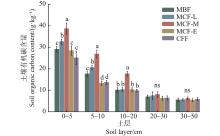
Fig.1
Variations in soil organic carbon content duringP. edulis expansion"
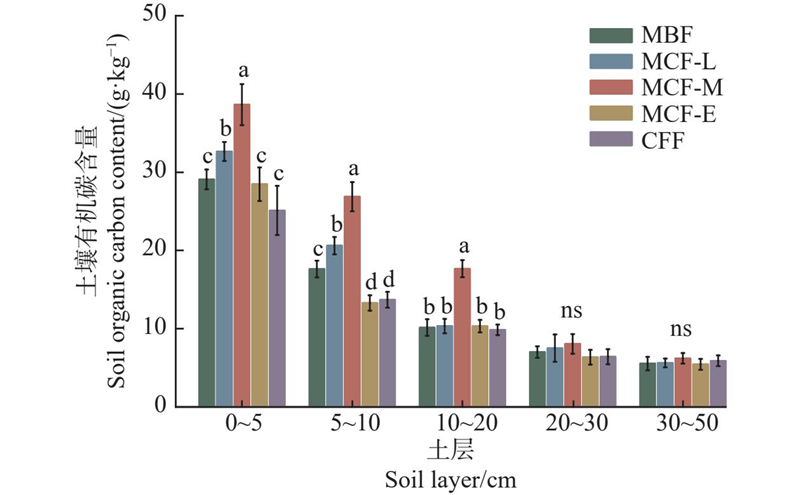
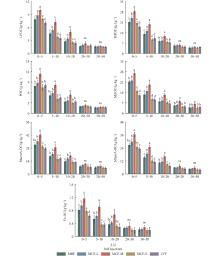
Fig.2
Variations in soil physical carbon fractions during P. edulis expansion"
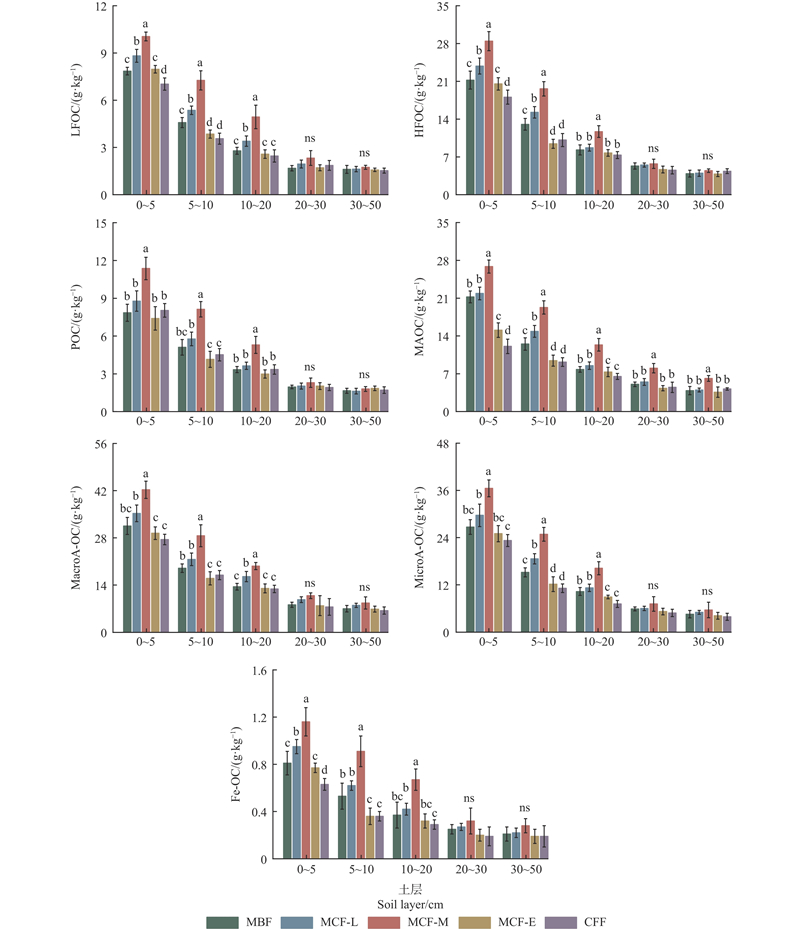
Fig.3
Variations in soil chemical carbon fractions during P. edulis expansion"
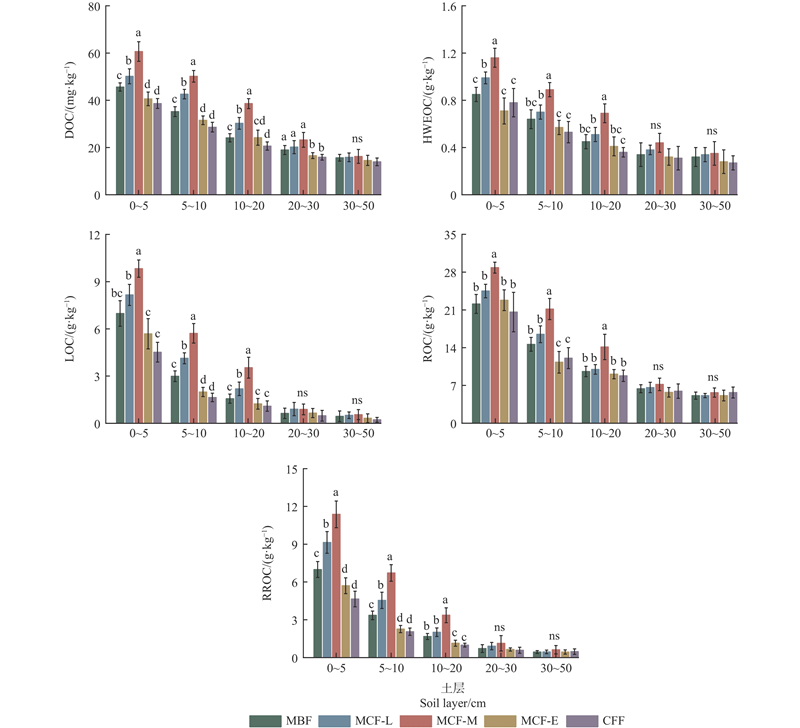
Fig.4
Variations in soil microbial carbon fractions during P. edulis expansion"
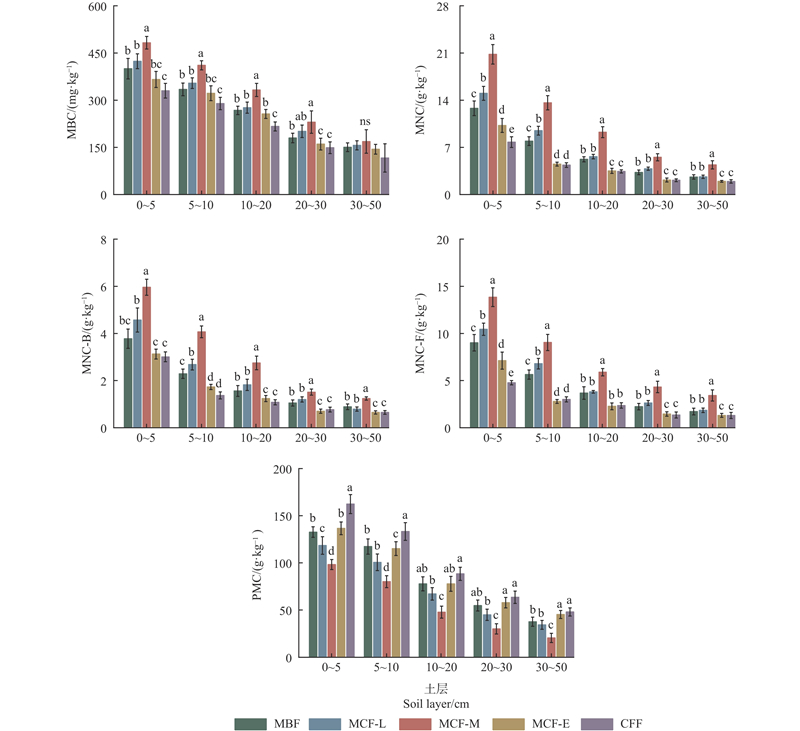
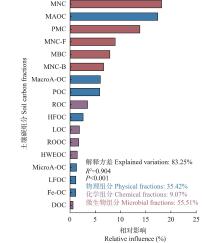
Fig.5
Relative influence of soil physical, chemical, and microbial carbon fractions on the variation of SOC at the depth of 0?20 cm during P. edulis expansion"
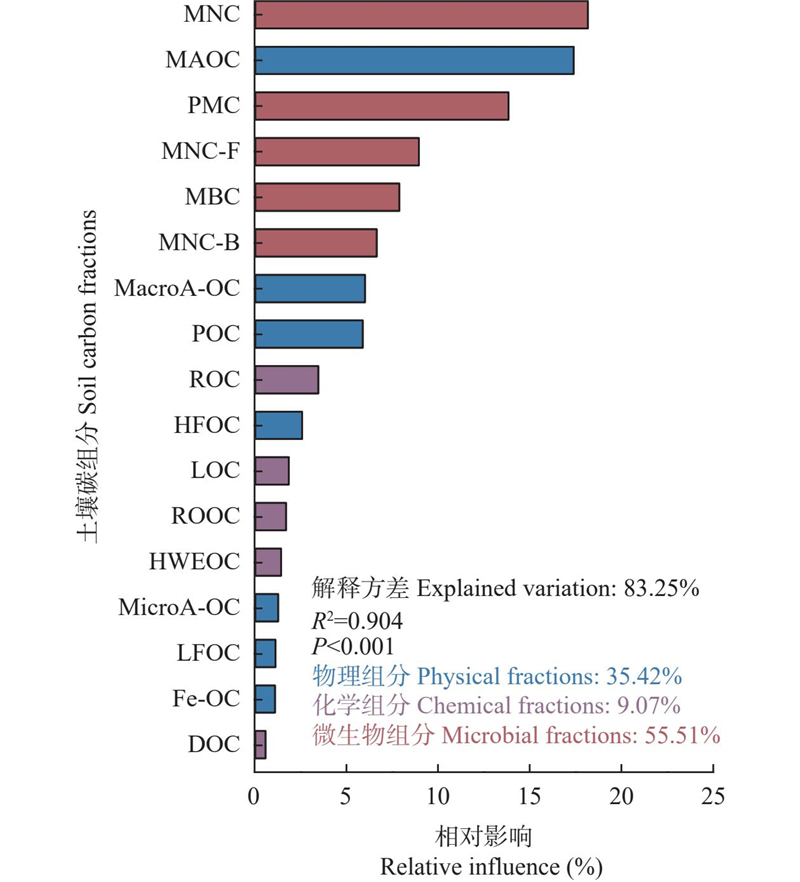

Fig.6
Results of the multiple stepwise regression analysis between soil physical, chemical, and microbial carbon fractions and SOC at the depth of 0?20 cm during P. edulis expansion"

| 鲍士旦. 2000. 土壤农化分析. 3版. 北京: 中国农业出版社. | |
| Bao S D. 2000. Soil agricultural chemistry analysis. 3rd ed. Beijing: China Agriculture Press. [in Chinese] | |
|
杜 雪, 王海燕. 中国森林土壤有机碳活性组分及其影响因素. 世界林业研究, 2022, 35 (1): 76- 81.
doi: 10.13348/j.cnki.sjlyyj.2021.0068.y |
|
|
Du X, Wang H Y. Active components of forest soil organic carbon and its influencing factors in China. World Forestry Research, 2022, 35 (1): 76- 81.
doi: 10.13348/j.cnki.sjlyyj.2021.0068.y |
|
| 范少辉, 申景昕, 刘广路, 等. 2019. 毛竹向杉木林扩展对土壤养分含量及计量比的影响. 西北植物学报, 39(8): 1455−1462. | |
| Fan S H, Shen J X, Liu G L, et al. 2019. Soil nutrients and ecological stoichiometry characteristics after Phyllostachys edulis expansion to Cunninghamia lanceolata forest. Acta Botanica Boreali-Occidentalia Sinica, 39(8): 1455–1462. [in Chinese] | |
| 刘广路, 范少辉, 唐晓鹿, 等. 2017. 毛竹向杉木林扩展过程中叶功能性状的适应策略. 林业科学, 53(8): 17–25. | |
| Liu G L, Fan S H, Tang X L, et al. 2017. Adaptive strategies of leaf functional traits of moso bamboo during its expansion to Chinese fir forests. Scientia Silvae Sinicae, 53(8): 17–25. [in Chinese] | |
| 邵 帅, 王中乾, 潘灵强, 等. 毛竹扩张对常绿阔叶林土壤微生物残体碳累积的影响. 浙江农林大学学报, 2024, 41 (5): 1005- 1012. | |
| Shao S, Wang Z Q, Pan L Q, et al. Effects of Phyllostachys edulis expansion on soil microbial residue carbon accumulation in evergreen broad-leaved forests. Journal of Zhejiang A&F University, 2024, 41 (5): 1005- 1012. | |
| 王 晶, 解宏图, 朱 平, 等. 土壤活性有机质(碳)的内涵和现代分析方法概述. 生态学杂志, 2003, 22 (6): 109- 112. | |
| Wang J, Xie H T, Zhu P, et al. Cannotation and modern analysis method for active soil organic matter (carbon). Chinese Journal of Ecology, 2003, 22 (6): 109- 112. | |
|
王杉杉, 徐秋芳, 范 博, 等. 毛竹扩张对杉木林土壤微生物残体碳积累的影响. 生态学报, 2023, 43 (5): 1902- 1912.
doi: 10.5846/stxb202202030289 |
|
|
Wang S S, Xu Q F, Fan B, et al. Effects of moso bamboo expansion on accumulation of soil microbial residual carbon in Chinese fir forest. Acta Ecologica Sinica, 2023, 43 (5): 1902- 1912.
doi: 10.5846/stxb202202030289 |
|
|
徐英德. 基于保护性农业的土壤固碳过程研究进展. 中国生态农业学报 (中英文), 2022, 30 (4): 658- 670.
doi: 10.12357/cjea.20210889 |
|
|
Xu Y D. Conservation agriculture-mediated soil carbon sequestration: a review. Chinese Journal of Eco-Agriculture, 2022, 30 (4): 658- 670.
doi: 10.12357/cjea.20210889 |
|
| 张方方, 岳善超, 李世清. 土壤有机碳组分化学测定方法及碳指数研究进展. 农业环境科学学报, 2021, 40 (2): 252- 259. | |
| Zhang F F, Yue S C, Li S Q. Chemical methods to determine soil organic carbon fractions and carbon indexes: a review. Journal of Agro-Environment Science, 2021, 40 (2): 252- 259. | |
|
张睿博, 汪金松, 王全成, 等. 土壤颗粒态有机碳与矿物结合态有机碳对气候变暖响应的研究进展. 地理科学进展, 2023, 42 (12): 2471- 2484.
doi: 10.18306/dlkxjz.2023.12.015 |
|
|
Zhang R B, Wang J S, Wang Q C, et al. Responses of soil particulate and mineral-associated organic carbon to climate warming: a review. Progress in Geography, 2023, 42 (12): 2471- 2484.
doi: 10.18306/dlkxjz.2023.12.015 |
|
|
周德中, 叶继生, 宋怀芬, 等. 毛竹扩张对森林生态系统影响的研究进展. 南方林业科学, 2024, 52 (2): 66- 69, 76.
doi: 10.16259/j.cnki.36-1342/s.2024.02.013 |
|
|
Zhou D Z, Ye J S, Song H F, et al. Research progress on effects of Phyllostachys edulis expansion on forest ecology. South China Forestry Science, 2024, 52 (2): 66- 69, 76.
doi: 10.16259/j.cnki.36-1342/s.2024.02.013 |
|
| 朱志建, 姜培坤, 徐秋芳. 不同森林植被下土壤微生物量碳和易氧化态碳的比较. 林业科学研究, 2006, 19 (4): 523- 526. | |
| Zhu Z J, Jiang P K, Xu Q F. Study on the active organic carbon in soil under different types of vegetation. Forest Research, 2006, 19 (4): 523- 526. | |
|
Beillouin D, Corbeels M, Demenois J, et al. A global meta-analysis of soil organic carbon in the Anthropocene. Nature Communications, 2023, 14, 3700.
doi: 10.1038/s41467-023-39338-z |
|
|
Blair G J, Lefroy R D, Lisle L. Soil carbon fractions based on their degree of oxidation, and the development of a carbon management index for agricultural systems. Australian Journal of Agricultural Research, 1995, 46 (7): 1459- 1466.
doi: 10.1071/ar9951459 |
|
|
Button E S, Pett-Ridge J, Murphy D V, et al. Deep-C storage: biological, chemical and physical strategies to enhance carbon stocks in agricultural subsoils. Soil Biology and Biochemistry, 2022, 170, 108697.
doi: 10.1016/j.soilbio.2022.108697 |
|
| Cambardella C A, Elliott E T. Particulate soil organic matter changes across a grassland cultivation sequence. Soil Science Society of America Journal, 1992, 56 (3): 777- 783. | |
| Cotrufo M F, Wallenstein M D, Boot C M, et al. 2013. The microbial efficiency-matrix stabilization (MEMS) framework integrates plant litter decomposition with soil organic matter stabilization: do labile plant inputs form stable soil organic matter? Global Change Biology, 19(4): 988–995. | |
|
Elliott E T. Aggregate structure and carbon, nitrogen, and phosphorus in native and cultivated soils. Soil Science Society of America Journal, 1986, 50 (3): 627- 633.
doi: 10.2136/sssaj1986.03615995005000030017x |
|
| Fu H R, Chen H, Mа Z B, et al. Fungal necromass carbon dominates global soil organic carbon storage. Global Change Biology, 2025, 31 (8): e70413. | |
|
Ghani A, Dexter M, Perrott K W. Hot-water extractable carbon in soils: a sensitive measurement for determining impacts of fertilisation, grazing and cultivation. Soil Biology and Biochemistry, 2003, 35 (9): 1231- 1243.
doi: 10.1016/S0038-0717(03)00186-X |
|
|
Janzen H H, Campbell C A, Brandt S A, et al. Light-fraction organic matter in soils from long-term crop rotations. Soil Science Society of America Journal, 1992, 56 (6): 1799- 1806.
doi: 10.2136/sssaj1992.03615995005600060025x |
|
|
Kaiser K, Kalbitz K. Cycling downwards: dissolved organic matter in soils. Soil Biology and Biochemistry, 2012, 52, 29- 32.
doi: 10.1016/j.soilbio.2012.04.002 |
|
|
Lalonde K, Mucci A, Ouellet A, et al. Preservation of organic matter in sediments promoted by iron. Nature, 2012, 483(7388), 198- 200.
doi: 10.1038/nature10855 |
|
|
Lehmann J, Kleber M. The contentious nature of soil organic matter. Nature, 2015, 528(7580), 60- 68.
doi: 10.1038/nature16069 |
|
| Liang C, Schimel J P, Jastrow, J D. The importance of anabolism in microbial control over soil carbon storage. Nature Microbiology, 2017, 2 (17105): 1- 6. | |
|
Lin Y T, Tang S L, Pai C W, et al. Changes in the soil bacterial communities in a cedar plantation invaded by moso bamboo. Microbial Ecology, 2014, 67 (2): 421- 429.
doi: 10.1007/s00248-013-0291-3 |
|
|
Liu X S, Siemann E, Cui C, et al. Moso bamboo (Phyllostachys edulis) invasion effects on litter, soil and microbial PLFA characteristics depend on sites and invaded forests. Plant and Soil, 2019, 438(1), 85- 99.
doi: 10.1007/s11104-019-04010-3 |
|
|
Liu X T, Xu Y, Ameen A, et al. Precipitation, elevation, and bamboo-to-tree ratio regulate soil organic carbon accumulation in mixed moso bamboo forests. Plant and Soil, 2025, 514 (2): 2923- 2938.
doi: 10.1007/s11104-025-07556-7 |
|
|
Luan J W, Li S Y, Dong W, et al. Litter decomposition affected by bamboo expansion is modulated by litter-mixing and microbial composition. Functional Ecology, 2021, 35(11), 2562- 2574.
doi: 10.1111/1365-2435.13911 |
|
|
Rumpel C, Kögel-Knabner I. Deep soil organic matter:a key but poorly understood component of terrestrial carbon cycle. Soil Biology and Biochemistry, 2011, 43 (9): 1842- 1850.
doi: 10.1007/s11104-010-0391-5 |
|
|
Sardar M F, Chen Z H, Tang C X, et al. Seasonal linkages between soil nitrogen mineralization and the microbial community in broadleaf forests with moso bamboo (Phyllostachys edulis) invasion. Science of the Total Environment, 2023, 899, 165557.
doi: 10.1016/j.scitotenv.2023.165557 |
|
|
Schrumpf M, Kaiser K, Guggenberger G, et al. Storage and stability of organic carbon in soils as related to depth, occlusion within aggregates, and attachment to minerals. Biogeosciences, 2013, 10 (3): 1675- 1691.
doi: 10.5194/bg-10-1675-2013 |
|
|
Shao S, He H B, Liang C F, et al. Moso bamboo expansion into a broadleaved forest alters the dominant soil organic carbon source. European Journal of Soil Science, 2023, 74 (3): e13366.
doi: 10.1111/ejss.13366 |
|
|
Teng Q M, Fang T, Zhang Q Q, et al. Successional transition from broadleaf to bamboo forests promotes fungal communities and soil carbon mineralization following the altered litterfall quality. Applied Soil Ecology, 2025, 209, 106006.
doi: 10.1016/j.apsoil.2025.106006 |
|
| Vance E D, Brookes P C, Jenkinson D S, 1987. An extraction method for measuring soil microbial biomass C. Soil Biology and Biochemistry, 19(6): 703–707. | |
|
Wu Y X, Guo J H, Tang Z Y, et al. Moso bamboo (Phyllostachys edulis) expansion enhances soil pH and alters soil nutrients and microbial communities. Science of the Total Environment, 2024, 912, 169346.
doi: 10.1016/j.scitotenv.2023.169346 |
|
| Yang C B, Ni H J, Zhong Z K, et al. Changes in soil carbon pools and components induced by replacing secondary evergreen broadleaf forest with moso bamboo plantations in subtropical China. Catena, 2019, 180, 309- 319. | |
|
Zhang X, Amelung W. Gas chromatographic determination of muramic acid, glucosamine, mannosamine, and galactosamine in soils. Soil Biology and Biochemistry, 1996, 28 (9): 1201- 1206.
doi: 10.1016/0038-0717(96)00117-4 |
|
| Zhang Y, Gu F, Chen J, et al. Decomposition dynamics of bamboo and broadleaf forest litter: implications for carbon cycling in subtropical forests. Forest Ecology and Management, 2013, 305, 163- 172. | |
|
Zhou J, Wen Y, Shi L L, et al. Strong priming of soil organic matter induced by frequent input of labile carbon. Soil Biology and Biochemistry, 2021, 152, 108069.
doi: 10.1016/j.soilbio.2020.108069 |
| Viewed | ||||||
|
Full text |
|
|||||
|
Abstract |
|
|||||
