
Scientia Silvae Sinicae ›› 2026, Vol. 62 ›› Issue (8): 55-70.doi: 10.11707/j.1001-7488.LYKX20260063
• Research papers • Previous Articles Next Articles
Qiyan Li1,Peishan Zhao1,Guanglei Gao1,2,3,4,5,*( ),Guodong Ding1,2,3,4,5,Ying Zhang1,4,5
Received:2026-01-27
Revised:2026-07-13
Online:2026-08-10
Published:2026-08-20
Contact:
Guanglei Gao
E-mail:gaoguanglei@bjfu.edu.cn
CLC Number:
Qiyan Li,Peishan Zhao,Guanglei Gao,Guodong Ding,Ying Zhang. Soil Characteristics, Rhizosphere Effects and Their Influencing Factors in Pinus sylvestris var. mongolica Plantations[J]. Scientia Silvae Sinicae, 2026, 62(8): 55-70.
Table 1
Information of Pinus sylvestris var. mongolica plantations in different introduction sites"
| 样地 Plots | 林龄 Stand age/a | 平均树高 Mean tree height/m | 平均胸径 Mean DBH/cm | |
| HB | HB_28a | 28 | 5.82±1.13 | 12.86±2.27 |
| HB_39a | 39 | 9.01±2.16 | 20.94±3.02 | |
| HB_48a | 48 | 13.57±1.61 | 26.37±2.86 | |
| HQ | HQ_28a | 28 | 5.84±1.06 | 12.27±2.21 |
| HQ_40a | 40 | 10.05±1.28 | 18.35±2.76 | |
| HQ_49a | 49 | 12.65±2.73 | 24.69±3.42 | |
| MU | MU_27a | 27 | 7.64±1.26 | 13.59±2.68 |
| MU_37a | 37 | 12.35±1.37 | 21.89±1.19 | |
| MU_48a | 48 | 15.37±1.59 | 25.64±3.05 | |
Table 2
Soil and meteorological data of Pinus sylvestris var. mongolica plantation plots"
| 样地 Plots | pH | 土壤含 水率Soil water content (%) | 气温 Temperature/ ℃ | 降水量 Precipitation/ mm | 干燥度 Aridity index | |
| HB | HB_28a | 6.36±0.11 | 7.32±0.71 | ?0.42 | 356.91 | 2.24 |
| HB_39a | 7.01±0.10 | 8.06±0.52 | ?0.52 | 354.57 | 2.24 | |
| HB_48a | 6.11±0.08 | 9.44±0.65 | ?0.53 | 352.98 | 2.25 | |
| HQ | HQ_27a | 6.37±0.11 | 6.44±0.47 | 8.15 | 542.63 | 1.90 |
| HQ_40a | 6.70±0.45 | 9.65±0.60 | 8.07 | 530.97 | 1.93 | |
| HQ_49a | 5.88±0.22 | 8.59±0.56 | 8.14 | 546.44 | 1.90 | |
| MU | MU_27a | 7.62±0.14 | 5.05±0.42 | 9.55 | 432.71 | 2.60 |
| MU_37a | 7.89±0.13 | 9.67±0.57 | 9.53 | 435.41 | 2.59 | |
| MU_48a | 8.10±0.29 | 9.14±0.69 | 9.53 | 435.41 | 2.59 | |
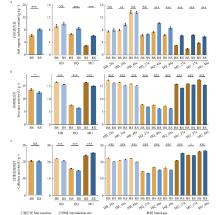
Fig.1
Soil organic carbon content, invertase activity, and cellulase activity in Pinus sylvestris var. mongolica plantations a: Soil organic carbon content in bulk and rhizosphere soils of plantations across different introduction sites and stand ages; b: Invertase activity in bulk and rhizosphere soils of plantations across different introduction sites and stand ages; c: Cellulase activity in bulk and rhizosphere soils of plantations across different introduction sites and stand ages. BS: Bulk soil; RS: Rhizosphere soil. HB: Hulunbuir sandy land; HQ:Horqin sandy land; MU: Mu Us sandy land. Significance labels indicate the significance of differences between bulk and rhizosphere soils. NS: Not significant; *: P < 0.05; **: P < 0.01; ***: P < 0.001."
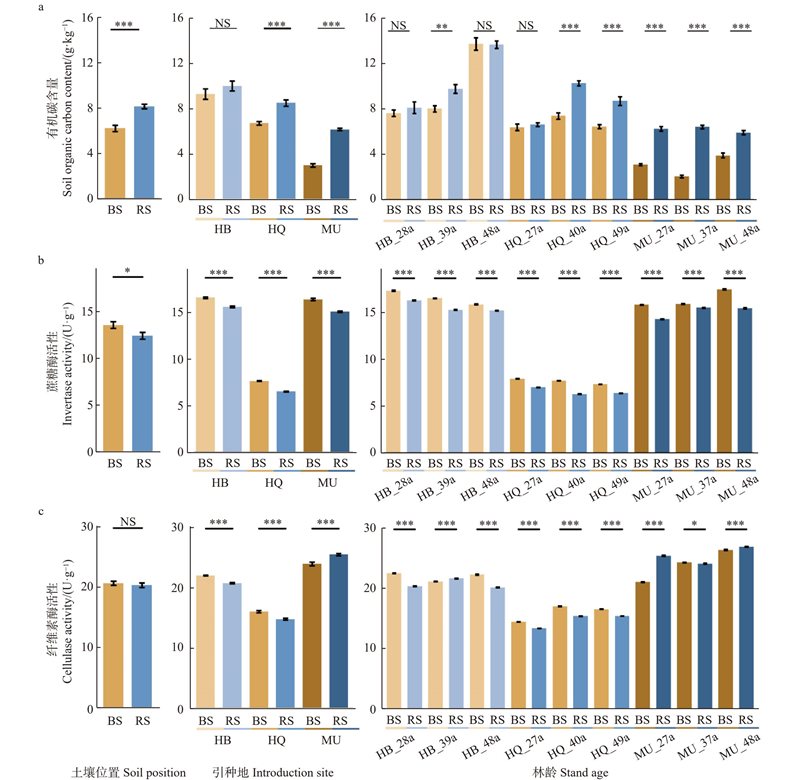
Table 3
Effects of introduction site and stand age on soil organic carbon content, invertase activity, and cellulase activity"
| 分组Group | 项目Item | 因子Factor | 自由度 Degrees of freedom | 平方和 Sum of squares | F | P |
| 非根际土 Bulk soil | 有机碳含量 Soil organic carbon content | 引种地 Introduction site | 2 | 1 136.34 | 492.07 | <0.001 |
| 林龄(引种地)Stand age (introduction site) | 6 | 515.57 | 74.42 | <0.001 | ||
| 残差Residuals | 126 | 145.49 | ||||
| 蔗糖酶活性 Invertase activity | 引种地 Introduction site | 2 | 2 340.08 | 56 447.00 | <0.001 | |
| 林龄(引种地)Stand age (introduction site) | 6 | 44.08 | 354.50 | <0.001 | ||
| 残差Residuals | 126 | 2.60 | ||||
| 纤维素酶活性 Cellulase activity | 引种地 Introduction site | 2 | 1 522.77 | <0.001 | ||
| 林龄(引种地)Stand age (introduction site) | 6 | 287.87 | <0.001 | |||
| 残差Residuals | 126 | 5.30 | ||||
| 根际土 Rhizosphere soil | 有机碳含量 Soil organic carbon content | 引种地 Introduction site | 2 | 508.25 | 158.58 | <0.001 |
| 林龄(引种地) Stand age (introduction site) | 6 | 483.54 | 50.29 | <0.001 | ||
| 残差Residuals | 126 | 201.91 | ||||
| 蔗糖酶活性 Invertase activity | 引种地 Introduction site | 2 | 2 327.73 | 44 657.80 | <0.001 | |
| 林龄(引种地) Stand age (introduction site) | 6 | 29.89 | 191.20 | <0.001 | ||
| 残差Residuals | 126 | 3.30 | ||||
| 纤维素酶活性 Cellulase activity | 引种地 Introduction site | 2 | 2 589.20 | 29 753.40 | <0.001 | |
| 林龄(引种地) Stand age (introduction site) | 6 | 118.60 | 454.10 | <0.001 | ||
| 残差Residuals | 126 | 5.50 |
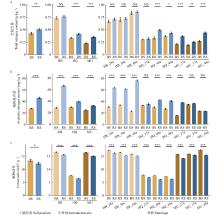
Fig.2
Total nitrogen content, available nitrogen content, and urease activity in Pinus sylvestris var. mongolica plantations"
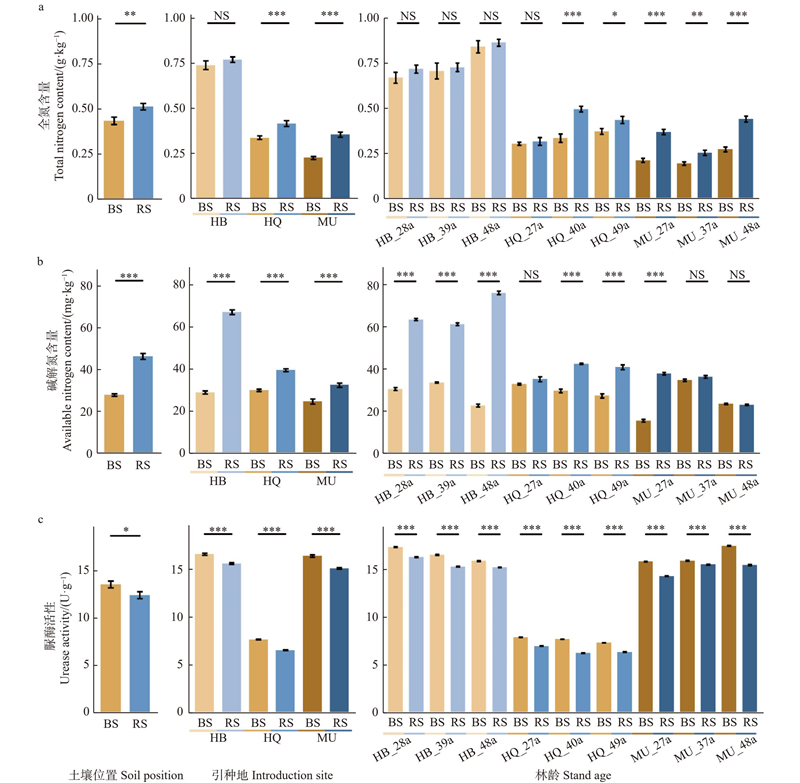
Table 4
Effects of introduction site and stand age on total nitrogen content, available nitrogen content, and urease activity"
| 分组Group | 项目Item | 因子 Factor | 自由度 Degrees of freedom | 平方和 Sum of squares | F | P |
| 非根际土 Bulk soil | 全氮含量 Total nitrogen content | 引种地 Introduction site | 2 | 6.57 | 368.23 | <0.001 |
| 林龄(引种地)Stand age (introduction site) | 6 | 0.33 | 6.23 | <0.001 | ||
| 残差Residuals | 126 | 1.13 | ||||
| 碱解氮含量 Available nitrogen content | 引种地 Introduction site | 2 | 732.68 | 58.91 | <0.001 | |
| 林龄(引种地)Stand age (introduction site) | 6 | 4 001.76 | 107.24 | <0.001 | ||
| 残差Residuals | 126 | 784.00 | ||||
| 脲酶活性 Urease activity | 引种地 Introduction site | 2 | 3 290.24 | 170.20 | <0.001 | |
| 林龄(引种地) Stand age (introduction site) | 6 | 10 338.00 | 178.20 | <0.001 | ||
| 残差Residuals | 126 | 1 22 | ||||
| 根际土 Rhizosphere soil | 全氮含量 Total nitrogen content | 引种地 Introduction site | 2 | 4.55 | 427.70 | <0.001 |
| 林龄(引种地) Stand age (introduction site) | 6 | 0.72 | 22.68 | <0.001 | ||
| 残差Residuals | 126 | 0.67 | ||||
| 碱解氮含量 Available nitrogen content | 引种地 Introduction site | 2 | 30 134.17 | 1 874.18 | <0.001 | |
| 林龄(引种地) Stand age (introduction site) | 6 | 4 367.80 | 90.57 | <0.001 | ||
| 残差Residuals | 126 | 1 012.95 | ||||
| 脲酶活性 Urease activity | 引种地 Introduction site | 2 | 7 562.95 | <0.001 | ||
| 林龄(引种地) Stand age (introduction site) | 6 | 12 900.85 | 606.70 | <0.001 | ||
| 残差Residuals | 126 | 447.00 |
Fig.3
Total phosphorus content, available phosphorus content, and acid phosphatase activity in Pinus sylvestris var. mongolica plantations"
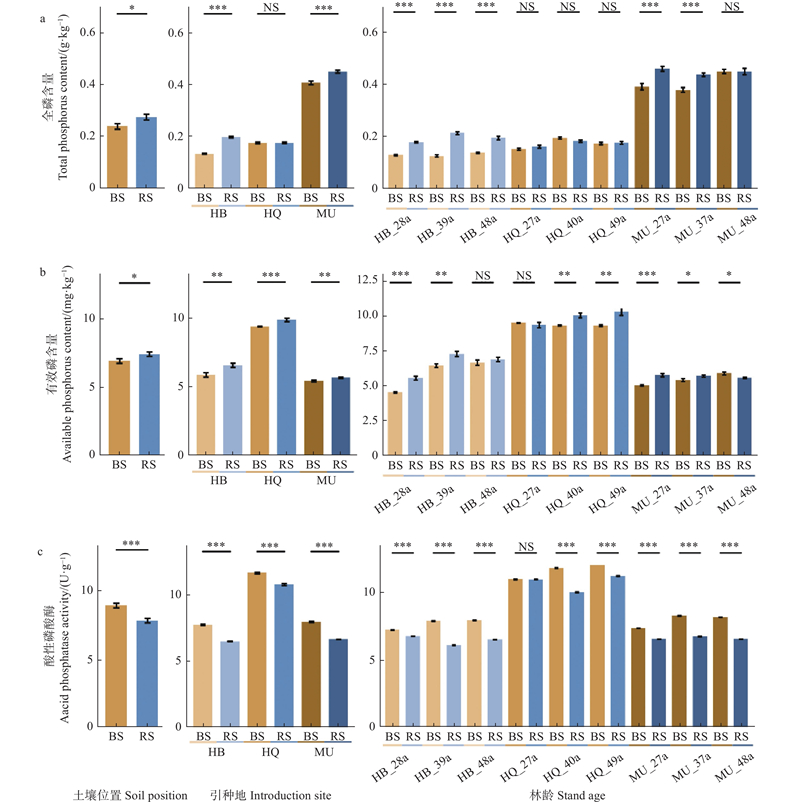
Table 5
Effects of introduction site and stand age on total phosphorus content, available phosphorus content, and acid phosphatase activity"
| 分组Group | 项目Item | 因子 Factor | 自由度 Degrees of freedom | 平方和 Sum of squares | F | P |
| 非根际土 Bulk soil | 全磷含量 Total phosphorus content | 引种地 Introduction site | 2 | 1.96 | 1 563.40 | <0.001 |
| 林龄(引种地)Stand age (introduction site) | 6 | 0.06 | 15.20 | <0.001 | ||
| 残差Residuals | 126 | 0.08 | ||||
| 有效磷含量 Available phosphorus content | 引种地 Introduction site | 2 | 424.02 | 1 359.64 | <0.001 | |
| 林龄(引种地)Stand age (introduction site) | 6 | 47.48 | 50.75 | <0.001 | ||
| 残差Residuals | 126 | 19.64 | ||||
| 酸性磷酸酶活性 Acid phosphatase activity | 引种地 Introduction site | 2 | 440.25 | 36 517.90 | <0.001 | |
| 林龄(引种地) Stand age (introduction site) | 6 | 22.40 | 619.70 | <0.001 | ||
| 残差Residuals | 126 | 0.8 | ||||
| 根际土 Rhizosphere soil | 全磷含量 Total phosphorus content | 引种地 Introduction site | 2 | 2.08 | 1 356.99 | <0.001 |
| 林龄(引种地) Stand age (introduction site) | 6 | 0.017 | 3.58 | 0.003 | ||
| 残差Residuals | 126 | 0.10 | ||||
| 有效磷含量 Available phosphorus content | 引种地 Introduction site | 2 | 448.45 | 568.82 | <0.001 | |
| 林龄(引种地) Stand age (introduction site) | 6 | 31.91 | 13.49 | <0.001 | ||
| 残差Residuals | 126 | 49.67 | ||||
| 酸性磷酸酶活性 Acid phosphatase activity | 引种地 Introduction site | 2 | 537.79 | 33 983.10 | <0.001 | |
| 林龄(引种地) Stand age (introduction site) | 6 | 16.10 | 338.70 | <0.001 | ||
| 残差Residuals | 126 | 1.00 |
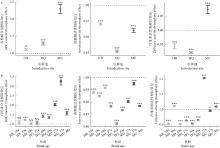
Fig.4
Rhizosphere effects of soil organic carbon content, invertase activity, and cellulase activity in Pinus sylvestris var. mongolica plantations a: Rhizosphere effects of soil organic carbon content, invertase activity, and cellulase activity in plantations across different introduction sites; b: Rhizosphere effects of soil organic carbon content, invertase activity, and cellulase activity in plantations across different stand ages. HB: Hulunbuir sandy land; HQ: Horqin sandy land; MU: Mu Us sandy land. Significance markers indicate the statistical difference between rhizosphere effect and 1. NS: Not significant; *: P < 0.05; **: P < 0.01; ***: P < 0.001."
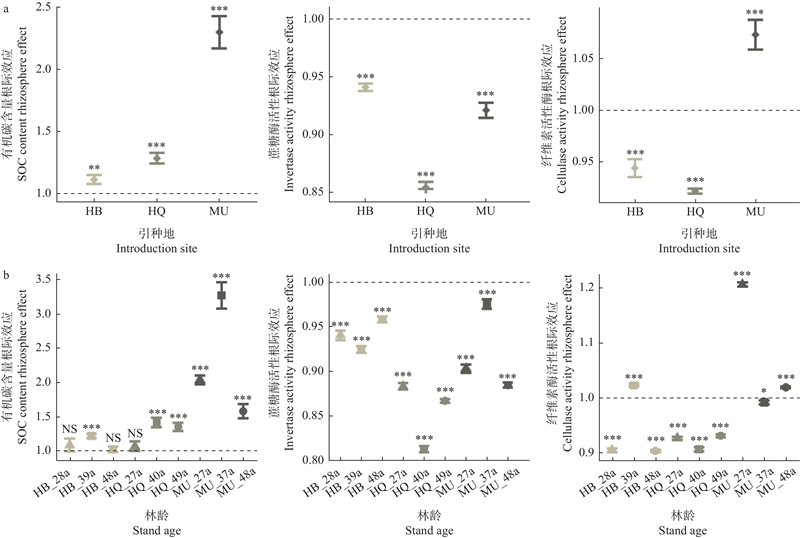
Table 6
Effects of introduction site and stand age on rhizosphere effects of soil organic carbon, invertase and cellulase"
| 项目Item | 因子 Factor | 自由度 Degrees of freedom | 平方和 Sum of squares | F | P |
| 有机碳根际效应 Rhizosphere effect of soil organic carbon | 引种地 Introduction site | 2 | 36.96 | 145.50 | <0.001 |
| 林龄(引种地) Stand age (introduction site) | 6 | 24.16 | 31.71 | <0.001 | |
| 残差Residuals | 126 | 16.00 | |||
| 蔗糖酶根际效应 Rhizosphere effect of invertase | 引种地 Introduction site | 2 | 0.19 | 385.66 | <0.001 |
| 林龄(引种地) Stand age (introduction site) | 6 | 0.12 | 81.87 | <0.001 | |
| 残差Residuals | 126 | 0.03 | |||
| 纤维素酶根际效应 Rhizosphere effect of cellulase | 引种地 Introduction site | 2 | 0.60 | <0.001 | |
| 林龄(引种地) Stand age (introduction site) | 6 | 0.55 | 636.90 | <0.001 | |
| 残差Residuals | 126 | 0.018 3 |
Fig.5
Rhizosphere effects of total nitrogen, available nitrogen content, and urease activity in Pinus sylvestris var. mongolica plantationss a: Rhizosphere effects of total nitrogen,available nitrogen content, and urease activity in plantations across different introduction sites; b: Rhizosphere effects of soil organic carbon content, invertase activity, and cellulase activity in plantations across different stand ages. HB: Hulunbuir sandy land; HQ: Horqin sandy land; MU: Mu Us sandy land. Significance markers indicate the statistical difference between rhizosphere effect and 1. NS: Not significant; *: P < 0.05; **: P < 0.01; ***: P < 0.001."
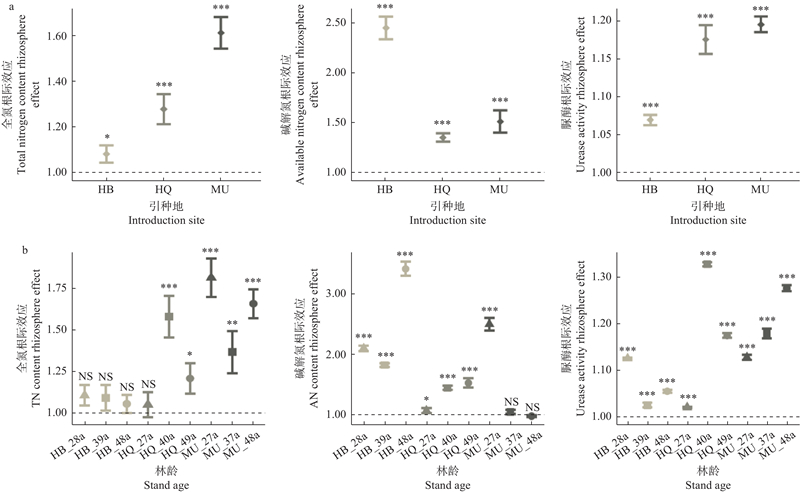
Table 7
Effects of introduction site and stand age on rhizosphere effects of total nitrogen, available nitrogen content, and urease activity"
| 项目Item | 因子 Factor | 自由度 Degrees of freedom | 平方和 Sum of squares | F | P |
| 全氮根际效应 Rhizosphere effect of total nitrogen | 引种地 Introduction site | 2 | 6.48 | 24.24 | <0.001 |
| 林龄(引种地) Stand age (introduction site) | 6 | 3.82 | 4.76 | <0.001 | |
| 残差Residuals | 126 | 16.85 | |||
| 碱解氮根际效应 Rhizosphere effect of available nitrogen | 引种地 Introduction site | 2 | 31.69 | 245.40 | <0.001 |
| 林龄(引种地) Stand age (introduction site) | 6 | 45.71 | 118.00 | <0.001 | |
| 残差Residuals | 126 | 8.13 | |||
| 脲酶根际效应 Rhizosphere effect of urease activity | 引种地 Introduction site | 2 | 0.41 | 440.10 | <0.001 |
| 林龄(引种地) Stand age (introduction site) | 6 | 0.95 | 341.30 | <0.001 | |
| 残差Residuals | 126 | 0.06 |
Fig.6
Rhizosphere effects of total phosphorus content, available phosphorus content, and acid phosphatase activity in Pinus sylvestris var. mongolica plantations a: Rhizosphere effects of total phosphorus content,available phosphorus content, and acid phosphatase activity in plantations across different introduction sites; b: Rhizosphere effects of total phosphorus content,available phosphorus content,and acid phosphatase activity in plantations across different stand ages. HB: Hulunbuir sandy land; HQ:Horqin sandy land; MU: Mu Us sandy land. Significance markers indicate the statistical difference between rhizosphere effect and 1. NS: Not significant; *: P < 0.05; **: P < 0.01; ***: P < 0.001."
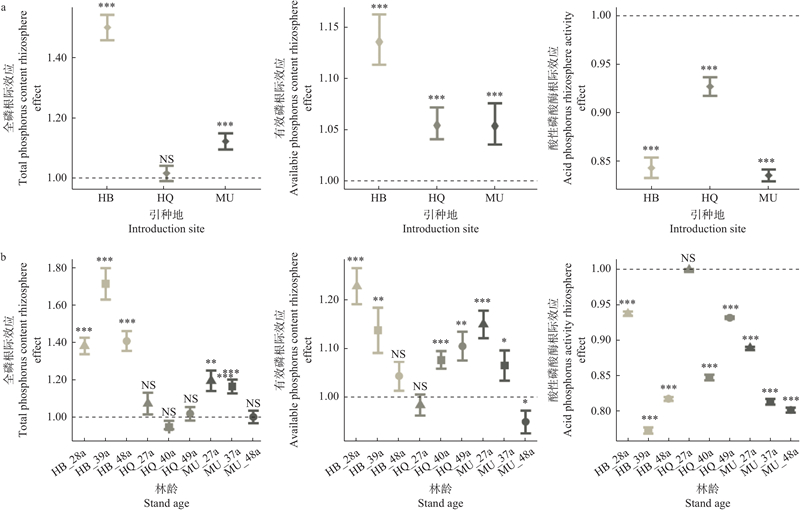
Table 8
Effects of introduction site and stand age on rhizosphere effects of total phosphorus, available phosphorus, and acid phosphatase"
| 项目Item | 因子 Factor | 自由度 Degrees of freedom | 平方和 Sum of squares | F | P |
| 全磷根际效应 Rhizosphere effect of total phosphorus | 引种地 Introduction site | 2 | 5.90 | 77.38 | <0.001 |
| 林龄(引种地) Stand age (introduction site) | 6 | 1.46 | 6.37 | <0.001 | |
| 残差Residuals | 126 | 4.81 | |||
| 有效磷根际效应 Rhizosphere effect of available phosphorus | 引种地 Introduction site | 2 | 0.20 | 7.09 | 0.001 |
| 林龄(引种地) Stand age (introduction site) | 6 | 0.69 | 8.10 | <0.001 | |
| 残差Residuals | 126 | 1.78 | |||
| 酸性磷酸酶根际效应 Rhizosphere effect of acid phosphatase | 引种地 Introduction site | 2 | 0.23 | 745.20 | <0.001 |
| 林龄(引种地) Stand age (introduction site) | 6 | 0.46 | 491.70 | <0.001 | |
| 残差Residuals | 126 | 0.02 |
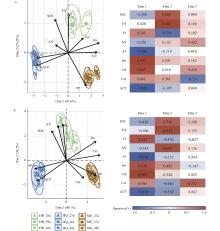
Fig.7
Principal component analysis of soil properties and their loadings a: Principal component analysis of bulk soil properties and their loadings; b: Principal component analysis of rhizosphere soil properties and their loadings. SOC: Soil organic carbon content; TN: Total nitrogen content; TP: Total phosphorus content; AN: Available nitrogen content; AP: Available phosphorus content; Inv: Invertase activity; Cel: Cellulase activity; Ure: Urease activity; ACP: Acid phosphatase activity."
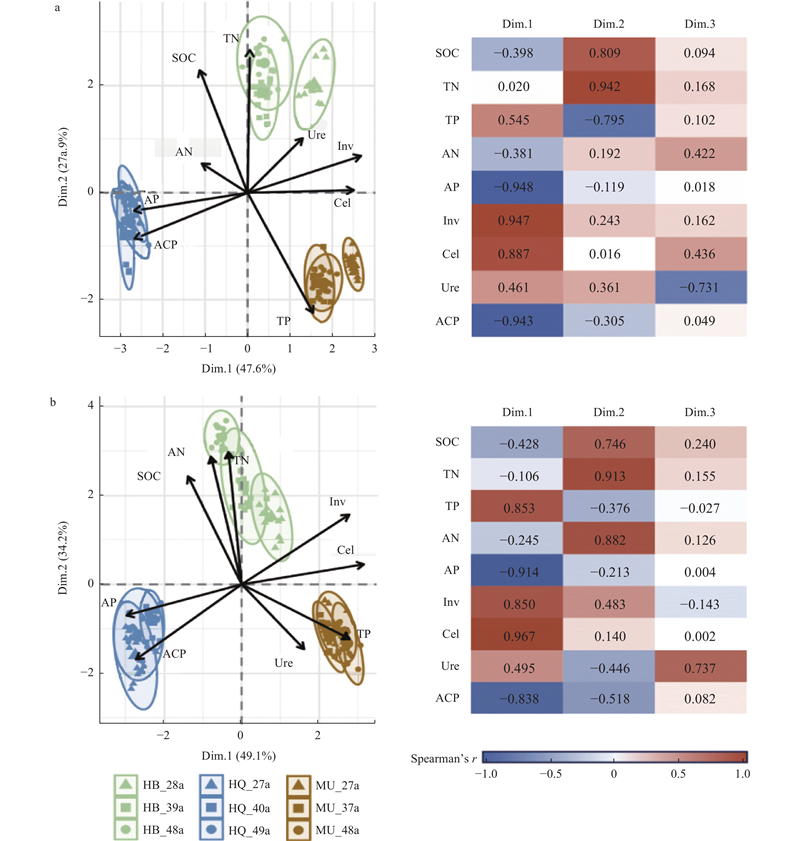
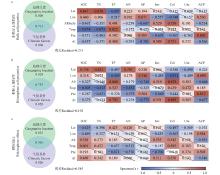
Fig.8
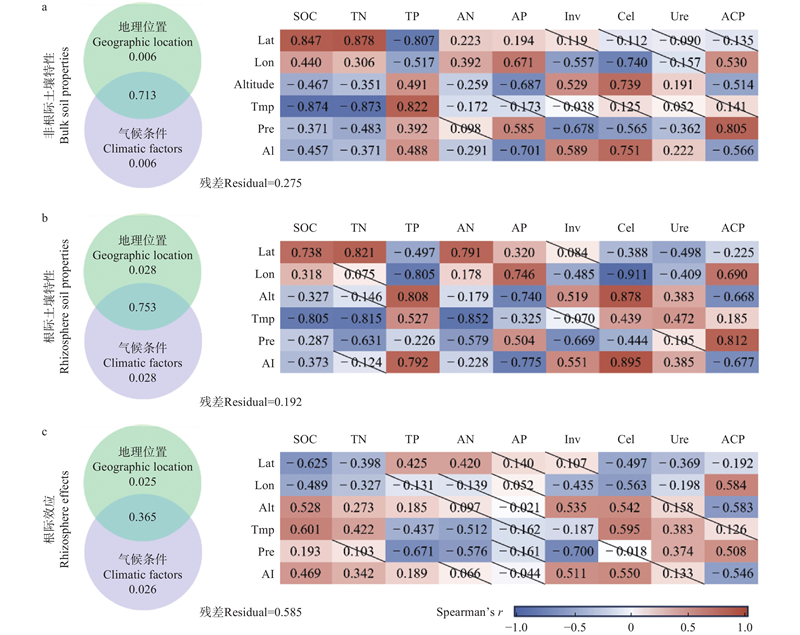
Variance partitioning analysis and Spearman correlation test on the effects of geographic and climatic factors on soil properties and their rhizosphere effects a: Influence of environmental factors on the bulk soil properties; b: Influence of environmental factors on the characteristics rhizosphere soil properties; c: Influence of environmental factors on rhizosphere effects. Geographic location includes latitude,longitude and altitude,and climatic conditions include temperature,precipitation and aridity index. Lat: Latitude;Lon: Longitude;Alt: Altitude; Tmp: Temperature; Pre: Precipitation; AI: Aridity index. SOC: Soil organic carbon content; TN: Total nitrogen content; TP: Total phosphorus content; AN: Available nitrogen content; AP: Available phosphorus content; Inv: Invertase activity; Cel: Cellulase activity; Ure: Urease activity; ACP: Acid phosphatase activity."
|
陈 娟, 马忠明, 刘莉莉, 等. 不同耕作方式对土壤有机碳、微生物量及酶活性的影响. 植物营养与肥料学报, 2016, 22 (3): 667- 675.
doi: 10.11674/zwyf.15246 |
|
|
Chen J, Ma Z M, Liu L L, et al. Effect of tillage system on soil organic carbon, microbial biomassand enzyme activities. Journal of Plant Nutrition and Fertilizer, 2016, 22 (3): 667- 675.
doi: 10.11674/zwyf.15246 |
|
| 邓娇娇, 周永斌, 殷 有, 等. 辽东山区两种针叶人工林土壤真菌群落结构特征. 北京林业大学学报, 2019, 41 (9): 130- 138. | |
| Deng J J, Zhou Y B, Yin Y, et al. Characteristics of soil fungal community structure at two coniferous plantations in mountainous region of eastern Liaoning Province, northeastern China. Journal of Beijing Forestry University, 2019, 41 (9): 130- 138. | |
|
范媛媛, 李 懿, 李启迪. 不同林龄油松土壤微生物、酶活性和养分特征. 水土保持研究, 2019, 26 (6): 58- 64.
doi: 10.13869/j.cnki.rswc.2019.06.009 |
|
|
Fan Y Y, Li Y, Li Q D. Microbe, enzymatic activity and nutrient contents of soils in different stand ages of Pinus tabuliformis. Research of Soil and Water Conservation, 2019, 26 (6): 58- 64.
doi: 10.13869/j.cnki.rswc.2019.06.009 |
|
|
付粱晨, 丁宗巨, 唐 茂, 等. 北京东灵山白桦和蒙古栎的根际效应及其季节动态. 植物生态学报, 2024, 48 (4): 508- 522.
doi: 10.17521/cjpe.2022.0485 |
|
|
Fu L C, Ding Z J, Tang M, et al. Rhizosphere effects of Betula platyphylla and Quercus mongolica and their seasonal dynamics in Dongling Mountain, Beijing. Chinese Journal of Plant Ecology, 2024, 48 (4): 508- 522.
doi: 10.17521/cjpe.2022.0485 |
|
| 关松荫. 1986. 土壤酶及其研究法. 北京: 中国农业出版社. | |
| Guan S Y. 1986. Soil enzymes and their research methods. Beijing: China Agriculture Press. [in Chinese] | |
| 李青华, 张 静, 王 力, 等. 黄土丘陵沟壑区山地苹果林土壤干化及养分变异特征. 土壤学报, 2018, 55 (2): 503- 514. | |
| Li Q H, Zhang J, Wang L, et al. Desiccation and nutrient status of the soil in apple orchards in hilly-gully region of the Loess Plateau. Acta Pedologica Sinica, 2018, 55 (2): 503- 514. | |
| 李汝振, 李 雯, 杨 柳, 等. 氮添加对华北落叶松根际与非根际土壤养分的影响. 林业科学研究, 2024, 37 (5): 195- 204. | |
| Li R Z, Li W, Yang L, et al. Effects of nitrogen addition on soil nutrients in the rhizosphere and non rhizosphere of Larix principis-rupprechtii plantation. Forest Research, 2024, 37 (5): 195- 204. | |
|
梁天豪, 熊德成, 刘源豪, 等. 不同菌根类型树种的根系分泌物特征及其根际效应研究进展. 植物生态学报, 2025, 49 (7): 1038- 1052.
doi: 10.17521/cjpe.2024.0196 |
|
|
Liang T H, Xiong D C, Liu Y H, et al. Research progress on root exudates and rhizosphere effects of tree species associated with different mycorrhizal types. Chinese Journal of Plant Ecology, 2025, 49 (7): 1038- 1052.
doi: 10.17521/cjpe.2024.0196 |
|
|
任 悦, 高广磊, 丁国栋, 等. 沙地樟子松人工林叶片–枯落物–土壤有机碳含量特征. 北京林业大学学报, 2018, 40 (7): 36- 44.
doi: 10.13332/j.1000-1522.20180138 |
|
|
Ren Y, Gao G L, Ding G D, et al. Characteristics of organic carbon content of leaf-litter-soil system in Pinus sylvestris var. mongolica plantations. Journal of Beijing Forestry University, 2018, 40 (7): 36- 44.
doi: 10.13332/j.1000-1522.20180138 |
|
| 孙 悦, 徐兴良, Yakov K. 根际激发效应的发生机制及其生态重要性. 植物生态学报, 2014, 38 (1): 62- 75. | |
| Sun Y, Xu X L, Yakov K. Mechanisms of rhizosphere priming effects and their ecological significance. Chinese Journal of Plant Ecology, 2014, 38 (1): 62- 75. | |
|
闫 姣, 贺学礼, 张亚娟, 等. 荒漠北沙柳根系丛枝菌根真菌和黑隔内生真菌定殖状况. 植物生态学报, 2014, 38 (9): 949- 958.
doi: 10.3724/SP.J.1258.2014.00089 |
|
|
Yan J, He X L, Zhang Y J, et al. Colonization of arbuscular mycorrhizal fungi and dark septate endophytes in roots of desert Salix psammophila. Chinese Journal of Plant Ecology, 2014, 38 (9): 949- 958.
doi: 10.3724/SP.J.1258.2014.00089 |
|
|
于 婧, 肖 娟, 罗尚华, 等. 川西亚高山云杉人工林根际和非根际土壤有机碳含量与稳定性差异. 应用与环境生物学报, 2025, 31 (3): 394- 403.
doi: 10.19675/j.cnki.1006-687x.2024.08010 |
|
|
Yu J, Xiao J, Luo S H, et al. Differences in organic carbon content and stability between the rhizosphere and bulk soils of subalpine spruce plantations in western Sichuan, China. Chinese Journal of Applied and Environmental Biology, 2025, 31 (3): 394- 403.
doi: 10.19675/j.cnki.1006-687x.2024.08010 |
|
| 叶钰倩, 赵家豪, 刘 畅, 等. 间伐强度对马尾松人工林根际与非根际土壤中性糖特征的影响. 林业科学, 2019, 55 (8): 28- 35. | |
| Ye Y Q, Zhao J H, Liu C, et al. Impacts of thinning intensity on neutral sugars in rhizosphere and bulk soil of Pinus massoniana plantation. Scientia Silvae Sinicae, 2019, 55 (8): 28- 35. | |
| 朱教君, 宋立宁, 王国晨. 沙地樟子松引种70年的历史、进展与展望. 林业科学, 2025, 61 (7): 23- 34. | |
| Zhu J J, Song L N, Wang G C. 70 Years of introducing of mongolian pine to sandy lands: history, progress, and perspectives. Scientia Silvae Sinicae, 2025, 61 (7): 23- 34. | |
|
Banerjee S, Bora S, Thrall P H, et al. Soil C and N as causal factors of spatial variation in extracellular enzyme activity across grassland-woodland ecotones. Applied Soil Ecology, 2016, 105, 1- 8.
doi: 10.1016/j.apsoil.2016.04.002 |
|
|
Cheng W, Parton W J, Gonzalez-Meler M A, et al. Synthesis and modeling perspectives of rhizosphere priming. New Phytologist, 2014, 201, 31- 44.
doi: 10.1111/nph.12440 |
|
|
Dick W A, Tabatabai M A. Hydrolysis of organic and inor-ganic phosphorus compounds added to soils. Geoderma, 1978, 21 (3): 175- 182.
doi: 10.1016/0016-7061(78)90025-3 |
|
|
Dijkstra F A, Cheng W. Moisture modulates rhizosphere effects on C decomposition in two different soil types. Soil Biology and Biochemistry, 2007, 39 (9): 2264- 2274.
doi: 10.1016/j.soilbio.2007.03.026 |
|
| Dotaniya M L, Meena V D. 2015. Rhizosphere effect on nutrient availability in soil and its uptake by plants: a review. Proceedings of the National Academy of Sciences, India Section B: Biological Sciences, 85: 1–12. | |
|
Dusenge M E, Duarte A G, Way D A. Plant carbon metabolism and climate change: elevated CO2 and temperature impacts on photosynthesis, photorespiration and respiration. New Phytologist, 2019, 221, 32- 49.
doi: 10.1111/nph.15283 |
|
|
Finzi A C, Abramoff R Z, Spiller K S, et al. Rhizosphere processes are quantitatively important components of terrestrial carbon and nutrient cycles. Global Change Biology, 2015, 21, 2082- 2094.
doi: 10.1111/gcb.12816 |
|
|
Fontaine S, Henault C, Aamor A, et al. Fungi mediate long term sequestration of carbon and nitrogen in soil through their priming effect. Soil Biology and Biochemistry, 2011, 43, 86- 96.
doi: 10.1016/j.soilbio.2010.09.017 |
|
|
Gan D, Feng J, Han M, et al. Rhizosphere effects of woody plants on soil biogeochemical processes: a meta-analysis. Soil Biology and Biochemistry, 2021, 160, 108310.
doi: 10.1016/j.soilbio.2021.108310 |
|
|
Ge T, Wei X, Razavi B S, et al. Stability and dynamics of enzyme activity patterns in the rice rhizosphere: effects of plant growth and temperature. Soil Biology and Biochemistry, 2017, 113, 108- 115.
doi: 10.1016/j.soilbio.2017.06.005 |
|
|
Guo L, Ju C, Xu X, et al. Unveiling pervasive soil microbial P limitation in terrestrial ecosystems worldwide. Ecology Letters, 2024, 27, e70011.
doi: 10.1111/ele.70011 |
|
|
Henneron L, Kardol P, Wardle D A, et al. Rhizosphere control of soil nitrogen cycling: a key component of plant economic strategies. New Phytologist, 2020, 228 (4): 1269- 1282.
doi: 10.1111/nph.16760 |
|
|
Hess L J T, Austin A T. Pine afforestation alters rhizosphere effects and soil nutrient turnover across a precipitation gradient in Patagonia, Argentina. Plant and Soil, 2017, 415, 449- 464.
doi: 10.1007/s11104-017-3174-4 |
|
|
Jones D L, Nguyen C, Finlay R D. Carbon flow in the rhizosphere: carbon trading at the soil–root interface. Plant and Soil, 2009, 321, 5- 33.
doi: 10.1007/s11104-009-9925-0 |
|
|
Keiluweit M, Bougoure J J, Nico P S, et al. Mineral protection of soil carbon counteracted by root exudates. Nature Climate Change, 2015, 5, 588- 595.
doi: 10.1038/nclimate2580 |
|
|
Lee J H, Kim K, Guber A K, et al. Direct root contact among neighboring plants influences activity of soil extracellular enzymes. Applied Soil Ecology, 2025, 215, 106422.
doi: 10.1016/j.apsoil.2025.106422 |
|
|
Li J Y, Chen P, Li Z G, et al. Soil aggregate-associated organic carbon mineralization and its driving factors in rhizosphere soil. Soil Biology and Biochemistry, 2023, 186, 109182.
doi: 10.1016/j.soilbio.2023.109182 |
|
|
Moorhead D L, Sinsabaugh R L, Hill B H, et al. Vector analysis of ecoenzyme activities reveal constraints on coupled C, N and P dynamics. Soil Biology and Biochemistry, 2016, 93, 1- 7.
doi: 10.1016/j.soilbio.2015.10.019 |
|
|
Pausch J, Kuzyakov Y. Carbon input by roots into the soil: Quantification of rhizodeposition from root to ecosystem scale. Global Change Biology, 2018, 24, 1- 12.
doi: 10.1111/gcb.13850 |
|
|
Peng S, Ding Y, Liu W, et al. 1 km monthly temperature and precipitation dataset for China from 1901 to 2017. Earth System Science Data, 2019, 11 (4): 1931- 1946.
doi: 10.5194/essd-11-1931-2019 |
|
|
Peng S, Ding Y, Wen Z, et al. Spatiotemporal change and trend analysis of potential evapotranspiration over the Loess Plateau of China during 2011—2100. Agricultural and Forest Meteorology, 2017, 233, 183- 194.
doi: 10.1016/j.agrformet.2016.11.129 |
|
|
Perveen N, Barot S, Alvarez G, et al. Priming effect and microbial diversity in ecosystem functioning and response to global change: a modeling approach using the SYMPHONY model. Global Change Biology, 2014, 20, 1174- 1190.
doi: 10.1111/gcb.12493 |
|
|
Philippot L, Raaijmakers J M, Lemanceau P, et al. Going back to the roots: the microbial ecology of the rhizosphere. Nature Reviews Microbiology, 2013, 11, 789- 799.
doi: 10.1038/nrmicro3109 |
|
|
Qiu T, Yu J, He L, et al. Slope position mediates the co-utilization of phosphorus by plants and microbes through rhizosphere processes in a phosphorus-limited forest. CATENA, 2023, 222, 106808.
doi: 10.1016/j.catena.2022.106808 |
|
|
Sinsabaugh R L, Moorhead D L. Resource allocation to extracellular enzyme production: a model for nitrogen and phosphorus control of litter decomposition. Soil Biology and Biochemistry, 1994, 26 (10): 1305- 1311.
doi: 10.1016/0038-0717(94)90211-9 |
|
|
Solomon W, Janda T, Molnár Z. Unveiling the significance of rhizosphere: implications for plant growth, stress response, and sustainable agriculture. Plant Physiology and Biochemistry, 2024, 206, 108290.
doi: 10.1016/j.plaphy.2023.108290 |
|
|
Sun L, Tsujii Y, Xu T, et al. Species of fast bulk-soil nutrient cycling have lower rhizosphere effects: a nutrient spectrum of rhizosphere effects. Ecology, 2023, 104, e3981.
doi: 10.1002/ecy.3981 |
|
|
Sun Z, Liu L, Peng S, et al. Age-related modulation of the nitrogen resorption efficiency response to growth requirements and soil nitrogen availability in a temperate pine plantation. Ecosystems, 2016, 19 (4): 698- 709.
doi: 10.1007/s10021-016-9962-5 |
|
|
Wang G, Lin G, Zhang Y, et al. Shifts from an extensive to an intensive root nutrient-acquisition mode with stand development of three Pinus species. Journal of Ecology, 2024a, 112, 886- 900.
doi: 10.1111/1365-2745.14277 |
|
|
Wang X, Guo H, Wang J, et al. Microbial phosphorus-cycling genes in soil under global change. Global Change Biology, 2024b, 30, e17281.
doi: 10.1111/gcb.17281 |
|
|
Wu G, Li X, Zhou S, et al. Soil organic carbon sources exhibit different patterns with stand age in rhizosphere and non-rhizosphere soils. CATENA, 2025a, 248, 108579.
doi: 10.1016/j.catena.2024.108579 |
|
|
Wu R, Wang Y, Huo X, et al. Drought and vegetation restoration patterns shape soil enzyme activity and nutrient limitation dynamics in the Loess Plateau. Journal of Environmental Management, 2025b, 374, 123846.
doi: 10.1016/j.jenvman.2024.123846 |
|
|
Zhang X, Dippold M A, Kuzyakov Y, et al. Spatial pattern of enzyme activities depends on root exudate composition. Soil Biology and Biochemistry, 2019, 133, 83- 93.
doi: 10.1016/j.soilbio.2019.02.010 |
|
|
Zhao P S, Ding G D, Li Q Y, et al. Unravelling belowground fungal community assembly: niche drives diversity and function, geography shapes stability and composition. Plant and Soil, 2026, 518, 41- 59.
doi: 10.1007/s11104-025-07979-2 |
|
|
Zhao X, Tian P, Sun Z, et al. Rhizosphere effects on soil organic carbon processes in terrestrial ecosystems: a meta-analysis. Geoderma, 2022, 412, 115739.
doi: 10.1016/j.geoderma.2022.115739 |
|
|
Zhu B, Gutknecht J L M, Herman D J, et al. Rhizosphere priming effects on soil carbon and nitrogen mineralization. Soil Biology and Biochemistry, 2014, 76, 183- 192.
doi: 10.1016/j.soilbio.2014.04.033 |
|
|
Zhu X, Liu D, Yin H. Roots regulate microbial N processes to achieve an efficient NH4+ supply in the rhizosphere of alpine coniferous forests. Biogeochemistry, 2021, 155, 39- 57.
doi: 10.1007/s10533-021-00811-w |
|
|
Zhu X, Liu M, Kou Y, et al. Differential effects of N addition on the stoichiometry of microbes and extracellular enzymes in the bulk and rhizosphere soils of an alpine shrubland. Plant and Soil, 2020, 449 (1/2): 285- 301.
doi: 10.1007/s11104-020-04468-6 |
|
|
Zuccarini P, Sardans J, Asensio L, et al. Altered activities of extracellular soil enzymes by the interacting global environmental changes. Global Change Biology, 2023, 29, 2067- 2091.
doi: 10.1111/gcb.16604 |
| Viewed | ||||||
|
Full text |
|
|||||
|
Abstract |
|
|||||
