
Scientia Silvae Sinicae ›› 2026, Vol. 62 ›› Issue (8): 144-157.doi: 10.11707/j.1001-7488.LYKX20250784
• Research papers • Previous Articles Next Articles
Mingrong Cao,Zhenyuan Zhou,Dongxu Jia,Chenggong Liu,Qinjun Huang,Jinhua Li*( )
)
Received:2025-12-28
Revised:2026-04-27
Online:2026-08-10
Published:2026-08-20
Contact:
Jinhua Li
E-mail:lijinh@caf.ac.cn
CLC Number:
Mingrong Cao,Zhenyuan Zhou,Dongxu Jia,Chenggong Liu,Qinjun Huang,Jinhua Li. Multi-trait Comprehensive Evaluation of Drought Tolerance in Poplar Hybrid Progeny Using MGIDI and FAI-BLUP Index[J]. Scientia Silvae Sinicae, 2026, 62(8): 144-157.
Table 1
Variance components and genetic parameters of mixed liner model"
| 性状 Traits | 表型方差 Phenotypic variance | 广义遗传力 h2g | 均值遗传力 h2gm | 基因型?环境互作效应的 决定系数R2GEI | 基因型?环境 相关系数rge | 选择准确性 Ac | 遗传变异系数 CVg |
| H2 | 112.007 | 0.281 | 0.537 | 0.367 | 0.510 | 0.733 | 15.835 |
| HS | 45.241 | 1.087E-10 | 4.447E-10 | 0.233 | 0.233 | 2.109E-05 | 8.358E-04 |
| D2 | 1.109 | 0.380 | 0.719 | 0.136 | 0.219 | 0.848 | 13.592 |
| DS | 0.664 | 0.130 | 0.443 | 0.057 1 | 0.065 7 | 0.666 | 25.186 |
| LA | 26.169 | 0 | 0 | 0.085 6 | 0.085 6 | 0 | 0 |
| FW | 0.021 5 | 0.014 6 | 0.079 8 | 0.014 1 | 0.014 3 | 0.282 | 2.901 |
| TW | 0.030 8 | 0.012 9 | 0.068 1 | 0.034 3 | 0.034 8 | 0.267 | 2.797 |
| LDW | 0.010 8 | 0.011 2 | 0.063 4 | 0.001 2 | 0.001 2 | 0.252 | 5.490 |
| RWC | 0.001 1 | 7.293E-09 | 3.997E-08 | 0.047 5 | 0.047 5 | 1.999 E-04 | 2.520E-04 |
| PN | 8.449 | 0.038 5 | 0.182 | 0.037 7 | 0.039 3 | 0.426 | 5.815 |
| GS | 2.727 | 0 | 0 | 0 | 0 | 0 | 0 |
| CI | 1.059 | 0 | 0 | 0.002 5 | 0.002 5 | 0 | 0 |
| TR | 1.662 | 0.052 9 | 0.215 | 0.105 | 0.111 | 0.464 | 7.760 |
| WUE | 1.610 | 0.053 8 | 0.240 | 0.037 4 | 0.039 6 | 0.490 | 9.936 |
| LS | 6.565E-03 | 0 | 0 | 2.747E-15 | 2.747E-15 | 0 | 0 |
| SD | 787.402 | 0.043 3 | 0.214 | 0 | 0 | 0.462 | 4.642 |
| SL | 6.501 | 0.043 5 | 0.214 | 0 | 0 | 0.463 | 3.164 |
| SW | 1.840 | 0 | 0 | 0 | 0 | 0 | 0 |
| SA | 481.133 | 0.013 | 0.071 | 0 | 0 | 0.267 | 3.323 |
| RDW | 0.371 | 0.187 | 0.426 | 0.352 | 0.433 | 0.652 | 15.798 |
| TRL | 0.696 | 0.198 | 0.596 | 2.625E-16 | 3.271E-16 | 0.772 | 17.103 |
| RSA | 0.080 | 0.261 | 0.679 | 0 | 0 | 0.824 | 20.082 |
| AD | 0.104 | 0.189 | 0.583 | 0 | 0 | 0.763 | 15.335 |
Table 2
Selection differential and genetic gain of the selected progeny with FAL-BLIP"
| 性状 Traits | 因子1 FA1 | 因子2 FA2 | 因子3 FA3 | 因子4 FA4 | 共同度 Communality | 变量 VAR | 因子 Factor | 总体均 值Xo | 中选均 值Xs | 选择差 SD | 选择增 益SG% | 方向 Sense | 目标 Goal | |
| H2 | –0.757 | –0.084 | 0.135 | 0.175 | 0.628 | H2 | FA1 | 35.409 | 38.212 | 2.803 | 7.916 | 上升Increase | 100 | |
| D2 | –0.931 | –0.062 | –0.010 | 0.106 | 0.882 | D2 | FA1 | 4.775 | 5.207 | 0.432 | 9.045 | 上升Increase | 100 | |
| DS | –0.809 | –0.065 | –0.015 | –0.027 | 0.659 | DS | FA1 | 1.168 | 1.310 | 0.142 | 12.172 | 上升Increase | 100 | |
| RDW | –0.739 | 0.141 | –0.138 | –0.081 | 0.592 | RDW | FA1 | 1.668 | 1.847 | 0.179 | 10.711 | 上升Increase | 100 | |
| TRL | –0.159 | –0.103 | –0.684 | –0.361 | 0.634 | TR | FA2 | 3.822 | 3.727 | –0.096 | –2.506 | 下降Decrease | 100 | |
| RSA | –0.125 | –0.058 | 0.745 | –0.359 | 0.703 | WUE | FA2 | 2.962 | 3.056 | 3.162 | 上升Increase | 100 | ||
| AD | –0.128 | 0.041 | –0.025 | 0.853 | 0.746 | TRL | FA3 | 2.169 | 2.201 | 1.481 | 上升Increase | 100 | ||
| TR | 0.017 | –0.874 | –0.023 | –0.105 | 0.776 | RSA | FA3 | 0.721 | 0.731 | 0.100 | 1.372 | 上升Increase | 100 | |
| WUE | 0.060 | 0.883 | 0.007 | –0.037 | 0.785 | AD | FA4 | 0.913 | 0.924 | 0.011 | 1.157 | 上升Increase | 100 | |
| 特征值 Eigenvalues | 2.729 | 1.613 | 1.061 | 1.002 | ||||||||||
| 方差 Variance (%) | 30.317 | 17.918 | 11.793 | 11.138 | ||||||||||
| 累计方差 Cum.variance(%) | 30.317 | 48.235 | 60.028 | 71.166 |
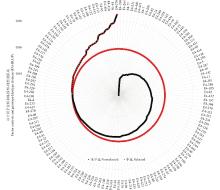
Fig.1
Genotypes ranking and selected genotypes with FAI-BLUP index"
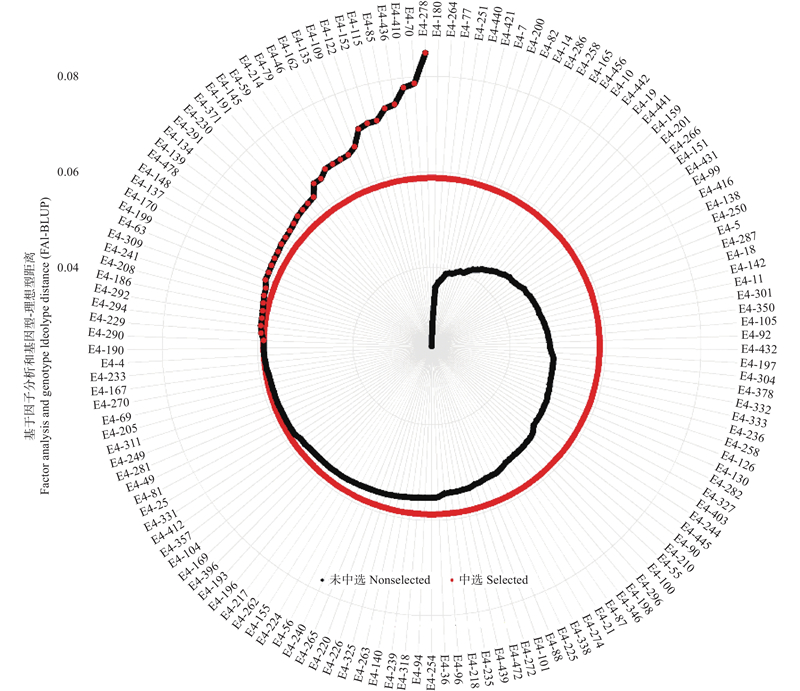
Table 3
Selection differential and selection gain of the selected genotypes with MGIDI based BLUP"
| 性状 Traits | 因子1 FA1 | 因子2 FA2 | 因子3 FA3 | 因子4 FA4 | 共同度 Communality | 唯一性 Uniquenesses | 变量 VAR | 因子 Factor | 总体均 值Xo | 中选均 值Xs | 选择 差SD | 选择增 益SG% | 方向 Sense | 目标 Goal | |
| H2 | –0.757 | –0.084 | 0.135 | –0.175 | 0.628 | 0.372 | H2 | FA1 | 35.4 | 38.563 | 3.154 | 8.907 | 上升Increase | 100 | |
| D2 | –0.931 | –0.062 | –0.010 | –0.106 | 0.882 | 0.118 | D2 | FA1 | 4.78 | 5.298 | 0.523 | 10.948 | 上升Increase | 100 | |
| DS | –0.809 | –0.065 | –0.015 | 0.027 | 0.659 | 0.341 | DS | FA1 | 1.168 | 1.328 | 0.156 | 13.672 | 上升Increase | 100 | |
| RDW | –0.739 | 0.141 | –0.138 | 0.081 | 0.592 | 0.408 | RDW | FA1 | 1.668 | 1.857 | 0.189 | 11.319 | 上升Increase | 100 | |
| TRL | –0.159 | –0.103 | –0.684 | 0.361 | 0.634 | 0.366 | TR | FA2 | 3.822 | 3.762 | –0.061 | –1.583 | 下降Decrease | 100 | |
| RSA | –0.125 | –0.057 | 0.745 | 0.359 | 0.703 | 0.297 | WUE | FA2 | 2.962 | 2.984 | 0.022 | 0.755 | 上升Increase | 100 | |
| AD | –0.128 | 0.041 | –0.025 | –0.853 | 0.746 | 0.254 | TRL | FA3 | 2.169 | 2.195 | 0.026 | 1.197 | 上升Increase | 100 | |
| TR | –0.017 | 0.874 | 0.023 | –0.105 | 0.776 | 0.224 | RSA | FA3 | 0.721 | 0.741 | 0.020 | 2.833 | 上升Increase | 100 | |
| WUE | 0.060 | 0.883 | 0.007 | 0.037 | 0.785 | 0.215 | AD | FA4 | 0.913 | 0.949 | 3.925 | 上升Increase | 100 | ||
| 特征值Eigenvalues | 2.729 | 1.613 | 1.061 | 1.002 | |||||||||||
| 方差 Variance (%) | 30.317 | 17.917 | 11.793 | 11.138 | |||||||||||
| 累计方差 Cum.variance(%) | 30.317 | 48.235 | 60.028 | 71.166 |
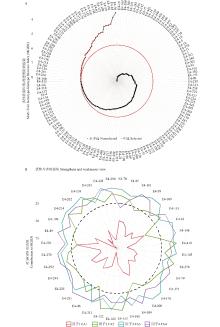
Fig.2
Genotypes ranking, selected genotypes (A) and their strengths and weaknesses with MGIDI (B) based on BLUP"
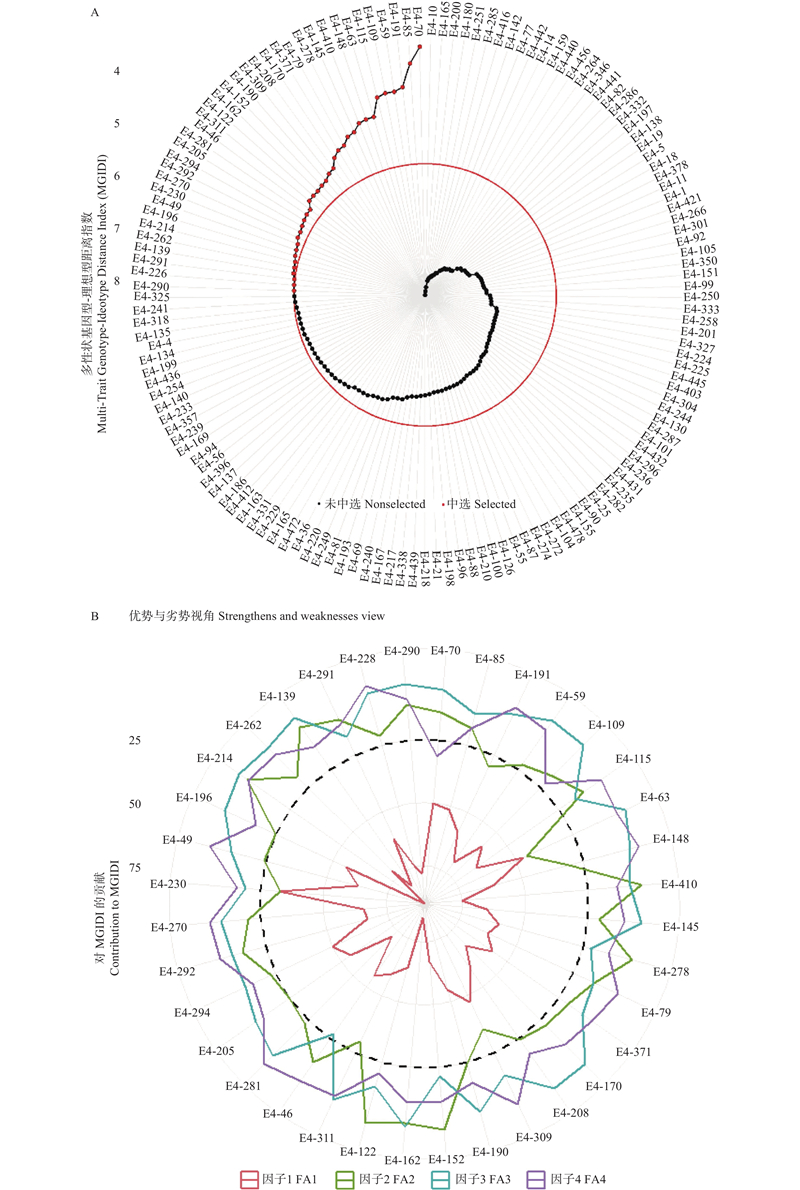
Table 4
Selection differential and selection gain of the selected genotypes with MGIDI based on LWindex"
| 变量 VAR | 因子1 FA1 | 因子2 FA2 | 因子3 FA3 | 因子4 FA4 | 共同度 Communality | 唯一性 Uniquenesses | 变量 VAR | 因子 Factor | 总体均 值Xo | 中选均 值Xs | 选择差 SD | 选择增 益SG% | 方向 Sense | 目标 Goal | |
| H2 | –0.623 | 0.089 | 0.416 | –0.101 | 0.582 | 0.418 | H2 | FA1 | 0.965 | 0.174 | 22.058 | 上升Increase | 100 | ||
| D2 | –0.895 | – | – | 0.811 | 0.189 | D2 | FA1 | 0.882 | 0.957 | 8.489 | 上升Increase | 100 | |||
| DS | –0.679 | – | –0.335 | 0.311 | 0.671 | 0.329 | DS | FA1 | 1.019 | 4.331 | 上升Increase | 100 | |||
| RDW | –0.136 | 0.183 | 0.464 | 0.269 | 0.731 | TR | FA2 | 0.620 | 0.607 | – | –2.130 | 下降Decrease | 100 | ||
| TRL | 0.192 | 0.131 | 0.372 | –0.304 | 0.285 | 0.715 | WUE | FA2 | 1.236 | 1.239 | 0.237 | 上升Increase | 100 | ||
| RSA | –0.149 | 0.750 | 0.595 | 0.405 | RDW | FA3 | 0.871 | 0.947 | 8.702 | 上升Increase | 100 | ||||
| AD | –0.061 | – | –0.120 | –0.927 | 0.885 | 0.115 | TRL | FA3 | 1.034 | 1.035 | 0.129 | 上升Increase | 100 | ||
| TR | –0.010 | 0.892 | – | 0.802 | 0.198 | RSA | FA3 | 0.993 | 0.994 | 上升Increase | 100 | ||||
| WUE | – | 0.871 | 0.763 | 0.237 | AD | FA4 | 0.733 | 0.740 | 0.974 | 上升Increase | 100 | ||||
| 特征值 Eigenvalues | 1.792 | 1.627 | 1.211 | 1.031 | |||||||||||
| 方差 Variance (%) | 19.914 | 18.075 | 13.456 | 10.270 | |||||||||||
| 累计方差 Cum.variance(%) | 19.914 | 37.988 | 51.447 | 62.903 |
Fig.3
Genotypes ranking, selected genotypes (A) and their strengths and weaknesses with MGIDI (B) based on LWindex"
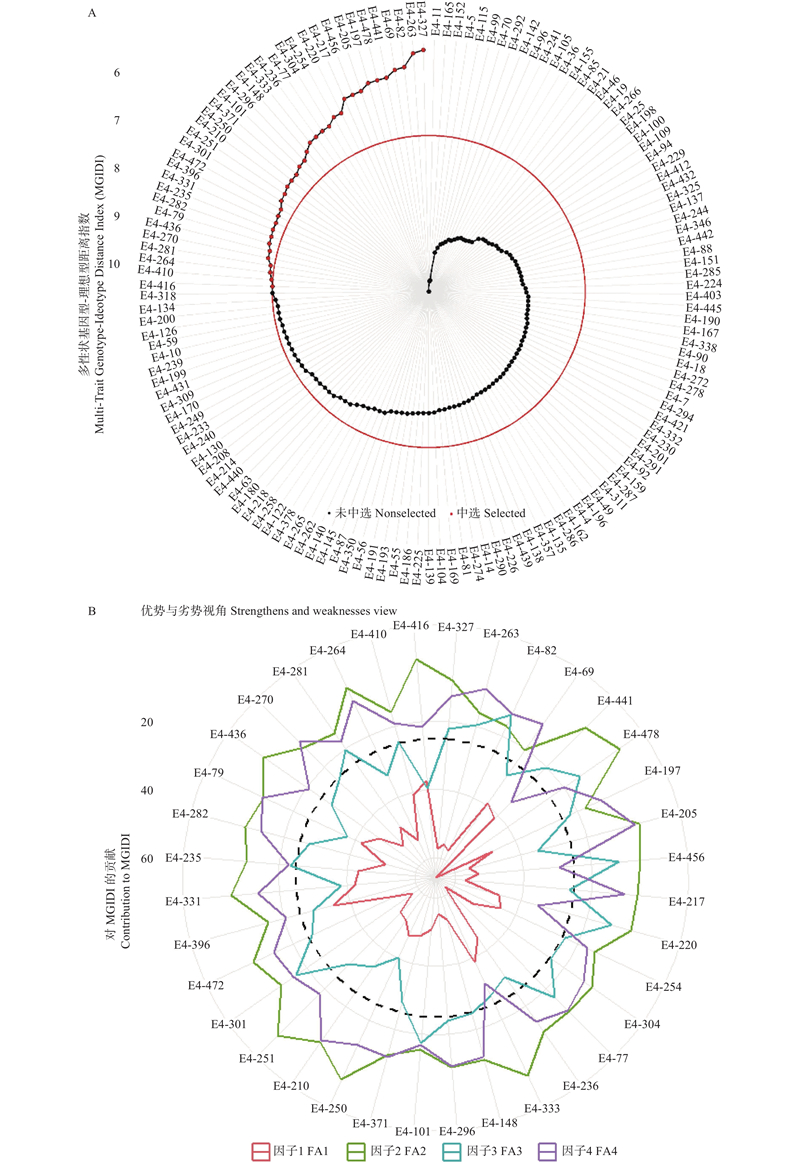
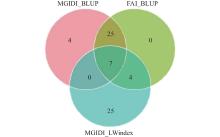
Fig.4
Venn plot of the selected progeny with FAI-BLUP, MGIDI based on BLUP and MGIDI based on LWindex"
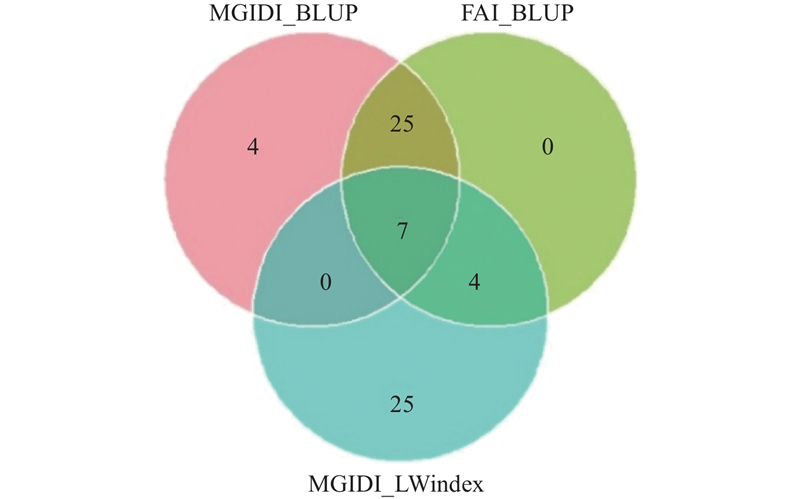
Table 5
Co-selected genotypes under three selection indexes"
| 选择指数1 Selection index 1 | 选择指数2 Selection index 2 | 中选基因型数量 Number of selected genotypes | 3种选择策略中选基因型 Selected genotypes of three selection strategies | 共选基因型 Co-selected genotypes |
| FAI-BLUP | MGIDI_BLUP | 27 | E4-70、E4-85、E4-191、E4-59、E4-109、E4-115、E4-63、 E4-148、E4-410、E4-145、E4-278、E4-79、E4-371、E4-170、 E4-208、E4-309、E4-152、E4-162、E4-122、E4-46、E4-294、 E4-292、E4-230、E4-214、E4-139、E4-291、E4-290 | E4-148、E4-410、 E4-79、E4-371 |
| MGIDI_BLUP | MGIDI_LWindex | 7 | E4-148、E4-410、E4-79、E4-371、E4-281、E4-205、E4-270 | |
| MGIDI_LWindex | FAI-BLUP | 6 | E4-410、E4-436、E4-79、E4-371、E4-478、E4-148 |
| 国家林业和草原局. 2019. 中国森林资源报告(2014—2018). 北京: 中国林业出版社. | |
| National Forestry and Grassland Administration. 2019. China forest resources report 2014—2018. Beijing: China Forestry Publishing House. [in Chinese] | |
| 康向阳. 林木遗传育种研究进展. 南京林业大学学报(自然科学版), 2020, 44 (3): 1- 10. | |
| Kang X Y. Research progress of forest genetics and tree breeding. Journal of Nanjing Forestry University (Natural Sciences Edition), 2020, 44 (3): 1- 10. | |
| 李春情, 刘翔宇, 闫 鹏, 等. 不同玉米品种抗旱性的生理鉴定与综合评价. 作物杂志, 2024, 40 (4): 253- 362. | |
| Li C Q, Liu X Y, Yan P, et al. Physiological identification and comprehensive evaluation of drought resistance of different maize varieties. Crops, 2024, 40 (4): 253- 362. | |
| 牛晋鸿, 王天欣, 曹明嵘, 等. 基于FAI-BLUP多性状选择指数的耐低氮杨树品种筛选. 林业科学研究, 2025, 38 (1): 61- 72. | |
| Niu J H, Wang T X, Cao M R, et al. Screening of poplar varieties with low-nitrogen tolerance based on FAI-BLUP multiple trait selection index. Forest Research, 2025, 38 (1): 61- 72. | |
|
乔滨杰, 王德秋, 高海燕, 等. 干旱胁迫下杨树无性系苗期光合与气孔形态变异研究. 植物研究, 2020, 40 (2): 177- 188.
doi: 10.7525/j.issn.1673-5102.2020.02.003 |
|
|
Qiao B J, Wang D Q, Gao H Y, et al. Photosynthetic and stomatal morphological variation of poplar clones in seedling stage under drought stress. Bulletin of Botanical Research, 2020, 40 (2): 177- 188.
doi: 10.7525/j.issn.1673-5102.2020.02.003 |
|
| 苏晓华, 丁昌俊, 马常耕. 我国杨树育种的研究进展及对策. 林业科学研究, 2010, 23 (1): 31- 37. | |
| Su X H, Ding C J, Ma C G. Research progress and strategies of poplar breeding in China. Forest Research, 2010, 23 (1): 31- 37. | |
| 孙 佩, 姬慧娟, 张亚红, 等. 丹红杨×通辽1号杨杂交子代苗期抗旱性初步评价. 植物遗传资源学报, 2019, 20 (2): 297- 308. | |
| Sun P, Ji H J, Zhang Y H, et al. Preliminary evaluation of drought resistance for Populus deltoides 'Danhong' × P. simonii 'Tongliao1' hybrid progenies at the seedling stage. Journal of Plant Genetic Resources, 2019, 20 (2): 297- 308. | |
|
王天欣, 牛晋鸿, 曹明嵘, 等. 低氮下小黑杨×欧洲黑杨杂交子代苗期性状遗传变异和选择. 林业科学, 2025, 61 (2): 142- 151.
doi: 10.11707/j.1001-7488.LYKX20240374 |
|
|
Wang T X, Niu J H, Cao M R, et al. Genetic variation and selection of seedling traits in the progeny of Populus simonigra × P. nigra under low nitrogen condition. Scientia Silvae Sinicae, 2025, 61 (2): 142- 151.
doi: 10.11707/j.1001-7488.LYKX20240374 |
|
| 席本野. 2019. 杨树根系形态、分布、动态特征及其吸水特性. 北京林业大学学报, 41(12): 37–49. | |
| Xi B Y. 2019. Morphology, distribution, dynamic characteristics of poplar roots and its water uptake habits. Journal of Beijing Forestry University, 41(12): 37–49. [in Chinese] | |
|
张 蕾, 姜鹏飞, 王一鸣, 等. 苦杨×小叶杨杂交F1代苗期抗旱性比较研究. 植物学报, 2023, 58 (4): 519- 534.
doi: 10.11983/CBB22086 |
|
|
Zhang L, Jiang P F, Wang Y M, et al. Comparative study on the drought resistance of young seedling from Populus laurifolia × P. simonii F1 progeny. Chinese Bulletin of Botany, 2023, 58 (4): 519- 534.
doi: 10.11983/CBB22086 |
|
|
Amjid M, Üstün R. Selection of soybean genotypes exhibiting drought resistance by assessing morphological and yield traits. Euphytica, 2025, 221 (4): 44.
doi: 10.1007/s10681-025-03493-9 |
|
|
Basavaraj P S, Babar R, Gangurde A, et al. Unveiling drought-tolerant mungbean genotypes through integrated multi-trait selection. Scientific Reports, 2026, 16 (1): 6018.
doi: 10.1038/s41598-026-36830-6 |
|
|
Biselli C, Vietto L, Rosso L, et al. Advanced breeding for biotic stress resistance in poplar. Plants, 2022, 11 (15): 2032.
doi: 10.3390/plants11152032 |
|
| Céron-Rojas J J, Crossa J. 2018. Linear phenotypic eigen selection index methods. In: Linear selection indices in modern plant breeding. Cham: Springer International Publishing: 149-176. | |
|
Costa C S R, de Lima M A C, Neto F P L, et al. Genetic parameters and selection of mango genotypes using the FAI-BLUP multitrait index. Scientia Horticulturae, 2023, 317, 112049.
doi: 10.1016/j.scienta.2023.112049 |
|
| Dastfall M, Najafi Mirak T, Zali H. Selection of durum wheat (Triticum turgidum L. var. durum) genotypes tolerant to terminal season drought stress using multi-trait indices (MGIDI). Iranian Journal of Crop Sciences, 2024, 25 (4): 342- 361. | |
|
Debnath P, Chakma K, Bhuiyan M S U, et al. A novel multi trait genotype ideotype distance index (MGIDI) for genotype selection in plant breeding: application, prospects, and limitations. Crop Design, 2024, 3 (4): 100074.
doi: 10.1016/j.cropd.2024.100074 |
|
|
Du C J, Sun P, Cheng X Q, et al. QTL mapping of drought-related traits in the hybrids of Populus deltoides ‘Danhong’ × Populus simoni ‘Tongliao1’. BMC Plant Biology, 2022, 22, 238.
doi: 10.1186/s12870-022-03613-w |
|
|
Duruflé H, Déjardin A, Jorge V, et al. Natural variation in chalcone isomerase defines a major locus controlling radial stem growth variation among Populus nigra populations. Peer Community Journal, 2025, 5, e50.
doi: 10.24072/pcjournal.559 |
|
| FAO. 2021. Synthesis of country progress reports received, prepared for the 26th session of the international poplar and other fast-growing trees sustaining people and the environment. Rome: IPC. | |
|
Farid M, Anshori M F, Mantja K, et al. Selection of lowland tomato advanced lines using selection indices based on PCA, path analysis, and the Smith-Hazel index. SABRAO Journal of Breeding and Genetics, 2024, 56 (2): 708- 718.
doi: 10.54910/sabrao2024.56.2.22 |
|
|
Getman-Pickering Z L, Campbell A, Aflitto N, et al. LeafByte: a mobile application that measures leaf area and herbivory quickly and accurately. Methods in Ecology and Evolution, 2020, 11 (2): 215- 221.
doi: 10.1111/2041-210X.13340 |
|
| Ghavidel S, Pour-Aboughadareh A, Mostafavi K. Identification of drought-tolerant genotypes of barley (Hordeum vulgare L.) based on selection indices. Crop Science Research in Arid Regions, 2024, 5 (3): 671- 687. | |
|
Gunes A, Inal A, Adak M S, et al. Effect of drought stress implemented at pre-or post-anthesis stage on some physiological parameters as screening criteria in chickpea cultivars. Russian Journal of Plant Physiology, 2008, 55 (1): 59- 67.
doi: 10.1134/S102144370801007X |
|
|
Himes A, Emerson P, McClung R, et al. Leaf traits indicative of drought resistance in hybrid poplar. Agricultural Water Management, 2021, 246, 106676.
doi: 10.1016/j.agwat.2020.106676 |
|
| Isebrands J, G. Aronsson P, Carlson M, et al. 2014. Environmental applications of poplars and willows//Isebrands J G, Richardson J. Eds. Poplars and willows: trees for society and the environment. Oxfordshire, England: CABI, 258–336. | |
|
Khan A, Gong X W, Zhang C, et al. Contrasts in hydraulics underlie the divergent performances of Populus and native tree species in water-limited sandy land environments. Physiologia Plantarum, 2025, 177 (1): e70075.
doi: 10.1111/ppl.70075 |
|
|
Kutsokon N K, Jose S, Holzmueller E. A global analysis of temperature effects on Populus plantation production potential. American Journal of Plant Science, 2015, 6 (1): 23- 33.
doi: 10.4236/ajps.2015.61004 |
|
|
Mokarroma N, Uddin M R, Ahmed I M, et al. Multivariate analysis for identifying drought-tolerant barley (Hordeum vulgare L.) genotypes using stress indices. Data in Brief, 2025, 59, 111452.
doi: 10.1016/j.dib.2025.111452 |
|
|
Mohammadi R. Efficiency of yield-based drought tolerance indices to identify tolerant genotypes in durum wheat. Euphytica, 2016, 211 (1): 71- 89.
doi: 10.1007/s10681-016-1727-x |
|
| Mohi-Ud-Din M, Hossain M. A, Rohman M M, et al. Multi-trait index-based selection of drought tolerant wheat: physiological and biochemical profiling. Plants, 2025, 14 (1): 35. | |
|
Olivoto T, Lúcio A. D. Metan: an R package for multi-environment trial analysis. Methods in Ecology and Evolution, 2020, 11 (6): 783- 789.
doi: 10.1111/2041-210X.13384 |
|
|
Olivoto T, Diel M I, Schmidt D, et al. MGIDI: a powerful tool to analyze plant multivariate data. Plant Methods, 2022, 18 (1): 121.
doi: 10.1186/s13007-022-00952-5 |
|
|
Olivoto T, Nardino M. MGIDI: toward an effective multivariate selection in biological experiments. Bioinformatics, 2021, 37 (10): 1383- 1389.
doi: 10.1093/bioinformatics/btaa981 |
|
|
Pathy T L, Vinu V, Arunkumar R, et al. Multi-trait index based Elucidation of drought tolerance potential of Saccharum spontaneum. Plant Physiology Reports, 2025, 30 (4): 928- 941.
doi: 10.1007/s40502-025-00911-x |
|
|
Rocha J R A S C, Machado J C, Carneiro P C S. Multitrait index based on factor analysis and ideotype-design: proposal and application on elephant grass breeding for bioenergy. GCB Bioenergy, 2018, 10 (1): 52- 60.
doi: 10.1111/gcbb.12443 |
|
| Rosso L, Cantamessa S, Bergante S, et al. 2023. Responses to drought stress in poplar: what do we know and what can we learn? Life, 13(2): 533. | |
|
Rovida Kojima E A, González C V, Mundo I A, et al. Mechanisms of drought resistance in Populus deltoides and P. × canadensis clones to possible situations of water restriction in irrigated systems in drylands. Trees, 2024, 38 (5): 1267- 1281.
doi: 10.1007/s00468-024-02551-4 |
|
|
Safdar A, Hameed A, Hassan H M. Biochemical and morpho-physiological insights revealed low moisture stress adaptation mechanisms in cotton (Gossypium hirsutum L.). Scientific Reports, 2024, 14 (1): 25942.
doi: 10.1038/s41598-024-77204-0 |
|
|
Salami M, Tan H, Alizadeh B, et al. Photosynthetic performance, pigments and biochemicals influence seed yield in rapeseed under water deficit conditions: MGIDI index helps screening drought-tolerant genotypes. Field Crops Research, 2025, 322, 109733.
doi: 10.1016/j.fcr.2024.109733 |
|
|
Shani M Y, Ditta A, Khan M K R, et al. Deciphering drought tolerance in cotton genotypes through integrated morpho-physiological and biochemical markers at flowering stage. Scientific Reports, 2025, 15 (1): 44123.
doi: 10.1038/s41598-025-28237-6 |
|
|
Song R J, Shi P C, Xiang L, et al. Evaluation of barley genotypes for drought adaptability: based on stress indices and comprehensive evaluation as criteria. Frontiers in Plant Science, 2024, 15, 1436872.
doi: 10.3389/fpls.2024.1436872 |
|
|
Sorwar Jahan M A H, Azam M G, Mohi-Ud-Din M, et al. Agronomic parameters and drought tolerance indices of bread wheat genotypes as influenced by well-watered and water deficit conditions. BMC Plant Biology, 2025, 25 (1): 1342.
doi: 10.1186/s12870-025-07355-3 |
|
|
Sun P, Jia H X, Cheng X Q, et al. Genetic architecture of leaf morphological and physiological traits in a Populus deltoides ‘Danhong’ × P. simonii ‘Tongliao1’ pedigree revealed by quantitative trait locus analysis. Tree Genetics & Genomes, 2020, 16 (3): 45.
doi: 10.1007/s11295-020-01438-y |
|
|
Wang X Y, Li X M, Zhao W, et al. Current views of drought research: experimental methods, adaptation mechanisms and regulatory strategies. Frontiers in Plant Science, 2024, 15, 1371895.
doi: 10.3389/fpls.2024.1371895 |
|
|
Yan C J, Song S H, Wang W B, et al. Screening diverse soybean genotypes for drought tolerance by membership function value based on multiple traits and drought-tolerant coefficient of yield. BMC Plant Biology, 2020, 20 (1): 321.
doi: 10.1186/s12870-020-02519-9 |
|
|
Zahedi S M, Karimi M, Venditti A, et al. Plant adaptation to drought stress: the role of anatomical and morphological characteristics in maintaining the water status. Journal of Soil Science and Plant Nutrition, 2025, 25 (1): 409- 427.
doi: 10.1007/s42729-024-02141-w |
|
|
Zhou Z Y, Cao M R, Jia D X, et al. Integrating multivariate selection indices with weighted rank aggregation to identify drought-tolerant Populus simonii × P. nigra F1 progenies. BMC Plant Biology, 2026, 26 (1): 291.
doi: 10.1186/s12870-025-08054-9 |
| [1] | Tianxin Wang,Jinhong Niu,Mingrong Cao,Chenggong Liu,Jinhua Li. Genetic Variation and Selection of Seedling Traits in the Progeny of Populus simonigra × P. nigra under Low Nitrogen Condition [J]. Scientia Silvae Sinicae, 2025, 61(2): 142-151. |
| [2] | Chubiao Wang,Jianzhong Luo,Wenliang He,Wanhong Lu,Yan Lin,Yuduan Ou. G×E Analysis and Selection of Eucalyptus Clones by Multi-Region Combined Test [J]. Scientia Silvae Sinicae, 2022, 58(11): 108-117. |
| [3] | Jinhua Li. Genotype by Environment Interaction for Growth Traits of Clones of Populus Section Aigeiros Based on BLUP and GGE Biplot [J]. Scientia Silvae Sinicae, 2021, 57(6): 64-73. |
| [4] | Zheng Conghui, Zhang Hongjing, Wang Yuzhong, Dai Jianfeng, Dang Lei, Du Zichun, Liu Jianting, Gao Yunru. An Analysis of a Regional Trial of Larix principis-rupprechtii Families Based on BLUP and GGE Biplot [J]. Scientia Silvae Sinicae, 2019, 55(8): 73-83. |
| [5] | Zu Xiaofeng, Ni Chengcai, Gorden Nigh, Qin Xianlin. Based on Mixed-Effects Model and Empirical Best Linear Unbiased Predictor to Predict Growth Profile of Dominant Height [J]. Scientia Silvae Sinicae, 2015, 51(3): 25-33. |
| [6] | Wang Runhui;Hu Dehuo;Zheng Huiquan;Wei Ruping;Huang Yuemao;Cai Weijiu. Clonal Variation in Growth and Wood Quality and the Multi-Trait Index Selection of Chinese Fir [J]. Scientia Silvae Sinicae, 2012, 48(3): 45-50. |
| Viewed | ||||||
|
Full text |
|
|||||
|
Abstract |
|
|||||
