
Scientia Silvae Sinicae ›› 2026, Vol. 62 ›› Issue (8): 120-128.doi: 10.11707/j.1001-7488.LYKX20250763
• Research papers • Previous Articles Next Articles
Wei Zhang1,2,Xin Zhang1,Quanxin Bi2,Xiaojuan Liu2,Guowei Jiang1,Chulong Ning1,Haiyan Zhao1,Libing Wang1,2,*( )
)
Received:2025-12-21
Revised:2026-06-14
Online:2026-08-10
Published:2026-08-20
Contact:
Libing Wang
E-mail:wlibing@nwsuaf.edu.cn
CLC Number:
Wei Zhang,Xin Zhang,Quanxin Bi,Xiaojuan Liu,Guowei Jiang,Chulong Ning,Haiyan Zhao,Libing Wang. Construction of Agrobacterium rhizogenes-mediated Genetic Transformation System for Xanthoceras sorbifolium Hairy Roots[J]. Scientia Silvae Sinicae, 2026, 62(8): 120-128.

Table 1
Primer sequence"
| 引物名称 Primer name | 引物序列 Primer sequences(5′→3′) | 引物用途 Primer purpose |
| eYFP-F/Ruby–F | GGAAGTTCATTTCATTTGGAGAGA | 基因克隆与验证 Gene cloning and verification |
| eYFP–R | TGTGGCCGTTTACGTCGCC | |
| Ruby–R | GTGAATCTTGGCGAGGTTGGC | |
| XsXTH32–F | ATGGCTTCCATTATTGTGTA | |
| XsXTH32–R | TTAACATTCTGGTATCTGGGT | |
| 35S::XsXTH32–F | ccatggtagatctgactagtATGGCTTCCATTATTGTGTA | |
| 35S::XsXTH32–R | ggcctcctaggtacacgcgtACATTCTGGTATCTGGGTAT | |
| qRT-Ruby–F | AACAGCATCCTTGAGTCTCTTCG | 荧光定量 Fluorescence quantitative |
| qRT-Ruby–R | TTCTCTTTGGAGATCTCGCCTTC | |
| qRT-eYFP–F | CCACATGAAGCAGCACGACT | |
| qRT-eYFP–R | GTTGTACTCCAGCTTGTGCC | |
| qRT-XsXTH32–F | ACCTTCCCCAGGCTACAACC | |
| qRT-XsXTH32–R | ATTGCAACTTAATGGCCGCA | |
| qRT-XsTip41–F | AAGATGAATTGGCTGATAACGGA | |
| qRT-XsTip41–R | AGCTCTCACGAAGAATGACTGGG |
Fig.1
Protocol for Agrobacterium rhizogenes-mediated genetic transformation of Xanthoceras sorbifolium a: 2–4 leaf–stage X. sorbifolium seedlings; b: Application of an overnight-grown A. rhizogenes bacterial lawn onto the wound site; c: Replanting of the inoculated seedlings into the substrate; d: Callus formation at the wound site after approximately 2 weeks of cultivation; e: Development of the callus into positive hairy roots after 3–4 weeks of cultivation; f: Further development of the positive hairy roots into adventitious roots. Scale bar: 1 cm."
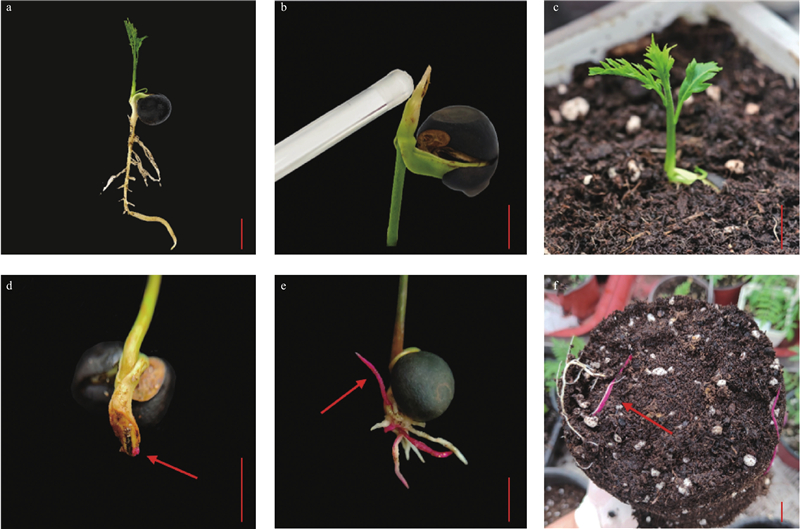
Table 2
Statistical analysis of hairy root induction in Xanthoceras sorbifolium by different Agrobacterium rhizogenes strains"
| 菌株类型 Strain type | 侵染外植体数 Number of the explant inoculated | 产生阳性毛状根平均外植体数 Number of average positive rooting explants | 阳性根诱导率 Positive root induction rate (%) | 毛状根转化率 Hairy root transformation efficiency (%) |
| MSU440 | 50 | 34.33±1.53b | 27.81±6.42b | 68.67±2.49b |
| ArA4 | 50 | 37.67±2.08ab | 37.91±6.53b | 75.33±3.40ab |
| C58C1 | 50 | 35.33±2.52ab | 35.64±5.77b | 70.67±4.11ab |
| Ar1193 | 50 | 36.67±1.53ab | 36.07±5.89b | 73.33±2.49ab |
| K599 | 50 | 39.33±3.06a | 51.39±14.25a | 78.67±4.99a |
Fig.2
Expression analysis of the reporter gene in positive hairy roots of Xanthoceras sorbifolium a, b: PCR amplification and electrophoresis identification of Ruby and eYFP. Lane 1, WT; lanes 2–4, genomic DNA from positive hairy roots; c: Schematic diagram of construction of vector; d: Expression level in transgenic hairy roots."
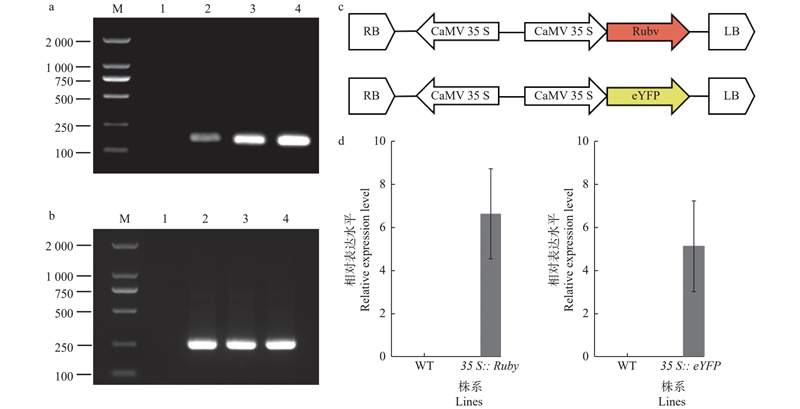
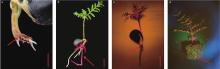
Fig.3
Phenotype of positive transgenic hairy roots in Xanthoceras sorbifolium"
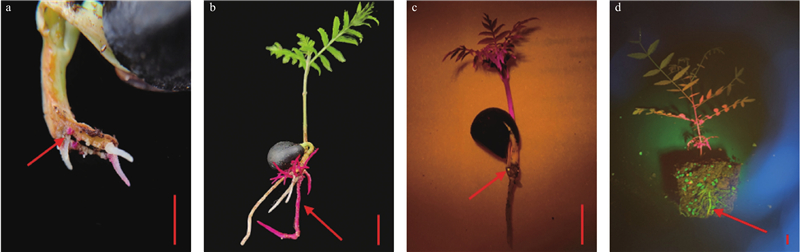
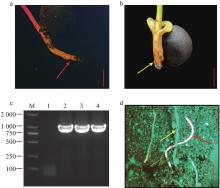
Fig.4
PCR detection and phenotype of XsXTH32 transgenic roots in Xanthoceras sorbifolium"
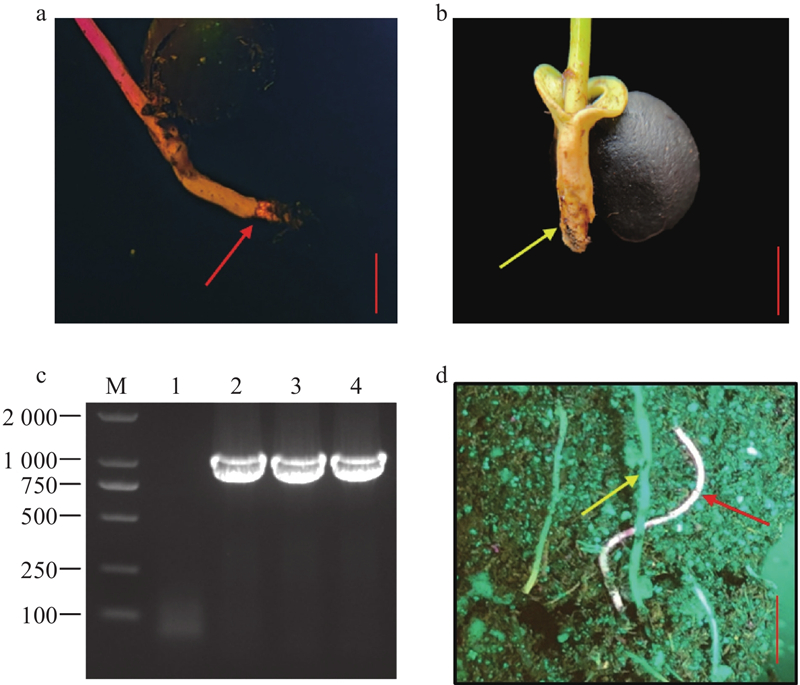
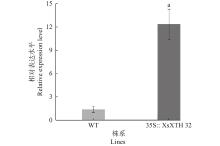
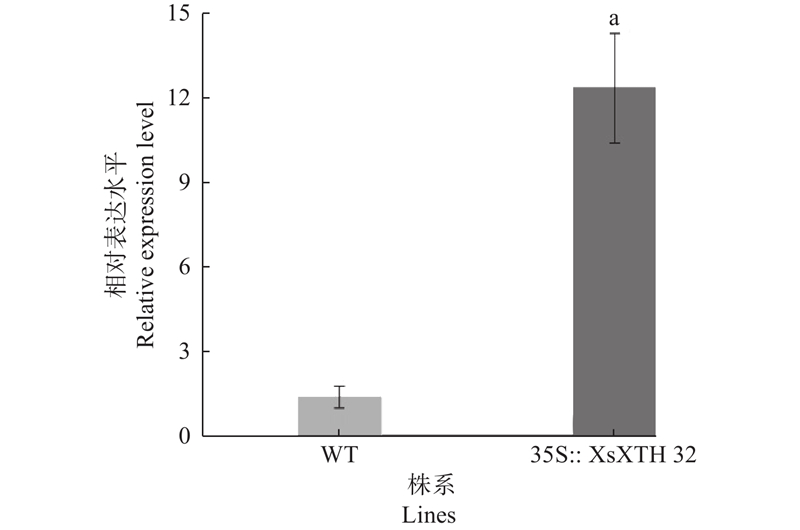
Fig.5
Expression level of XsXTH32 in transgenic hairy roots of Xanthoceras sorbifolium The different letters indicated significant differences between treatments (P<0.05)."
|
陈新玲, 王 媛, 孙吉康, 等. 蚬壳花椒毛状根的诱导及其培养技术体系构建. 植物生理学报, 2023, 59 (11): 2117- 2125.
doi: 10.13592/j.cnki.ppj.100835 |
|
|
Chen X L, Wang Y, Sun J K, et al. Induction and cultivation of hairy roots of Zanthoxylum dissitum. Plant Physiology Journal, 2023, 59 (11): 2117- 2125.
doi: 10.13592/j.cnki.ppj.100835 |
|
|
陈燕勤, 王雪莉, 宋世方, 等. 磷酸活化文冠果果壳生物炭及其对亚甲基蓝的吸附性能. 食品与机械, 2023, 39 (5): 1- 8.
doi: 10.13652/j.spjx.1003.5788.2022.80811 |
|
|
Chen Y Q, Wang X L, Song S F, et al. Preparation of Xanthoceras sorbifolia Bunge shell biochar activated by phosphoric acid and its adsorption performance for methylene blue. Food & Machinery, 2023, 39 (5): 1- 8.
doi: 10.13652/j.spjx.1003.5788.2022.80811 |
|
| 党培怡. 2025. 海棠花组培及遗传转化体系的建立. 杨凌: 西北农林科技大学. | |
| Dang P Y. 2025. Establishment of tissue culture and genetic transformation system of Malus spectabilis. Yangling: Northwest A&F University. [in Chinese] | |
| 冯 维, 林 凯, 王建忠, 等. 尾巨桉转基因毛状根的诱导及其用于获得转基因再生植株初探. 基因组学与应用生物学, 2025, 44 (5): 429- 442. | |
| Feng W, Lin K, Wang J Z, et al. Induction of transgenic hairy roots in Eucalyptus urophylla × E. grandis and their preliminary use for obtaining transgenic regenerated plants. Genomics and Applied Biology, 2025, 44 (5): 429- 442. | |
| 盖莎莎, 王力畅, 李春宇, 等. 文冠果组织培养再生体系的建立. 经济林研究, 2024, 42 (2): 158- 166. | |
| Gai S S, Wang L C, Li C Y, et al. Establishment of tissue culture and regeneration system for Xanthoceras sorbifolium Bunge. Nonwood Forest Research, 2024, 42 (2): 158- 166. | |
| 黄卫丽, 张文军, 张海东, 等. 2022. 文冠果组织培养快繁体系的构建. 北方农业学报, 50(4): 102–108. | |
| Huang W L, Zhang W J, Zhang H D, et al. 2022. Study on rapid propagation system of Xanthoceras sorbifolia tissue culture. Journal of Northern Agriculture, 50(4): 102–108. [in Chinese] | |
| 焦 阳, 乔 静, 曾智新, 等. 84K杨组培苗高效毛状根遗传转化体系构建. 林业科学, 2026, 62 (1): 122- 132. | |
| Jiao Y, Qiao J, Zeng Z X, et al. Construction of an efficient hairy root genetic transformation system in 84K poplar tissue culture seedlings. Scientia Silvae Sinicae, 2026, 62 (1): 122- 132. | |
| Jin H C. 2025. 黄芪皂苷在毛状根体系中的高效生产研究. 哈尔滨: 东北林业大学. | |
| Jin H C. 2025. Study on the efficient production of astragaloside in hairy root system. Harbin: Northeast Forestry University. [in Chinese] | |
| 李 函, 赵雅琦, 朱仕心. 等. 2026. 发根农杆菌介导的红麻毛状根诱导体系的建立. 福建农林大学学报(自然科学版), 55(3): 1–8. | |
| Li H, Zhao Y Q, Zhu S X, et al. 2026. Establishment of a hairy root induction system in kenafmediated by Agrobacterium rhizogenes. Journal of Fujian Agriculture and Forestry University (Natural Science Edition), 55(3): 1–8. [in Chinese] | |
| 李麟坤, 梁重钧, 宁楚龙, 等. 文冠果种子发育基因表达分析内参基因的选择. 林业科学研究, 2024, 37 (3): 79- 85. | |
| Li L K, Liang C J, Ning C L, et al. Selection of reference genes for gene expression analysis in seed development of Xanthoceras sorbifolium Bunge. Forest Research, 2024, 37 (3): 79- 85. | |
| 李孟涛. 2023. 基于发根农杆菌的桃遗传转化体系构建及在香气物质合成基因功能研究上的应用. 杭州: 浙江大学. | |
| Li M T. 2023. Employing the Agrobacterium rhizogenes–mediated genetic transformation system to elucidate gene functions related to aroma formation in peach. Hangzhou: Zhejiang University. [in Chinese] | |
| 刘闵豪, 徐郡儡, 叶 靖, 等. 农杆菌介导的杜仲叶片愈伤组织遗传转化体系. 林业科学, 2020, 56 (2): 79- 88. | |
| Liu M H, Xu J L, Ye J, et al. Agrobacterium tumefaciens-mediated transformation of leaf callus in Eucommia ulmoides. Scientia Silvae Sinicae, 2020, 56 (2): 79- 88. | |
| 梁 静. 2024. 发根农杆菌K599介导的猕猴桃遗传转化体系的建立和优化. 合肥: 安徽农业大学. | |
| Liang J. 2024. Establishment and optimization of genetic transformation system of kiwifruit mediated by Agrobacterium rhizogenes K599. Hefei: Anhui Agricultural University | |
| 梁重钧, 李麟坤, 胡振华, 等. 文冠果种子高表达XsKCS7基因的克隆和酵母表达功能鉴定. 林业科学研究, 2024, 37 (2): 1- 8. | |
| Liang C J, Li L K, Hu Z H, et al. Cloning and yeast expression function identification of high expression XsKCS7 gene in Xanthoceras sorbifolium seed. Forest Research, 2024, 37 (2): 1- 8. | |
| 林建维, 张丽丽, 杨 俊, 等. 文冠果药食价值及其应用前景. 内蒙古林业调查设计, 2024, 47 (4): 69- 73. | |
| Lin J W, Zhang L L, Yang J, et al. Medicinal and edible value of Xanthoceras sorbifolium and its application prospects. Inner Mongolia Forestry Investigation and Design, 2024, 47 (4): 69- 73. | |
|
林 凯, 张育华, 柴 霞, 等. 发根农杆菌介导的星油藤毛状根遗传转化体系建立. 植物生理学报, 2023, 59 (2): 373- 382.
doi: 10.13592/j.cnki.ppj.100398 |
|
|
Lin K, Zhang Y H, Chai X, et al. Establishment of an Agrobacterium rhizogenes–mediated genetic transformation system of hairy roots in Sacha inchi (Plukenetia volubilis L. ). Plant Physiology Journal, 2023, 59 (2): 373- 382.
doi: 10.13592/j.cnki.ppj.100398 |
|
|
刘松英, 罗 锦, 周 敏, 等. 花生AhXTH32蛋白的生物信息学分析、亚细胞定位与原核表达. 分子植物育种, 2023, 21 (6): 1774- 1784.
doi: 10.13271/j.mpb.021.001774 |
|
|
Liu S Y, Luo J, Zhou M, et al. Bioinformatics analysis, subcellular localization and prokaryotic expression of AhXTH32 protein in peanut. Molecular Plant Breeding, 2023, 21 (6): 1774- 1784.
doi: 10.13271/j.mpb.021.001774 |
|
|
陆 昕, 李显玉, 陶 超, 等. 文冠果油对雄性小鼠记忆能力的影响. 中国油脂, 2024, 49 (4): 28- 31, 39.
doi: 10.19902/j.cnki.zgyz.1003-7969.220521 |
|
|
Lu X, Li X Y, Tao C, et al. Effect of Xanthoceras sorbifolium Bunge oil on memory ability of male mice. China Oils and Fats, 2024, 49 (4): 28- 31, 39.
doi: 10.19902/j.cnki.zgyz.1003-7969.220521 |
|
| 汪炜檬, 魏云晓, 唐云霓, 等. 棉花发根农杆菌转化体系的建立及生根优化. 中国农业科学, 2025, 58 (8): 1479- 1493. | |
| Wang W M, Wei Y X, Tang Y N, et al. Establishment and rooting optimization of Agrobacterium rhizogenes transformation system in cotton. Scientia Agricultura Sinica, 2025, 58 (8): 1479- 1493. | |
| 王升升, 段 珍, 张吉宇. 发根农杆菌介导的白花草木樨毛状根转化体系的建立. 草地学报, 2021, 29 (11): 2591- 2599. | |
| Wang S S, Duan Z, Zhang J Y. Establishment of hairy root transformation system of Melilotus albus induced by Agrobacterium rhizogenes. Acta Agrestia Sinica, 2021, 29 (11): 2591- 2599. | |
|
王 硕, 王 芳, 张丽纯, 等. 川续断毛状根诱导条件研究. 种业导刊, 2024 (6): 7- 11.
doi: 10.3969/j.issn.1003-4749.2024.06.002 |
|
|
Wang S, Wang F, Zhang L C, et al. Study on induction conditions of hairy roots of Dipsacus asperoidess. Journal of Seed Industry Guide, 2024 (6): 7- 11.
doi: 10.3969/j.issn.1003-4749.2024.06.002 |
|
|
卫昊钰, 高佳惠, 王学君, 等. 黑木相思毛状根遗传转化体系的建立. 中南林业科技大学学报, 2025, 45 (12): 176- 183.
doi: 10.14067/j.cnki.1673-923x.2025.12.017 |
|
|
Wei H Y, Gao J H, Wang X J, et al. Establishment of the genetic transformation system of hairy roots of Acacia melanoxylon. Journal of Central South University of Forestry & Technology, 2025, 45 (12): 176- 183.
doi: 10.14067/j.cnki.1673-923x.2025.12.017 |
|
|
卫 瑶, 戚 亚, 周晓娇, 等. 叶用文冠果叶片性状及次生代谢物含量动态变化. 经济林研究, 2025, 43 (2): 158- 165.
doi: 10.14067/j.cnki.1003-8981.2025.02.017 |
|
|
Wei Y, Qi Y, Zhou X J, et al. Dynamic changes of leaf traits and secondary metabolites content of Xanthoceras sorbifolia. Non-wood Forest Research, 2025, 43 (2): 158- 165.
doi: 10.14067/j.cnki.1003-8981.2025.02.017 |
|
|
吴梦洁, 洪家都, 李芳燕, 等. 发根农杆菌介导的闽楠遗传转化体系构建与优化. 核农学报, 2023, 37 (8): 1516- 1522.
doi: 10.11869/j.issn.1000-8551.2023.08.1516 |
|
|
Wu M J, Hong J D, Li F Y, et al. Construction and optimization of genetic transformation system mediated by Agrobacterium rhizogenes in Phoebe bournei. Journal of Nuclear Agricultural Sciences, 2023, 37 (8): 1516- 1522.
doi: 10.11869/j.issn.1000-8551.2023.08.1516 |
|
|
谢晓婷, 黄巧宇, 温广超, 等. 非组培依赖的发根农杆菌介导的薄壳山核桃转化体系构建. 果树学报, 2022, 39 (1): 131- 140.
doi: 10.13925/j.cnki.gsxb.20210383 |
|
|
Xie X T, Huang Q Y, Wen G C, et al. Construction of Agrobacterium rhizogenes-mediated transformation system of Carya illinoinensis without dependence on tissue culture. Journal of Fruit Science, 2022, 39 (1): 131- 140.
doi: 10.13925/j.cnki.gsxb.20210383 |
|
|
薛雯心, 刘立业, 袁金月, 等. 党参毛状根诱导条件研究. 安徽农业科学, 2017, 45 (10): 121- 123, 146.
doi: 10.3969/j.issn.0517-6611.2017.10.041 |
|
|
Xue W X, Liu L Y, Yuan J Y, et al. Study on the induction condition of hairy roots of Codonopsis pilosula. Journal of Anhui Agricultural Sciences, 2017, 45 (10): 121- 123, 146.
doi: 10.3969/j.issn.0517-6611.2017.10.041 |
|
| 杨 闯. 2021. 柠条毛状根遗传转化体系的建立及条件优化. 呼和浩特: 内蒙古农业大学. | |
| Yang C. 2021. Establishment of genetic transformation system of hairy roots of Caragana intermedia and its optimization. Hohhot: Inner Mongolia Agricultural University | |
|
曾文丹, 严华兵, 吴正丹, 等. 发根农杆菌介导的野葛毛状根遗传转化体系. 植物学报, 2025, 60 (3): 425- 434.
doi: 10.11983/CBB24092 |
|
|
Zeng W D, Yan H B, Wu Z D, et al. Agrobacterium rhizogenes–mediated transformation system of Pueraria lobata hairy roots. Chinese Bulletin of Botany, 2025, 60 (3): 425- 434.
doi: 10.11983/CBB24092 |
|
| 张 敏. 2023. 中国沙棘植株再生与移栽技术体系的优化和遗传转化初探. 呼和浩特: 内蒙古农业大学. | |
| Zhang M. 2023. Optimization of plant regeneration and transplanting technique system of Chinese seabuckthorn and preliminary study on its genetic transformation. Hohhot: Inner Mongolia Agricultural University | |
| 张漪曼, 路龙俊, 张毓婷, 等. 闽楠紫色酸性磷酸酶基因(PAPs)家族分析及3个PAPs在低磷胁迫下的功能. 林业科学, 2025, 61 (5): 146- 160. | |
| Zhang Y M, Lu L J, Zhang Y T, et al. Analysis of purple acid phosphatases genes (PAPs) family in Phoebe bournei and the functions of three PAPs under low phosphorus stress. Scientia Silvae Sinicae, 2025, 61 (5): 146- 160. | |
| 周芳伟, 徐 梁, 石从广, 等. 2026. 植物高效遗传转化体系研究进展. 南京林业大学学报(自然科学版), 50(3): 1–28. | |
| Zhou F W, Xu L, Shi C G, et al. 2026. Research progress on efficient genetic transformation systems in plants. Journal of Nanjing Forestry University (Natural Sciences Edition), 50(3): 1–28. [in Chinese] | |
|
朱雨萱, 姚明军, 李 斌, 等. 发根农杆菌介导的草莓遗传转化体系构建. 果树学报, 2026, 43 (1): 196- 210.
doi: 10.13925/j.cnki.gsxb.20250313 |
|
|
Zhu Y X, Yao M J, Li B, et al. Establishment of genetic transformation system mediated by Agrobacterium rhizogenes in strawberry. Journal of Fruit Science, 2026, 43 (1): 196- 210.
doi: 10.13925/j.cnki.gsxb.20250313 |
|
|
Azizi-Dargahlou S, Pouresmaeil M. Agrobacterium tumefaciens-mediated plant transformation: a review. Molecular Biotechnology, 2024, 66 (7): 1563- 1580.
doi: 10.1007/s12033-023-00788-x |
|
|
Bahramnejad B, Naji M, Bose R, et al. A critical review on use of Agrobacterium rhizogenes and their associated binary vectors for plant transformation. Biotechnology Advances, 2019, 37 (7): 107405.
doi: 10.1016/j.biotechadv.2019.06.004 |
|
|
Bi Q X, Zhao Y, Du W, et al. Pseudomolecule-level assembly of the Chinese oil tree yellowhorn (Xanthoceras sorbifolium) genome. GigaScience, 2019a, 8 (6): giz070.
doi: 10.1093/gigascience/giz070 |
|
|
Bi Q X, Cui Y F, Zhao Y, et al. Complete mitochondrial genome of a Chinese oil tree yellowhorn, Xanthoceras sorbifolium (Sapindales, Sapindaceae). Mitochondrial DNA Part B–Resources, 2019b, 4 (1): 1492- 1493.
doi: 10.1080/23802359.2019.1601038 |
|
|
Cao X S, Xie H T, Song M L, et al. Cut-dip-budding delivery system enables genetic modifications in plants without tissue culture. Innovation, 2023, 4 (1): 100345.
doi: 10.1016/j.xinn.2022.100345 |
|
|
Cao X, Qin Z F, Fan P H, et al. A simple widely applicable hairy root transformation method for gene function studies in medicinal plants. Acta Pharmaceutica Sinica B, 2025, 15 (8): 4300- 4305.
doi: 10.1016/j.apsb.2025.03.038 |
|
|
He Y B, Zhang T, Sun H, et al. A reporter for noninvasively monitoring gene expression and plant transformation. Horticulture Research, 2020, 7, 152.
doi: 10.1038/s41438-020-00390-1 |
|
|
Li L K, Liang C J, Zhang W, et al. 3-ketoacyl-CoA synthase 7 from Xanthoceras sorbifolium seeds is a crucial regulatory enzyme for nervonic acid biosynthesis. Plant Science, 2024, 347, 112184.
doi: 10.1016/j.plantsci.2024.112184 |
|
|
Liu F, Wang P D, Xiong X J, et al. A review of nervonic acid production in plants: prospects for the genetic engineering of high nervonic acid cultivars plants. Frontiers in Plant Science, 2021, 12, 626625.
doi: 10.3389/fpls.2021.626625 |
|
|
Liu L, Qu J H, Wang C Y, et al. An efficient genetic transformation system mediated by Rhizobium rhizogenes in fruit trees based on the transgenic hairy root to shoot conversion. Plant Biotechnology Journal, 2024, 22 (8): 2093- 2103.
doi: 10.1111/pbi.14328 |
|
|
Liu Y B, Lu S M, Zhang J F, et al. A xyloglucan endotransglucosylase/hydrolase involves in growth of primary root and alters the deposition of cellulose in Arabidopsis. Planta, 2007, 226 (6): 1547- 1560.
doi: 10.1007/s00425-007-0591-2 |
|
|
Mei G G, Chen A, Wang Y R, et al. A simple and efficient in planta transformation method based on the active regeneration capacity of plants. Plant Communications, 2024, 5 (4): 100822.
doi: 10.1016/j.xplc.2024.100822 |
|
|
Nagle M, Déjardin A, Pilate G, et al. Opportunities for innovation in genetic transformation of forest trees. Frontiers in Plant Science, 2018, 9, 1443.
doi: 10.3389/fpls.2018.01443 |
|
|
Sha H J, Li S K, Li J X, et al. Widely targeted metabolomics and network pharmacology reveal the nutritional potential of yellowhorn (Xanthoceras sorbifolium Bunge) leaves and flowers. Foods, 2024, 13 (8): 1274.
doi: 10.3390/foods13081274 |
|
|
Soulard C, Monfort M, Pillot J P, et al. Efficient and heritable gene editing through CRISPR-Cas9 in Pisum sativum. Plant Biotechnology Journal, 2025, 23 (8): 3398- 3400.
doi: 10.1111/pbi.70091 |
|
|
Wang J G, Liu S Y, Ma H P, et al. Reliable and efficient Agrobacterium tumefaciens-mediated genetic transformation of Dianthus spiculifolius. Horticultural Plant Journal, 2020, 6 (3): 199- 204.
doi: 10.1016/j.hpj.2020.03.004 |
|
| Wei M, Huang Y, Zhang H D, et al. 2026. Efficient Agrobacterium rhizogenes-mediated transformation of poplar via transgenic hairy root shoot regeneration. Plant, Cell & Environment, 49(3): 1309–1312. | |
|
Xiu Y, Wu G D, Tang W S, et al. Oil biosynthesis and transcriptome profiles in developing endosperm and oil characteristic analyses in Paeonia ostii var. lishizhenii. Journal of Plant Physiology, 2018, 228 (1): 121- 133.
doi: 10.1016/j.jplph.2018.05.011 |
|
| Xu H H, Liu X J, Ban Z, et al. 2025. XsLTPG31 confers leaf cuticular wax deposition and drought resistance in yellowhorn. Plant, Cell & Environment, 48(12): 8518–8533. | |
|
Xu P P, Fang S, Chen H Y, et al. The brassinosteroid-responsive xyloglucan endotransglucosylase/hydrolase19 (XTH19) and XTH23 genes are involved in lateral root development under salt stress in Arabidopsis. The Plant Journal, 2020, 104 (1): 59- 75.
doi: 10.1111/tpj.14905 |
|
|
Yin M, Jiang Y H, Wen Y J, et al. Establishment of an efficient Agrobacterium rhizogenes-mediated hairy root transformation method for subtropical fruit trees. Horticultural Plant Journal, 2025, 11 (4): 1699- 1702.
doi: 10.1016/j.hpj.2025.04.001 |
|
|
Zhao S W, Cao Q Q, Li L, et al. Functional analysis of Cucumis melo CmXTH11 in regulating drought stress tolerance in Arabidopsis thaliana. International Journal of Molecular Sciences, 2024a, 25 (20): 11031.
doi: 10.3390/ijms252011031 |
|
|
Zhao Y, Zhu H J, Lu X Q, et al. Streamlined Agrobacterium rhizogenes-mediated hairy root transformation for efficient CRISPR/Cas9-based gene editing evaluation in diverse Citrullus cultivars. Horticultural Plant Journal, 2025, 11 (2): 816- 826.
doi: 10.1016/j.hpj.2023.10.005 |
|
|
Zhao Z Q, Liang C J, Zhang W, et al. Genome-wide association analysis identifies a candidate gene controlling seed size and yield in Xanthoceras sorbifolium Bunge. Horticulture Research, 2024b, 11 (1): uhad243.
doi: 10.1093/hr/uhad243 |
| [1] | Yang Jiao,Jing Qiao,Zhixin Zeng,Shen Wang,Xuexin Yang,Yingrui Zhang,Yubing Yang,Yusen Zhao,Wenbo Shu. Construction of an Efficient Hairy Root Genetic Transformation System in 84K Poplar Tissue Culture Seedlings [J]. Scientia Silvae Sinicae, 2026, 62(1): 122-132. |
| [2] | Luo Zaiqi, Guo Huili, Yang Yadong, Yang Mingfeng, Ma Lanqin, Wang Younian. Agrobacterium-Mediated Transformation of Resveratrol Synthase Gene (PcPKS5) into Huping Jujube (Zizyphus jujuba) [J]. Scientia Silvae Sinicae, 2015, 51(10): 101-109. |
| Viewed | ||||||
|
Full text |
|
|||||
|
Abstract |
|
|||||
