
Scientia Silvae Sinicae ›› 2026, Vol. 62 ›› Issue (8): 129-143.doi: 10.11707/j.1001-7488.LYKX20250648
• Research papers • Previous Articles Next Articles
Yuechao Zhang,Pujun Xie*( ),Caihong Zhang,Yejun Deng,Xiang Wang,Lixin Huang*()
Received:2025-10-29
Revised:2026-03-02
Online:2026-08-10
Published:2026-08-20
Contact:
Pujun Xie,Lixin Huang
E-mail:pujunxie@caf.ac.cn;l_x_huang@163.com
CLC Number:
Yuechao Zhang,Pujun Xie,Caihong Zhang,Yejun Deng,Xiang Wang,Lixin Huang. Kinetics and Cost-Effectiveness of Polyphenol Extraction and Magnification from Olive Pomace and the Photoprotective Effects of Its Extracts[J]. Scientia Silvae Sinicae, 2026, 62(8): 129-143.
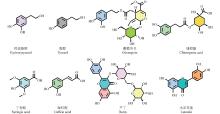
Fig.1
Eight polyphenol structural formulas of olive pomace"
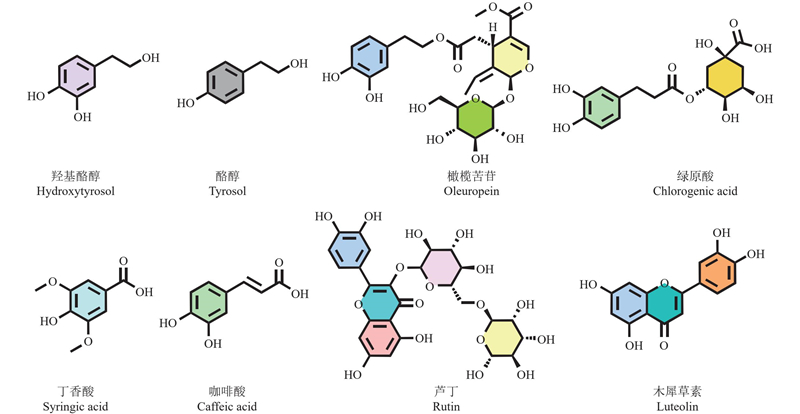
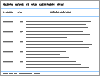
Table 1
Experimental factors and levels of response surface"
| 因素Factor | 水平Level | ||
| –1 | 0 | 1 | |
| X1 | 30 | 60 | 90 |
| X2 | 60 | 80 | 100 |
| X3 | 1∶10 | 1∶20 | 1∶30 |
| X4 | 60 | 80 | 100 |
Table 2
Product of EE × I (simulated sunlight) at seven points with intervals of 5 nm from 290 to 320 nm in wavelength"
| 波长Wave length (λ) / nm | 标准化EE×I |
| 290 | 0.015 0 |
| 295 | 0.081 7 |
| 300 | 0.287 4 |
| 305 | 0.327 8 |
| 310 | 0.186 4 |
| 315 | 0.083 7 |
| 320 | 0.018 0 |
| 合计Total | 1.000 0 |
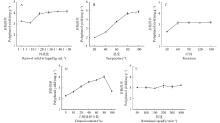
Fig.2
Single factor experiment of polyphenol extracts extraction from olive pomace A: The effect of solid-liquid ratio on the yield of polyphenols; B: The effect of extraction temperature on the yield of polyphenols; C: The effect of time on the yield of polyphenols; D: The effect of ethanol volume fraction on the yield of polyphenols; E: Effect of rotational speed on polyphenol yield."
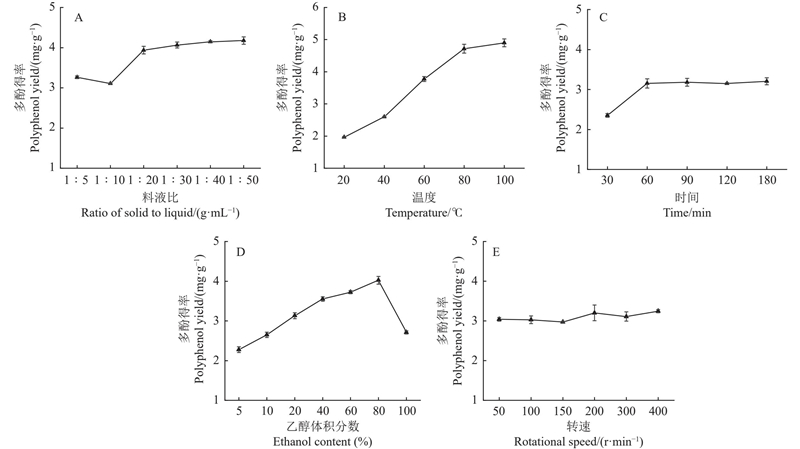
Table 3
Box-Behnken test plan and results"
| 试验号 Test number | X1 | X2 | X3 | X4 | 多酚得率Polyphenol yield/(mg·g?1) |
| 1 | –1 | –1 | 0 | 0 | 3.109 |
| 2 | 1 | –1 | 0 | 0 | 4.131 |
| 3 | –1 | 1 | 0 | 0 | 4.372 |
| 4 | 1 | 1 | 0 | 0 | 5.359 |
| 5 | 0 | 0 | –1 | –1 | 3.775 |
| 6 | 0 | 0 | 1 | –1 | 4.973 |
| 7 | 0 | 0 | –1 | 1 | 2.905 |
| 8 | 0 | 0 | 1 | 1 | 3.212 |
| 9 | –1 | 0 | 0 | –1 | 4.558 |
| 10 | 1 | 0 | 0 | –1 | 4.935 |
| 11 | –1 | 0 | 0 | 1 | 2.541 |
| 12 | 1 | 0 | 0 | 1 | 3.897 |
| 13 | 0 | –1 | –1 | 0 | 3.804 |
| 14 | 0 | 1 | –1 | 0 | 3.327 |
| 15 | 0 | –1 | 1 | 0 | 3.247 |
| 16 | 0 | 1 | 1 | 0 | 5.544 |
| 17 | –1 | 0 | –1 | 0 | 3.703 |
| 18 | 1 | 0 | –1 | 0 | 3.937 |
| 19 | –1 | 0 | 1 | 0 | 3.641 |
| 20 | 1 | 0 | 1 | 0 | 5.222 |
| 21 | 0 | –1 | 0 | –1 | 4.307 |
| 22 | 0 | 1 | 0 | –1 | 4.989 |
| 23 | 0 | –1 | 0 | 1 | 2.789 |
| 24 | 0 | 1 | 0 | 1 | 3.566 |
| 25 | 0 | 0 | 0 | 0 | 4.728 |
| 26 | 0 | 0 | 0 | 0 | 4.568 |
| 27 | 0 | 0 | 0 | 0 | 4.712 |
| 28 | 0 | 0 | 0 | 0 | 4.651 |
| 29 | 0 | 0 | 0 | 0 | 4.648 |
Table 4
Analysis of variance based on polyphenol yield as response value"
| 方差来源 Source of variance | 总方差 Total square deviation | 自由度 Degree of freedom | 均方差 Mean square deviation | F | P | 显著性 Significance |
| Model | 18.46 | 14 | 1.32 | 84.00 | < 0.000 1 | ** |
| X1 | 2.57 | 1 | 2.57 | 163.91 | < 0.000 1 | ** |
| X2 | 2.77 | 1 | 2.77 | 176.71 | < 0.000 1 | ** |
| X3 | 1.60 | 1 | 1.60 | 102.20 | < 0.000 1 | ** |
| X4 | 6.20 | 1 | 6.20 | 395.04 | < 0.000 1 | ** |
| X1X2 | 0.00 | 1 | 0.00 | 0.02 | 0.890 9 | ns |
| X1X3 | 0.45 | 1 | 0.45 | 28.89 | < 0.000 1 | ** |
| X1X4 | 0.24 | 1 | 0.24 | 15.26 | 0.001 6 | ** |
| X2X3 | 1.92 | 1 | 1.92 | 122.53 | < 0.000 1 | ** |
| X2X4 | 0.00 | 1 | 0.00 | 0.14 | 0.710 3 | ns |
| X3X4 | 0.20 | 1 | 0.20 | 12.64 | 0.003 2 | ** |
| X12 | 0.14 | 1 | 0.14 | 9.12 | 0.009 2 | ** |
| X22 | 0.43 | 1 | 0.43 | 27.11 | 0.000 1 | ** |
| X32 | 1.11 | 1 | 1.11 | 70.44 | < 0.000 1 | ** |
| X42 | 1.74 | 1 | 1.74 | 110.98 | < 0.000 1 | ** |
| 残差 Residual error | 0.22 | 14 | ||||
| 失拟误差 Misfit error | 0.20 | 10 | 5.09 | ns | ||
| 纯误差 Pure error | 0.02 | 4 | ||||
| 总离差 Total dispersion | 18.68 | 28 |
Fig.3
Effects of interaction of different factors on the yield of polyphenols from olive pomace A: The effect of the interaction between extraction time and solid-liquid ratio on the yield of polyphenols; B: The interaction between extraction time and ethanol volume fraction on the yield of polyphenols; C: The effect of interaction between solid-liquid ratio and extraction temperature on the yield of polyphenols; D: Effect of interaction between ethanol volume fraction and solid-liquid ratio on polyphenol yield."
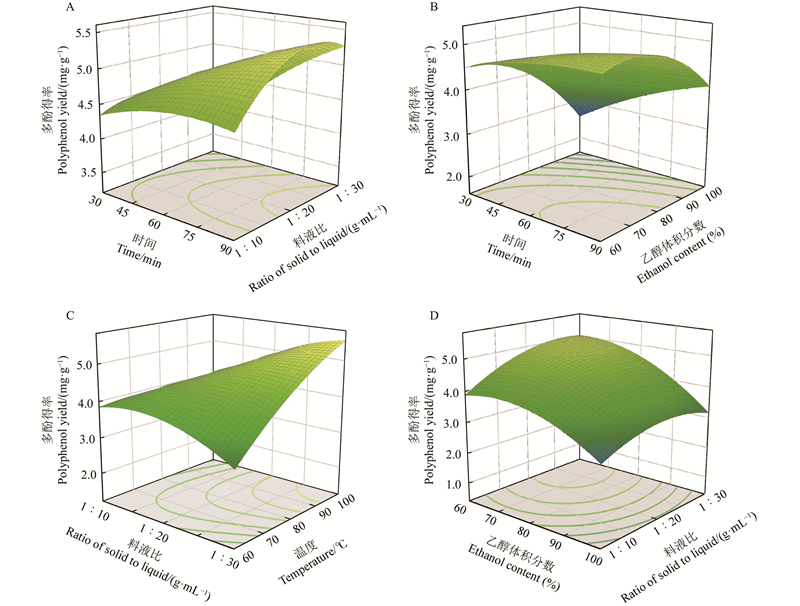
Table 5
Experimental results of extraction kinetics"
| 时间 Time/min | 多酚得率 Polyphenol yield/ (mg·g?1) | 羟基酪醇 Hydroxytyrosol/ (μg·g?1) | 酪醇 Tyrosol/ (μg·g?1) | 丁香酸 Syringic acid/ (μg·g?1) | 绿原酸 Chlorogenic acid/ (μg·g?1) | 咖啡酸 Caffeic acid/ (μg·g?1) | 芦丁 Rutin/ (μg·g?1) | 橄榄苦苷 Oleuropein/ (μg·g?1) | 木犀草素 Luteolin/ (μg·g?1) |
| 5 | 1.85 | 6.61 | 168.52 | 0.14 | 176.12 | 8.39 | 230.26 | 724.64 | 67.39 |
| 10 | 1.87 | 6.19 | 175.19 | 4.46 | 178.81 | 9.63 | 224.79 | 726.62 | 74.47 |
| 15 | 2.89 | 28.67 | 290.14 | 64.68 | 235.65 | 41.04 | 304.53 | 193.87 | |
| 30 | 3.29 | 51.29 | 446.84 | 178.20 | 267.63 | 49.75 | 681.53 | 271.14 | |
| 60 | 4.84 | 54.19 | 594.07 | 256.37 | 344.94 | 63.58 | 941.02 | 433.29 | |
| 77 | 4.92 | 57.80 | 608.26 | 259.46 | 353.85 | 66.88 | 978.73 | 458.07 | |
| 90 | 5.10 | 58.08 | 609.85 | 260.22 | 370.88 | 68.79 | 472.78 | ||
| 120 | 5.10 | 60.98 | 613.09 | 262.93 | 380.66 | 69.03 | 481.22 |
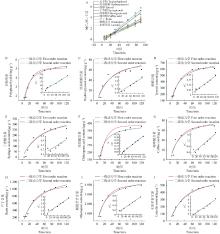
Fig.4
Olive polyphenol extraction kinetics fitting curve"
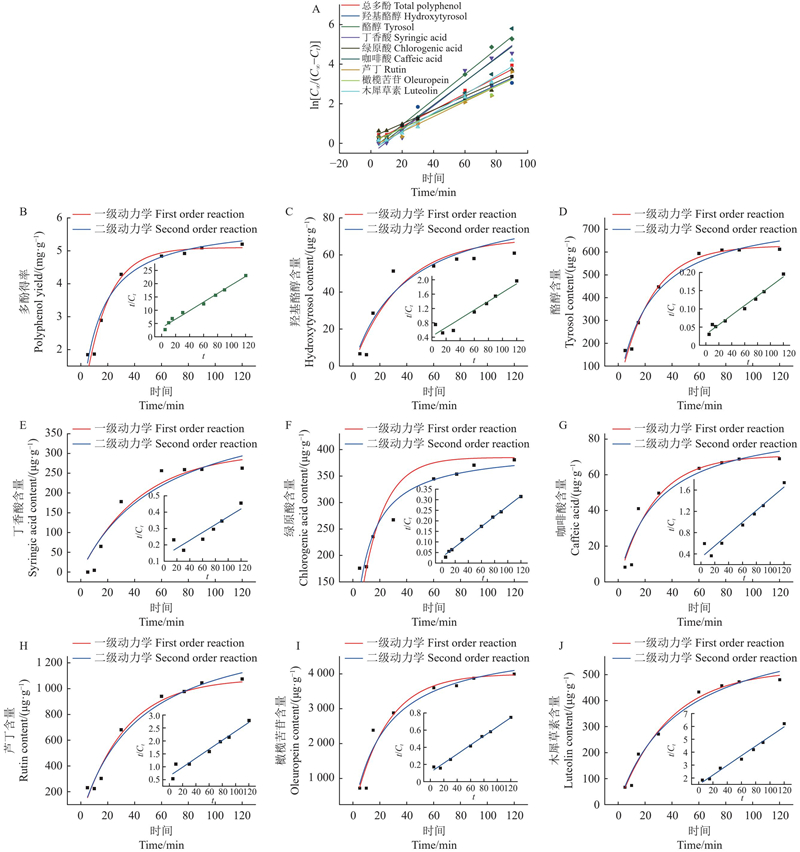
Table 6
Extraction kinetics model of total polyphenols and eight polyphenols"
| 项目Items | 菲克扩散模型 Fick diffusion model | 一级动力学 First-order kinetics | 二级动力学 Second-order kinetics | 二级动力学t/Ct与t的线性形式 The second-order kinetics t/Ctt and the linear form of |
| 总多酚Total polyphenols | y=0.041x+0.032,R2=0.978 | y=51.00×(1?e?0.057t), R2=0.965 | y=0.164x+3.346,R 2=0.984 | |
| 羟基酪醇Hydroxytyrosol | y =0.036x +0.047,R2=0.928 | y=69.23×(1?e?0.028t), R 2=0.903 | y=0.012x+0.425,R 2=0.923 | |
| 酪醇Tyrosol | y =0.064x -0.341,R2=0.987 | y=628.43×(1?e?0.042t), R 2=0.984 | y= | |
| 丁香酸Syringic acid | y =0.061x -0.548,R2=0.972 | y=305.29×(1?e?0.022t), R 2=0.928 | y=0.002x+0.132,R 2=0.830 | |
| 绿原酸Chlorogenic acid | y =0.034x+0.293,R2=0.974 | y=385.20×(1?e?0.060t), R 2=0.790 | y=0.002x+0.028,R 2=0.996 | |
| 咖啡酸Caffeic acid | y =0.059x-0.418,R2=0.935 | y=70.88×(1?e?0.038t), R 2=0.937 | y=0.011x+0.331,R 2=0.945 | |
| 芦丁Rutin | y =0.038x-0.175,R2=0.964 | y= R 2=0.978 | y=0.017x+0.640,R 2=0.959 | |
| 橄榄苦苷Oleuropein | y =0.035x+0.051,R2=0.974 | y= R 2=0.943 | y=0.005x+0.109,R 2=0.991 | |
| 木犀草素Luteolin | y =0.047x-0.344,R2=0.982 | y=519.18×(1?e?0.026t), R 2=0.983 | y=0.037x+1.479,R 2=0.983 |
Table 7
Cost accounting of polyphenol extracts extraction process of olive pomace (based on the production of 1 kg)"
| 成本项目Cost items | 计算依据与消耗量Calculation basis and consumption | 单价Unit price | 价格说明Price description |
| 油橄榄果渣 Olive pomace | 5 kg | 3 yuan·kg?1 | 原材料采购的预估市场价 Estimated market price for raw material purchases |
| 无水乙醇 Absolute alcohol | 87.5 L | 4.4 yuan·L?1 | 大宗工业级溶剂的市场采购价 Market purchase price of bulk industrial grade solvents |
| 水Water | 37.5 L | 根据中国水网可知水费价格大概为1.97 yuan·m?3 Water price is about 1.97 yuan·m?3 according to China 's water network | |
| 电力(提取、浓缩、干燥)Electricity ( extraction, concentration, drying ) | 30 kWh | 0.8 650 yuan·(kWh)?1 | 耗电量(每5 kg果渣30 kWh)是基于设备功率和运行时间的工艺估算,根据国家电网,工业用电为0.8 650 yuan·(kWh)?1 This power consumption (30 kWh per 5 kg of pomace ) is based on process estimation of equipment power and running time. The industrial electricity price is 0.865 0 yuan·(kWh)?1 according to the State Grid |
| 人工操作及维护Manual operation and maintenance | 按年产200 t分摊(人工成本为50 yuan·kg?1,维护成本 1.5 yuan·kg?1)Amortized at an annual output of 200 tons ( labor costs 50 yuan·kg?1, maintenance costs 1.5 yuan·kg?1 ) | 51.5 yuan·kg?1 | 固定成本的分摊Allocation of fixed costs 人工成本(50 yuan·kg?1):基于生产线所需的操作和管理的工资、福利等,按年总人工费用分摊到200 t年产量上得出,具体见 维护成本(1.5 yuan·kg?1):指日常的设备保养、巡检、小零件更换等常规维护费用,同样按年产量分摊 Labor cost (50 yuan·kg?1): based on the operation and management of the production line required wages, benefits, etc., according to the total annual labor costs allocated to 200 tons of annual output. The specific calculation is shown in supplemental table 1. Maintenance cost (1.5 yuan·kg?1): refers to the daily equipment maintenance, inspection, small parts replacement and other conventional maintenance costs, also allocated according to annual output |
| 设备维护、耗材、管理等Equipment maintenance, consumables, management, etc. | 按CAPEX的2%年费率估算并分摊Estimated and apportioned at CAPEX 's 2% annual rate | 1.67 yuan·kg?1 | 固定资产和综合管理费的分摊Allocation of fixed assets and comprehensive management fees 将项目总投资(CAPEX,即设备、厂房等固定资产)按2%的年费率(涵盖设备折旧、大修基金、保险、财务成本等)估算出年度总费用,再分摊到200 t的年产量上,得到每千克的成本The total investment of the project (CAPEX, equipment, plant and other fixed assets) is estimated at an annual rate of 2% (covering equipment depreciation, overhaul fund, insurance, financial cost, etc.) to estimate the total annual cost, and then apportioned to the annual output of 200 tons to obtain the cost per kilogram |
| 总成本Total cost | 565.66 yuan·kg?1 | (5 kg果渣成本+87.5 L乙醇成本+30 kWh电力成本)/1.167 kg产品+人工及维护成本+设备管理等成本=(15+385+26)/1.167+51.5+1.67≈418.21 yuan·kg?1 (5 kg pomace cost+87.5 L ethanol cost+30 kWh power cost)/1.167 kg product + labor and maintenance cost+equipment management cost=(15+385+26)/ 1.167+51.5+1.67≈418.21 yuan·kg?1 |
Table 8
SPF value and tyrosinase inhibition rate of the combination of two polyphenols in olive pomace extract"
| 二元光保护剂组合 Binary Photoprotective agent combination | 摩尔比 Molar ratio | SPF值 SPF value | 协同效应值 Synergistic effect value | 相互作用 Interaction | 酪氨酸酶抑制率 Tyrosinase inhibition rate (%) | 协同效应值 Synergistic effect value | 相互作用 Interaction | |
| 橄榄苦苷 Oleuropein | 羟基酪醇Hydroxytyrosol | 10∶1 | 1.35±0.02 | 1.70 | 协同效应 Synergistic effect | 77.46±2.12 | 1.58 | 协同效应 Synergistic effect |
| 酪醇Tyrosol | 2∶1 | 0.73±0.03 | 0.57 | 拮抗效应 Antagonistic effect | 64.19±0.35 | 1.20 | 协同效应 Synergistic effect | |
| 阿魏酸Ferulic acid | 8∶1 | 1.17±0.11 | 0.27 | 拮抗效应 Antagonistic effect | 68.70±0.35 | 1.41 | 协同效应 Synergistic effect | |
| 丁香酸Syringic acid | 10∶1 | 1.06±0.03 | 0.95 | 相加效应 Additive effect | 64.23±1.27 | 1.28 | 协同效应 Synergistic effect | |
| 槲皮素Quercetin | 5∶1 | 5.05±0.26 | 3.56 | 协同效应 Synergistic effect | 68.45±2.12 | 1.36 | 协同效应 Synergistic effect | |
| 阿魏酸 Ferulic acid | 木犀草素Luteolin | 5∶1 | 11.95±0.45 | 10.39 | 协同效应 Synergistic effect | 66.44±0.15 | 1.35 | 协同效应 Synergistic effect |
| 酪醇Tyrosol | 1∶4 | 5.77±0.36 | 1.10 | 相加效应 Additive effect | 66.44±1.42 | 1.27 | 协同效应 Synergistic effect | |
| 木犀草素Luteolin | 2∶3 | 9.64±0.33 | 1.81 | 协同效应 Synergistic effect | 54.17±1.77 | 1.24 | 协同效应 Synergistic effect | |
| 羟基酪醇Hydroxytyrosol | 4∶3 | 7.57±0.47 | 1.44 | 协同效应 Synergistic effect | 72.95±1.04 | 1.79 | 协同效应 Synergistic effect | |
| 槲皮素 Quercetin | 木犀草素Luteolin | 1∶1 | 10.70±0.62 | 5.22 | 协同效应 Synergistic effect | 61.19±3.19 | 1.20 | 协同效应 Synergistic effect |
| 羟基酪醇Hydroxytyrosol | 2∶1 | 3.21±0.15 | 2.33 | 协同效应 Synergistic effect | 58.70±2.20 | 1.18 | 协同效应 Synergistic effect | |
Table S1
Calculation instructions for labor cost"
| 项目Item | 直接工人成本(81人) Direct worker cost (81 people)/yuan | 间接人员成本(9人) Indirect personnel costs (9 people)/yuan | 计算说明Calculation description |
| 月基本工资Monthly basic salary | 486 000 | 72 000 | 直接工人:6 000元/人 Direct worker: 6 000 yuan/per 间接人员:8 000元/人 Indirect personnel: 8 000 yuan per person |
| 加班费Overtime pay | 50 000 | 0 | 按法定标准计算 Calculated according to statutory standards |
| 绩效奖金Performance bonus | 25 000 | 5 000 | 与产量/质量挂钩 Linked to output/quality |
| 小计(薪酬)Subtotal (salary ) | 561 000 | 77 000 | |
| 社保公积金(公司部分) Social security provident fund (company part ) | 56 100 | 7 700 | 按薪酬的10%估算(比例因地区而异) Estimated at 10% of salary (the proportion varies by region) |
| 餐费交通补贴Meal traffic subsidy | 40 500 | 4 500 | 直接工人:500元/人 Direct worker: 500 yuan per person 间接人员:500元/人 Indirect personnel: 500 yuan per person |
| 招聘培训分摊 Recruitment and training allocation | 10 000 | 2 000 | 按年度总费用按月分摊 Amortize the total annual cost on a monthly basis |
| 小计(间接成本)Subtotal (indirect costs) | 106 600 | 14 200 | |
| 该班组月总人工成本 Total monthly labor cost of the team | 667 600 | 91 200 |
|
邓 娜, 乔 沈, 高 芯, 等. 响应面试验优化石榴皮多酚提取工艺及石榴不同部位多酚的抗氧化活性分析. 食品科学, 2016, 37 (6): 39- 43.
doi: 10.7506/spkx1002-6630-201606007 |
|
|
Deng N, Qiao S, Gao X, et al. Optimization of extraction process of polyphenols from pomegranate peel by response surface methodology and antioxidant activity analysis of polyphenols in different parts of pomegranate fruit. Food Science, 2016, 37 (6): 39- 43.
doi: 10.7506/spkx1002-6630-201606007 |
|
| 丁莎莎. 2017. 油橄榄果渣膳食纤维的制备、特性及改性研究. 北京: 中国林业科学研究院. | |
| Ding S S. 2017. Preparation, properties and modification of dietary fiber from olive pomace. Beijing: Chinese Academy of Forestry Sciences. [in Chinese] | |
| 王安华, 龙国清, 王东东, 等. 油橄榄果渣中多酚提取及活性研究进展. 食品研究与开发, 2021, 42 (5): 219- 224. | |
| Wang A H, Long G Q, Wang D D, et al. Research progress on extraction and activities of polyphenols from Olea europaea fruit residue. Food Research and Development, 2021, 42 (5): 219- 224. | |
| 王成章, 陈 强, 罗建军, 等. 中国油橄榄发展历程与产业展望. 生物质化学工程, 2013, 47 (2): 41- 46. | |
| Wang C Z, Chen Q, Luo J J, et al. Development and industrial prospect of China’s olive. Biomass Chemical Engineering, 2013, 47 (2): 41- 46. | |
| 王 芳, 白万明. 陇南市油橄榄果渣利用现状分析. 甘肃林业科技, 2024, 49 (2): 89- 93. | |
| Wang F, Bai W M. Analysis of the pomace utilization status of olive in Longnan City. Journal of Gansu Forestry Science and Technology, 2024, 49 (2): 89- 93. | |
| 王璐馨. 2022. 油茶壳提取物的美白功效初探. 杭州: 浙江大学. | |
| Wang L X. 2022. Study on the whitening effect of Camellia oleifera shell extract. Hangzhou: Zhejiang University. [in Chinese] | |
|
王晓杰, 黄立新, 张彩虹, 等. 油橄榄叶提取物的制备及理化性质研究. 林产化学与工业, 2019, 39 (4): 83- 90.
doi: 10.3969/j.issn.0253-2417.2019.04.012 |
|
|
Wang X J, Huang L X, Zhang C H, et al. Preparation and physicochemical properties of olive leaf extract. Chemistry and Industry of Forest Products, 2019, 39 (4): 83- 90.
doi: 10.3969/j.issn.0253-2417.2019.04.012 |
|
| 王志宏. 2018. 油橄榄果渣多酚活性物制备及其生物活性研究. 北京: 中国林业科学研究院. | |
| Wang Z H. 2018. Study on preparation and biological activity of polyphenol actives from olive pomace. Beijing: Chinese Academy of Forestry. [in Chinese] | |
|
魏玉萍, 赵 岩, 宋丽军, 等. 超声波辅助DES提取肉苁蓉多酚的工艺优化、动力学及抗氧化活性研究. 食品工业科技, 2023, 44 (16): 246- 254.
doi: 10.13386/j.issn1002-0306.2022100230 |
|
|
Wei Y P, Zhao Y, Song L J, et al. Optimization of ultrasonic-assisted DES extraction process, kinetics and antioxidant activity of Cistanche tubulosa polyphenols. Science and Technology of Food Industry, 2023, 44 (16): 246- 254.
doi: 10.13386/j.issn1002-0306.2022100230 |
|
| 张 怡, 张 煜, 刘 攀, 等. 闪式提取辣椒渣黄酮及总酚的工艺研究. 食品工业科技, 2014, 35 (3): 245- 248. | |
| Zhang Y, Zhang Y, Liu P, et al. Study on flavonoid and total phenol extraction from Capsicum residual by blitzkrieg extraction. Science and Technology of Food Industry, 2014, 35 (3): 245- 248. | |
| 郑依凡. 2016. 微生物油脂的分离提取工艺研究. 北京: 北京化工大学. | |
| Zheng Y F. 2016. Research on separation and extraction process of microbial oil. Beijing: Beijing University of Chemical Technology. [in Chinese] | |
|
Albahari P, Jug M, Radić K, et al. Characterization of olive pomace extract obtained by cyclodextrin-enhanced pulsed ultrasound assisted extraction. LWT, 2018, 92, 22- 31.
doi: 10.1016/j.lwt.2018.02.011 |
|
|
Ali A, Lim X Y, Chong C H, et al. Ultrasound-assisted extraction of natural antioxidants from betel leaves (Piper betle): extraction kinetics and modeling. Separation Science and Technology, 2018, 53 (14): 2192- 2205.
doi: 10.1080/01496395.2018.1443137 |
|
|
Deng Y, Wang W J, Liu D H. Ultrasound-assisted accelerated penetration extraction of polyphenols from pomegranate peels: enhanced mass transfer by calcium ion precipitation and utilization of Fick’s law. Food and Bioprocess Technology, 2024, 17 (4): 1017- 1029.
doi: 10.1007/s11947-023-03181-3 |
|
| Dilucia F, Rutigliano M, Libutti A, et al. 2023. Effect of a novel pretreatment before freeze-drying process on the antioxidant activity and polyphenol content of Malva sylvestris L., Calendula officinalis L., and Asparagus officinalis L. infusions. Food and Bioprocess Technology, 16(10): 2113–2125. | |
|
Expósito-Almellón X, Munguía-Ubierna Á, Duque-Soto C, et al. Optimized ultrasound-assisted extraction for enhanced recovery of valuable phenolic compounds from olive by-products. Antioxidants, 2025, 14 (8): 938.
doi: 10.3390/antiox14080938 |
|
|
Galanakis C M, Tsatalas P, Galanakis I M. Phenols from olive mill wastewater and other natural antioxidants as UV filters in sunscreens. Environmental Technology & Innovation, 2018, 9, 160- 168.
doi: 10.1016/j.eti.2017.12.002 |
|
|
Han C L, Yang Z W, Chen X Q, et al. Ultrasound-assisted natural deep eutectic solvents extraction of flavonoids from Hippophae rhamnoides: Optimization and kinetics studies. Chemical Engineering and Processing-Process Intensification, 2025, 211, 110244.
doi: 10.1016/j.cep.2025.110244 |
|
|
Khanzada B, Akhtar N, ul haq I, et al. Polyphenol assisted nano-reinforced chitosan films with antioxidant and antimicrobial properties. Food Hydrocolloids, 2024, 153, 110010.
doi: 10.1016/j.foodhyd.2024.110010 |
|
|
Latif A, Khan M I, Latif A, et al. Enhancing polyphenol extraction from white button mushrooms using microwave-assisted extraction: a response surface methodology optimization approach. Microchemical Journal, 2024, 203, 110876.
doi: 10.1016/j.microc.2024.110876 |
|
|
Lazar L, Talmaciu A I, Volf I, et al. Kinetic modeling of the ultrasound-assisted extraction of polyphenols from Picea abies bark. Ultrasonics Sonochemistry, 2016, 32, 191- 197.
doi: 10.1016/j.ultsonch.2016.03.009 |
|
|
Lissaneddine A, Mandi L, El Achaby M, et al. Performance and dynamic modeling of a continuously operated pomace olive packed bed for olive mill wastewater treatment and phenol recovery. Chemosphere, 2021, 280, 130797.
doi: 10.1016/j.chemosphere.2021.130797 |
|
|
Luís Â, Duarte A P, Pereira L, et al. Interactions between the major bioactive polyphenols of berries: effects on antioxidant properties. European Food Research and Technology, 2018, 244 (1): 175- 185.
doi: 10.1007/s00217-017-2948-5 |
|
|
Neviani M, Aliakbarian B, Perego P, et al. Extraction of polyphenols from olive pomace: mathematical modeling and technological feasibility in a high temperature and high pressure stirred reactor. Chemical Engineering Research and Design, 2019, 141, 32- 46.
doi: 10.1016/j.cherd.2018.10.033 |
|
|
Pereira S G, Martins A A, Mata T M, et al. Life cycle assessment and cost analysis of innovative agar extraction technologies from red seaweeds. Bioresource Technology, 2024, 414, 131649.
doi: 10.1016/j.biortech.2024.131649 |
|
| Pogorzelska-Nowicka E, Hanula M, Pogorzelski G. 2024. Extraction of polyphenols and essential oils from herbs with green extraction methods–an insightful review. Food Chemistry, 460(Pt 1): 140456. | |
|
Rahmalia W, Dasilia C, Usman T, et al. Astaxanthin and omega-3-rich oil from fermented Acetes (cincalok) and its application as bioactive additive and sunscreen in lotion. Oilseeds & Fats Crops and Lipids, 2022, 29 (18): 8.
doi: 10.1051/ocl/2022012 |
|
|
Rodríguez-Aguilar F, Ortega-Regules A E, Ramírez-Rodrigues M M. Influence of time-temperature in the antioxidant activity, anthocyanin and polyphenols profile, and color of Ardisia compressa K. extracts, with the addition of sucrose or citric acid. Food Chemistry, 2024, 440, 138181.
doi: 10.1016/j.foodchem.2023.138181 |
|
|
Tapia-Quirós P, miR-Cerdà A, Granados M, et al. From waste to resource: exploring green approaches for phenolics recovery from olive leaves. Antioxidants, 2025, 14 (2): 136.
doi: 10.3390/antiox14020136 |
|
|
Torun M, Dincer C, Topuz A, et al. Aqueous extraction kinetics of soluble solids, phenolics and flavonoids from sage (Salvia fruticosa Miller) leaves. Journal of Food Science and Technology, 2015, 52 (5): 2797- 2805.
doi: 10.1007/s13197-014-1308-8 |
|
|
Wang W X, Yang J B, Yang J. Optimization of ultrasound-assisted aqueous two phase extraction of polyphenols from olive leaves. Preparative Biochemistry & Biotechnology, 2021, 51 (8): 821- 831.
doi: 10.1080/10826068.2020.1861012 |
|
|
Zhang Y, Zhang C H, Xu C, et al. Effect of geographical location and soil fertility on main phenolic compounds and fatty acids compositions of virgin olive oil from Leccino cultivar in China. Food Research International, 2022, 157, 111207.
doi: 10.1016/j.foodres.2022.111207 |
|
|
Zhao Y Q, Tran K, Brennan M, et al. Kinetics of ultrasonic extraction of polyphenols, anthocyanins and tannins from five different New Zealand grape pomaces. International Journal of Food Science & Technology, 2021, 56 (6): 2687- 2695.
doi: 10.1111/ijfs.14898 |
| [1] | Honggang Zhao,Weihong Sun,Pengpeng Liang,Zixu Zhao,Jianping Sun,Lei Le. Effect of Laser Cutting of Oak Wood Based on Response Surface Methodology [J]. Scientia Silvae Sinicae, 2025, 61(8): 172-179. |
| [2] | Chunmei Yang,Tongbin Liu,Yaqiang Ma,Yucheng Ding,Jincong Wang,Song Hu,Wenlong Song. Optimization of Paint Diffusion Angle and Uniformity in Wood Spraying Using Response Surface Method [J]. Scientia Silvae Sinicae, 2024, 60(6): 136-147. |
| [3] | Xiaoqian Xiong,Defu Hu,Baoqing Liu,Kai Li. Cost-Benefit Analysis of Different Breeding Modes of Forest Musk Deer (Moschus berezovskii) in Fengxian County, Shaanxi Province [J]. Scientia Silvae Sinicae, 2019, 55(12): 101-112. |
| [4] | Li Na, Jiang Yongxin, Li Meijuan, Luo Xulu, Liu Yun, Kan Huan, Zhang Jiayan, Zhao Ping. Optimization of Depolymerization Process of Polymeric Proanthocyanidins from the Barks of Pinus kesiya var. langbianensis [J]. Scientia Silvae Sinicae, 2017, 53(2): 110-116. |
| [5] | Liu Chao, Shi Zhengqin, Xiang Wei, Huang Xianzhi, Xu Li, Lan Jun. 1-Deoxynojirimycin Extraction from Ramulus Mori and Relationship Analysis between Its Content in Extracts and α-Glucosidase Inhibitory Activity [J]. Scientia Silvae Sinicae, 2015, 51(2): 112-120. |
| [6] | Xu Ming, Xu Fuyuan, Wu Xiaoqin. Effects of the Mixture of Bt and Chlorbenzuron on the Activity of Midgut Proteinase, Haemolymph Proteins on 4th Instar Larvae of Hyphantria cunea [J]. Scientia Silvae Sinicae, 2015, 51(11): 137-144. |
| [7] | Li Hongjun, Zhou Guoying, Lu Zongyan, Tan Yimin, Duan Aiguo. Optimization of Fermentation Medium Formula and Culture Conditions for the Antagonistic Bacterium HY32 against Colletotrichum gloeosporioides [J]. Scientia Silvae Sinicae, 2014, 50(12): 94-100. |
| [8] | Xu Kang, Lü Jianxiong, Li Xianjun, Wu Yiqiang, Liu Yuan. Process of Wood High-Intensity Microwave Pretreatment Based on Response Surface Methodology [J]. Scientia Silvae Sinicae, 2014, 50(11): 109-114. |
| [9] | Jin Hao;Tang Lirong;Zeng Qiaoling;Zheng Xinyu;Lin Guanfeng;Huang Biao. Research on Carbon/Pottery Adsorption Composite for Removing Fluoride [J]. Scientia Silvae Sinicae, 2011, 47(4): 147-151. |
| [10] | Fu Yong;Yan Shanchun;Li Xiaoping. Technique Optimization for Extracting Tenebrio molitor Lipid by Response Surface Methodology [J]. Scientia Silvae Sinicae, 2010, 46(8): 125-129. |
| [11] | Gu Jiyou;Zhao Jianing;Ni Rongchao. Optimization of the Synthetic Technology of UreaFormaldehyde Resin Using Response Surface Methodology [J]. Scientia Silvae Sinicae, 2010, 46(1): 101-106. |
| Viewed | ||||||
|
Full text |
|
|||||
|
Abstract |
|
|||||
