
Scientia Silvae Sinicae ›› 2026, Vol. 62 ›› Issue (8): 191-205.doi: 10.11707/j.1001-7488.LYKX20250537
• Research papers • Previous Articles Next Articles
Tianyu Wang1,Yongjie Lei2,Bin Zhang3,Fei Xiao4,Jianhua Yang3,Jin Yang1,Jianbo Zhou1,*( )
)
Received:2025-09-07
Revised:2026-04-16
Online:2026-08-10
Published:2026-08-20
Contact:
Jianbo Zhou
E-mail:zhoujianbol@126.com
CLC Number:
Tianyu Wang,Yongjie Lei,Bin Zhang,Fei Xiao,Jianhua Yang,Jin Yang,Jianbo Zhou. Analysis of Separation Mechanism of Bamboo Strip Stacks and Design of an Automatic Feeding System for Rough Milling[J]. Scientia Silvae Sinicae, 2026, 62(8): 191-205.
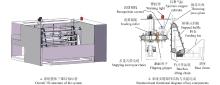
Fig.1
Structure of the automatic feeding system for bamboo rough milling"
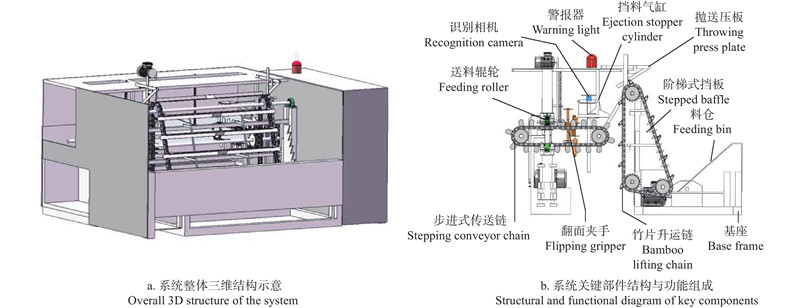
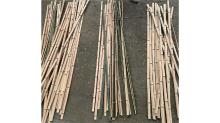
Fig.2
Actual stacking states of raw bamboo strips"
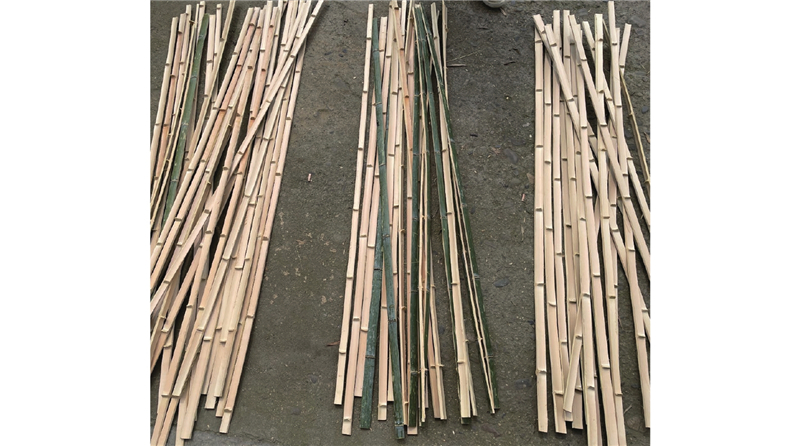
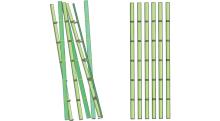
Fig.3
Schematic diagram of bamboo strip stacking states"
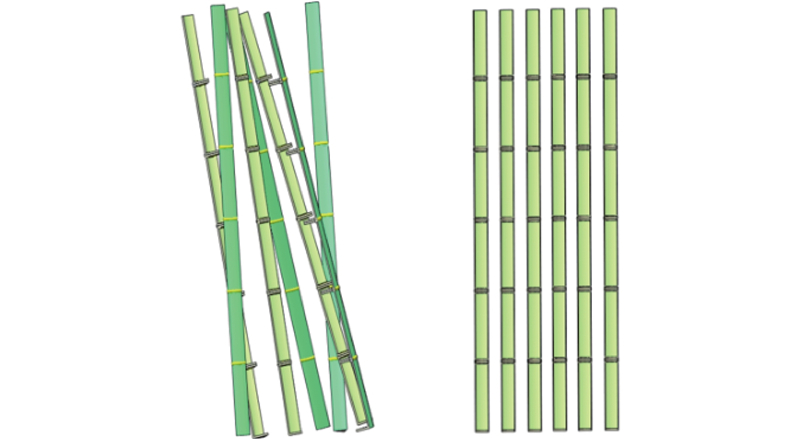
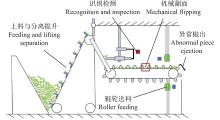
Fig.4
Schematic diagram of the sorting and feeding workflow"
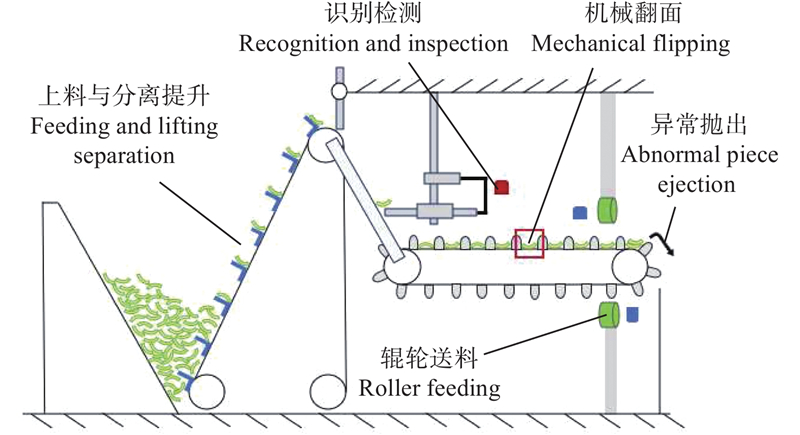
Table 1
Main parameters of the continuous feeding system for bamboo rough milling"
| 技术参数Technical parameter | 数值Values |
| 整机尺寸(长×宽×高)Overall dimensions (L×W×H) | 2 300 mm×2 000 mm×1 800 mm |
| 机器总功率Total power/kW | 3.22 |
| 升运链转速Conveyor chain speed/(m·s?1) | 0.1~0.3 |
| 升运链倾角Conveyor chain inclination/(°) | 30~75 |
| 加工竹片长度Processed bamboo strip length/mm | 1 500~2 100 |
| 加工竹片宽度Processed bamboo strip width/mm | 25~35 |
| 翻面响应时间Flipping response time/s | ≤0.5? |
| 竹片分离率Bamboo strip separation rate (%) | 96 |
| 竹面识别率Bamboo surface recognition accuracy (%) | 98.5 |
| 粗铣送料速度Rough milling feed speed/(m·min?1) | ≥52 |
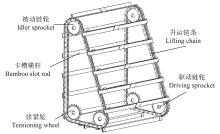
Fig.5
Structure of the lifting chain"
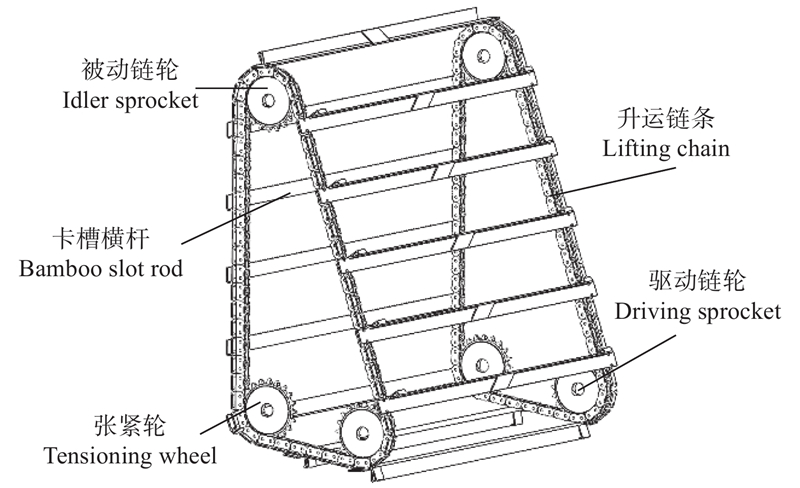
Fig.6
Structure of the flipping execution device"
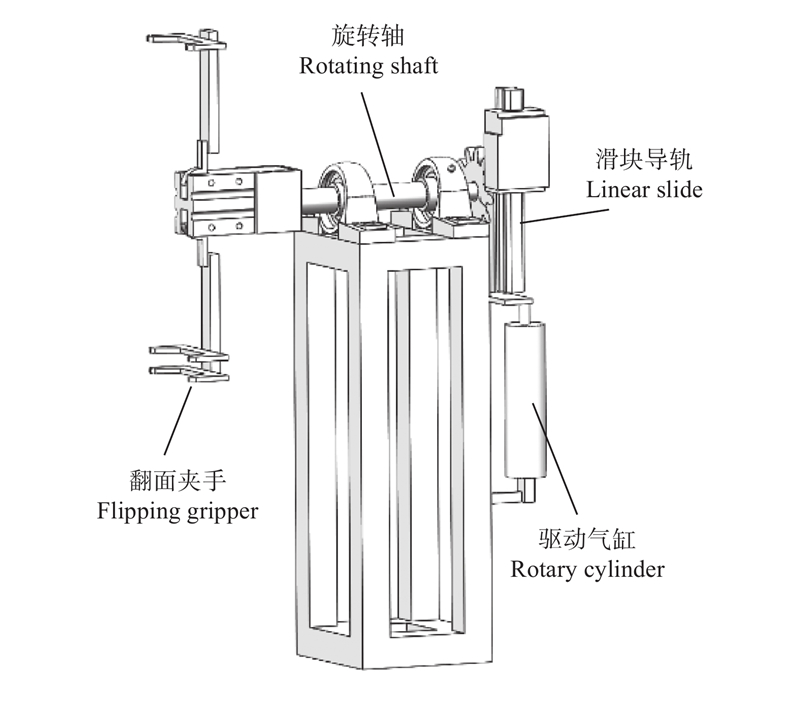
Fig.7
Typical results of bamboo strip image recognition"
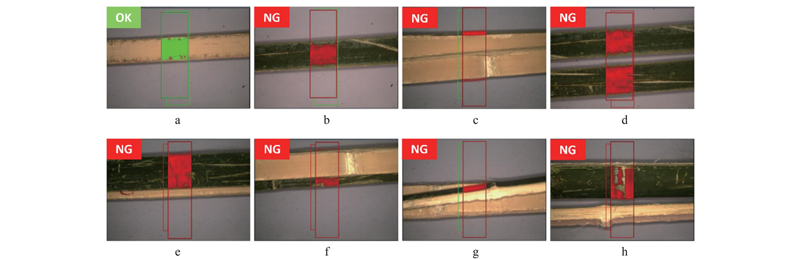
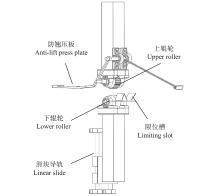
Fig.8
Structure of the roller-type feeding mechanism for rough milling"
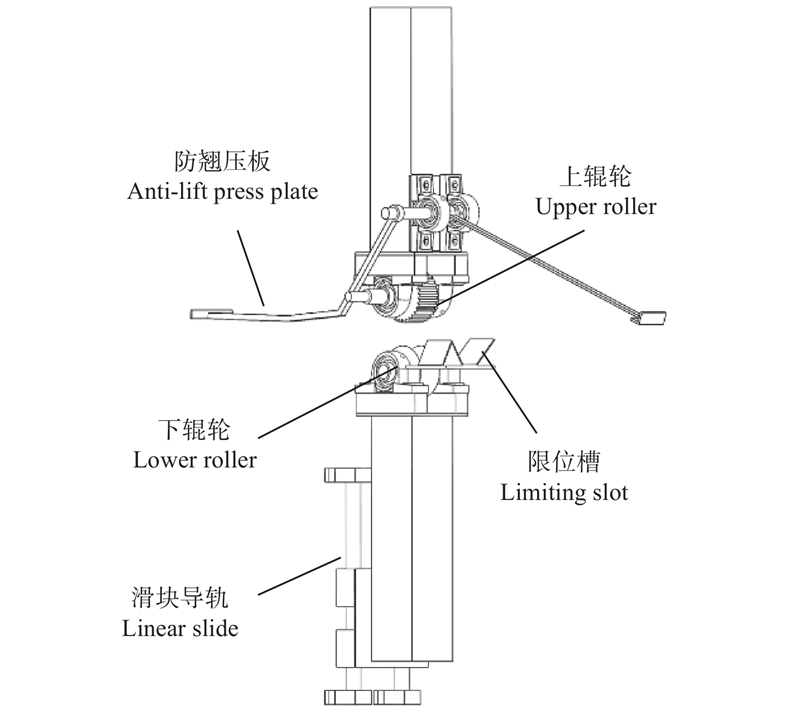

Fig.9
Typical stacking configurations of bamboo strips"

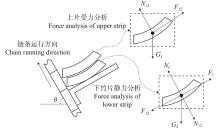
Fig.10
Force analysis of stacked bamboo strips"
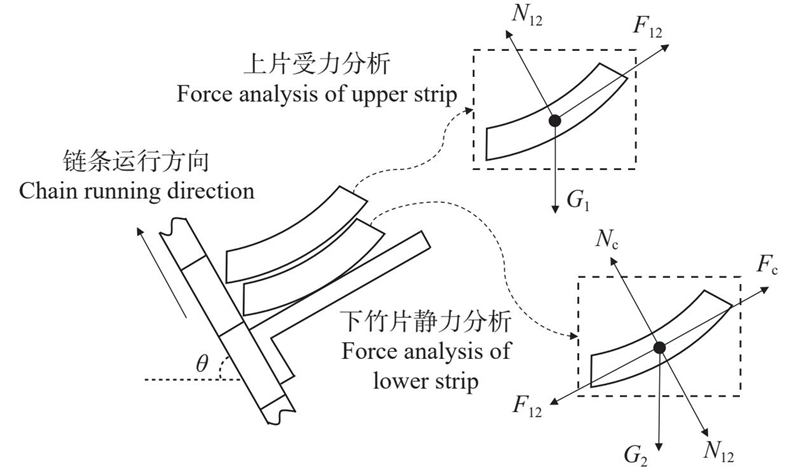
Table 2
Contact types and separability determination of typical stacking configurations"
| 堆叠状态 Stacking state | 接触类型 Contact type | 临界倾角差 Critical angle difference (Δθ) | 分离性判定 Separability judgment |
| 凹+凹 Concave + concave | 黄?青,面 Yellow-green, surface contact | >0 | 可分离 Separable |
| 凹+凸 Concave + convex | 黄?黄,线 Yellow-yellow, line contact | >0 | 可分离 Separable |
| 凸+凹 Convex + concave | 青?青,线 Green-green, line contact | >0 | 可分离 Separable |
| 凸+凸 Convex + convex | 青?黄,面 Green-yellow, surface contact | ≤0 | 难分离 Difficult to separate |
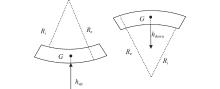
Fig.11
Center of gravity of curved bamboo strips"
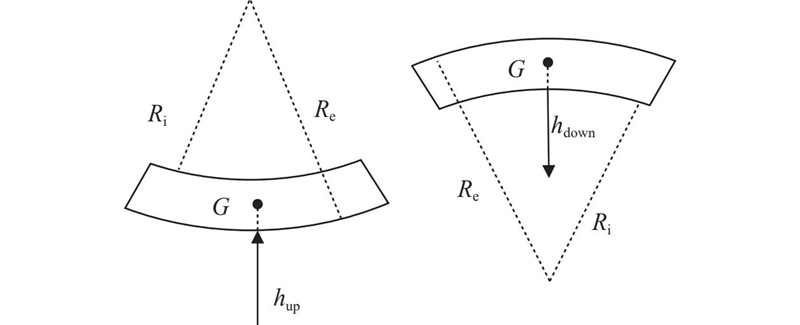
Fig.12
Force and motion diagram of the separation process for stacked bamboo strips"
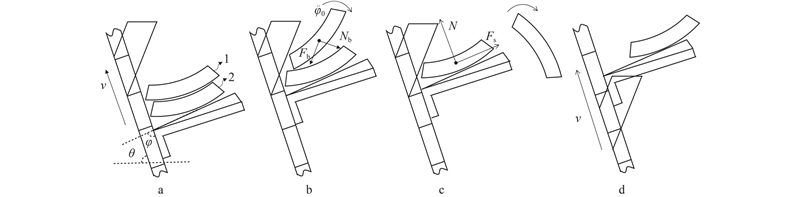
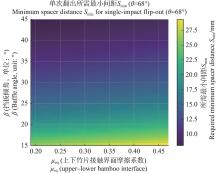
Fig.13
Heatmap of minimum flip-out distance"
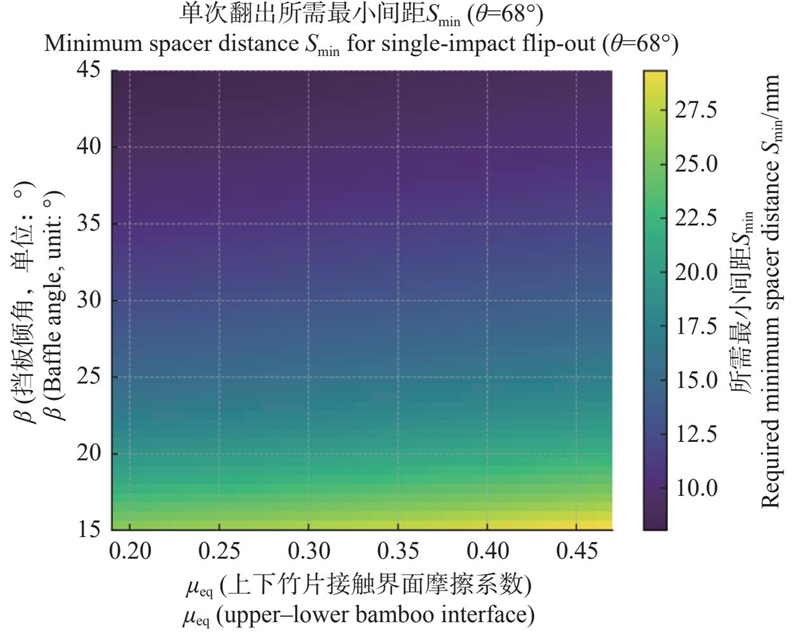
Fig.14
Heatmap of the minimum slot width"
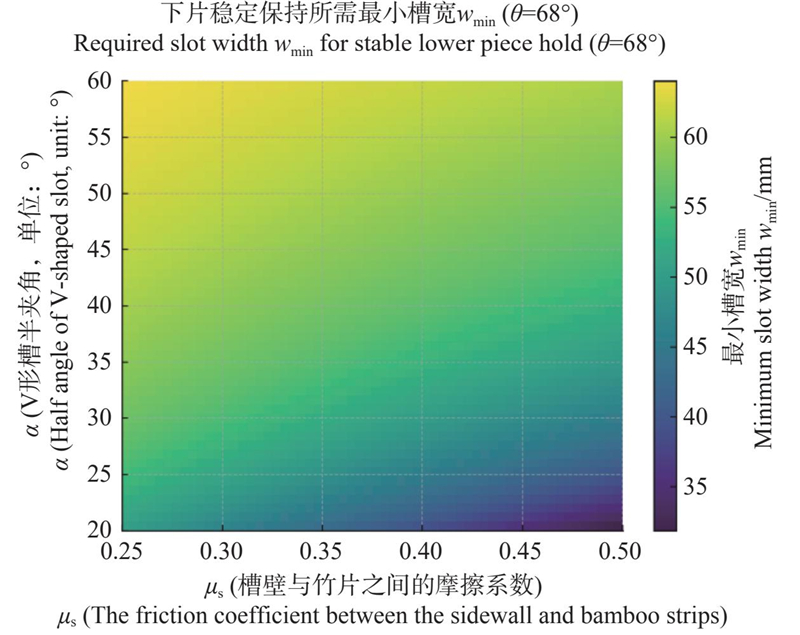

Fig.15
Experimental setup of bamboo strip sorting and feeding system"
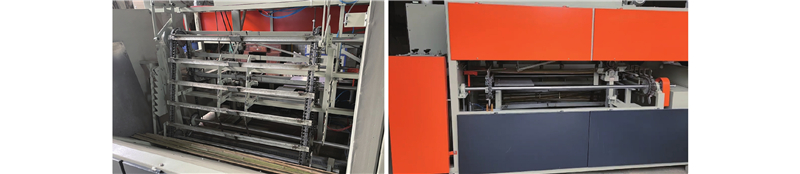
Table 3
Experimental factors and levels"
| 试验因素Experimental factor | 水平1 Level 1 | 水平2 Level 2 | 水平3 Level 3 |
| 升运链倾角Conveyor inclination/(°) | 55 | 65 | 75 |
| 升运链转速Conveyor speed/(m·s?1) | 0.15 | 0.225 | 0.30 |
| 竹片宽度Bamboo strip width/mm | 25 | 30 | 35 |
| 竹片长度Bamboo strip length/mm | 1 700 | 1 900 | 2 100 |
Table 4
Original data of response surface experiments"
| 序号 No. | 倾角 Inclination angle (θ)/(°) | 转速 Conveyor speed (v)/(m·s?1) | 宽度 Strip width (w)/mm | 长度 Strip length (l)/mm | 分离率 Separation rate (%) | 分离效率 Separation efficiency/ (strips·min?1) |
| 1 | 75 | 0.150 | 30 | 1 900 | 82.56 | 24.00 |
| 2 | 55 | 0.300 | 30 | 1 900 | 85.35 | 24.07 |
| 3 | 55 | 0.225 | 35 | 1 900 | 88.79 | 25.65 |
| 4 | 75 | 0.225 | 25 | 1 900 | 89.94 | 26.79 |
| 5 | 55 | 0.225 | 30 | 2 100 | 91.44 | 25.44 |
| 6 | 75 | 0.225 | 30 | 1 700 | 92.67 | 25.75 |
| 7 | 65 | 0.225 | 35 | 1 700 | 94.72 | 28.00 |
| 8 | 65 | 0.225 | 25 | 95.22 | 27.34 | |
| 9 | 65 | 0.150 | 35 | 1 900 | 82.91 | 23.15 |
| 10 | 65 | 0.150 | 25 | 1 900 | 83.97 | 24.39 |
| 11 | 65 | 0.150 | 30 | 1 700 | 84.73 | 23.60 |
| 12 | 65 | 0.150 | 30 | 2 100 | 84.26 | 23.49 |
| 13 | 65 | 0.225 | 35 | 2 100 | 93.52 | 26.42 |
| 14 | 65 | 0.300 | 30 | 1 700 | 87.64 | 22.90 |
| 15 | 65 | 0.300 | 30 | 2 100 | 88.53 | 23.29 |
| 16 | 65 | 0.300 | 35 | 1 900 | 86.54 | 23.94 |
| 17 | 65 | 0.300 | 25 | 1 900 | 87.17 | 23.66 |
| 18 | 65 | 0.225 | 25 | 2 100 | 94.20 | 26.65 |
| 19 | 75 | 0.225 | 35 | 1 900 | 90.79 | 24.64 |
| 20 | 55 | 0.225 | 25 | 1 900 | 89.2 | 23.77 |
| 21 | 75 | 0.225 | 30 | 2 100 | 92.05 | 27.24 |
| 22 | 55 | 0.225 | 30 | 1 700 | 91.42 | 25.45 |
| 23 | 75 | 0.300 | 30 | 1 900 | 86.02 | 24.43 |
| 24 | 55 | 0.150 | 30 | 1 900 | 82.00 | 22.00 |
| 25 | 65 | 0.225 | 30 | 1 900 | 96.50 | 26.38 |
| 26 | 65 | 0.225 | 30 | 1 900 | 97.99 | 27.37 |
| 27 | 65 | 0.225 | 30 | 1 900 | 96.71 | 25.84 |
| 28 | 65 | 0.225 | 30 | 1 900 | 95.71 | 27.08 |
| 29 | 65 | 0.225 | 30 | 1 900 | 97.62 | 26.59 |
Table 5
Significance analysis of the regression model for separation rate"
| 变异来源Source of variation | F | P | 显著性Significance |
| 模型Model | 59.75 | <0.000 1 | *** |
| A | 5.09 | 0.039 0 | * |
| B | 217.7 | <0.000 1 | *** |
| A2 | 208.4 | <0.000 1 | *** |
| B2 | 101.1 | <0.000 1 | *** |
| C2 | 42.14 | <0.000 1 | *** |
| D2 | 3.64 | 0.075 7 | |
| AC | 2.85 | 0.109 7 | |
| 失拟差Lack of fit | 0.930 1 | 0.580 4 |
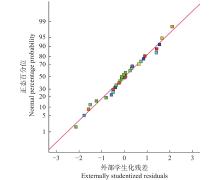
Fig.16
Normal probability plot of residuals"
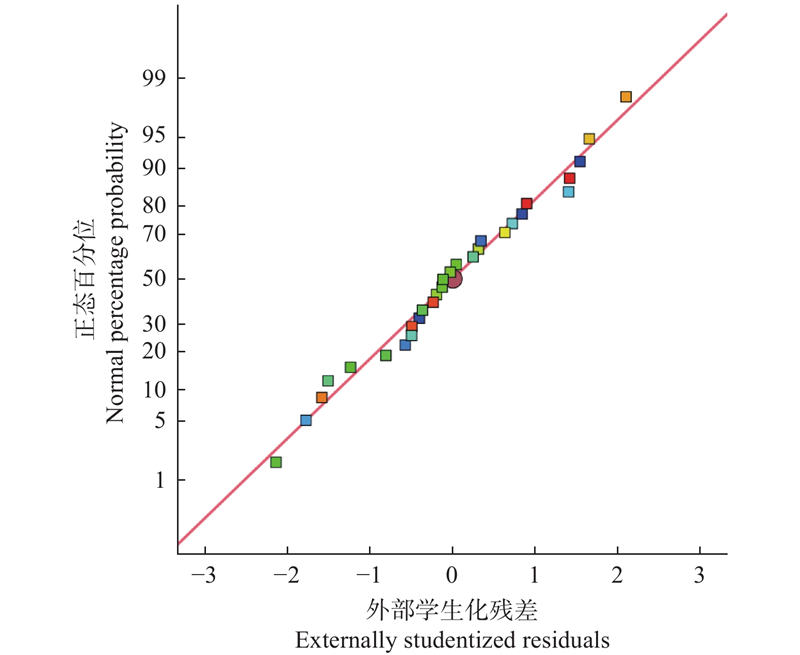
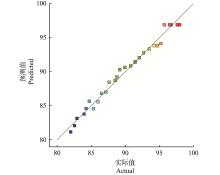
Fig.17
Predicted vs. actual values for separation rate"
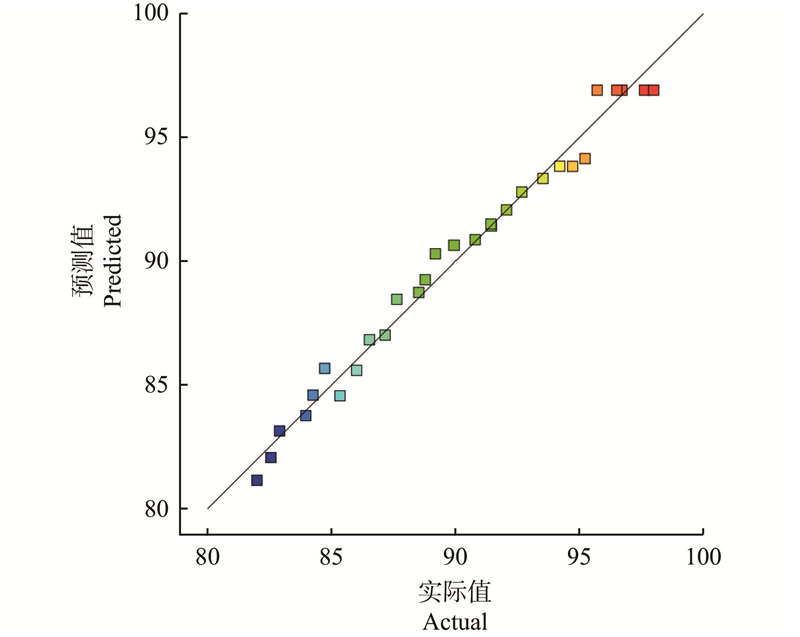
Table 6
Significance analysis of the regression model for separation efficiency"
| 变异来源Source of variation | F | P | 显著性Significance |
| 模型Model | 6.15 | 0.000 6 | ** |
| A | 4.93 | 0.043 4 | * |
| B2 | 33.53 | <0.000 1 | *** |
| 其余项Remainder terms | < 3 | > 0.1 | |
| 失拟差Lack of fit | 2.36 | 0.211 8 |
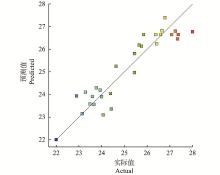
Fig.18
Predicted vs. actual values for feeding efficiency"
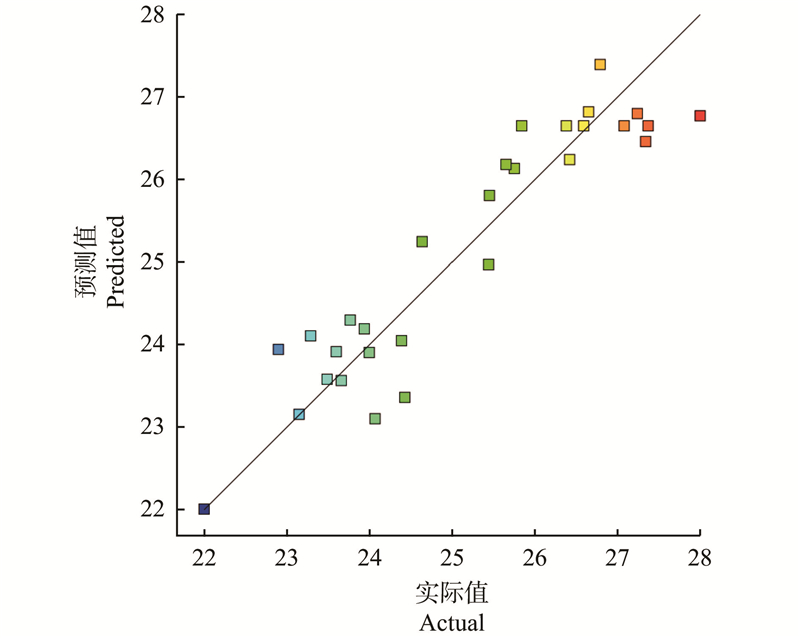
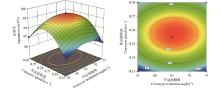
Fig.19
Response surface of separation rate versus conveyor inclination and speed"
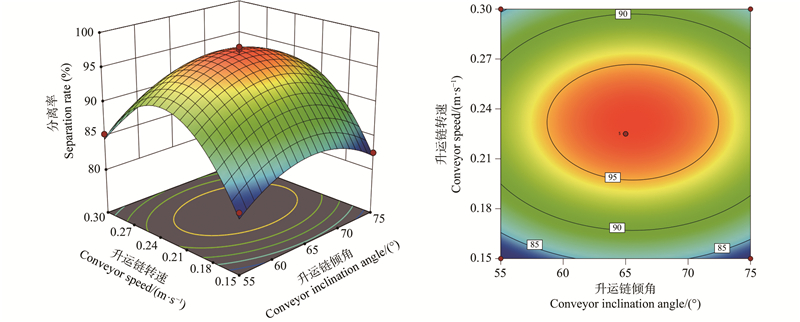
Fig.20
Response surface of separation rate versus conveyor inclination and bamboo strip width"
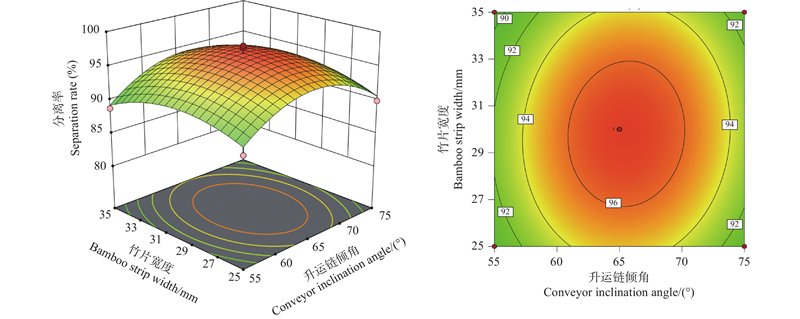
Fig.21
Response surface of feeding efficiency versus conveyor inclination and speed"
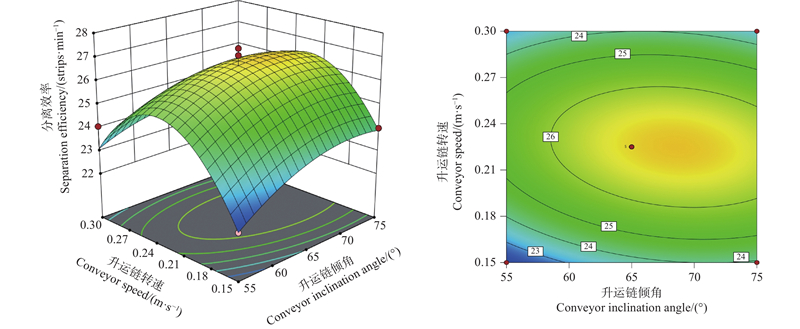
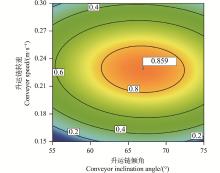
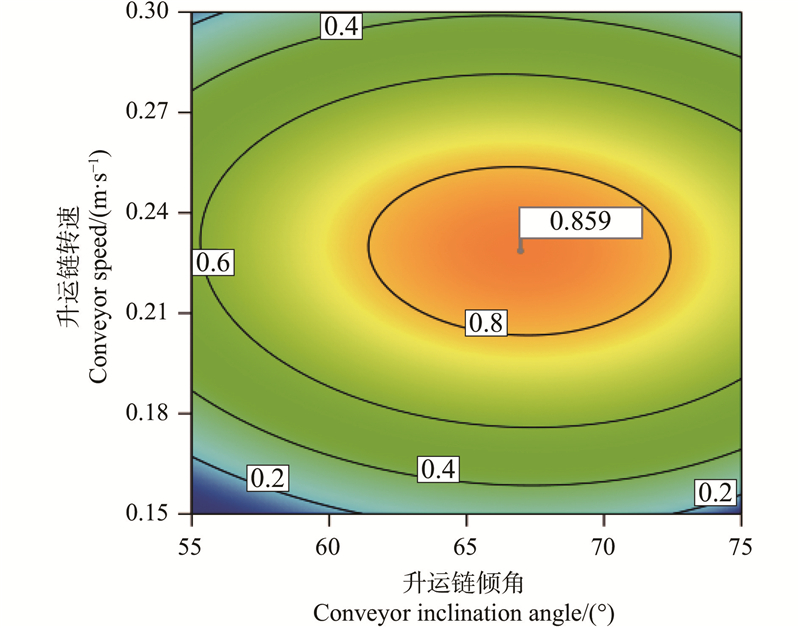
Fig.22
Desirability contour for double-response optimization"
| 车皓莹, 王玉娇, 孔令凤, 等. 竹青层增强竹材耐候性的作用机制. 北京林业大学学报, 2025, 47 (9): 153- 161. | |
| Che H Y, Wang Y J, Kong L F, et al. Mechanism of green outer layer in enhancing weathering resistance of bamboo. Journal of Beijing Forestry University, 2025, 47 (9): 153- 161. | |
| 蒋鹏飞, 张 彬, 周建波, 等. 竹片粗铣连续化定向进料系统设计与试验. 林业科学, 2022, 58 (6): 128- 140. | |
| Jiang P F, Zhang B, Zhou J B, et al. Design and experiment of continuous directional feeding system for bamboo slice milling. Scientia Silvae Sinicae, 2022, 58 (6): 128- 140. | |
|
雷永杰, 蒋鹏飞, 冯海韵, 等. 竹片粗铣用分离输送装置设计与试验. 林业工程学报, 2023, 8 (2): 131- 137.
doi: 10.13360/j.issn.2096-1359.202207023 |
|
|
Lei Y J, Jiang P F, Feng H Y, et al. Development of separation conveyor for rough milling of bamboo pieces. Journal of Forestry Engineering, 2023, 8 (2): 131- 137.
doi: 10.13360/j.issn.2096-1359.202207023 |
|
|
李 能, 陈玉和, 包永洁, 等. 竹片近青面和近黄面表面性能的研究. 南京林业大学学报(自然科学版), 2014, 38 (4): 127- 130.
doi: 10.3969/j.issn.1000-2006.2014.04.024 |
|
|
Li N, Chen Y H, Bao Y J, et al. Study on surface properties of bamboo closed to outer skin and inner skin. Journal of Nanjing Forestry University (Natural Sciences Edition), 2014, 38 (4): 127- 130.
doi: 10.3969/j.issn.1000-2006.2014.04.024 |
|
|
李海涛, 周文静, 吴义强, 等. 不同温度下毛竹抗弯力学性能. 林业科学, 2025, 61 (2): 163- 171.
doi: 10.11707/j.1001-7488.LYKX20230459 |
|
|
Li H T, Zhou W J, Wu Y Q, et al. Bending mechanical properties of Phyllostachys edulis at different temperatures. Scientia Silvae Sinicae, 2025, 61 (2): 163- 171.
doi: 10.11707/j.1001-7488.LYKX20230459 |
|
|
李玉敏, 冯鹏飞. 基于第九次全国森林资源清查的中国竹资源分析. 世界竹藤通讯, 2019, 17 (6): 45- 48.
doi: 10.12168/sjzttx.2019.06.010 |
|
|
Li Y M, Feng P F. Bamboo resources in China based on the ninth national forest inventory data. World Bamboo and Rattan, 2019, 17 (6): 45- 48.
doi: 10.12168/sjzttx.2019.06.010 |
|
|
李政豪, 刁 燕, 史生坤, 等. 基于形态学方法与边缘检测的原竹几何特征识别. 林产工业, 2024, 61 (2): 18- 23.
doi: 10.19531/j.issn1001-5299.202402004 |
|
|
Li Z H, Diao Y, Shi S K, et al. Identification of geometric characteristics of bamboo based on morphological method and edge detection. China Forest Products Industry, 2024, 61 (2): 18- 23.
doi: 10.19531/j.issn1001-5299.202402004 |
|
|
刘延鹤, 雷永杰, 周建波, 等. 竹材自动定段设备的设计与样机试验. 林业工程学报, 2022, 7 (4): 128- 134.
doi: 10.13360/j.issn.2096-1359.202101003 |
|
|
Liu Y H, Lei Y J, Zhou J B, et al. Design and prototype test of bamboo automatic segmentation equipment. Journal of Forestry Engineering, 2022, 7 (4): 128- 134.
doi: 10.13360/j.issn.2096-1359.202101003 |
|
| 卢秋芬. 2019. 基于机器视觉竹条缺陷识别技术研究. 福州: 福建农林大学. | |
| Lu Q F. 2019. Research on bamboo strip defects recognition technology based on computer vision. Fuzhou: Fujian Agriculture and Forestry University. [in Chinese] | |
| 马良城, 徐筱茹, 伍希志. 基于改进可变形-端到端目标检测模型的竹片缺陷检测方法. 森林工程, 2025, 41 (2): 349- 359. | |
| Ma L C, Xu X R, Wu X Z. Defect detection method for bamboo slice based on improved Deformable-DETR. Forest Engineering, 2025, 41 (2): 349- 359. | |
| 牛 晗, 伍希志, 任桂芹, 等. 基于OTSU与CANNY算法的竹片缺陷图像检测. 森林工程, 2022, 38 (6): 75- 81. | |
| Niu H, Wu X Z, Ren G Q, et al. Image detection of bamboo chip defects based on OTSU and CANNY algorithms. Forest Engineering, 2022, 38 (6): 75- 81. | |
| 彭浩哲. 2024. 粗刨竹条连续化制备技术研究. 南京: 南京林业大学. | |
| Peng H Z. 2024. Continuous preparation technology of coarse bamboo strips. Nanjing: Nanjing Forestry University. [in Chinese] | |
|
阮承治, 陈 茜, 陈 旭, 等. 颜色空间直方图相交法的竹条色差分类检测系统研究. 中国农机化学报, 2022, 43 (5): 85- 92.
doi: 10.13733/j.jcam.issn.2095-5553.2022.05.013 |
|
|
Ruan C Z, Chen X, Chen X, et al. Study on bamboo sliver chromatic aberration classification and detection system based on color space histogram intersection method. Journal of Chinese Agricultural Mechanization, 2022, 43 (5): 85- 92.
doi: 10.13733/j.jcam.issn.2095-5553.2022.05.013 |
|
|
王和平. 竹片初加工自动连续化生产工艺的探索与研究. 农业装备与智能技术, 2024 (3): 25- 28.
doi: 10.3969/j.issn.1004-3969.2024.03.006 |
|
|
Wang H P. Exploration and research on automatic continuous production process of bamboo slices initial processing. Agricultural Equipment and Intelligent Technology, 2024 (3): 25- 28.
doi: 10.3969/j.issn.1004-3969.2024.03.006 |
|
|
叶翰舟, 傅金和, 程海涛, 等. 以竹代塑加工技术与产品现状及其市场发展潜力. 林业科学, 2024, 60 (1): 129- 141.
doi: 10.11707/j.1001-7488.LYKX20230140 |
|
|
Ye H Z, Fu J H, Cheng H T, et al. The current status and market development potential of processing technology and products using bamboo as a substitute for plastic. Scientia Silvae Sinicae, 2024, 60 (1): 129- 141.
doi: 10.11707/j.1001-7488.LYKX20230140 |
|
| 杨以春, 李贵强, 陈继飞, 等. 竹产业全链工程技术装备研究现状与展望. 世界竹藤通讯, 2025, 23 (2): 9- 20. | |
| Yang Y C, Li G Q, Chen J F, et al. Whole-chain engineering technology and equipment for bamboo industry: research status and development outlook. World Bamboo and Rattan, 2025, 23 (2): 9- 20. | |
|
郑洪涛, 范梦娟, 郑兆桐. 中国“以竹代塑”财经政策效应与创新深化路径. 世界竹藤通讯, 2025, 23 (2): 26- 32.
doi: 10.12168/sjzttx.2025.02.27.001 |
|
|
Zheng H T, Fan M J, Zheng Z T. Effect of financial and economic policies for “bamboo as a substitute for plastic” in China and its pathways to deepening innovation. World Bamboo and Rattan, 2025, 23 (2): 26- 32.
doi: 10.12168/sjzttx.2025.02.27.001 |
|
| Chen L J, Wang K Q, Xie Y H, et al. The segmentation of timber defects based on color and the mathematical morphology. Optik- International Journal for Light and Electron Optics, 2014, 125 (3): 965- 967. | |
|
He L, Chen L, Shao H J, et al. Microstructure and physicochemical properties of the anisotropic moso bamboo (Phyllostachys pubescens) surface. European Journal of Wood and Wood Products, 2022, 80 (2): 277- 288.
doi: 10.1007/s00107-021-01750-x |
|
|
Hashemnia K, Pourandi S. Study the effect of vibration frequency and amplitude on the quality of fluidization of a vibrated granular flow using discrete element method. Powder Technology, 2018, 327, 335- 345.
doi: 10.1016/j.powtec.2017.12.097 |
|
|
Jafarnia N, Mofidi A. Engineered bamboo for sustainable construction: a systematic review of characterization methods. Sustainability, 2025, 17 (13): 5977.
doi: 10.3390/su17135977 |
|
|
Jakovljević S, Lisjak D. Investigation into the effects of humidity on the mechanical and physical properties of bamboo. Construction and Building Materials, 2019, 194, 386- 396.
doi: 10.1016/j.conbuildmat.2018.11.030 |
| [1] | Chenxu Wu,Dongyan Zhang,Lanxiang Zhang,Nuo Chen,Siyu Mao. Detection Method of Pinecones in the Forest Based on RT-DETR [J]. Scientia Silvae Sinicae, 2025, 61(6): 25-37. |
| Viewed | ||||||
|
Full text |
|
|||||
|
Abstract |
|
|||||
