
Scientia Silvae Sinicae ›› 2026, Vol. 62 ›› Issue (8): 158-168.doi: 10.11707/j.1001-7488.LYKX20250483
• Research papers • Previous Articles Next Articles
Weiguang Li*( ),Zhen Zhu,Xiao Wang
Received:2025-08-02
Revised:2026-06-10
Online:2026-08-10
Published:2026-08-20
Contact:
Weiguang Li
E-mail:liwg@caf.ac.cn
CLC Number:
Weiguang Li,Zhen Zhu,Xiao Wang. Effect of Micro-Texture on the Adhesion of Wood Surface[J]. Scientia Silvae Sinicae, 2026, 62(8): 158-168.
Fig.1
Adhesion model between two different surfaces"
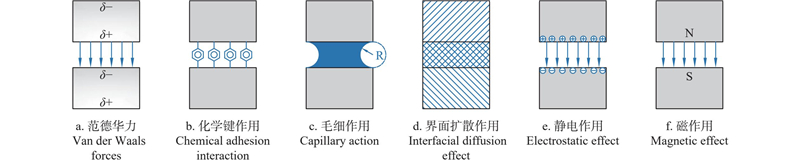
Table 1
Methods for conditioning wood moisture content"
| 木材含水率状态 Moisture content | 调节方法 Conditioning methods | 终含水率 Actual moisture content (%) |
| 饱水材 Waterlogged wood | 将生材试样置于水中至少2个月,至试样质量不再增加 Place the green wood sample in water for at least 2 months until the sample is no longer gaining mass | 112 |
| 生材 Green wood | 采伐后原木制成试样后冷冻(?6 ℃)保存 The felled logs are made into samples and stored in the cold storage (?6 ℃) | 72 |
| 纤维饱和点木材 Fiber saturation point wood | 将生材试样在气干棚干燥2个月后,置于一个底部盛有蒸馏水的双层密闭容器中直至平衡 The green wood samples are dried in an air drying shed for 2 months, and then placed in a double-layer closed container with distilled water at the bottom until equilibrium | 24 |
| 气干材 Air-dried wood | 将生材试样在气干棚干燥2个月后,置于温度20 ℃和相对湿度65%的恒温恒湿箱中至水分平衡 The green wood samples are dried in an air drying shed for 2 months, and then placed in a constant temperature and humidity chamber with a temperature of 20 ℃ and a relative humidity of 65% until the moisture content was balanced | 12 |
| 绝干材 Oven-dried wood | 将生材试样在气干棚干燥2个月后,置于103 ℃的烘箱干燥至少48 h, 直至前后2次含水率的变化小于0.5% The green wood samples are dried in an air drying shed for 2 months, and then dried in an oven at 103 ℃ for at least 48 H until the change of moisture content is less than 0.5% | 0 |
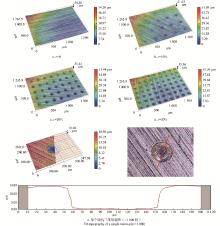
Fig.2
Configuration of micro-pits on the surface of 4 kinds of cemented carbide samples under 3D profiler"
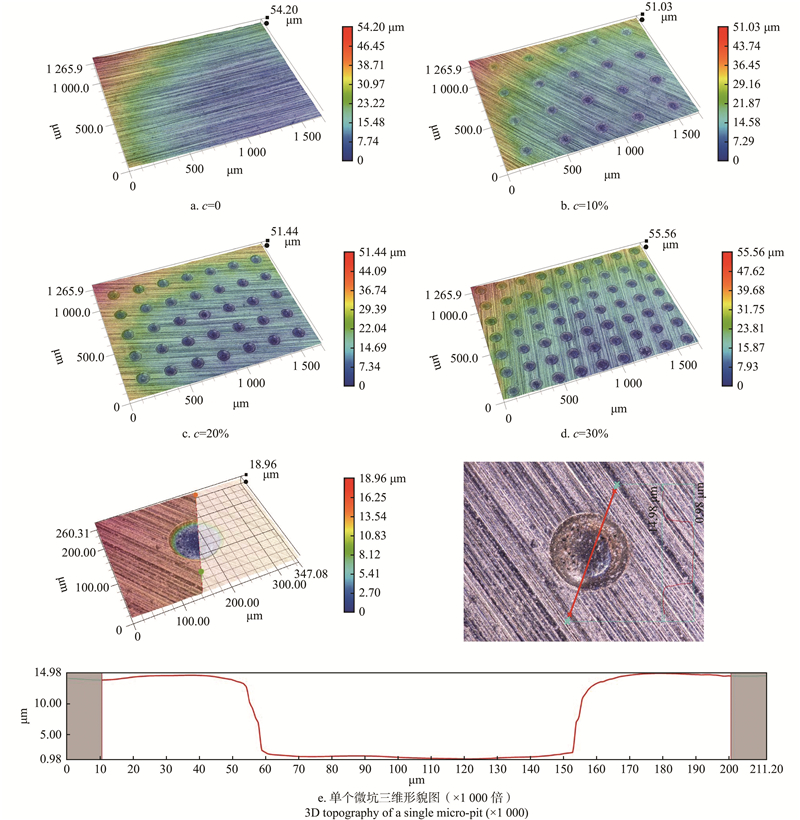
Fig.3
High precision uniaxial mechanics testing system"
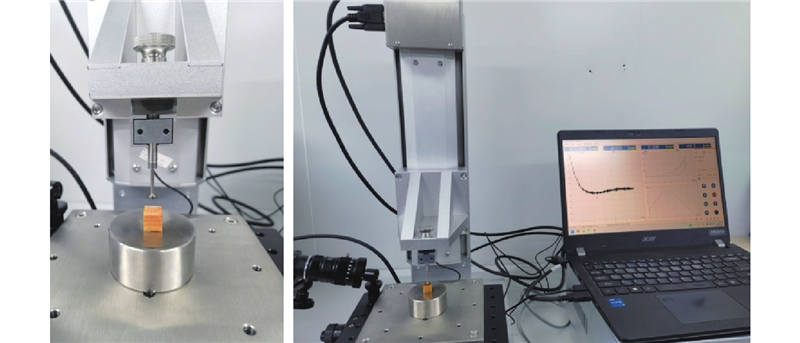

Fig.4
Schematic diagram of adhesion measurement process"

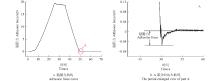
Fig.5
Typical adhesion measurement curves"
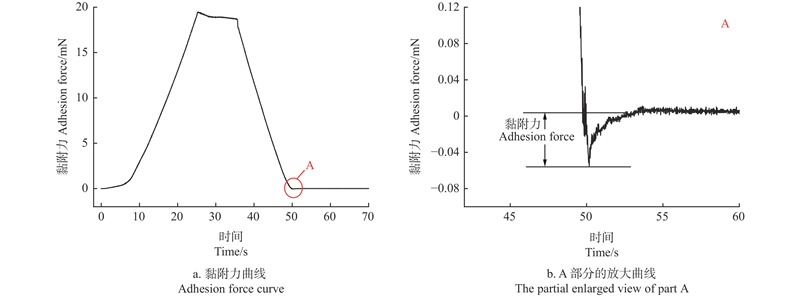
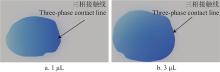
Fig.6
Three-phase contact line after droplet spreading with different volume"
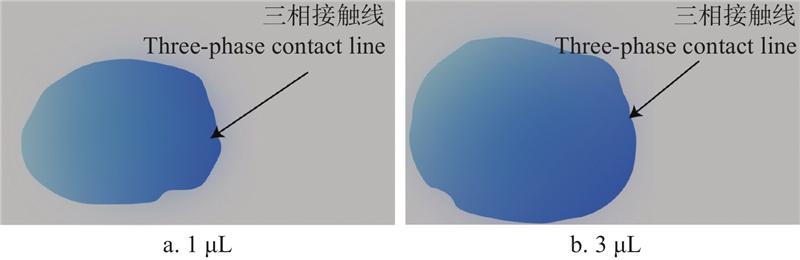
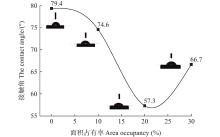
Fig.7
Changes in the contact angle of the cemented carbide surface with different texture area occupancy"
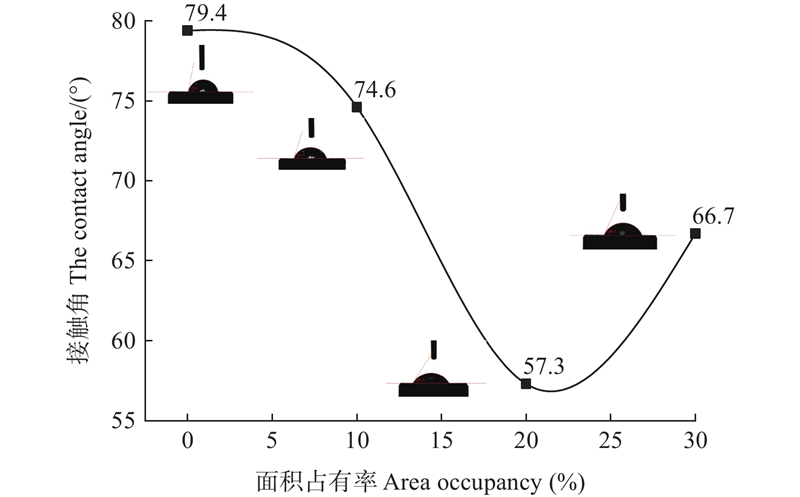
Fig.8
Effects of different wood moisture content on adhesion"
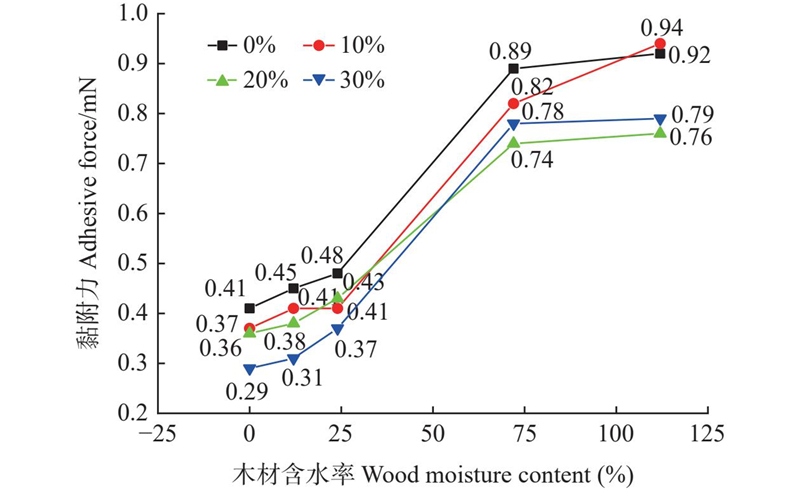
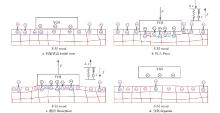
Fig.9
Schematic diagram of press-in and separation between cemented carbide YG8 and wood during adhesion test"
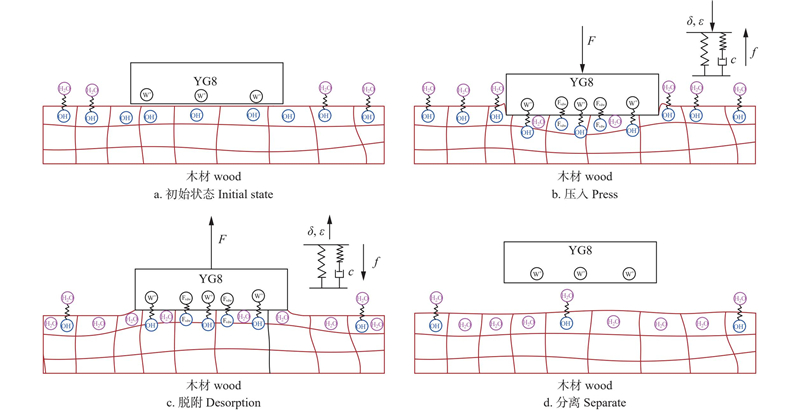
Fig.10
Contact diagram of cemented carbide YG8 with different moisture content and wood"
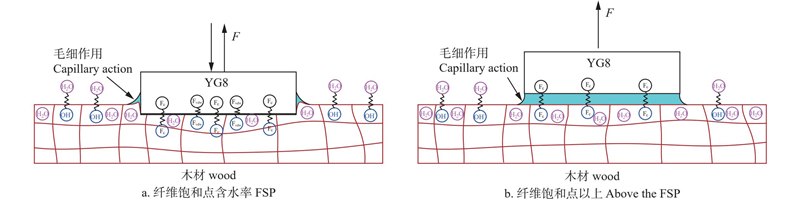
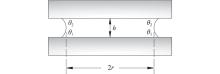
Fig.11
Two-plane capillary adhesion model"
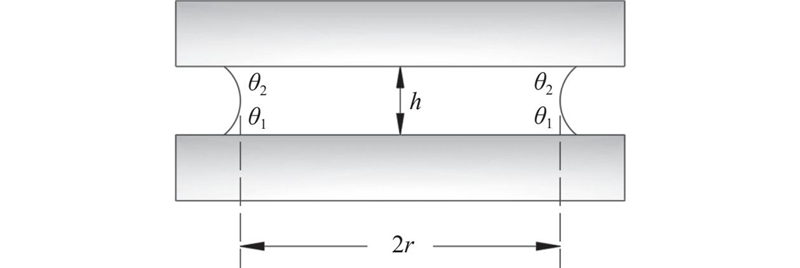
Fig.12
Stefan adhesion model between two surfaces"
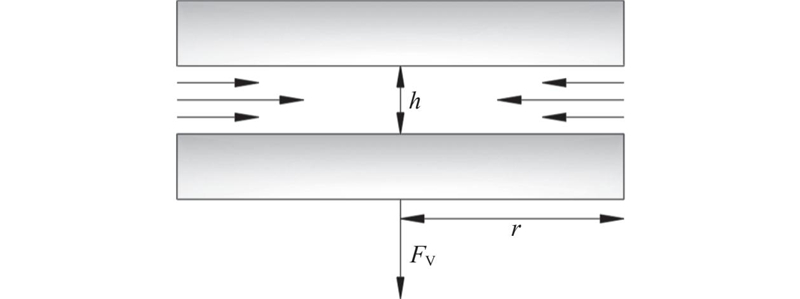
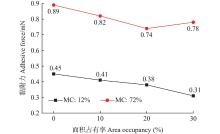
Fig.13
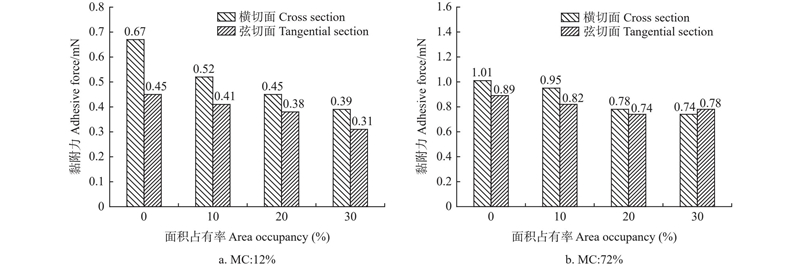
Effects of different area occupancy content on adhesion"
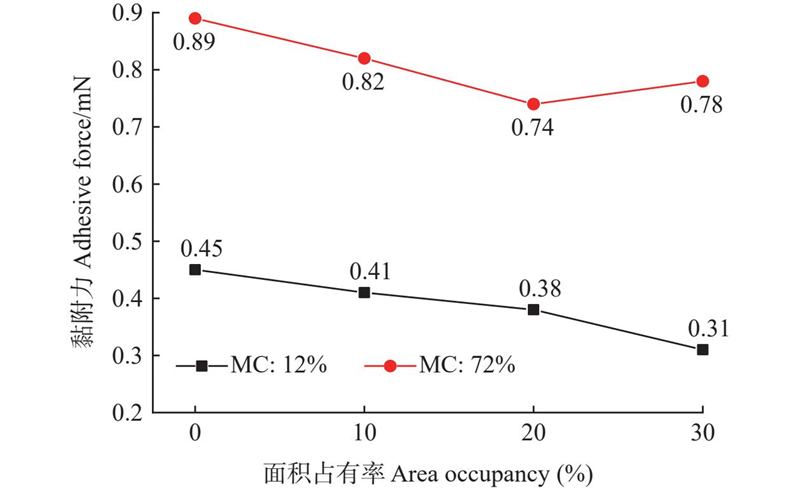
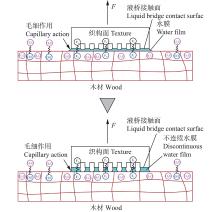
Fig.14
Surface liquid bridge model during the desorption of texture surface and wood"
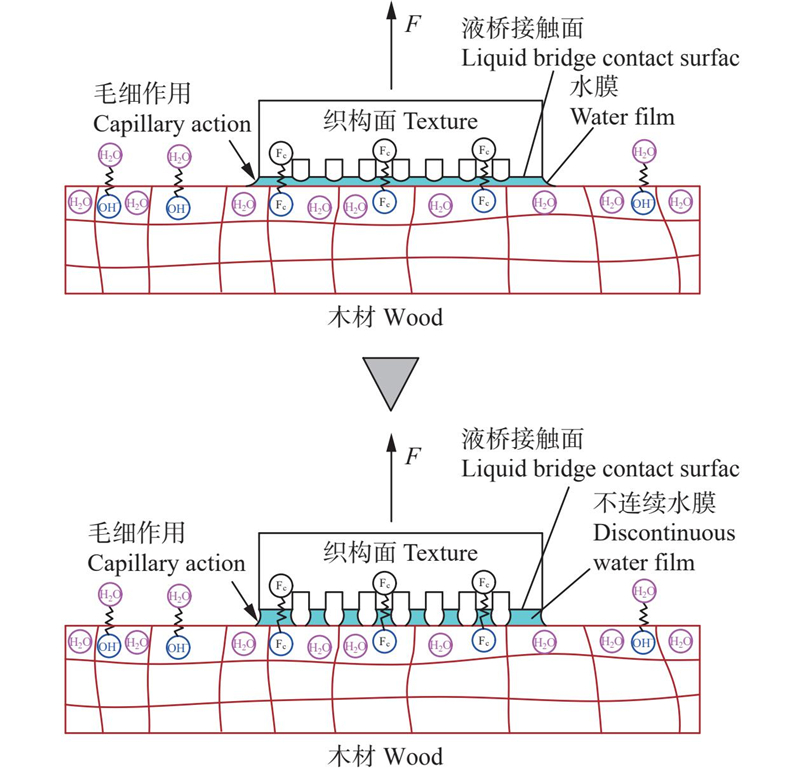
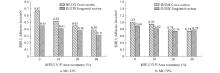
Fig.15
Effects of different wood moisture content on adhesion"
|
陈 娟, 曾良才, 湛从昌. TiAlN涂层耦合织构固体表面润湿性能研究. 润滑与密封, 2021, 46 (12): 72- 77.
doi: 10.3969/j.issn.0254-0150.2021.12.010 |
|
|
Chen J, Zeng L C, Zhan C C. Study on wettability of the solid surface with TiAlN coating coupling textured. Lubrication Engineering, 2021, 46 (12): 72- 77.
doi: 10.3969/j.issn.0254-0150.2021.12.010 |
|
|
李 坚, 甘文涛, 陈志俊, 等. 向新出发, 木材科学前沿发展. 森林工程, 2025, 41 (1): 1- 39.
doi: 10.7525/j.issn.1006-8023.2025.01.001 |
|
|
Li J, Gan W T, Chen Z J, et al. Frontier advances in wood science towards a new departure. Forest Engineering, 2025, 41 (1): 1- 39.
doi: 10.7525/j.issn.1006-8023.2025.01.001 |
|
| 李 蒙. 2020. 仿生湿黏附系统的力学行为研究. 南京: 南京航空航天大学. | |
| Li M. 2020. The mechanical behaviors of bioinspired wet adhesion. Nanjing: Nanjing University of Aeronautics and Astronautics. [in Chinese] | |
|
李伟光, 张占宽. 木材切削过程中摩擦行为的研究进展. 木材工业, 2018a, 32 (6): 23- 27.
doi: 10.19455/j.mcgy.20180606 |
|
|
Li W G, Zhang Z K. Research progress of friction behavior in wood cutting. China Wood Industry, 2018a, 32 (6): 23- 27.
doi: 10.19455/j.mcgy.20180606 |
|
| 李伟光, 张占宽. 表面微织构硬质合金对桦木摩擦特性的影响. 林业工程学报, 2018b, 3 (1): 103- 108. | |
| Li W G, Zhang Z K. Effect of surface micro-texture cemented carbide on friction characteristics of birch. Journal of Forestry Engineering, 2018b, 3 (1): 103- 108. | |
|
李伟光, 许亚东, 冒旭东, 等. 不同织构形式硬质合金表面与木材径切面的摩擦性能. 林业工程学报, 2020, 5 (1): 29- 33.
doi: 10.13360/j.issn.2096-1359.201903024 |
|
|
Li W G, Xu Y D, Mao X D, et al. Study on friction performance between wood radial section and cemented carbide surface with different micro-textures. Journal of Forestry Engineering, 2020, 5 (1): 29- 33.
doi: 10.13360/j.issn.2096-1359.201903024 |
|
|
李伟光, 张占宽. 微坑型微织构硬质合金表面对木材摩擦特性的影响. 林业科学, 2019, 55 (4): 136- 143.
doi: 10.11707/j.1001-7488.20190414 |
|
|
Li W G, Zhang Z K. The effect of micro-pits texture on the coefficient of friction between wood and cemented carbide. Scientia Silvae Sinicae, 2019, 55 (4): 136- 143.
doi: 10.11707/j.1001-7488.20190414 |
|
|
刘晓辉, 郑晓强, 王子朋, 等. 激光织构化不同材料表面对润湿性能的影响. 机床与液压, 2023, 51 (24): 1- 8.
doi: 10.3969/j.issn.1001-3881.2023.24.001 |
|
|
Liu X H, Zheng X Q, Wang Z P, et al. Effect of laser texturing on wettability of different material surfaces. Machine Tool & Hydraulics, 2023, 51 (24): 1- 8.
doi: 10.3969/j.issn.1001-3881.2023.24.001 |
|
| 卿 涛, 邵天敏, 温诗铸. 相对湿度对材料表面粘附力影响的研究. 摩擦学学报, 2006, 26 (4): 295- 299. | |
| Qing T, Shao T M, Wen S Z. Effects of relative humidity on surface adhesion. Tribology, 2006, 26 (4): 295- 299. | |
| 尹思慈. 1996. 木材学. 北京: 中国林业出版社. | |
| Yin S C. 1996. Wood science. Beijing: China Forestry Publishing House. [in Chinese] | |
| 赵丽媛. 2016. 低温作用对桦木力学性能影响及机理研究. 北京: 中国林业科学研究院. | |
| Zhao L Y. 2016. Study on the effect of low temperature on mechanical properties of birch wood. Beijing: Chinese Academy of Forestry. [in Chinese] | |
| 仲 翔, 张少军, 马尔妮. 不同含水率状态下木材细胞壁孔径分布变化. 北京林业大学学报, 2021, 43 (11): 128- 136. | |
| Zhong X, Zhang S J, Ma E N. Variation in pore size distribution of wood cell wall under different moisture states. Journal of Beijing Forestry University, 2021, 43 (11): 128- 136. | |
| Bowden F, Tabor D. 1990. The fliction and lubrication of solids. London: Oxford University Press. | |
| Barnes W J P, Smith J, Oines C, et al. Bionics and wet grip. Tire Technology International, 2002, 12, 56- 60. | |
|
Duan R, Deng J X, Ge D L, et al. An approach to predict derivative-chip formation in derivative cutting of micro-textured tools. The International Journal of Advanced Manufacturing Technology, 2018, 95 (1): 973- 982.
doi: 10.1007/s00170-017-1285-y |
|
| Guan N, Thunell B, Lyth K. On the friction between steel and some common Swedish wood species. Holz Als Roh- und Werkstoff, 1983, 41 (2): 55- 60. | |
|
Heepe L, Gorb S N. Biologically inspired mushroom-shaped adhesive microstructures. Annual Review of Materials Research, 2014, 44, 173- 203.
doi: 10.1146/annurev-matsci-062910-100458 |
|
|
Klamecki B E. Friction mechanisms in wood cutting. Wood Science and Technology, 1976, 10 (3): 209- 214.
doi: 10.1007/BF00355741 |
|
|
Kawasegi N, Sugimori H, Morimoto H, et al. Development of cutting tools with microscale and nanoscale textures to improve frictional behavior. Precision Engineering, 2009, 33 (3): 248- 254.
doi: 10.1016/j.precisioneng.2008.07.005 |
|
|
Li W G, Zhang Z K. Effect of micro-pit texture parameters on characteristics of friction between cemented carbide and wood. Wood Science and Technology, 2019, 53 (3): 687- 702.
doi: 10.1007/s00226-019-01091-2 |
|
|
McKenzie W M. Friction in wood cutting. Forest Products Journal, 1967, 17, 38.
doi: 10.1007/bf00355741 |
|
|
McKenzie W M, Karpovich H. The frictional behaviour of wood. Wood Science and Technology, 1968, 2 (2): 139- 152.
doi: 10.1007/BF00394962 |
|
| McMillin C W, Lemoine T, Manwiller F G. Friction coefficient of oven-dry spruce pine on steel, as related to temperature and wood properties. Wood and Fiber Science, 2007, 2, 6- 11. | |
| Murase Y. Effect of temperature on friction between wood and steel. Mokuzai Gakkaishi, 1979, 25, 264- 271. | |
| Murase, Y. Coefficient of friction and surface temperature in the sliding friction between wood and steel. Mokuzai Gakkaishi, 1980, 26, 571- 575. | |
| Nachtigall W. 1974. Biological mechanisms of attachment: the comparative morphology and bioengineering of organs for linkage, suction, and adhesion. Springer-Verlag. | |
|
Wenzel R N. Resistance of solid surfaces to wetting by water. Industrial & Engineering Chemistry, 1936, 28 (8): 988- 994.
doi: 10.1021/ie50320a024 |
|
|
Xie J, Li M, Dai Q W, et al. Key parameters of biomimetic patterned surface for wet adhesion. International Journal of Adhesion and Adhesives, 2018, 82, 72- 78.
doi: 10.1016/j.ijadhadh.2018.01.004 |
| Viewed | ||||||
|
Full text |
|
|||||
|
Abstract |
|
|||||
