
Scientia Silvae Sinicae ›› 2026, Vol. 62 ›› Issue (8): 97-105.doi: 10.11707/j.1001-7488.LYKX20250423
• Research papers • Previous Articles Next Articles
Kailun Zou1,Zhanyin Wang2,Kexin Zhang1,Xiangdong Lei1,Xiaoxue Guo1,Lu Yang1,Xianzhao Liu1,*( )
)
Received:2025-07-01
Revised:2026-06-12
Online:2026-08-10
Published:2026-08-20
Contact:
Xianzhao Liu
E-mail:liuxianzhao@ifrit.ac.cn
CLC Number:
Kailun Zou,Zhanyin Wang,Kexin Zhang,Xiangdong Lei,Xiaoxue Guo,Lu Yang,Xianzhao Liu. Differential Model of Basal Area Growth at Breast Height for Individual-Tree in Larch Plantations and Analysis of Its Driving Factors[J]. Scientia Silvae Sinicae, 2026, 62(8): 97-105.

Table 1
Overview of individual tree and stand factors"
| 因子 Factor | 最小值 Minimum | 最大值 Maximum | 均值 Mean | 标准差 Standard deviation |
| 期初单木断面积 Initial basal area per tree/m2 | 0.002 0 | 0.120 7 | 0.010 3 | 0.009 2 |
| 期末单木断面积 Final basal area per tree/m2 | 0.002 1 | 0.136 6 | 0.013 6 | 0.010 9 |
| 期初单木胸径 Initial DBH/cm | 5.0 | 39.2 | 10.6 | 4.3 |
| 期末单木胸径 Final DBH/cm | 5.2 | 41.7 | 12.3 | 4.5 |
| 大于对象木的 胸高断面积 Basal area of larger trees/(m2·hm?2) | 0.000 0 | 41.181 8 | 8.569 6 | 7.212 5 |
| 林分每公顷断面积 Stand basal area per hectare/(m2·hm?2) | 0.110 0 | 41.210 0 | 14.353 3 | 8.962 4 |
| 林分株树密度 Stand tree density/(stems·hm?2) | 50 | 4 083 | 1 585 | 842 |
| 林分密度指数 Stand density index | 6 | 1 594 | 571 | 326 |
Table 2
Overview of climate factors"
| 因子 Factor | 最小值 Minimum | 最大值 Maximum | 均值 Mean | 标准差 Standard deviation |
| 夏季平均最高温度 Summer mean maximum temperature/℃ | 18.64 | 28.48 | 23.98 | 1.74 |
| 冬季平均最低温度 Winter mean minimum temperature/℃ | ?33.06 | ?8.04 | ?20.98 | 5.71 |
| 最暖月平均温度 Mean warmest month temperature/℃ | 15.62 | 24.06 | 19.16 | 1.69 |
| 最冷月平均温度 Mean coldest month temperature/℃ | ?27.94 | ?6.06 | ?17.24 | 5.54 |
| 年均降水量 Mean annual precipitation/mm | 385.40 | 808.40 | 526.01 | 91.45 |
| 年均太阳辐射总量 Annual mean total solar radiation/(kWh·m?2) | 62.64 | 3 044.00 | 1 920.60 | 795.09 |
Table 3
Age-independent difference model expressions"
| 编号 No. | 基础模型来源 Basic model derivation source | 表达式 Expression |
| 模型 1 Model 1 | Logistic | |
| 模型 2 Model 2 | Gompertz |
Table 4
Model fitting results"
| 模型 Model | ||
| 基于Logistic的无关年龄差分模型(模型1) Logistic-based age-independent difference model (Model 1) | 0.947 9 | 0.002 483 |
| 基于Gompertz的无关年龄差分模型(模型2) Gompertz-based age-independent difference model (Model 2) | 0.951 5 | 0.002 396 |
| 含年太阳辐射量哑变量的模型(模型3) Model with annual solar radiation dummy variable (Model 3) | 0.951 6 | 0.002 393 |
| 含林分因子、单木竞争因子、气候因子和哑变量的模型(模型4) Model incorporating stand factors, individual tree competition factors, climate factors, and dummy variables (Model 4) | 0.956 4 | 0.002 272 |
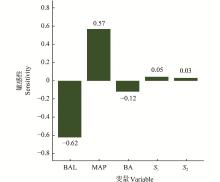
Fig.1
Sensitivity analysis results BAL denotes the basal area of trees larger than the subject tree at breast height; MAP denotes the mean annual precipitation; BA denotes the stand basal area per hectare; and S1 and S2 are dummy variables representing solar radiation."
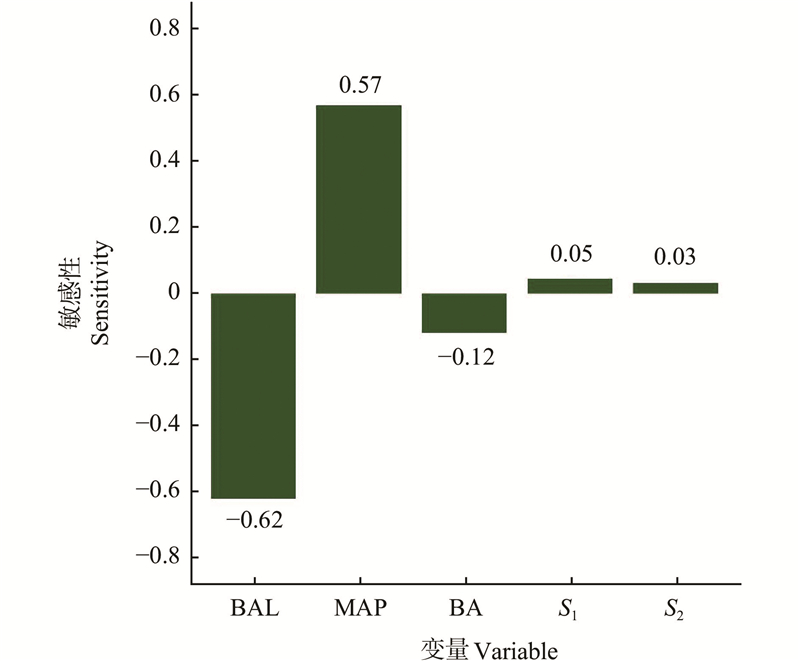
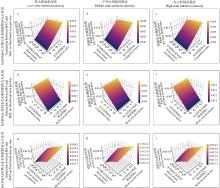
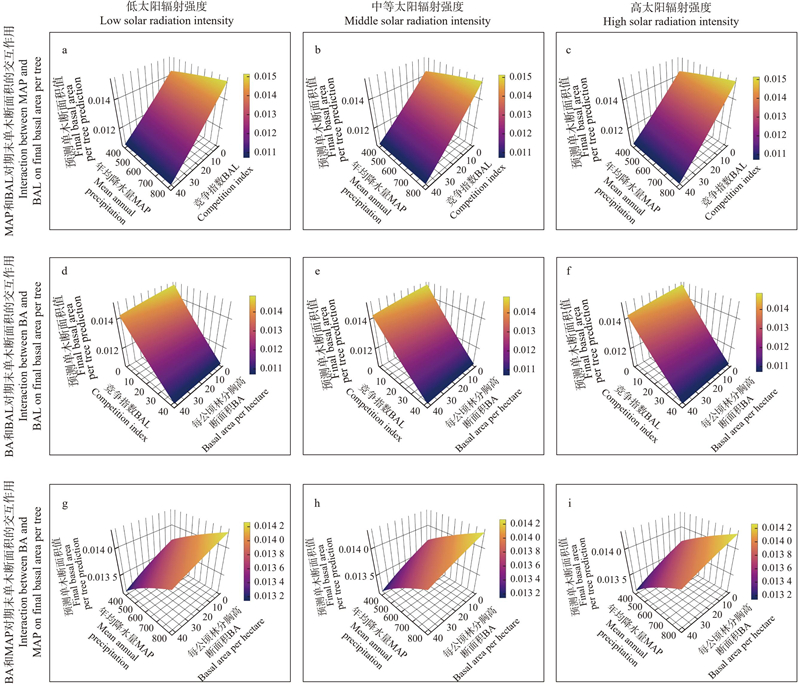
Fig.2
Analysis results of variable interactions"
| 国 红, 雷渊才, 郎璞玫. 年龄无关的生长模型研究: 以落叶松平均高为例. 林业科学研究, 2020, 33 (5): 129- 136. | |
| Guo H, Lei Y C, Lang P M. Study on age-independent tree model: taking the average height of Larix gmelinii as an example. Forest Research, 2020, 33 (5): 129- 136. | |
| 国家林业和草原局. 2020. 森林资源连续清查技术规程(GB/T 38590—2020). 北京: 中国标准出版社. | |
| National Forestry and Grassland Administration. 2020. Technical regulations for continuous forest inventory (GB/T 38590—2020). Beijing: China Standard Press. [in Chinese] | |
| 国家林业和草原局. 2023. 2021中国林草生态综合监测评价报告. 北京: 中国林业出版社. | |
| National Forestry and Grassland Administration. 2023. 2021 China forest and grasslandeecological comprehensive monitoring and evaluation report. Beijing: China Forestry Publishing House. [in Chinese] | |
|
何 江, 覃 林. 气候敏感的杉木天然林林分进界模型. 林业科学, 2025, 61 (1): 70- 80.
doi: 10.11707/j.1001-7488.LYKX20230538 |
|
|
He J, Qin L. Climate-sensitive tree recruitment model for natural Cunninghamia lanceolata forests. Scientia Silvae Sinicae, 2025, 61 (1): 70- 80.
doi: 10.11707/j.1001-7488.LYKX20230538 |
|
| 雷相东, 李永慈, 向 玮. 基于混合模型的单木断面积生长模型. 林业科学, 2009, 45 (1): 74- 80. | |
| Lei X D, Li Y C, Xiang W. Individual basal area growth model using multi-level linear mixed model with repeated measures. Scientia Silvae Sinicae, 2009, 45 (1): 74- 80. | |
|
商添雄, 韩海荣, 程小琴, 等. 华北落叶松人工林生长对抚育间伐的响应及其与土壤因子的关系. 林业科学研究, 2019, 32 (6): 40- 47.
doi: 10.13275/j.cnki.lykxyj.2019.06.006 |
|
|
Shang T X, Han H R, Cheng X Q, et al. Response of Larix principis-rupprechtii plantation growth to thinning and its relationship with soil factors. Forest Research, 2019, 32 (6): 40- 47.
doi: 10.13275/j.cnki.lykxyj.2019.06.006 |
|
|
王文俊, 李莲芳, 李小军, 等. 西南桦21年生人工林生长对造林密度的响应. 中南林业科技大学学报, 2023, 43 (11): 44- 52.
doi: 10.14067/j.cnki.1673-923x.2023.11.005 |
|
|
Wang W J, Li L F, Li X J, et al. Response of growth to density for a 21-year-old Betula alnoides plantation. Journal of Central South University of Forestry & Technology, 2023, 43 (11): 44- 52.
doi: 10.14067/j.cnki.1673-923x.2023.11.005 |
|
| 臧 颢, 刘洪生, 黄锦程, 等. 竞争和气候及其交互作用对杉木人工林胸径生长的影响. 林业科学, 2021, 57 (3): 39- 50. | |
| Zang H, Liu H S, Huang J C, et al. Effects of competition, climate factors and their interactions on diameter growth for Chinese fir plantations. Scientia Silvae Sinicae, 2021, 57 (3): 39- 50. | |
| Aber J, Neilson R P, McNulty S, et al. Forest processes and global environmental change: predicting the effects of individual and multiple stressors: we review the effects of several rapidly changing environmental drivers on ecosystem function, discuss interactions among them, and summarize predicted changes in productivity, carbon storage, and water balance. BioScience, 2001, 51 (9): 735- 751. | |
|
Aguilar C, Herrero J, Polo M J. Topographic effects on solar radiation distribution in mountainous watersheds and their influence on reference evapotranspiration estimates at watershed scale. Hydrology and Earth System Sciences, 2010, 14 (12): 2479- 2494.
doi: 10.5194/hess-14-2479-2010 |
|
|
Allen S T, Keim R F, Dean T J. Contrasting effects of flooding on tree growth and stand density determine aboveground production, in baldcypress forests. Forest Ecology and Management, 2019, 432, 345- 355.
doi: 10.1016/j.foreco.2018.09.041 |
|
|
Anandhi P, Nathiya D E. Application of linear regression with their advantages, disadvantages, assumption and limitations. International Journal of Statistics and Applied Mathematics, 2023, 8 (6): 133- 137.
doi: 10.22271/maths.2023.v8.i6b.1463 |
|
|
Bader M Y, van Geloof I, Rietkerk M. High solar radiation hinders tree regeneration above the Alpine treeline in northern Ecuador. Plant Ecology, 2007, 191 (1): 33- 45.
doi: 10.1007/s11258-006-9212-6 |
|
| Beier P, Burnham K P, Anderson D R. Model selection and inference: a practical information-theoretic approach. The Journal of Wildlife Management, 2001, 65 (3): 606. | |
|
Biging G S, Dobbertin M. Evaluation of competition indices in individual tree growth models. Forest Science, 1995, 41 (2): 360- 377.
doi: 10.1093/forestscience/41.2.360 |
|
|
Breidenbach J, Koch B, Kändler G, et al. Quantifying the influence of slope, aspect, crown shape and stem density on the estimation of tree height at plot level using lidar and InSAR data. International Journal of Remote Sensing, 2008, 29 (5): 1511- 1536.
doi: 10.1080/01431160701736364 |
|
|
Briseño-Reyes J, Corral-Rivas J J, Solis-Moreno R, et al. Individual tree diameter and height growth models for 30 tree species in mixed-species and uneven-aged forests of Mexico. Forests, 2020, 11 (4): 429.
doi: 10.3390/f11040429 |
|
|
Brunner A, Forrester D I. Tree species mixture effects on stem growth vary with stand density: an analysis based on individual tree responses. Forest Ecology and Management, 2020, 473, 118334.
doi: 10.1016/j.foreco.2020.118334 |
|
|
Drew T J, Flewelling J W. Stand density management: an alternative approach and its application to Douglas-fir plantations. Forest Science, 1979, 25 (3): 518- 532.
doi: 10.1093/forestscience/25.3.518 |
|
|
Ford K R, Breckheimer I K, Franklin J F, et al. Competition alters tree growth responses to climate at individual and stand scales. Canadian Journal of Forest Research, 2017, 47 (1): 53- 62.
doi: 10.1139/cjfr-2016-0188 |
|
|
Fu L Y, Sharma R P, Zhu G Y, et al. A basal area increment-based approach of site productivity evaluation for multi-aged and mixed forests. Forests, 2017, 8 (4): 119.
doi: 10.3390/f8040119 |
|
| García Chevesich P, Neary D G, Scott D F, et al. 2017. Forest management and the impact on water resources: a review of 13 countries. UNESCO. | |
|
Hatfield J L, Prueger J H. Temperature extremes: Effect on plant growth and development. Weather and Climate Extremes, 2015, 10, 4- 10.
doi: 10.1016/j.wace.2015.08.001 |
|
|
Jin L, Song X Q, Shi Y, et al. Photosynthetic acclimation of larch to the coupled effects of light intensity and water deficit in regions with changing water availability. Plants, 2024, 13 (14): 1891.
doi: 10.3390/plants13141891 |
|
|
Kašpar J, Krůček M, Král K. The effects of solar radiation on daily and seasonal stem increment of canopy trees in European temperate old-growth forests. New Phytologist, 2024, 243 (2): 662- 673.
doi: 10.1111/nph.19852 |
|
|
Khan M N I, Islam M R, Rahman A, et al. Allometric relationships of stand level carbon stocks to basal area, tree height and wood density of nine tree species in Bangladesh. Global Ecology and Conservation, 2020, 22, e01025.
doi: 10.1016/j.gecco.2020.e01025 |
|
|
Kumar L, Skidmore A K, Knowles E. Modelling topographic variation in solar radiation in a GIS environment. International Journal of Geographical Information Science, 1997, 11 (5): 475- 497.
doi: 10.1080/136588197242266 |
|
|
Liang H X, Huang J G, Ma Q Q, et al. Contributions of competition and climate on radial growth of Pinus massoniana in subtropics of China. Agricultural and Forest Meteorology, 2019, 274, 7- 17.
doi: 10.1016/j.agrformet.2019.04.014 |
|
|
Ma L H, Liu X L, Chai J, et al. Effects of slope aspect and rainfall on belowground deep fine root traits and aboveground tree height. Frontiers in Plant Science, 2021, 12, 684468.
doi: 10.3389/fpls.2021.684468 |
|
|
Mäkelä A, Vanninen P. Impacts of size and competition on tree form and distribution of aboveground biomass in Scots pine. Canadian Journal of Forest Research, 1998, 28 (2): 216- 227.
doi: 10.1139/x97-199 |
|
|
Metz J, Annighöfer P, Westekemper K, et al. Less is more: Effects of competition reduction and facilitation on intra-annual (basal area) growth of mature European beech. Trees, 2020, 34 (1): 17- 36.
doi: 10.1007/s00468-019-01894-7 |
|
|
Mohamedou C, Korhonen L, Eerikäinen K, et al. Using LiDAR-modified topographic wetness index, terrain attributes with leaf area index to improve a single-tree growth model in south-eastern Finland. Forestry: an International Journal of Forest Research, 2019, 92 (3): 253- 263.
doi: 10.1093/forestry/cpz010 |
|
|
Peltier D M P, Ogle K. Tree growth sensitivity to climate is temporally variable. Ecology Letters, 2020, 23 (11): 1561- 1572.
doi: 10.1111/ele.13575 |
|
| Peng J F, Li J B, Wang T, et al. Effect of altitude on climate–growth relationships of Chinese white pine (Pinus armandii) in the northern Funiu Mountain, central China. Climatic Change, 2019, 154 (1): 273- 288. | |
|
Porté A, Bartelink H H. Modelling mixed forest growth: a review of models for forest management. Ecological Modelling, 2002, 150 (1/2): 141- 188.
doi: 10.1016/s0304-3800(01)00476-8 |
|
|
Riofrío J, White J C, Tompalski P, et al. Modelling height growth of temperate mixedwood forests using an age-independent approach and multi-temporal airborne laser scanning data. Forest Ecology and Management, 2023, 543, 121137.
doi: 10.1016/j.foreco.2023.121137 |
|
| Saltelli A, Tarantola S, Campolongo F, et al. 2004. Sensitivity analysis in practice: a guide to assessing scientific models. Wiley Online Library. | |
|
Schippers P, Sterck F, Vlam M, et al. Tree growth variation in the tropical forest: understanding effects of temperature, rainfall and CO2. Global Change Biology, 2015, 21 (7): 2749- 2761.
doi: 10.1111/gcb.12877 |
|
| Takata K. Studies of the volume estimate by basal area at breast height (5) Construction of universal diameter-height curve (EHK). Journal of the Japanese Forestry Society, 1958, 40 (1): 1- 6. | |
|
Tomé J, Tomé M, Barreiro S, et al. Age-independent difference equations for modelling tree and stand growth. Canadian Journal of Forest Research, 2006, 36 (7): 1621- 1630.
doi: 10.1139/x06-065 |
|
|
Wang T L, Wang G Y, Innes J L, et al. ClimateAP: an application for dynamic local downscaling of historical and future climate data in Asia Pacific. Frontiers of Agricultural Science and Engineering, 2017, 4 (4): 448.
doi: 10.15302/J-FASE-2017172 |
|
|
West P W. Effects of site productivity on individual tree maximum basal area growth rates of Eucalyptus pilularis in subtropical Australia. Journal of Forestry Research, 2023, 34 (6): 1659- 1668.
doi: 10.1007/s11676-023-01623-4 |
|
| Wykoff W R, Crookston N L, Stage A R. User’s guide to the stand prognosis model. United States Department of Agriculture, Forest Service, Intermountain Forest and Range Experiment Station. General Technical Report, 1982, 133, 119. | |
| Zeide B. Analysis of growth equations. Forest Science, 1993, 39 (3): 594- 616. | |
|
Zou K L, Xu Q G, He P, et al. Climate sensitive growth model for volume and carbon storage of subtropical broadleaf secondary forests in China. Ecological Indicators, 2025, 170, 113056.
doi: 10.1016/j.ecolind.2024.113056 |
| Viewed | ||||||
|
Full text |
|
|||||
|
Abstract |
|
|||||
