
林业科学 ›› 2026, Vol. 62 ›› Issue (9): 28-41.doi: 10.11707/j.1001-7488.LYKX20260079
• 前沿热点 • 上一篇
罗鸿1,2,许行1,2,*( ),张晓花1,2,张志强1,2
收稿日期:2026-02-04
修回日期:2026-07-28
出版日期:2026-09-10
发布日期:2026-09-16
通讯作者:
许行
E-mail:hangxu@bjfu.edu.cn
基金资助:
Hong Luo1,2,Hang Xu1,2,*(),Xiaohua Zhang1,2,Zhiqiang Zhang1,2
Received:2026-02-04
Revised:2026-07-28
Online:2026-09-10
Published:2026-09-16
Contact:
Hang Xu
E-mail:hangxu@bjfu.edu.cn
摘要:
目的: 探究晋西黄土区人工林不同树种、不同密度条件下的土壤呼吸速率(RS)和土壤呼吸温度敏感性指数(Q10)特征,识别其关键驱动因子,为该区域人工林密度调控、树种配置优化和碳循环模型参数化提供依据。方法: 在晋西黄土区刺槐和油松人工纯林分别选择5个林分密度梯度,其中刺槐林密度为900、1 200、1 500、1 800和2 400株·hm–2,油松林密度为900、1 200、1 800、2 400和2 800株·hm–2,于2024年生长季(5—10月)采用LI-8100土壤碳通量监测系统测定土壤呼吸速率(RS);同时测定土壤的理化性质、土壤微生物特征、凋落物现存量、凋落物碳含量、细根生物量密度以及细根碳氮磷含量,并通过指数模型估算Q10值,进一步解析RS与Q10值变异的主要驱动机制。结果: 1) 在控制土壤温度、土壤含水量和月份后,树种对RS的影响达显著水平,油松林RS[(3.47±0.17) μmol·m–2s–1]显著高于刺槐林[(3.02±0.09) μmol·m–2s–1],其Q10值(3.23±0.26)也高于刺槐林(2.50±0.13)。2) 随林分密度升高,两树种RS均呈上升趋势,但同一树种不同密度间差异不显著。Q10值响应呈树种分异:刺槐林各密度间Q10值差异不显著,油松林2 800 株·hm–2密度的Q10值显著高于1 200 株·hm–2(P<0.05)。3) 相关分析表明,土壤黏粒含量和凋落物现存量是RS变异的关键驱动因子,凋落物特征、细根特征和土壤微生物特性在Q10值变化中发挥核心作用。结论: 人工林土壤呼吸和土壤呼吸温度敏感性指数受树种和林分密度的共同调控。植物凋落物特征、细根特征和土壤微生物特性是驱动土壤碳释放温度响应的关键因素。树种主要通过凋落物输入数量和质量的差异来影响土壤呼吸,油松林凋落物现存量大、碳含量高,为微生物呼吸提供了更充足的底物,使其RS和Q10值整体高于刺槐林。林分密度对土壤呼吸的影响则因树种而异:刺槐林各密度间Q10值变化不显著;油松林的高密度林分下底物充足,微生物代谢对温度的敏感性更强,驱动Q10值显著升高。本研究深化了对人工林土壤碳通量变化及其温度响应机制的认识,为人工林密度调控和结构优化提供了理论依据。
中图分类号:
罗鸿,许行,张晓花,张志强. 晋西黄土区典型人工林树种和林分密度对土壤呼吸及其温度敏感性的影响[J]. 林业科学, 2026, 62(9): 28-41.
Hong Luo,Hang Xu,Xiaohua Zhang,Zhiqiang Zhang. Effects of Tree Species and Stand Density on Soil Respiration and Its Temperature Sensitivity in Typical Plantations on the Loess Plateau of Western Shanxi Province[J]. Scientia Silvae Sinicae, 2026, 62(9): 28-41.

表1
样地基本信息"
| 树种 Tree species | 密度Density/ (trees·hm?2) | 经度 Longitude (E) | 纬度 Latitude (N) | 海拔 Altitude/m | 平均树高 Mean tree height/m | 平均胸径 Mean diameter at breast height/cm |
刺槐 R. pseudoacacia | 900 | 110°44′31″ | 36°16′32″ | 1 150 | 12.83±1.10 | 19.87±2.58 |
| 1 200 | 110°44′56″ | 36°16′42″ | 1 110 | 11.07±0.32 | 18.03±0.31 | |
| 1 500 | 110°44′31″ | 36°16′30″ | 1 205 | 12.40±0.35 | 17.54±1.46 | |
| 1 800 | 110°45′46″ | 36°16′21″ | 1 027 | 12.23±0.12 | 17.15±0.59 | |
| 2 400 | 110°46′15″ | 36°16′16″ | 998 | 8.43±0.12 | 15.00±0.72 | |
| 油松 P. tabuliformis | 900 | 110°46′16″ | 36°16′16″ | 1 105 | 6.37±0.06 | 16.13±0.72 |
| 1 200 | 110°45′31″ | 36°16′25″ | 1 121 | 6.20±0.10 | 14.67±0.58 | |
| 1 800 | 110°45′27″ | 36°02′33″ | 1 324 | 11.56±0.01 | 15.83±1.19 | |
| 2 400 | 110°45′24″ | 36°02′30″ | 1 333 | 9.73±0.50 | 12.47±3.33 | |
| 2 800 | 110°45′29″ | 36°02′34″ | 1 276 | 12.20±0.95 | 6.97±0.15 |

图1
土壤呼吸速率月际变化规律 ns:两树种间土壤呼吸速率差异不显著,P>0.05;**:两树种间土壤呼吸速率差异极显著,P<0.01;***:两树种间土壤呼吸速率差异极显著,P<0.001。同一月份同一树种在不同密度林分间的相同小写字母表示土壤呼吸速率差异不显著,P>0.05。样本量n=6,误差线表示平均值±标准差。ns: No significant difference in soil respiration rate between the two tree species (P>0.05); **: Significant difference in soil respiration rate between the two tree species (P<0.01); ***: Significant difference in soil respiration rate between the two tree species (P<0.001).Same lowercase letters indicate no significant difference in RS among stands with different densities for the same tree species in the same month. (P>0.05). n=6; error bars represent the mean±SD."

表2
土壤呼吸速率(RS)与土壤温度(T)和土壤质量含水量(W)的关系"
| 环境因子 Environmental factor | 统计指标 Statistical indicator | 线性模型Linear model | 非线性模型Nonlinear model | |||
| 刺槐 R. pseudoacacia | 油松 P. tabuliformis | 刺槐 R. pseudoacacia | 油松 P. tabuliformis | |||
| 土壤温度 Soil temperature | 拟合模型 Fitted model | |||||
| R2 | 0.29 | 0.28 | 0.37 | 0.38 | ||
| P | <0.001 | <0.001 | <0.001 | <0.001 | ||
| AIC | 336 | 390 | 323 | 375 | ||
| 土壤质量 含水量 Soil gravimetric water content | 拟合模型 Fitted model | |||||
| R2 | 0.05 | 0.17 | 0.20 | 0.17 | ||
| P | <0.05 | <0.001 | <0.05 | <0.001 | ||
| AIC | 362 | 403 | 349 | 405 | ||
| 双因子 Two-factors | 拟合模型 Fitted model | |||||
| R2 | 0.39 | 0.46 | 0.41 | 0.51 | ||
| P | <0.05 | <0.05 | <0.05 | <0.05 | ||
| AIC | 325 | 367 | 320 | 357 | ||
表3
控制土壤温度、质量含水量和月份后土壤呼吸速率(RS)的线性混合效应模型"
| 项Item | df | 估计值(标准误) Estimate (SE) | t 统计量 t-statistic | P值 P-value | III型方差分析P值 P-value (Type III) |
| 土壤温度Soil temperature | 176.90 | 0.08(0.02) | 4.39 | <0.001 | <0.001 |
| 土壤质量含水量Soil gravimetric water content | 176.01 | 0.08 | 0.08 | ||
| 月份Month | 157.26 | — | — | — | <0.001 |
| 树种Tree species | 49.77 | 0.28(0.11) | 2.56 | 0.02 | 0.01 |
| 密度Density | 29.10 | — | — | — | 0.06 |
| 树种×密度 Tree species × density | 29.63 | — | — | — | 0.35 |

图2
生长季平均土壤呼吸速率(A)和土壤呼吸温度敏感性指数(B)的林分密度差异 同一树种不同密度间相同小写字母表示无显著差异(P>0.05)。Identical lowercase letters indicate no significant difference among densities of the same tree species(P>0.05)."


图3
不同树种和林分密度下土壤理化性质、酶活性及微生物量碳、氮和磷的差异 TS: 树种Tree species; De: 密度Density. 同一树种不同密度间相同小写字母代表无显著差异(P>0.05)。Identical lowercase letters indicate no significant difference among densities of the same tree species(P>0.05)."
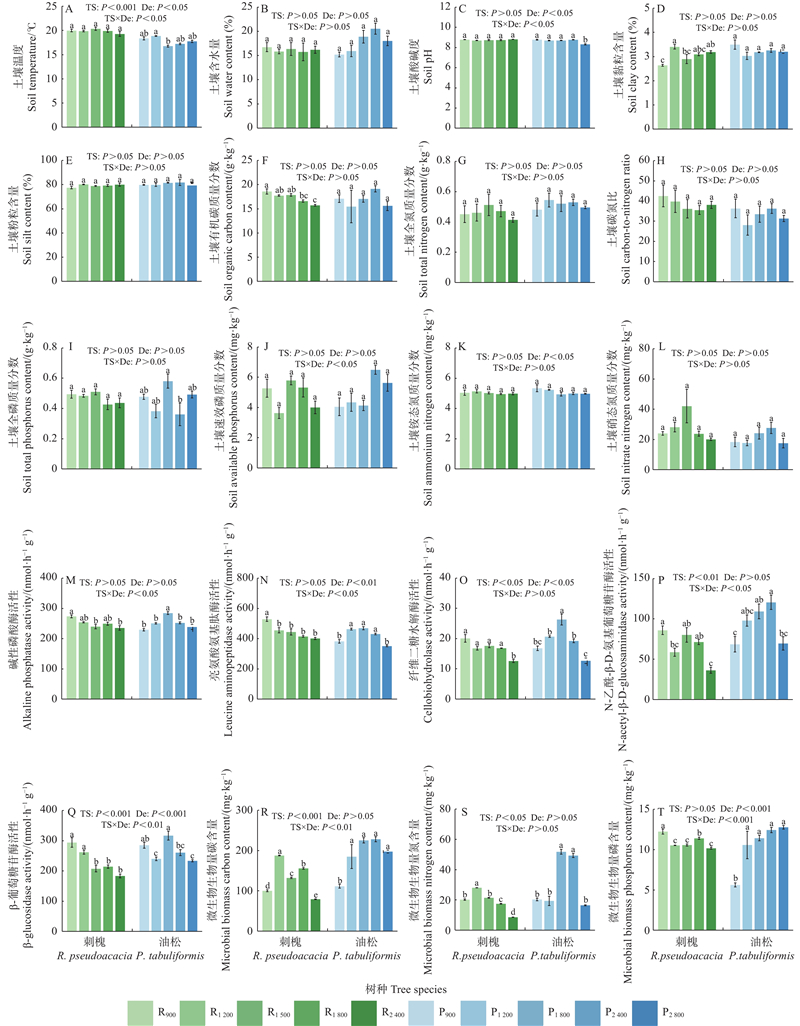
表4
植物凋落物现存量、细根生物量密度、凋落物和细根养分含量①"
| 树种 Tree species | 密度Density/ (tree·hm–2) | 凋落物 现存量 Litter standing crop/(t·hm–2) | 凋落物碳 含量 Litter carbon content/(g·kg–1) | 细根生物量 密度 Fine root biomass density/(kg·m–3) | 细根碳含量 Fine root carbon content/(g·kg–1) | 细根氮含量 Fine root nitrogen content/(g·kg–1) | 细根碳氮比 Fine root carbon- to-nitrogen ratio | 细根磷含量 Fine root phosphorus content/(g·kg–1) |
| 刺槐 R. pseudoacacia | 900 | 8.60±2.80b | 351.10±8.51a | 0.94±0.27a | 286.10±7.70b | 10.95±0.23e | 26.15±0.86a | 1.45±0.03b |
| 1 200 | 14.11±0.86ab | 361.50±8.09a | 1.12±0.26a | 293.60±28.05b | 12.06±0.12d | 24.36±2.14a | 1.36±0.06bc | |
| 1 500 | 14.18±3.55ab | 344.70±4.82a | 0.92±0.08a | 318.40±4.50ab | 16.76±0.10a | 18.99±0.21b | 1.41±0.09bc | |
| 1 800 | 12.56±1.29ab | 380.30±11.10a | 0.84±0.14a | 366.00±10.10a | 15.63±0.03b | 23.42±0.75ab | 1.63±0.01a | |
| 2 400 | 16.97±4.30a | 339.90±17.30a | 0.84±0.25a | 340.30±10.22ab | 12.95±0.07c | 26.28±0.74a | 1.31±0.03c | |
| 油松 P. tabuliformis | 900 | 16.72±0.58b | 409.20±12.08a | 1.59±0.28a | 319.90±11.68a | 3.14±0.01d | 101.88±3.80b | 1.12±0.01c |
| 1 200 | 17.89±1.20b | 418.30±9.87a | 1.64±0.33a | 333.40±14.31a | 2.59±0.03e | 128.93±5.39a | 1.06±0.01d | |
| 1 800 | 21.80±1.90ab | 416.30±7.44a | 1.57±0.15a | 316.50±7.20a | 7.02±0.06c | 45.08±0.68c | 1.26±0.02a | |
| 2 400 | 27.85±1.89a | 393.80±9.13a | 1.13±0.29a | 307.70±7.85a | 7.39±0.05b | 41.64±1.23cd | 1.15±0.03c | |
| 2 800 | 25.36±4.51a | 403.40±4.96a | 1.67±0.05a | 294.40±9.35a | 9.63±0.08a | 30.58±1.18d | 1.21±0.00b |

图4
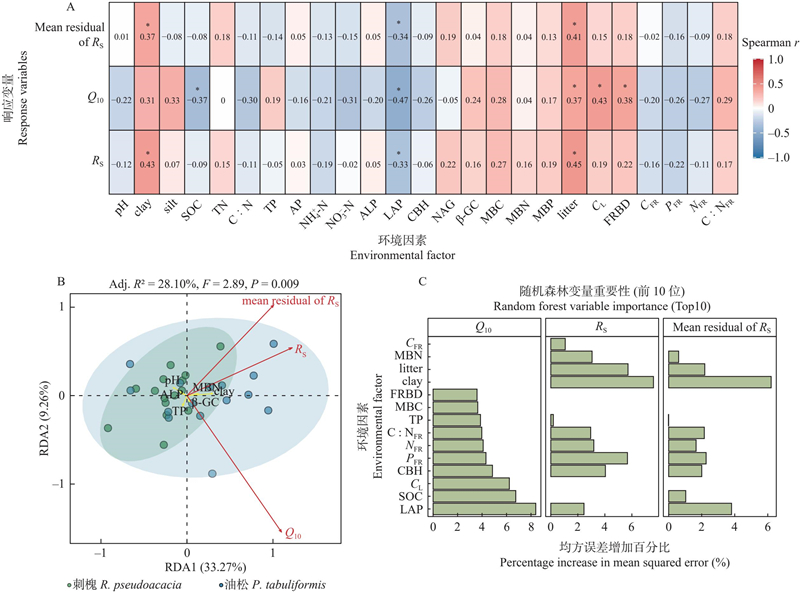
土壤呼吸速率、土壤呼吸温度敏感性指数与土壤环境和植物凋落物、细根特征的相关性 pH: 土壤酸碱度Soil pH; clay: 土壤黏粒含量Soil clay content; silt: 土壤粉粒含量Soil silt content; SOC: 土壤有机碳含量Soil organic carbon content; TN: 土壤全氮含量Soil total nitrogen content; C∶N: 土壤碳氮比Soil carbon-to-nitrogen ratio; TP: 土壤全磷含量Soil total phosphorus content; AP: 土壤有效磷含量Soil available phosphorus content; NH4+-N: 土壤铵态氮含量Soil ammonium nitrogen content; NO3–-N: 土壤硝态氮含量Soil nitrate nitrogen content; LAP: 亮氨酸氨基肽酶活性Leucine aminopeptidase activity; ALP: 碱性磷酸酶活性Alkaline phosphatase activity; CBH: 纤维二糖水解酶活性Cellobiohydrolase activity; NAG: N-乙酰-β-D-氨基葡萄糖苷酶活性N-acetyl-β-D-glucosaminidase activity; β-GC: β-葡萄糖苷酶活性β-glucosidase activity; MBC: 土壤微生物生物量碳含量Soil microbial biomass carbon content; MBN: 土壤微生物生物量氮含量Soil microbial biomass nitrogen content; MBP: 土壤微生物生物量磷含量Soil microbial biomass phosphorus content; litter: 凋落物现存量Litter standing crop; CL: 凋落物碳含量Litter carbon content; FRBD: 细根生物量密度Fine root biomass density; CFR: 细根碳含量Fine root carbon content; PFR: 细根磷含量Fine root phosphorus content; NFR: 细根氮含量Fine root nitrogen content; C∶NFR: 细根碳氮比Fine root carbon-to-nitrogen ratio; Mean residual of RS: RS残差均值Mean residual of RS; RS: 土壤呼吸速率Soil respiration rate; Q10: 土壤呼吸温度敏感性指数Soil respiration temperature sensitivity index; *: P<0.05."
|
陈 平, 赵 博, 闫子超, 等. 太岳山油松人工林土壤呼吸对模拟氮沉降的短期响应. 生态学报, 2018, 38 (22): 8184- 8193.
doi: 10.5846/stxb201708251537 |
|
|
Chen P, Zhao B, Yan Z C, et al. Short-term response of soil respiration to simulated nitrogen deposition in a Pinus tabulaeformis plantation on Taiyue Mountain, China. Acta Ecologica Sinica, 2018, 38 (22): 8184- 8193.
doi: 10.5846/stxb201708251537 |
|
| 戴 勐, 张志铭, 赵 勇, 等. 中国典型森林生态系统土壤呼吸差异性分析. 华中师范大学学报(自然科学版), 2015, 49 (2): 237- 245. | |
| Dai M, Zhang Z M, Zhao Y, et al. The difference of soil respiration for typical forest ecosystems in China. Journal of Central China Normal University (Natural Sciences), 2015, 49 (2): 237- 245. | |
| 高雅玉, 何文博, 郝建斌, 等. 2025. 极端干旱区土壤呼吸动态特征及对水热因子的响应. 节水灌溉, (8): 59–66. | |
| Gao Y Y, He W B, Hao J B, et al. 2025. Dynamic characteristics of soil respiration and its response to hydrothermal factors in extreme arid areas. Water Saving Irrigation, (8): 59-66. [in Chinese] | |
|
葛艳灵, 田沁瑞, 林 峰, 等. 晋西黄土区典型人工林叶片-凋落物-土壤-微生物的化学计量特征. 东北林业大学学报, 2025, 53 (10): 79- 91.
doi: 10.3969/j.issn.1000-5382.2025.10.011 |
|
|
Ge Y L, Tian Q R, Lin F, et al. Stoichiometric characteristics of leaf-litter-soil-microbe in typical plantations in the loess area of western Shanxi Province. Journal of Northeast Forestry University, 2025, 53 (10): 79- 91.
doi: 10.3969/j.issn.1000-5382.2025.10.011 |
|
|
郭 钰, 姚佳峰, 董 媛, 等. 油松和刺槐纯林及混交林根系分布特征. 应用生态学报, 2023, 34 (11): 2881- 2888.
doi: 10.13287/j.1001-9332.202311.008 |
|
|
Guo Y, Yao J F, Dong Y, et al. Root distribution characteristics of monoculture and mixture of Pinus tabuliformis and Robinia pseudoacacia plantation. Chinese Journal of Applied Ecology, 2023, 34 (11): 2881- 2888.
doi: 10.13287/j.1001-9332.202311.008 |
|
|
何锦煜, 袁建钰, 闫丽娟, 等. 施氮对陇中黄土高原旱作麦田N2O和CO2排放的影响. 甘肃农业大学学报, 2024, 59 (3): 81- 89.
doi: 10.13432/j.cnki.jgsau.2024.03.010 |
|
|
He J Y, Yuan J Y, Yan L J, et al. Effects of different nitrogen application amounts on N2O and CO2 emissions from dryland wheat fields in the Loess Plateau of central Gansu. Journal of Gansu Agricultural University, 2024, 59 (3): 81- 89.
doi: 10.13432/j.cnki.jgsau.2024.03.010 |
|
|
刘 宝, 王民煌, 余再鹏, 等. 中亚热带天然林改造成人工林后土壤呼吸的变化特征. 林业科学, 2019, 55 (4): 1- 12.
doi: 10.11707/j.1001-7488.20190401 |
|
|
Liu B, Wang M H, Yu Z P, et al. Characterization of soil respiration after conversion from natural forest to plantations in central-subtropical area. Scientia Silvae Sinicae, 2019, 55 (4): 1- 12.
doi: 10.11707/j.1001-7488.20190401 |
|
|
梁龙玥, 张建军, 李 阳, 等. 晋西黄土区油松人工林径向生长对气候变化的响应. 北京林业大学学报, 2025, 47 (5): 59- 71.
doi: 10.12171/j.1000-1522.20240140 |
|
|
Liang L Y, Zhang J J, Li Y, et al. Response of radial growth of Pinus tabuliformis plantations to climate change in loess area of western Shanxi Province of northern China. Journal of Beijing Forestry University, 2025, 47 (5): 59- 71.
doi: 10.12171/j.1000-1522.20240140 |
|
|
刘洪柳, 王泽鑫, 郭晋平, 等. 林分密度对华北落叶松天然次生林林下植被和土壤呼吸的影响. 广西林业科学, 2022, 51 (2): 190- 196.
doi: 10.19692/j.issn.1006-1126.20220204 |
|
|
Liu H L, Wang Z X, Guo J P, et al. Effects of stand density on understory vegetation and soil respiration in natural secondary Larix principis-rupprechtii forest. Guangxi Forestry Science, 2022, 51 (2): 190- 196.
doi: 10.19692/j.issn.1006-1126.20220204 |
|
| 鲁如坤. 2000. 土壤农业化学分析方法. 北京: 中国农业科学技术出版社. | |
| Lu R K. 2000. Methods of soil agrochemical analysis. Beijing: China Agricultural Science and Technology Press. [in Chinese] | |
|
宁晓梅, 张杰铭, 余锦亚南, 等. 晋西北黄土区不同密度油松林土壤团聚体稳定性和养分特征. 应用与环境生物学报, 2026, 32 (4): 579- 589.
doi: 10.19675/j.cnki.1006-687x.2025.04025 |
|
|
Ning X M, Zhang J M, Yu J Y N, et al. Soil aggregate stability and nutrient characteristics of Pinus tabuliformis with different densities in the loess region of northwestern Shanxi Province, China. Chinese Journal of Applied and Environmental Biology, 2026, 32 (4): 579- 589.
doi: 10.19675/j.cnki.1006-687x.2025.04025 |
|
|
邵英男, 田松岩, 刘延坤, 等. 密度调控对长白落叶松人工林土壤呼吸的影响. 北京林业大学学报, 2017, 39 (6): 51- 59.
doi: 10.13332/j.1000-1522.20170029 |
|
|
Shao Y N, Tian S Y, Liu Y K, et al. Effects of density control on soil respiration in Larix olgensis plantation. Journal of Beijing Forestry University, 2017, 39 (6): 51- 59.
doi: 10.13332/j.1000-1522.20170029 |
|
|
舒碧川, 孙晓阳, 张彦东. 林分密度对杂种落叶松人工林土壤呼吸的影响. 森林工程, 2020, 36 (5): 1- 7.
doi: 10.3969/j.issn.1006-8023.2020.05.001 |
|
|
Shu B C, Sun X Y, Zhang Y D. Effects of stand density on soil respiration in hybrid larch plantations. Forest Engineering, 2020, 36 (5): 1- 7.
doi: 10.3969/j.issn.1006-8023.2020.05.001 |
|
|
宋 丽, 李娇娇, 周鑫胜, 等. 太原市2个典型林分冬季土壤呼吸及其对温度和水分的响应. 东北林业大学学报, 2020, 48 (3): 84- 88, 94.
doi: 10.3969/j.issn.1000-5382.2020.03.015 |
|
|
Song L, Li J J, Zhou X S, et al. Soil respiration and its response to temperature and moisture in two typical stands of Taiyuan City in winter. Journal of Northeast Forestry University, 2020, 48 (3): 84- 88, 94.
doi: 10.3969/j.issn.1000-5382.2020.03.015 |
|
|
王澄海, 冯 祥. 土壤温、湿度调控土壤呼吸过程的参数化进展及趋势. 中国科学(地球科学), 2025 (6): 1817- 1836.
doi: 10.1007/s11430-024-1554-y |
|
|
Wang C H, Feng X. Progress and perspective in parameterizing soil respiration responses to temperature and moisture. Science China (Earth Sciences), 2025 (6): 1817- 1836.
doi: 10.1007/s11430-024-1554-y |
|
|
王子萌, 杨 光, 吴 际, 等. 黄土丘陵沟壑区典型人工林土壤入渗特征研究. 土壤通报, 2025, 56 (4): 968- 978.
doi: 10.19336/j.cnki.trtb.2024080202 |
|
|
Wang Z M, Yang G, Wu J, et al. Soil infiltration characteristics of typical plantation in loess hilly and Gully Region. Chinese Journal of Soil Science, 2025, 56 (4): 968- 978.
doi: 10.19336/j.cnki.trtb.2024080202 |
|
|
谢育利, 陈云明, 唐亚坤, 等. 黄土丘陵区油松、沙棘人工林土壤呼吸动态及其对土壤温度和水分的响应. 中国水土保持科学, 2017, 15 (1): 33- 42.
doi: 10.16843/j.sswc.2017.01.005 |
|
|
Xie Y L, Chen Y M, Tang Y K, et al. Soil respiration dynamics and its response to soil temperature and water content of Pinus tabulaeformis and Hippophae rhamnoides plantations in the Loess Hilly region. Science of Soil and Water Conservation, 2017, 15 (1): 33- 42.
doi: 10.16843/j.sswc.2017.01.005 |
|
|
许雯丽, 卞嘉琛, 林 茂, 等. 晋北赖草草地土壤呼吸对养分添加和改变降水的响应. 草地学报, 2025, 33 (1): 170- 180.
doi: 10.11733/j.issn.1007-0435.2025.01.019 |
|
|
Xu W L, Bian J C, Lin M, et al. Effects of nutrient addition and altered precipitation on soil respiration on the Leymus secalinus grassland in northern Shanxi. Acta Agrestia Sinica, 2025, 33 (1): 170- 180.
doi: 10.11733/j.issn.1007-0435.2025.01.019 |
|
|
杨 周, 张建军, 赵炯昌, 等. 晋西黄土区油松林土壤碳氮磷计量特征对林龄和密度的响应. 北京林业大学学报, 2024, 46 (12): 30- 40.
doi: 10.12171/j.1000-1522.20240188 |
|
|
Yang Z, Zhang J J, Zhao J C, et al. Response of soil carbon, nitrogen and phosphorus stoichiometric characteristics of Pinus tabuliformis forests to stand age and density in the Loess Plateau region of western Shanxi Province, northern China. Journal of Beijing Forestry University, 2024, 46 (12): 30- 40.
doi: 10.12171/j.1000-1522.20240188 |
|
|
殷晓晴, 马 岚, 牛凤娇. 模拟干旱条件下晋西黄土区刺槐林土壤水分运移特征. 林业科学, 2025, 61 (10): 49- 59.
doi: 10.11707/j.1001-7488.LYKX20250247 |
|
|
Yin X Q, Ma L, Niu F J. Soil water transport characteristics of Robinia pseudoacacia plantations in the Loess Plateau of western Shanxi Province under simulated drought conditions. Scientia Silvae Sinicae, 2025, 61 (10): 49- 59.
doi: 10.11707/j.1001-7488.LYKX20250247 |
|
|
张城伟, 王 兴, 安 可, 等. 黄土丘陵区退耕植被叶片-土壤生态化学计量特征与植物内稳态差异. 林业科学, 2025, 61 (6): 61- 74.
doi: 10.11707/j.1001-7488.LYKX20240365 |
|
|
Zhang C W, Wang X, An K, et al. Leaf-soil ecological stoichiometric characteristics and plant homeostasis differences of reclaimed vegetation in the Loess Hilly Region. Scientia Silvae Sinicae, 2025, 61 (6): 61- 74.
doi: 10.11707/j.1001-7488.LYKX20240365 |
|
|
张海龙, 武润琴, 李佳佳, 等. 根系分泌物C∶N对刺槐林地土壤理化特征和土壤呼吸的影响. 应用生态学报, 2022, 33 (4): 949- 956.
doi: 10.13287/j.1001-9332.202204.013 |
|
|
Zhang H L, Wu R Q, Li J J, et al. Effects of root exudates C: N on soil physical and chemical characteristics and soil respiration in Robinia pseudoacacia plantation. Chinese Journal of Applied Ecology, 2022, 33 (4): 949- 956.
doi: 10.13287/j.1001-9332.202204.013 |
|
|
张琳焓, 闭建荣, 张雪腾, 等. 黄土高原半干旱区2020年生长季草地土壤呼吸特征及其影响因素. 干旱气象, 2022, 40 (3): 354- 363.
doi: 10.11755/j.issn.1006-7639(2022)-03-0354 |
|
|
Zhang L H, Bi J R, Zhang X T, et al. Grassland soil respiration characteristics and their influencing factors in semi-arid region of Loess Plateau during the growing season in 2020. Journal of Arid Meteorology, 2022, 40 (3): 354- 363.
doi: 10.11755/j.issn.1006-7639(2022)-03-0354 |
|
|
张艳如, 陈秋文, 孙美美, 等. 黄土丘陵区4种植被类型土壤呼吸季节及年际变化. 应用与环境生物学报, 2018, 24 (4): 729- 734.
doi: 10.19675/j.cnki.1006-687x.2017.09027 |
|
|
Zhang Y R, Chen Q W, Sun M M, et al. Seasonal and interannual variation of soil respiration in four vegetation types in the Loess Hilly Region. Chinese Journal of Applied and Environmental Biology, 2018, 24 (4): 729- 734.
doi: 10.19675/j.cnki.1006-687x.2017.09027 |
|
|
朱玉帆, 刘伟超, 李佳欣, 等. 黄土丘陵区人工刺槐林土壤有机碳矿化特征及其与有机碳组分的关系. 环境科学, 2023, 44 (1): 444- 451.
doi: 10.13227/j.hjkx.202203162 |
|
|
Zhu Y F, Liu W C, Li J X, et al. Mineralization characteristics of soil organic carbon and its relationship with organic carbon components in artificial Robinia pseudoacacia forest in Loess Hilly Region. Environmental Science, 2023, 44 (1): 444- 451.
doi: 10.13227/j.hjkx.202203162 |
|
|
朱 珠, 徐 侠, 杨赛兰, 等. 陆地生态系统土壤有机碳分解温度敏感性研究进展. 南京林业大学学报(自然科学版), 2022, 46 (1): 33- 39.
doi: 10.12302/j.issn.1000-2006.202002049 |
|
|
Zhu Z, Xu X, Yang S L, et al. A review on the temperature sensitivity of soil organic carbon decomposition in terrestrial ecosystem. Journal of Nanjing Forestry University (Natural Sciences Edition), 2022, 46 (1): 33- 39.
doi: 10.12302/j.issn.1000-2006.202002049 |
|
| 左 强, 何怀江, 张春雨, 等. 采伐对蛟河阔叶红松混交林土壤呼吸的影响. 北京林业大学学报, 2016, 38 (4): 71- 76. | |
| Zuo Q, He H J, Zhang C Y, et al. Effects of cutting on soil respiration in a mixed broadleaf-Korean pine forest in western foothill of Changbai Mountain, northeast China. Journal of Beijing Forestry University, 2016, 38 (4): 71- 76. | |
|
Abramoff R Z, Finzi A C. Seasonality and partitioning of root allocation to rhizosphere soils in a midlatitude forest. Ecosphere, 2016, 7 (11): e01547.
doi: 10.1002/ecs2.1547 |
|
|
Abrar M M, Xu H, Aziz T, et al. Carbon, nitrogen, and phosphorus stoichiometry mediate sensitivity of carbon stabilization mechanisms along with surface layers of a Mollisol after long-term fertilization in Northeast China. Journal of Soils and Sediments, 2021, 21 (2): 705- 723.
doi: 10.1007/s11368-020-02825-7 |
|
|
Cao T T, Zhang Q, Chen Y R, et al. Enlarging interface reverses the dominance of fungi over bacteria in litter decomposition. Soil Biology and Biochemistry, 2024, 198, 109543.
doi: 10.1016/j.soilbio.2024.109543 |
|
|
Chen C, Pei J M, Li B, et al. Nutrient addition enhances the temperature sensitivity of soil carbon decomposition across forest ecosystems. Global Change Biology, 2024, 30 (10): e17543.
doi: 10.1111/gcb.17543 |
|
|
de Souza L C, Procópio L. The profile of the soil microbiota in the Cerrado is influenced by land use. Applied Microbiology and Biotechnology, 2021, 105 (11): 4791- 4803.
doi: 10.1007/s00253-021-11377-w |
|
|
Feng J Y, Wang C Y, Gao J J, et al. Changes in plant litter and root carbon inputs alter soil respiration in three different forests of a climate transitional region. Agricultural and Forest Meteorology, 2024, 358, 110212.
doi: 10.1016/j.agrformet.2024.110212 |
|
|
Gao F, Gao D D, Ning C, et al. Tree diversity affects temperature sensitivity of soil organic matter decomposition in rhizosphere. Plant and Soil, 2025, 514 (1): 625- 641.
doi: 10.1007/s11104-025-07410-w |
|
|
Han X Y, Gao G Y, Li Z S, et al. Effects of plantation age and precipitation gradient on soil carbon and nitrogen changes following afforestation in the Chinese Loess Plateau. Land Degradation & Development, 2019, 30 (18): 2298- 2310.
doi: 10.1002/ldr.3422 |
|
|
He L Y, Mazza Rodrigues J L, Soudzilovskaia N A, et al. Global biogeography of fungal and bacterial biomass carbon in topsoil. Soil Biology and Biochemistry, 2020, 151, 108024.
doi: 10.1016/j.soilbio.2020.108024 |
|
|
Hong S B, Yin G D, Piao S L, et al. Divergent responses of soil organic carbon to afforestation. Nature Sustainability, 2020, 3 (9): 694- 700.
doi: 10.1038/s41893-020-0557-y |
|
|
Jia X, Zha T S, Wu B, et al. Temperature response of soil respiration in a Chinese pine plantation: hysteresis and seasonal vs. diel Q10. PLoS ONE, 2013, 8 (2): e57858.
doi: 10.1371/journal.pone.0057858 |
|
|
Jiang L Z, Ushio M, Imai N, et al. Changes of bacterial versus fungal community composition along a forest degradation gradient of logged-over tropical rain forests, and their consequences on soil enzyme activities in Malaysian Borneo. Plant and Soil, 2025, 510 (1): 541- 563.
doi: 10.1007/s11104-024-06939-6 |
|
|
Laine A L, Leino S. Plant microbiomes feel the heat. Science, 2025, 388 (6752): 1150- 1152.
doi: 10.1126/science.adw3659 |
|
|
Lang A K, Jevon F V, Ayres M P, et al. Higher soil respiration rate beneath arbuscular mycorrhizal trees in a northern hardwood forest is driven by associated soil properties. Ecosystems, 2020, 23 (6): 1243- 1253.
doi: 10.1007/s10021-019-00466-7 |
|
|
Lei J S, Guo X, Zeng Y F, et al. Temporal changes in global soil respiration since 1987. Nature Communications, 2021, 12 (1): 403.
doi: 10.1038/s41467-020-20616-z |
|
|
Li J Q, Pei J M, Pendall E, et al. Spatial heterogeneity of temperature sensitivity of soil respiration: a global analysis of field observations. Soil Biology and Biochemistry, 2020, 141, 107675.
doi: 10.1016/j.soilbio.2019.107675 |
|
|
Li Y, Zhang J L, Li E Z, et al. Changes in carbon inputs affect soil respiration and its temperature sensitivity in a broadleaved forest in Central China. Catena, 2022, 213, 106197.
doi: 10.1016/j.catena.2022.106197 |
|
|
Liu C H, Wang B R, Liu J Q, et al. Arbuscular mycorrhizal fungi hyphal density rather than diversity stimulates microbial necromass accumulation after long-term Robinia pseudoacacia plantations. Soil Biology and Biochemistry, 2025, 206, 109817.
doi: 10.1016/j.soilbio.2025.109817 |
|
|
Liu T R, Peng D L, Tan Z J, et al. Effects of stand density on soil respiration and labile organic carbon in different aged Larix principis-rupprechtii plantations. Ecological Processes, 2021, 10 (1): 44.
doi: 10.1186/s13717-021-00301-9 |
|
|
Mikan C J, Schimel J P, Doyle A P. Temperature controls of microbial respiration in Arctic tundra soils above and below freezing. Soil Biology and Biochemistry, 2002, 34 (11): 1785- 1795.
doi: 10.1016/S0038-0717(02)00168-2 |
|
|
Nissan A, Alcolombri U, Peleg N, et al. Global warming accelerates soil heterotrophic respiration. Nature Communications, 2023, 14 (1): 3452.
doi: 10.1038/s41467-023-38981-w |
|
|
Noh N J, Son Y, Lee S K, et al. Influence of stand density on soil CO2 efflux for a Pinus densiflora forest in Korea. Journal of Plant Research, 2010, 123 (4): 411- 419.
doi: 10.1007/s10265-010-0331-8 |
|
|
Raich J W, Tufekciogul A. Vegetation and soil respiration: correlations and controls. Biogeochemistry, 2000, 48 (1): 71- 90.
doi: 10.1023/A:1006112000616 |
|
|
Sáez-Sandino T, García-Palacios P, Maestre F T, et al. The soil microbiome governs the response of microbial respiration to warming across the globe. Nature Climate Change, 2023, 13 (12): 1382- 1387.
doi: 10.1038/s41558-023-01868-1 |
|
|
Shi P, Qin Y L, Liu Q, et al. Soil respiration and response of carbon source changes to vegetation restoration in the Loess Plateau, China. Science of the Total Environment, 2020, 707, 135507.
doi: 10.1016/j.scitotenv.2019.135507 |
|
|
Sun L F, Hirano T, Yazaki T, et al. Fine root dynamics and partitioning of root respiration into growth and maintenance components in cool temperate deciduous and evergreen forests. Plant and Soil, 2020, 446 (1): 471- 486.
doi: 10.1007/s11104-019-04343-z |
|
|
Sun M M, Zhai B C, Chen Q W, et al. Response of density-related fine root production to soil and leaf traits in coniferous and broad-leaved plantations in the semiarid Loess Hilly Region of China. Journal of Forestry Research, 2022, 33 (3): 1071- 1082.
doi: 10.1007/s11676-021-01358-0 |
|
|
Tong D, Xiao H B, Li Z W, et al. Stand ages adjust fluctuating patterns of soil respiration and decrease temperature sensitivity after revegetation. Soil Science Society of America Journal, 2020, 84 (3): 760- 774.
doi: 10.1002/saj2.20077 |
|
|
vanʼt Hoff M J H. Etudes de dynamique chimique. Recueil des Travaux Chimiques des Pays-Bas, 1884, 3 (10): 333- 336.
doi: 10.1002/recl.18840031003 |
|
|
Wang C, Wang S, Fu B J, et al. Integrating vegetation suitability in sustainable revegetation for the Loess Plateau, China. Science of the Total Environment, 2021a, 759, 143572.
doi: 10.1016/j.scitotenv.2020.143572 |
|
|
Wang X Q, Wang C K. Mycorrhizal associations differentiate soil respiration in five temperate monocultures in northeast China. Forest Ecology and Management, 2018, 430, 78- 85.
doi: 10.1016/j.foreco.2018.08.001 |
|
|
Wang Y G, Sun X Y, Li S Y, et al. Lignin and cellulose contents in Chinese red pine (Pinus tabuliformis Carr. ) plantations varied in stand structure, soil property, and regional climate. Forests, 2024, 15 (2): 240.
doi: 10.3390/f15020240 |
|
|
Wang Y T, Xie Y Z, Rapson G, et al. Increased precipitation enhances soil respiration in a semi-arid grassland on the Loess Plateau, China. PeerJ, 2021b, 9, e10729.
doi: 10.7717/peerj.10729 |
|
|
Wang Z X, Shen H H, Xing A J, et al. Biotic and abiotic factors jointly drive the temperature sensitivity of soil respiration in forests worldwide. Forest Ecosystems, 2025, 14, 100340.
doi: 10.1016/j.fecs.2025.100340 |
|
|
Wei X, Bi H X, Liang W J, et al. Relationship between soil characteristics and stand structure of Robinia pseudoacacia L. and Pinus tabulaeformis Carr. mixed plantations in the Caijiachuan watershed: an application of structural equation modeling. Forests, 2018, 9 (3): 124.
doi: 10.3390/f9030124 |
|
|
Wei X, Liang W J. Regulation of stand density alters forest structure and soil moisture during afforestation with Robinia pseudoacacia L. and Pinus tabulaeformis Carr. On the Loess Plateau. Forest Ecology and Management, 2021, 491, 119196.
doi: 10.1016/j.foreco.2021.119196 |
|
|
Xanthopoulos G, Radoglou K, Derrien D, et al. Carbon sequestration and soil nitrogen enrichment in Robinia pseudoacacia L. post-mining restoration plantations. Frontiers in Forests and Global Change, 2023, 6, 1190026.
doi: 10.3389/ffgc.2023.1190026 |
|
|
Xu X T, Zhang Q Q, Song M X, et al. Soil organic carbon decomposition responding to warming under nitrogen addition across Chinese vegetable soils. Ecotoxicology and Environmental Safety, 2022, 242, 113932.
doi: 10.1016/j.ecoenv.2022.113932 |
|
|
Zhang G D, Zhou G Y, Zhou X H, et al. Effects of tree mycorrhizal type on soil respiration and carbon stock via fine root biomass and litter dynamic in tropical plantations. Journal of Plant Ecology, 2023a, 16 (1): rtac056.
doi: 10.1093/jpe/rtac056 |
|
|
Zhang L, Wang Q, Lü J P, et al. The response of soil respiration to land-use change depends on soil microbial community being regulated by edaphic factors in the Loess Plateau, China. Land Degradation & Development, 2023b, 34 (15): 4781- 4792.
doi: 10.1002/ldr.4809 |
|
|
Zhang S L, Yang D W, Yang Y T, et al. Excessive afforestation and soil drying on China’s Loess Plateau. Journal of Geophysical Research: Biogeosciences, 2018, 123 (3): 923- 935.
doi: 10.1002/2017JG004038 |
|
|
Zhao B, Cao J, Geng Y, et al. Inconsistent responses of soil respiration and its components to thinning intensity in a Pinus tabuliformis plantation in northern China. Agricultural and Forest Meteorology, 2019, 265, 370- 380.
doi: 10.1016/j.agrformet.2018.11.034 |
|
| Zhu H Y, Li H Y, Wang X L, et al. Water use characteristics of the artificial forests black locust (Robinia pseudoacacia) and Chinese pine (Pinus tabulaeformis) on the Loess Plateau of China. Ecohydrology, 2023, 16 (4): e2526. |
| [1] | 田惠玲,朱建华,何潇,陈新云,王冉,肖文发,雷相东. 中亚热带典型森林类型林分乔木碳储量生长模型[J]. 林业科学, 2026, 62(2): 15-24. |
| [2] | 竹万宽,王志超,许宇星,黄润霞,陶怡,钟源源,杜阿朋. 基于机器学习算法的雷州半岛桉树复层混交林土壤呼吸模拟[J]. 林业科学, 2026, 62(1): 67-82. |
| [3] | 李平平,王彦辉,于澎涛,王依瑞,段文标,万艳芳,韦小茶,史再军. 黄土高原刺槐人工林生长对立地质量和林分密度的响应[J]. 林业科学, 2025, 61(7): 192-207. |
| [4] | 何潇,罗光成,高文强,李海奎,曾伟生,段福军,雷相东. 山西中条山林局油松纯林碳汇潜力[J]. 林业科学, 2025, 61(5): 74-84. |
| [5] | 曾伟生,杨学云,蒲莹. 天然落叶松林木冠幅模型与林分密度模型及其关系[J]. 林业科学, 2025, 61(2): 93-100. |
| [6] | 韩新生,王彦辉,于澎涛,李振华,于艺鹏,王晓. 宁夏六盘山北部华北落叶松林树高与胸径生长的多因子响应耦合模型构建[J]. 林业科学, 2024, 60(11): 13-24. |
| [7] | 龙时胜, 曾思齐, 杨盛扬. 基于改进林分密度指数的栎类天然林最大密度线[J]. 林业科学, 2023, 59(9): 13-22. |
| [8] | 黄金莲,崔鸿侠,唐万鹏,胡琛,马致远,雷静品. 虫害对华山松人工林土壤酶活性及碳氮磷化学计量特征的影响[J]. 林业科学, 2023, 59(10): 128-137. |
| [9] | 王梓璇,王鼎,赵鹏武,张岐岳,杨磊,周梅. 寒温带冻土区火烧木管理方式对土壤呼吸及其组分的影响[J]. 林业科学, 2021, 57(8): 13-23. |
| [10] | 房焕英,肖胜生,余小芳,熊永,欧阳勋志,秦晓蕾. 湿地松人工林土壤呼吸及其组分对模拟酸雨的响应[J]. 林业科学, 2021, 57(7): 20-31. |
| [11] | 刘悦,谢玲芝,张彦东,王政权,谷加存. 不同密度水曲柳人工林细根生物量对邻近树木胸径和距离的响应[J]. 林业科学, 2021, 57(10): 15-22. |
| [12] | 杨璐,汪金松,赵博,赵秀海. 长期施氮对暖温带油松林土壤呼吸及其组分的影响[J]. 林业科学, 2021, 57(1): 1-11. |
| [13] | 王玉哲,张凤丽,郑兴波,韩士杰,郑俊强. 添加硫和锰对长白山森林土壤与腐殖质顽固性有机碳矿化的影响[J]. 林业科学, 2020, 56(8): 11-19. |
| [14] | 李一凡, 王玉杰, 王彬, 李通. 西南酸雨区重庆缙云山常绿阔叶林土壤氮矿化特征[J]. 林业科学, 2019, 55(6): 1-12. |
| [15] | 巫志龙, 周成军, 周新年, 刘富万, 朱奇雄, 黄金湧, 陈文. 不同强度采伐5年后杉阔混交人工林土壤呼吸速率差异[J]. 林业科学, 2019, 55(6): 142-149. |
| 阅读次数 | ||||||
|
全文 |
|
|||||
|
摘要 |
|
|||||

