
林业科学 ›› 2026, Vol. 62 ›› Issue (9): 198-208.doi: 10.11707/j.1001-7488.LYKX20250745
• 研究论文 • 上一篇
宗志洁,李志强,赵佳玥*( )
)
收稿日期:2025-12-14
修回日期:2026-05-18
出版日期:2026-09-10
发布日期:2026-09-16
通讯作者:
赵佳玥
E-mail:jiayuezhao@icbr.ac.cn
基金资助:
Zhijie Zong,Zhiqiang Li,Jiayue Zhao*()
Received:2025-12-14
Revised:2026-05-18
Online:2026-09-10
Published:2026-09-16
Contact:
Jiayue Zhao
E-mail:jiayuezhao@icbr.ac.cn
摘要:
目的: 优化烟管菌降解木质素的最佳条件,探究其对竹材的降解效果,为解决竹材废弃物难降解问题并提高其资源化利用水平提供参考。方法: 通过测定木质素氧化酶活性评估烟管菌降解木质素的能力,依次利用单因素预试验、Plackett-Burman关键因素筛选试验和Box-Behnken响应面试验优化烟管菌降解木质素的最佳条件,探究烟管菌在液体培养基中对竹木质纤维素的降解效果。结果: 烟管菌主要分泌漆酶和高活性锰过氧化物酶,二者的酶活性均在第6天达到峰值,分别为69.13和329.02 U·mL?1。单因素和Plackett-Burman试验证明,C/N、初始pH和Mn2+浓度是影响烟管菌降解木质素的关键因素,响应面试验明确烟管菌降解木质素的最优条件为C/N 7.80、初始pH 6.10、Mn2+浓度20.10 μmol·L?1。在此条件下,第9天烟管菌对木质素的降解率为45.52%,较优化前提升36.61%。此外,经烟管菌处理后,竹材的化学结构和表面形态被显著破坏,变得粗糙且疏松,并有大量孔洞结构生成。结论: 烟管菌主要分泌漆酶和高活性的锰过氧化物酶降解竹木质纤维素,在C/N 7.80、初始pH 6.10、Mn2+浓度20.10 μmol·L?1条件下对竹材表现出良好的降解效果,在竹材废弃物生物预处理领域具有广阔应用前景。
中图分类号:
宗志洁,李志强,赵佳玥. 烟管菌降解木质素的条件优化及其对竹材的降解特性[J]. 林业科学, 2026, 62(9): 198-208.
Zhijie Zong,Zhiqiang Li,Jiayue Zhao. Optimization of Conditions for Lignin Degradation by Bjerkandera adusta and the Degradation Characteristics on Bamboo[J]. Scientia Silvae Sinicae, 2026, 62(9): 198-208.

图1
烟管菌分泌漆酶和锰过氧化物酶活性(A)及烟管菌木质素降解(B)随时间的动态变化"


图2
培养体系中C/N(A)、初始pH(B)、Mn2+浓度(C)、接种量(D)和木质素质量浓度(E)对烟管菌木质素降解的影响"

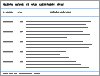
表1
Plackett-Burman试验设计与结果①"
| 序号 No. | 因素水平 Factor levels | 木质素降解率 Lignin degradation (%) | ||||
| X1 | X2 | X3 | X4 | X5 | ||
| 1 | ?1 | 1 | ?1 | 1 | 1 | 34.36 |
| 2 | ?1 | ?1 | ?1 | ?1 | ?1 | 32.59 |
| 3 | ?1 | 1 | 1 | 1 | 1 | 32.40 |
| 4 | 1 | ?1 | ?1 | ?1 | 1 | 38.72 |
| 5 | 1 | 1 | ?1 | 1 | ?1 | 38.71 |
| 6 | ?1 | ?1 | ?1 | 1 | ?1 | 33.64 |
| 7 | 1 | 1 | 1 | ?1 | ?1 | 36.67 |
| 8 | 1 | 1 | ?1 | ?1 | 1 | 41.76 |
| 9 | ?1 | 1 | 1 | ?1 | ?1 | 33.40 |
| 10 | 1 | ?1 | 1 | 1 | 1 | 35.80 |
| 11 | 1 | ?1 | 1 | 1 | ?1 | 35.58 |
| 12 | ?1 | ?1 | 1 | ?1 | 1 | 30.72 |
| P | 0.000 1 | 0.023 1 | 0.004 1 | 0.357 7 | 0.385 0 | — |
| R2 | 0.948 5 | — | — | — | — | — |
表2
响应面试验设计与结果"
| 序号 No. | 因素水平 Factor levels | 木质素降解率 Lignin degradation (%) | 方差来源 Source | 平方和 Sum of squares | df | 均方差 Mean square | F | P | ||
| A | B | C | ||||||||
| 1 | ?1 | ?1 | 0 | 40.49 | A | 2.06 | 1 | 2.06 | 10.29 | 0.014 9 |
| 2 | 1 | ?1 | 0 | 40.22 | B | 1.16 | 1 | 1.26 | 5.77 | 0.047 4 |
| 3 | ?1 | 1 | 0 | 39.65 | C | 3.38 | 1 | 3.38 | 16.87 | 0.004 5 |
| 4 | 1 | 1 | 0 | 42.44 | AB | 2.34 | 1 | 2.34 | 11.69 | 0.011 2 |
| 5 | ?1 | 0 | ?1 | 39.78 | AC | 1.42 | 1 | 1.42 | 7.07 | 0.032 5 |
| 6 | 1 | 0 | ?1 | 41.74 | BC | 0.504 1 | 1 | 0.504 1 | 2.52 | 0.156 7 |
| 7 | ?1 | 0 | 1 | 42.03 | A2 | 40.57 | 1 | 40.57 | 202.50 | <0.000 1 |
| 8 | 1 | 0 | 1 | 41.61 | B2 | 18.46 | 1 | 18.46 | 92.16 | <0.000 1 |
| 9 | 0 | ?1 | ?1 | 40.76 | C2 | 9.52 | 1 | 9.52 | 47.54 | 0.000 2 |
| 10 | 0 | 1 | ?1 | 42.30 | 模型 Model | 86.55 | 9 | 9.62 | 48.00 | <0.000 1 |
| 11 | 0 | ?1 | 1 | 43.01 | 误差 Residual | 1.40 | 7 | 0.200 3 | — | — |
| 12 | 0 | 1 | 1 | 43.13 | 失拟项 Lack of fit | 0.245 1 | 3 | 0.081 7 | 0.282 3 | 0.836 5 |
| 13 | 0 | 0 | 0 | 45.92 | 纯误差 Pure error | 1.16 | 4 | 0.289 3 | — | — |
| 14 | 0 | 0 | 0 | 46.36 | 总和 Total | 87.95 | 16 | — | — | — |
| 15 | 0 | 0 | 0 | 45.50 | R2 | 0.984 1 | — | — | — | — |
| 16 | 0 | 0 | 0 | 45.23 | R2adj | 0.963 6 | — | — | — | — |
| 17 | 0 | 0 | 0 | 46.48 | R2pred | 0.934 9 | — | — | — | — |

图3
C/N、初始pH和Mn2+浓度交互作用对烟管菌木质素降解影响的响应面(A?C)和等高线(a?c)"


图4
烟管菌降解前后竹材的傅里叶红外光谱"


图5
烟管菌降解前后竹材的X射线衍射"


图6
烟管菌降解前后竹材的扫描电镜图 A、B:未处理的竹材Untreated bamboo;C、D:处理30天后的竹材Bamboo treated for 30 days."

|
李 坚, 甘文涛, 陈志俊, 等. 向新出发, 木材科学前沿发展. 森林工程, 2025, 41 (1): 1- 39.
doi: 10.7525/j.issn.1006-8023.2025.01.001 |
|
|
Li J, Gan W T, Chen Z J, et al. Frontier advances in wood science towards a new departure. Forest Engineering, 2025, 41 (1): 1- 39.
doi: 10.7525/j.issn.1006-8023.2025.01.001 |
|
|
李 思, 程 伟, 张富美, 等. 烟管孔菌G14产锰过氧化物酶条件优化及其对染料的脱色. 菌物学报, 2021, 40 (6): 1511- 1524.
doi: 10.13346/j.mycosystema.200373 |
|
|
Li S, Cheng W, Zhang F M, et al. Optimization of production conditions and dye decolorization ability of manganese peroxidase from Bjerkandera adusta G14. Mycosystema, 2021, 40 (6): 1511- 1524.
doi: 10.13346/j.mycosystema.200373 |
|
| 李慧星. 2015. 微生物法脱色印染染料及其机制研究. 无锡: 江南大学. | |
| Li H X. 2015. Microbial decolorization of dyes and its mechanism. Wuxi: Jiangnan University. [in Chinese] | |
|
李金业, 程 昊, 徐青云, 等. 柑橘废弃物堆肥中高效木质素降解菌的筛选及其降解效果. 微生物学通报, 2025, 52 (1): 230- 248.
doi: 10.13344/j.microbiol.china.240335 |
|
|
Li J Y, Cheng H, Xu Q Y, et al. Screening of efficient lignin-degrading bacteria in Citrus waste compost. Microbiology China, 2025, 52 (1): 230- 248.
doi: 10.13344/j.microbiol.china.240335 |
|
| 李灵灵, 王敬红, 赵 铎, 等. 木质素降解菌BYL-7的筛选及降解条件优化. 微生物学通报, 2020, 47 (12): 4059- 4071. | |
| Li L L, Wang J H, Zhao D, et al. Screening of lignin degrading strain BYL-7 and optimization of degradation conditions. Microbiology China, 2020, 47 (12): 4059- 4071. | |
| 刘 剑, 刘君昂, 周国英, 等. 竹材木质素高效降解菌的分离筛选及鉴定. 中南林业科技大学学报, 2014, 34 (8): 48- 52. | |
| Liu J, Liu J A, Zhou G Y, et al. Isolation, screening and identification of high effective bamboo-lignin degradation fungus. Journal of Central South University of Forestry & Technology, 2014, 34 (8): 48- 52. | |
|
吕世翔, 王秋玉. 白腐菌在木质纤维素降解中的应用进展. 森林工程, 2009, 25 (4): 26- 31.
doi: 10.16270/j.cnki.slgc.2009.04.001 |
|
|
Lü S X, Wang Q Y. Application progress of white rot fungi in lignocellulose degradation. Forest Engineering, 2009, 25 (4): 26- 31.
doi: 10.16270/j.cnki.slgc.2009.04.001 |
|
|
尚 菲, 李进翠, 杨佳琪, 等. 子午岭林区木质素降解菌的筛选鉴定及降解特性研究. 陇东学院学报, 2024, 35 (5): 1- 6.
doi: 10.3969/j.issn.1674-1730.2024.05.002 |
|
|
Shang F, Li J C, Yang J Q, et al. Screening and degradation characteristics of lignin degrading strains in Ziwuling forest area. Journal of Longdong University, 2024, 35 (5): 1- 6.
doi: 10.3969/j.issn.1674-1730.2024.05.002 |
|
| 王 岩. 2025. 高效木质素降解白腐真菌的筛选与降解机制研究. 沈阳: 辽宁大学. | |
| Wang Y. 2025. Screening of efficient lignin-degrading white-rot fungi and study of degradation mechanisms. Shenyang: Liaoning University. [in Chinese] | |
|
徐一鸣, 王敬红, 徐红敏, 等. 芽孢八叠球菌(Sporosarcina sp. ) N2的分离与低温降解木质素的特征解析. 微生物学通报, 2024, 51 (12): 5121- 5140.
doi: 10.13344/j.microbiol.china.240445 |
|
|
Xu Y M, Wang J H, Xu H M, et al. Sporosarcina sp. N2: isolation and degradation of lignin at low temperatures. Microbiology China, 2024, 51 (12): 5121- 5140.
doi: 10.13344/j.microbiol.china.240445 |
|
|
熊怡心, 王 爽, 马星霞, 等. 木质素氧化酶系高产复合真菌培养体系构建. 林业科学, 2024, 60 (10): 133- 142.
doi: 10.11707/j.1001-7488.LYKX20230074 |
|
|
Xiong Y X, Wang S, Ma X X, et al. Construction of compound fungal culture system for high-yield ligninolytic enzymes. Scientia Silvae Sinicae, 2024, 60 (10): 133- 142.
doi: 10.11707/j.1001-7488.LYKX20230074 |
|
| 杨 静, 蒋剑春, 张 宁, 等. 微生物降解木质素的研究进展. 生物质化学工程, 2021, 55 (3): 62- 70. | |
| Yang J, Jiang J C, Zhang N, et al. Research progress on lignin degradation by microorganism. Biomass Chemical Engineering, 2021, 55 (3): 62- 70. | |
| 杨趁仙. 2018. 木质素降解细菌的筛选及其酶对木质素降解机制的研究. 杨凌: 西北农林科技大学. | |
| Yang C X. 2018. The isolation of lignin-degradation bacteria and the degradation mechanism of enzymes. Yangling: Northwest A&F University. [in Chinese] | |
| 张 桐, 张 波, 李 玉. 三种白腐真菌脱色噻嗪染料亚甲基蓝. 菌物学报, 2018, 37 (9): 1243- 1250. | |
| Zhang T, Zhang B, Li Y. Decolorization of thiazine dye methylene blue by three white-rot fungi. Mycosystema, 2018, 37 (9): 1243- 1250. | |
|
张芳芳, 张 桐, 戴 丹, 等. 高效木质素降解菌的筛选及其对玉米秸秆的降解效果. 菌物学报, 2021, 40 (7): 1869- 1880.
doi: 10.13346/j.mycosystema.200408 |
|
|
Zhang F F, Zhang T, Dai D, et al. Screening of efficient lignin-degrading fungal strains and their degradation on cornstalk. Mycosystema, 2021, 40 (7): 1869- 1880.
doi: 10.13346/j.mycosystema.200408 |
|
| 赵丰贝. 2022. 木质素降解菌的筛选及降解机理探究. 阜阳: 阜阳师范大学. | |
| Zhao F B. 2022. Screening and degradation pathways of lignin-degrading bacteria. Fuyang: Fuyang Normal University. [in Chinese] | |
| 赵佳玥, 宗志洁, 彭玺元, 等. 真菌降解木质素的酶及其代谢途径研究进展. 林业科学, 2026, 62 (3): 1- 12. | |
| Zhao J Y, Zong Z J, Peng X Y, et al. Research progress on enzymes and metabolic pathways involved in lignin biodegradation by fungi. Scientia Silvae Sinicae, 2026, 62 (3): 1- 12. | |
| Ayeronfe F, Kassim A, Ishak N, et al. A review on microbial degradation of lignin. Advanced Science Letters, 2018, 24 (6): 4407- 4413. | |
|
Balakshin M Y, Capanema E A. Comprehensive structural analysis of biorefinery lignins with a quantitative 13C NMR approach. RSC Advances, 2015, 5 (106): 87187- 87199.
doi: 10.1039/C5RA16649G |
|
|
Chen M, Zeng G M, Lai C, et al. Molecular basis of laccase bound to lignin: insight from comparative studies on the interaction of Trametes versicolor laccase with various lignin model compounds. RSC Advances, 2015, 5 (65): 52307- 52313.
doi: 10.1039/C5RA07916K |
|
|
Chen Y, Wang Y Y, Xu Z, et al. Enhanced humification of maize straw and canola residue during composting by inoculating Phanerochaete chrysosporium in the cooling period. Bioresource Technology, 2019, 293, 122075.
doi: 10.1016/j.biortech.2019.122075 |
|
|
Chio C, Sain M, Qin W S. Lignin utilization: a review of lignin depolymerization from various aspects. Renewable and Sustainable Energy Reviews, 2019, 107, 232- 249.
doi: 10.1016/j.rser.2019.03.008 |
|
|
Deng Z C, Xia A, Liao Q, et al. Laccase pretreatment of wheat straw: effects of the physicochemical characteristics and the kinetics of enzymatic hydrolysis. Biotechnology for Biofuels, 2019, 12 (1): 159.
doi: 10.1186/s13068-019-1499-3 |
|
|
Floudas D, Binder M, Riley R, et al. The Paleozoic origin of enzymatic lignin decomposition reconstructed from 31 fungal genomes. Science, 2012, 336 (6089): 1715- 1719.
doi: 10.1126/science.1221748 |
|
|
Guo Y J, Zhang Z, Dou J Z, et al. Structural characterization of corn fiber hemicelluloses extracted by organic solvent and screening of degradation enzymes. Carbohydrate Polymers, 2023, 313, 120820.
doi: 10.1016/j.carbpol.2023.120820 |
|
|
Ilić N, Tričković J F, Milić M, et al. Harnessing the hidden environmental power of Bjerkandera adusta laccase: sustainable production, green immobilization, and eco-friendly decolorization of mixed azo dyes. Sustainable Chemistry and Pharmacy, 2024, 42, 101747.
doi: 10.1016/j.scp.2024.101747 |
|
|
Knežević A, Milovanović I, Stajić M, et al. Lignin degradation by selected fungal species. Bioresource Technology, 2013, 138, 117- 123.
doi: 10.1016/j.biortech.2013.03.182 |
|
| Korniłłowicz-Kowalska T, Rybczyńska-Tkaczyk K. Decolorization and biodegradation of melanoidin contained in beet molasses by an anamorphic strain of Bjerkandera adusta CCBAS930 and its mutants. World Journal of Microbiology and Biotechnology, 2020, 37 (1): 1. | |
|
Li Y B, Meng X Z, Meng R Q, et al. Valorization of homogeneous linear catechyl lignin: opportunities and challenges. RSC Advances, 2023, 13 (19): 12750- 12759.
doi: 10.1039/D3RA01546G |
|
|
Li Y, Zhang J, Li J, et al. Screening of a lignin decomposing bacterium and its application in bamboo biomechanical pulping. PLoS One, 2025, 20 (6): e0326076.
doi: 10.1371/journal.pone.0326076 |
|
|
Luo R H, Liao Q, Xia A, et al. Synergistic treatment of alkali lignin via fungal coculture for biofuel production: comparison of physicochemical properties and adsorption of enzymes used as catalysts. Frontiers in Energy Research, 2020, 8, 575371.
doi: 10.3389/fenrg.2020.575371 |
|
|
Moody S C, Dudley E, Hiscox J, et al. Interdependence of primary metabolism and xenobiotic mitigation characterizes the proteome of Bjerkandera adusta during wood decomposition. Applied and Environmental Microbiology, 2018, 84 (2): e01401- e01417.
doi: 10.1128/aem.01401-17 |
|
|
Qin X, Su X Y, Luo H Y, et al. Deciphering lignocellulose deconstruction by the white rot fungus Irpex lacteus based on genomic and transcriptomic analyses. Biotechnology for Biofuels, 2018, 11 (1): 58.
doi: 10.1186/s13068-018-1060-9 |
|
|
Ramarajan R, Manohar C S. Biological pretreatment and bioconversion of agricultural wastes, using ligninolytic and cellulolytic fungal consortia. Bioremediation Journal, 2017, 21 (2): 89- 99.
doi: 10.1080/10889868.2017.1282937 |
|
|
Ren W T, Guo F, Zhu J W, et al. A comparative study on the crystalline structure of cellulose isolated from bamboo fibers and parenchyma cells. Cellulose, 2021, 28 (10): 5993- 6005.
doi: 10.1007/s10570-021-03892-w |
|
|
Singh D, Chen S L. The white-rot fungus Phanerochaete chrysosporium: conditions for the production of lignin-degrading enzymes. Applied Microbiology and Biotechnology, 2008, 81 (3): 399- 417.
doi: 10.1007/s00253-008-1706-9 |
|
|
Singh J, Mandal A, Nandabalan Y K. Synergistic effect on lignolytic enzyme production through co-culturing of white rot fungi during solid state fermentation of agricultural residues. Bulletin of the National Research Centre, 2025, 49 (1): 3.
doi: 10.1186/s42269-024-01289-w |
|
|
Su Y J, Yu X X, Sun Y, et al. Evaluation of screened lignin-degrading fungi for the biological pretreatment of corn stover. Scientific Reports, 2018, 8, 5385.
doi: 10.1038/s41598-018-23626-6 |
|
|
Wang J H, Zhang W, Wu C Y, et al. Synergistic analysis of lignin degrading bacterial consortium and its application in rice straw fiber film. Science of the Total Environment, 2024a, 927, 172386.
doi: 10.1016/j.scitotenv.2024.172386 |
|
|
Wang M X, Long J, Zhao J Y, et al. Effect of alkali treatment on enzymatic hydrolysis of p-toluenesulfonic acid pretreated bamboo substrates. Bioresource Technology, 2024b, 396, 130454.
doi: 10.1016/j.biortech.2024.130454 |
|
|
Wu X Y, Amanze C, Wang J S, et al. Isolation and characterization of a novel thermotolerant alkali lignin-degrading bacterium Aneurinibacillus sp. LD3 and its application in food waste composting. Chemosphere, 2022, 307, 135859.
doi: 10.1016/j.chemosphere.2022.135859 |
|
|
Xue J, Cui D R, Cao J Z. Competition patterns and biodegradation results of multiple fungal species on Moso bamboo (Phyllostachys edulis). Wood Material Science & Engineering, 2023, 18 (3): 1105- 1114.
doi: 10.1080/17480272.2022.2109209 |
|
|
Xue J, Cui D R, Zhou M, et al. Fungal specificity in degradation of moso bamboo: white-rot versus brown-rot fungi. Industrial Crops and Products, 2025, 236, 122047.
doi: 10.1016/j.indcrop.2025.122047 |
|
| Zeng G M, Yu M, Chen Y N, et al. Effects of inoculation with Phanerochaete chrysosporium at various time points on enzyme activities during agricultural waste composting. Bioresource Technology, 2010, 101 (1): 222- 227. | |
|
Zhan Y W, Wang M X, Ma T F, et al. Enhancing the potential production of bioethanol with bamboo by γ-valerolactone/water pretreatment. RSC Advances, 2022, 12 (26): 16942- 16954.
doi: 10.1039/D2RA02421G |
|
|
Zhang K J, Si M Y, Liu D, et al. A bionic system with Fenton reaction and bacteria as a model for bioprocessing lignocellulosic biomass. Biotechnology for Biofuels, 2018, 11 (1): 31.
doi: 10.1186/s13068-018-1035-x |
|
|
Zhang Z C, Shah A M, Mohamed H, et al. Isolation and screening of microorganisms for the effective pretreatment of lignocellulosic agricultural wastes. BioMed Research International, 2021, 2021, 5514745.
doi: 10.1155/2021/5514745 |
|
|
Zhao Z M, Zhang S Y, Meng X Z, et al. Elucidating the mechanisms of enhanced lignin bioconversion by an alkali sterilization strategy. Green Chemistry, 2021, 23 (13): 4697- 4709.
doi: 10.1039/D1GC00911G |
| [1] | 李启研,赵珮杉,高广磊,丁国栋,张英. 樟子松人工林土壤特性、根际效应及其影响因素[J]. 林业科学, 2026, 62(8): 55-70. |
| [2] | 文炳南,党龙,杨琪铉,邓柏林,王永健,张伟东,姜春前,白彦锋. 马尾松次生林土壤理化性质和胞外酶活性的林窗响应及其土层分异规律[J]. 林业科学, 2026, 62(8): 71-85. |
| [3] | 徐泽宇,李荣荣. 基于轻量化特征融合与空间重构的竹条表面缺陷检测算法[J]. 林业科学, 2026, 62(7): 186-196. |
| [4] | 李华靖,李晶,崔丽娟. 北方湿地土壤活性微生物对低温胁迫的响应机制[J]. 林业科学, 2026, 62(6): 27-35. |
| [5] | 何燕,尚念杰,苏石诚,韦小丽. 种子际真菌引发花榈木种子萌发的生理生化机制[J]. 林业科学, 2026, 62(5): 27-39. |
| [6] | 赵佳玥,宗志洁,彭玺元,李志强,马星霞. 真菌降解木质素的酶及其代谢途径研究进展[J]. 林业科学, 2026, 62(3): 1-12. |
| [7] | 胡宇欣,江怡航,刘振华,朱光玉,张建国,张雄清. 杉木纯林林下补植模式对土壤质量和微生物群落的影响[J]. 林业科学, 2026, 62(3): 61-73. |
| [8] | 张宇薇,莫梦婷,舒博,姚佳佳,袁志林. 真菌诱导子促进桑黄黄酮类物质积累及主要作用机制[J]. 林业科学, 2026, 62(3): 146-160. |
| [9] | 李威, 于珍珍, 何徽, 赵佳璐, 刘西军. 碳输入改变对湿地松人工成熟林土壤微生物群落的影响[J]. 林业科学, 2025, 61(6): 232-242. |
| [10] | 孙英杰,张德楠,沈育伊,徐广平,曹杨,黄科朝,陈运霜,毛馨月,滕秋梅,吕仕洪,褚俊智. 模拟氮沉降对中亚热带桉树人工林土壤微生物群落结构及酶活性的影响[J]. 林业科学, 2025, 61(5): 46-60. |
| [11] | 庄鹏,彭金根,刘思佳,白宇清,张露文,李荣生,杨锦昌,谢利娟,蔡洪月. 不同生长势毛棉杜鹃根部内生真菌多样性差异[J]. 林业科学, 2025, 61(5): 61-73. |
| [12] | 张嘉嘉,杜改改,李莉,刁松锋. 柿嫩枝扦插生根过程中生理变化特征[J]. 林业科学, 2025, 61(5): 98-107. |
| [13] | 李海涛,周文静,吴义强,陈晨,许伟. 不同温度下毛竹抗弯力学性能[J]. 林业科学, 2025, 61(2): 163-171. |
| [14] | 马欣欣,王游,王佳军,冯龙,马建锋. 热解过程中竹材灰分组成变化及硅的转化分布规律[J]. 林业科学, 2025, 61(2): 172-179. |
| [15] | 李鑫,刘红霞,陈生娟,盛敏. 混交林驯化的AMF通过抑制侧柏生长增强刺槐的竞争优势[J]. 林业科学, 2025, 61(10): 87-95. |
| 阅读次数 | ||||||
|
全文 |
|
|||||
|
摘要 |
|
|||||

